The Lloyd's building is a time machine | Owen Hatherley | Comment is free | guardian.co.uk

Created: 2012-11-14 19:35 Updated: 2012-11-14 19:35 Source: http://www.guardian.co.uk/commentisfree/2011/dec/20/lloyds-london-building Notebook: Architecture

The Lloyd's building is a time machine

A monument to 'high-tech', the Lloyd's of London building marries the capitalism of gentlemen with that of the industrialists

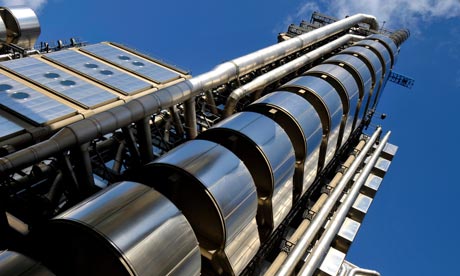
The Lloyd's building
The Lloyd's building has received Grade I listed status. Photograph: Geoff Moore/Rex Features

Richard Rogers's 1986 headquarters for the insurers Lloyd's of London has just been listed Grade I. This makes it, along with the Royal Festival Hall, one of the few 20th-century structures to be placed at the same level as, say, St Paul's. But, like the gothic cathedrals it so closely resembles, Lloyd's was not meant to be an entirely finished product. Look up to the top of its facade, and you'll find cranes are still there, left when construction ended, to make clear it could still be extended up and outwards. The gothic cathedrals did grow in this manner, but then they didn't get preservation orders 25 years after they were built.

There should be no doubt whatsoever that Lloyd's deserves its listing. But for a building so famous, Lloyd's is not well served by writers and historians. It is usually interpreted in one of two completely inadequate ways. For many, it's a metallic embodiment of the Big Bang, a Thatcherite machine for underwriting. In architectural history, it's a monument to "high-tech", a style that arose in the mid 1970s as a sort of last flicker from the white heat of the technological revolution, at the hands of currently ennobled architects – Lord Foster of Thames Bank, Lord Rogers of Riverside. High-tech, or a version of it, has been the dominant form of architecture in the UK for two decades, though you can read a lot from the change in its functions: in the 70s most of the above were designing factories. Now they design office blocks, cultural centres and luxury flats with a still residual "industrial aesthetic", including the world's most expensive One Hyde Park.

Lloyd's captures the tensions between industrialism and the "new economy" of financial services, then tries to resolve them. Before Rogers, the insurers were housed in a neoclassical building built as late as the 50s – an embodiment of a practically unchanging British gentlemanly capitalism. It was meant to reassure, to look eternal. If the 1986 replacement evokes any previously existing buildings of any kind, then they're industrial, almost temporary structures – oil refineries, or the North Sea oil rigs built off the east coast of Scotland in the 70s, much beloved of high-tech architects. These are visually striking because of sheer utility, because their functional parts are in no way sheathed or hidden, and because the refining process requires the baffling, twisting intricacies of pipes and gantries. The North Sea oil that kept Thatcherism secure in its confrontations with the unions provided inadvertent inspiration for the aesthetic of the City itself at the exact point it was let off the leash.

Lloyd's marks the point in British architecture where industrial features became something to enjoy in and of themselves; not coincidentally the point where industry itself faced forcible decimation. Maybe those bared ducts, those moving parts, those steel surfaces and gigantic, top-lit open spaces for working in were all some kind of unacknowledged appeasing of the gods of industry. It's also possible that Lloyd's was and is especially thrilling for people who have never worked in a factory, the only other kind of place where services are habitually left uncovered, in those places because "nobody" is looking.

What makes Lloyd's such a bizarre place, however, is seeing how the underwriters have conserved so many elements of their atavistic previous existence. These remnants were scattered around the new building, decontextualised fragments ripped from 1763, 1799, 1925 and 1958, rudely riveted onto the ducts and pipes. There's the antiquated uniforms worn by the service staff; the front facade of their earlier neoclassical offices is held up like a severed head. Inside, the Lutine Bell sits at the foot of the enormous, multilevel trading floor and, strangest of all, a complete 18th century dining room by Robert Adam was preserved and recreated.

At first, it seems like these are tokens kept on a sort of reservation of gentlemanly capitalism in order to placate the old guard. After a while you realise that what is really happening here is more like a marriage, a reconciliation, a mockery of the notion that there should be any difference or hostility between the capitalism of gentlemen and the capitalism of industrialists.

Inside the Adam Room, Lloyd's of London are still the organisation that built itself on the slave trade; it's a time machine that physically brings "old corruption" back to the site of its inception. British capitalism plays at modernisation, but keeps this place in reserve, as its ancestral home. Now, Lloyd's itself will be kept as a time capsule, a structure that can receive only the tiniest changes. When future generations want to know what happened to power in Britain in the 1980s, their questions will be answered here.

Comments

37 comments, displaying

Sort comments by
first
  • Staff
  • Contributor
Comments on this page are now closed.
  • chaz1

    20 December 2011 2:26PM

    it's a shame such a fine writer spoils his writing with ideological sneers and pontifications.

  • Supernovaaaa

    20 December 2011 2:28PM

    Que angry socialists just discovering what Lloyd's of London actually is.

  • nansikom

    20 December 2011 2:30PM

    Yeah, but it still looks like a person wearing their organs outside their body, just like Spitting Image said!

  • holbeck

    20 December 2011 2:30PM

    From the outside, it's ugly and depressing, and utterly disdains its environment.

    From within, it is ugly, depressing, and incoherent.

    An arrogant, unlovely, dehumanising building.

    I speak as one who used to have to visit it regularly.

  • borleg

    20 December 2011 2:40PM

    Well, it had already been done before.
    The exo-skeletal Georges Pompidou centre in Paris, thats not to say it isn't functional and visually appealing, in a technical sort of way.
    I fear Rodgers has omited one very important design feature though.
    A diving platform on the top floor would have been a nice touch, no water feature at the bottom though

  • theonionmurders

    20 December 2011 2:41PM

    A monument to 'high-tech', the Lloyd's of London building marries the capitalism of gentlemen with that of the industrialists

    Sorry Owen, that's postmodern shite.

    It's a pity the people who work inside are neither gentlemen or industrialists.

    To me, the building is a brutal and ugly looking 'fuck you' statement that seems to epitomise the worst excesses and sheer crassness of British finance capitalism.

  • undertherainbowboy

    20 December 2011 2:51PM

    Why is there no Caduceus on this building? Every bank in the city of London has one from the gentlemen industrialist era.

  • Rippleway

    20 December 2011 2:52PM

    A monument to 'high-tech', the Lloyd's of London building marries the capitalism of gentlemen with that of the industrialists

    An uncompromising design statement and Europe's most dazzling margarine works.

  • NewspeakDrone

    20 December 2011 3:09PM

    It is indeed a reflection of its time.

    Foster's Swiss Re HQ is also radical – technically and spatially – and, perhaps, better deserving of listed status in the future.

    The 'Gherkin' is also immediately recognisable and adds positively to the London skyline, which cannot be said of Renzo Piano's 'Shard'. This building over-dominates and brutalises many of London's natural vistas. I wish it had never left the drawing board.

    The brand new Rothschild building near to the Bank of England has been designed by Rem Koolhaas / OMA. The building is neutral and minimalist and cleverly opens up the view of St Stephen Walbrook, closed for many years.

    It is typical of Rothschild that they occupy such a calm exterior at the epicentre of such financial upheaval – which is disingenuous, given their substantial history and leading role in financial services.

    But that's another story.

  • undertherainbowboy

    20 December 2011 3:22PM

    @newspeak

    Is the place where the old Roman Temple of Mithras was found? Theres a building site there now, or last time I was there.

  • healey

    20 December 2011 3:30PM

    Newspeak,

    This building over-dominates and brutalises many of London's natural vistas.

    You mean the vistas that you have to go to Hampstead Heath and stand in just the right spot to have ruined?

    If I had a pound for every person who talks about the Shard "brutalising" London then I'd build another.

  • NewspeakDrone

    20 December 2011 3:51PM

    You mean the vistas that you have to go to Hampstead Heath and stand in just the right spot to have ruined?

    If I had a pound for every person who talks about the Shard "brutalising" London then I'd build another.

    It's brutal. There's another pound for you.

    It doesn't look so bad from a distance, where it merges with the rest of the skyline. Epsom Downs – not Hampstead Heath.

    I find it more imposing from ground level, when it suddenly looms into view. The fact that there's nothing around it makes it all the more stark. At least Canary Wharf was conceived as a group of buildings.

    The Shard: even the name is brutal.

  • oogin

    20 December 2011 4:02PM

    the gentlemen of lloyds hated it initially, especially with rogers' interior, but like most things, it gradually grew on them (some would still say like a wart).
    though never a fan, i have to say it's better than his other viscera-o-the-outside building in paris
    thankfully it was a style of architecture they soon got out of their system.....

  • donkiddick

    20 December 2011 4:07PM

    It looks like a giant ring binder spine stood on it's end.... ugly imo.

  • mjhunbeliever

    20 December 2011 4:16PM

    When I hear the name Lloyds I remember all those names screaming for the government to bail them out, those same people that don't want to pay Tax.

  • Swedinburgh

    20 December 2011 4:42PM

    The (attitudes behind the) phrase

    the capitalism of gentlemen and the capitalism of industrialists

    helps to illustrate why British industry ended up going around with a begging bowl for foreign money whilst high finance's every wish is government's command.

    including the world's most expensive One Hyde Park

    ...whose denizens are too tight to pay its laughably cheap council tax rates.

  • LucyQ

    20 December 2011 4:47PM

    A few years ago we happened to be in London for Doors Open and had a chance to go to the top of this building. It is wonderful and beautiful. Take a break from Troll House living and try modern, it lets the light it.

  • newsed1

    20 December 2011 5:31PM

    This building is pure posturing.

    The air-con ducts are made of steel and mounted on the outside. In the summer, the steel heats up massively and causes the cooled air to heat up again.

    The cranes left in place are not real cranes, but the kind of fake 'utility' that is the mark of modernists who can't/won't do applied decoration. He also put the same fake cranes on Montevetro in Battersea.

    Pretend Meccano cranes and putting the services on the outside of the building is just displacement activity. Brutalist modernism was a dead, de-humanising, end and Lloyds is just the architecture establishment having to introduce some kind of detailing without going back on modernist theory.

    These days, however, the cost of building in the West means all future buildings are simply steel frames and flat sheets of glass in whatever form that can be coaxed out of a computer programme. The weakest expression being Heathrow's T5 which disguises its flat, glazed, face with that steel venetian blind detail.

    Even the Gerkin is a steel frame and flat glass panels - aside from the glass dome at its peak.

  • drprl

    20 December 2011 5:31PM

    A few years ago we happened to be in London for Doors Open and had a chance to go to the top of this building. It is wonderful and beautiful.

    In the same way that the view from the Eiffel Tower has the attraction that you can't see the Eiffel tower ?

  • hampden

    20 December 2011 6:52PM

    Some years ago I worked as a (very humble!) clerk for a Lloyds broker and had the opportunity to visit the 1986 building on a regular basis; I was impressed both by it's beauty and utility from day one - and still am. This from a person who generally has little admiration for modern architecture!

    I think it stands up really well against many other buildings in the City. Many (apart from Wren's churches, the Tower, etc) are dreary and nondescript such as the previous 1950's Lloyds building that sits alongside it.

    I don't associate the building with the Big Bang, Thatcherism, greed or anything else although I generally found the underwriters to be a pompous bunch (both in the new as well as the old underwriting Room). Maybe, the 1986 building represents a welcome link to the 21st century. I hope things have changed on that score since my last visit in 1990!

  • lundiel

    20 December 2011 7:28PM

    It is a celebration of yuppie culture bought and paid for from the proceeds of cocaine.

  • LakerFan

    20 December 2011 7:44PM

    Archeologists of the future will rightly conclude it was the place where Soylent Green was processed.

  • HudsonBarBarfly

    20 December 2011 8:01PM

    Only in the Graun can someone get paid to spout utter shite about a building in London.

    Look, 90% of the population will never see it as we have no desire to go to that awful shit-hole.

  • brookben

    20 December 2011 8:32PM

    Lloyds building a time machine...I thought the Tardis had that honour.

  • CaptainNed

    20 December 2011 9:59PM

    To me, the building is a brutal and ugly looking 'fuck you' statement that seems to epitomise the worst excesses and sheer crassness of British finance capitalism.

    But surely the excesses and the crassness of which you speak are better epitomised by the monstrous vulgarity of all those Post-Modern office blocks, apartment complexes and luxury hotels? Nothing, in aesthetic terms, could be more revealing of the Thatcherite mindset than extravagantly tasteless 'historical' quirks embellishing buildings of often quite stunning ugliness (or, at best, ignoble mediocrity): greed-is-good brashness in an appeal to the prestige of tradition. I find the wretched pseudo-classical excrescences of Paternoster Square far more offensive to the eye than the Lloyd's of London building (which I don't particularly admire).

  • KeithMC

    20 December 2011 10:40PM

    Hasn't it been described as like a Toilet inside out - The plumbing on the outside, the Arse-holes on the inside?

  • Dapper

    20 December 2011 10:49PM

    No, it's a pile of shyte. Most modern buildings so appallingly clash with their surroundings I sometimes wonder whether the architects have ever bothered to visit the site beforehand.

    I'm not huge royalist but I definately rate Charlie's views on architecture over anyone in the architectural "establishment".

  • TheMackenator

    21 December 2011 12:31AM

    Oh, its not so bad. It lends London a steampunk atmosphere, juxtaposing modern shiny things with old stone things. In any case, it can't be any worse than the Brutalist architecture that - Christ, I didn't even know it had a name. I just thought it was what happened when no architects were involved - that peppers the average British urban centre. Now there's a building style you need to be drunk to appreciate.

  • Annonick

    21 December 2011 2:08AM

    The Lloyd's building is a time machine...

    Er, no, it's just another shiny eyesore.

  • NewspeakDrone

    21 December 2011 10:49AM

    newspeak

    Is the place where the old Roman Temple of Mithras was found? Theres a building site there now, or last time I was there.

    Sorry, I didn't see your post yesterday.

    The actual location of the original Temple was on the banks of the Walbrook stream, but the remains of its foundations were moved by a developer(!) to Temple Court in the 1950s where Bucklersbury House now stands – Legal & General's HQ – about 300 feet from St Stephen Walbrook church.

  • dotasa

    21 December 2011 11:48AM

    I think what spoils the views of London is the endless square miles of urban sprawl used to facilitate low-density suburban housing.

    Skyscrapers like the Shard & Gherkin, accompanied by a reduction in motor vehicle usage, is the only way we will break the growth of urban sprawl before every last mile of Britain in covered by roads and dreary, semi-detached brick houses.

  • undertherainbowboy

    21 December 2011 12:14PM

    @Newspeakdrone

    Sorry the rely function doesn't work here. Is it open to the public still? I've been trying to find it recently. There are incredible finds in the London Museum, including a Mithra statue head, eyes looking up at the heavens. And a Tauroctony bas-relief. Worth seeing.

  • NewspeakDrone

    22 December 2011 8:24AM

    Thanks for your reply.

    I agree with you, although urban sprawl is a global problem. Traditional city neighbourhoods work well, but the wider suburbs require greatly increased transportation and infrastructure costs to service them. And in the US, there is a direct connection between obesity and reduced walking within urban sprawl developments.

    The problem seems to be that we are addicted to the idea of living in the suburbs, with our own patch of land. And so, sadly, developers keep building to meet that demand.

  • NewspeakDrone

    22 December 2011 8:29AM

    Temple Court is a public space, and is accessible, but there isn't much remaining of the temple foundations to see apparently.

    I haven't been to the Museum of London for years, but I'll definitely visit in 2012. Thanks for the tip.

Comments on this page are now closed.


View static HTML