South wall
(theologically)
As on the north wall, the scenes of the upper two registers
relate to the activities of the underworld, whilst the bottom register
concerns the terrestrial activities.
Again, the styles in which Inerkhau and his wife are dressed
remains the same as on the north wall.
 |
| South wall, based on Farid. Click on the individual
scenes. |
 |
The numeration of the scenes of the south wall is based
on that of Bruyère (see left). However, this is not a logical sequence
because,
as can be seen, scene I is the outcome of the whole process
and
should therefore be described as the last. |
1)- The upper register
Scene I
(view unidia-3947) In what should be the final vignette,
which concludes both this register and the journey in this chamber, Inerkhau
is portrayed with a short beard of the living, a cane in his right hand and
an Isis knot in his left hand. He moves away of his tomb, whose door is
fully open. Above, a red sun projects five rays. This exit is made possible
by the auspices of Amenophis I, on the east wall.
The text removes all ambiguity as to the interpretation given to
this image: "Formula for leaving on the day and not
to die again". This vignette corresponds to §64 of the BoD.
Nevertheless, the second part of the sentence belongs to §44.
In other words, Inerkhau accomplished in the depths of the tomb
the rituals and the necessary operations for his rebirth; he can now come
and go as he pleases between two worlds: the Realm of the Dead and that of
the Living.
Scene II
This occupies the upper half of the register height.
A barque navigates from east to west on the hieroglyphic
"pet"-sign of the sky (view unidia-39548_01). It is provided with two rudder/oars
and their supports, all are painted with concentric bands and are surmounted
with a falcon head. The barque is operated by "his
son Inerkhau, justified". The deceased and his wife are seated on
chairs with the usual feet and are located under a canopy. They are sheathed
in a shroud in the likeness of Ptah. With both hands, Inerkhau holds a
flabellum.
This scene is a reminder of the traditional iconography of the
journeys to Abydos, the Holy City where the head of the god Osiris was
buried. The accompanying text starts with "Formula to
sail northwards" and doesn't correspond to any known section of the
BoD. It could be a mistake of copying by the scribe.
Scene III
Under the celestial barque we find a representation of a Hathoric
Menat collar whose counterweight is represented by a large Kheper scarab,
black and set in gold (view unidia-39548_02). It acts as a vignette to §30B of the
BoD, but the accompanying text is that of §76 : "Formula to turn into any form that one desires.".
Scene IV
Inerkhau preceded by Thot walks towards Osiris. Wearing a short beard
and having naked feet, Inerkhau raises his two arms in homage to the God.
Note the Isis knot which hangs from his left arm.
Thot who precedes him is doubly identified : on the one hand by
his ibis head, on the other hand by the two representations of the moon
(full and quarter) on his head. He holds in his left hand the palette of his
function as scribe of the gods, and in his right hand a sign of life, the
ankh. Between Thot and Osiris, some offerings are represented on a small
table.
Osiris is represented in his canonical form: seated on a low
cuboid throne resting on a mat, he holds in his hand a flabellum and a
was-sceptre of power. He wears the Atef crown. Silent, as always, the Great
God receives Inerkhau into his courtroom. This is represented to the
following scene which actually forms a single scene with this one.
Scene V
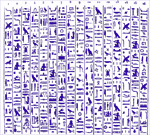
(View 53) The "scene" (for it is actually comprised mainly
of columns of text) is situated in a chapel whose doors are open. Each of
the forty columns end, at the bottom, with a squatting god-judge.
It seems that every judge is connected to a particular sin, and
is ready to subject the applicant to an vigorous interrogation before making
a pronouncement.
To avoid this unpleasant moment, the Egyptian scribes proposed
to use the magical strength of words, and mirrored the moment in a text in
which the deceased addresses every god-judge individually, while naming him
(although respectfully) in the manner of an old acquaintance, then affirming
not to have committed such and such a loathed sin. This is the "Negative
Confession".
It is such an excerpt that is offered here, in reasonable detail
: the challenged scribe produced forty judges (normally there would have
been forty-two of them), but omitted the continuation of the text, that is
the statement of the sin which had never been committed by Inerkhau !!
Hopefully the magic of the text will have compensated for the
insufficiencies of the scribe.
Scene VI
(View 39bis) Inerkhau, in a transparent white dress, faces
towards the west, with his right hand on his left shoulder in sign of
respectful greeting. He is led by a god who originally had the head of
baboon (Lepsius), who leads him towards a lake of fire, around which were
four other baboons who have also now disappeared.
Scene VII
(View 38bis) These are two superimposed scenes of
navigation. The barque at the top heads toward the east by crossing the sky.
It is decorated with two udjat-eyes. Resting at its centre is the head of a
falcon wearing on its head a solar disk surrounded by a snake. This scene
represents the vignette from §136B of the BoD, which starts with "Formula for navigation in the great barque of Ra, to pass
by the circle of flames.".
According to Inerkhau's text, this is the barque of Soped, which
represents the sun in the morning.
Underneath is a another similar barque (but meaningfully without
the udjat-eyes, because the deceased is not yet regenerated) travelling
towards the west, but this time on water, that of the underground Nile. It
transports four divinities : at the front is Isis, then Thot with the head
of an ibis, then Khepri with his scarab head, and finally Hu. Inerkhau
stands behind them and manoeuvres the barque.
Scene VIII
(View 37bis) This scene includes four of the mythological
locations or underworld regions (it omits ten of them) where the deceased
had to surrender. They are designated as "the first
of the regions"; "the second region, the god
who resides there is Horus of the two horizons (Horakhty)"; "the third region, the
Akh-spirit lives"; "the fourth region, (the
one of the) Ka". The first and the last have the aspect of a house
plan or interior room of a mastaba, the second represents the horizon, the
third is an oblong enclosure surrounded by a wall closed at one extremity by
a half circle with the other end remaining open, this is of obscure
significance.
2)- The middle register
Scene IX
(View 28bis) The first scene of this middle register is
mutilated by the disappearance of the text which accompanied the
representation of Inerkhau. According to Bruyère, he is in the position
called "Khefet her neb=s". In front of him is a lotus standing out of
the water and which inclines its open corolla toward him.
This relates to a lotus named Sechen, therefore clearly the blue
lotus (Nymphea caerulea), which is very fragrant; it follows the solar
cycle, emerging and opening up at dawn while in the evening closing again
and disappearing under the water. The name was in the text copied by Lepsius
and which today is missing; this text (based on §81 of the BoD) made
allusion to the exit of Nun every morning. Nun represents the water of the
primordial ocean, and it is also assimilated by the theologians to the
amniotic fluid.
By achieving a new cycle every renewed day, where it manages to
extract itself from the primordial and obscure aquatic environment, the full
symbolic value of this plant in the Egyptian imaginary of rebirth can be
understood.
Furthermore, from the point of view of the myth, the lotus is
capable of returning from the bottom of the water that which has been lost
there, notably the eye of Horus which was torn from him by Seth.
Scene X
(View 28bis and view 27bis)
Here, Inerkhau is knelt with his hands raised in worship. He wears neither
wig nor necklace. He stands in front of his Bas, often referred to as his
"souls" and which it would more correct to call his "Powers" of Nekhen
(Hierakopolis). In a canonical manner these are represented here as
andromorphic divinities with the head of a canine, in the "henu" position :
one knee on the ground, a hand on the chest in a tight fist and the other
raised at 90° behind.
Similar Bas are also met in Heliopolis and in Buto in the Delta.
These latter ones have the head of a falcon.
It is uncertain as to what these entities really refer : former
gods of the place? ancestors of the kings?
Scene XI
(View 26bis) This time, Inerkhau, in his long festive dress
and usual wig, is standing facing west in worship in front of the Benu bird
(the phoenix). Morphologically, it represents a heron. It wears the Atef
crown. It was identified at one time with Osiris and with Ra, representing
the linear time and the cyclic time, and by this fact included in the
funeral myths. The text which accompanies it logically is §83 of the BoD :
"Formula to turn into the Benu by the
Foreman in the Place of Truth, Inerkhau, justified".
Scene XII
(View 25bis) The scene takes place on a thick mat. Anubis
presents a heart (HIS heart) to Inerkhau (who here is in the form of his
anthropoid sarcophagus). Between the two, is a large basket holding an
oblong bread and two round breads; remembering that this type of "basket" is
traditional every time that one is in the presence of a Ba.
Behind the god we find a standard supporting what is called an
Abydos fetish, a shrine which is supposed to contain the head of Osiris.
This ensign, called the Ta-wer ("the great land") is that of the Thinite
nome in which is located Abydos, one of the main holy cities in connected
with Osiris. The deceased were supposed to make a pilgrimage to Abydos, real
or fictional (see scene II, above).
After this they will be able to accompany Sokar and be able to
partake of food and drink reserved for the blessed.
Scene XIII
(View 47bis and view unidia-39551). Here, Inerkhau kneels facing west with
his arms raised. On his chin is a black dotted line indicating a beard of
some days, usually a sign of masculine mourning. In front of him stands a
large falcon on a small elevation of sandy land, holding a whip and looking
towards the east. This is "a golden falcon, the great
god who puts in festival the Two Lands.".
Scene XIV
(View 35bis) This is a well known scene, and is the one
which made the reputation of the chamber. A cat with multi-coloured brown
fur, with the long ears of a hare is seated on its hind quarters, facing
west. It waves a knife in its left front paw with which it kills a fat snake
and places its right front paw on the snake's head. The snake, similar to a
grass-snake, projects its brush-like tongue and wraps itself around a persea
tree which is laden with red berries
This is the scene of the solar cat ("the
great cat of Heliopolis") killing Apophis (Aapep), the enemy of the
sun, under the persea tree of Heliopolis. This scene can be found in several
of the tombs of Deir el-Medina, especially in those of TT1, Sennedjem and
TT335,
Nakhtamon.
The scene is inspired by the 7th hour in the Book of the Amduat
which usually only exists in the royal tombs. The accompanying text actually belongs to the BoD; it says :
"Formula to separate the enemy, to cut
the backbone of Apophis. This god is happy in the middle of the other gods.
I came toward you, my heart full of truth (by) the Ka of the Osiris, master
craftsman of the Place of Truth to the west of Thebes, Foreman in the
horizon of eternity (= the necropolis), Inerkhau, justified. His
sister, (= wife) the mistress of house, the
chantress of Amon of Pa-Khenty, Wab, justified,. Made by his brother, the
scribe of the contours (= painter) of the place of eternity, Hor-Min,
justified.".
It is therefore certain that the scene was painted by Hor-Min.
Notice a detail in the text (framed in red on the image): the determinative
sign of the snake Aapep is stabbed repeatedly with knives! Indeed, the
hieroglyphic signs, as in all the other representations, are there to
magically bring them to life in the beyond, and they should not be
disregarded.
Scene XV
The register ends with a scene composed of two superimposed
sub-registers.
• The top section represents an empty yet closed net
trap. The text stipulates that, instead of him taking the net, the deceased
must be able to name the parts of the net, so that he will have power over
them.
• The lower part shows a man standing and facing the
east. He wears a wig which is shorter than found elsewhere on this wall and
also has a short square beard. He is dressed in the usual long white garment
with long sleeves. He holds in his right hand a long thin cane. From the
text we learn that this man is the chief of works, Nakhtemmut, whose son is
called Khonsu, who was also a chief of works. Both succeeded Inerkhau in
this responsibility during the XXth Dynasty. His presence in this place
illustrates the relations woven between the two men, so could this be a
reward for Nakhtemmut, who probably helped Inerkhau to create his chamber.
3)- The bottom register
On the lowermost register, the terrestrial activities are once
more resumed.
Scene XVI
(View 29bis) In the first (left-most) scene, the deceased
and his wife sit facing the east on chairs once again with lion's feet. They
receive fumigation of incense and libation of water from two men wearing
sandals, dressed in a long and pleated and transparent skirt, their naked
chests are again crossed with a white band, their heads are covered by a
long wig. According to a text, which today is missing, they represent two
sons of the couple.
The incense is provided by the first of the two men who holds a
small altar fire in his right hand; the libation is made by both men with
aid of a small pitcher. Inerkhau and his wife are dressed in long white
dresses with long pleated sleeves. Inerkhau's dress is more voluminous than
that of his wife and also has a pleated apron. With the exception of the
earring worn by Wabet, neither of them wear any jewelry. Both of them wear
sandals on their feet. The deceased holds a sekhem-sceptre in his left hand
and advances the half open right hand, palm upwards. His wife holds her
husband with her right hand placed on his shoulder and she raises the left
hand in front of her face. Her long divided wig hangs down in sections to
her waist.
Scene XVII
Still in their beautiful attire but with only Inerkhau wearing sandals,
the couple are represented seated in front of a pedestal on which stand four
flaming "candles", with their smoke heading towards the two deceased. They
have a conical shape, with a wick which spirals down the outside, from top
to bottom. Inerkhau (once more stubbly) passes his left arm lovingly around
his wife's shoulder and holds her left hand. With his right hand, he pours
water on himself, in an act of libation. Wabet wraps her right arm around
her husband, her hand resting on his right shoulder close to his neck.
(View 30bis) In front of them stand six men with shaven
heads, their naked chests are crossed by a broad white band which finishes
at the hips in a long white skirt. They all wear wear sandals on their feet.
The first is a sem-priest, who additionally wears a panther skin. He
presents the censer with the head of a falcon with his left hand raised to
height of his shoulder and holds a dripping ewer with his lowered right hand
in front of his body.
Behind him is a man whose skirt is transparent thus allowing his
legs to be seen below his flat triangular apron. He holds, like the four who
follow him, a ewer in his raised right hand to the height of his face.
Behind him, the four men, who stand side by side, all wear a long
non-transparent skirt without an apron.
Scene XVIII
(View 33bis) The deceased and his wife sit facing the east
listening to the song of a harpist crouched down in front of them on a mat.
They are both dressed as in the previous two scenes, but this time Wabet is
also adorned with a broad usekh-necklace in addition to her disk earrings.
Both have naked feet. With his right hand on his heart Inerkhau holds the
sekhem-sceptre; his left hand is placed palm down on his knee.
Wabet's right hand, which cannot be seen, probably rests on her
husband's right shoulder. Her left hand is raised in front of her face.
The harpist is an obese man, with a shaven head, with a pierced
earlobe, squatting on a mat. The body is shown in full profile according to
the conventions of the Ramesside period. He is not blind, as almost always
portrayed. His mouth is open because he sings while accompanying himself on
the harp. He is portrayed with the usual inaccuracies: strangely shaped
hands in the strings, very skinny arms for the plumpness of the rest of him,
badly dimensioned feet, a malformed skull, feminine breasts and a very
pleated abdomen. It should also be noted that both of his arms are drawn of
the same side of the harp, which is a typically Egyptian style shown to
enhance them and to show that handling the instrument definitely requires
two hands.
The harp rests on the ground behind the deceased's feet and ends
at the top in the form of a falcon's head. The number of strings (22) and
keys (36) are a mismatch.
The song is an example of that which is named the "Song of the
Harpist", which is a hymn to the enjoyment of terrestrial life (view 32bis).
 | |  |
| |
The musician speaks to the Osiris, the Foreman in
the Place of Truth, Inerkhau, justified.
He says: 'I am an official, a man in Ma'at, in the
good destiny made even by the god himself.
The forms are in the future since the body, being
dead, since the god's time.
The young arrive in their time, (as well as) the
Ba-powers and the Akh-minds which are in the underworld, and also the
mummies.
It is in the same way for the builders of funeral
monuments or tombs : these are those which rest in their pyramids
A monument is made for you in the Sacred Land where
your name can last.
Your works in the necropolis will be recognised, and
excellent will be your place in the west.
The stream flows out toward its mouth, and the wind
of the north toward the source.
Every man has his hour.
Have a happy day, the Osiris, Foreman in the Place
of Truth, Inerkhau, justified. Don't let your heart be tired, ever! Be with
your very beloved. Don't antagonise your heart during your time of life.
Have a happy day, in truth. Put ointment and fine
oil on yourself. Hold of the stems of lotus and flowers to your breast.
The lady who is in your heart, she is at your side.
Don't irritate your heart with everything that
occurs. Put the song in front of you. Do not think any more of evil or the
abomination of the god.
Remind yourself of your happy times, you man of
sound heart, witness of Ma'at, in peace, quiet, united with Re, calm and
happy, who never speaks badly.
Intoxicate your heart every day, until the day comes
when you must let go.
|
|
 | |  |
|
West wall
(theologically)
Still recognisable from the time of Bruyère (Bruyère plate 18) is the hole in the arched summit which
received the beam formed by two half palms, and which extended to the east
wall. This beam was supported at its middle by a wooden pillar. Beam and
pillar have disappeared completely, taking with its removal the whole
section of the wall which held the upper part of the image of the god Ptah.
This unique scene, which constituted the centre-piece of the
whole chamber and which occupied the whole wall, testified by its
measurements to its special importance.
The deceased crosses the north wall in a series of phases which
terminate on the west wall with Osiris. He leaves the west by assimilating
his new life with that of the sun with which he traverses the cycle of
resurrection with the assistance of Ptah, on the south wall.
Osiris and Ptah are standing back to back (Egyptian translation
of the position of these two gods, is that they both face east). They are
mummiforms and each stand on a bevelled pedestal representing Ma'at. Osiris
faces towards the north wall : This is the final outcome of the mysteries of
death; Ptah faces the south wall : this is the starting point of the
mysteries of the second life.
Osiris has his torso covered with pearl netting, the large
usekh-necklace, the red belt of the chthonic gods (gods of the underworld),
the white crown of Abydos decorated with the two Libyan feathers of Amentit,
the long curved beard of the dead, the bracelets, the royal attributes:
sceptre and flagellum.
Ptah holds his usual composite sceptre.
The deceased, (in festive dress with the triangular apron, long
wig and sandals) offers to each a portable altar where three pellets of
incense fumigate. On the right side, the deceased is followed by "his son, the wab-priest of Ptah, Qena, justified"
giving adoration to Osiris. Of the left side, the deceased is accompanied by
"his son, the scribe of the contours (= painter) in
the Horizon of Eternity, Hor-Min" giving adoration to Ptah.
The two sons (naked chest, long skirt and naked feet) make the
salute of worship, with the left hand for Osiris, with the right hand for
Ptah. The offering of incense by the deceased is also made with the opposing
hand.
| MATERIAL RECOVERED IN AND AROUND
THE TOMB |
The heavily compacted and uninteresting floor of the chamber was
covered by a thick layer of rubble and with the remnants of funerary
material and the remains of mummies.
In the courtyard situated in front of the porch of Qaha had been
found :
• The bottom part of the left doorpost of the
entrance doorway to the chamber was still in place at the time of discovery.
On the left, is a supplication to the cobra goddess Meretseger, protector of
the Theban summit and therefore of the community of the craftsmen, as well
as to Ptah-Sokar-Osiris. On the right, the two supplications are to Osiris
and Anubis.
• Another gatepost in well-preserved limestone (see
image, left) of 1.20m x 0.18m was also found. It includes
two columns of inscriptions in blue text on yellow base of gold.
• Several other fragments of lintels of doors or
doorposts have been recovered but they don't deserve to be described here.
• Fragments of a stela with a rounded top dedicated to Thot-moon in a barque
journeying towards the summit of the west. It is uncertain if it belonged to
Inerkhau.
• A votive offering on a limestone fragment dedicated to
baboon-god Thot wearing the lunar disk and another dedicated to the cobra goddess Meretseger.
Two years after the excavation, a stela belonging positively to
Inerkhau appeared on the Luxor antiques market and was bought for the Museum
of the Oriental Institute of Chicago by the Prof. Seele (see the
stela, based on Bruyère).
The top part of a stela also belonging to him is preserved in
the Louvre (Louvre N° 538) and represents a procession carrying the
statue of the divine Amenophis I. The lower part could be at the Museum of
Marseille under the number 38.
|
|
Inerkhau had a second tomb,
TT299. Click on page
5 |
Original page created by Thierry Benderitter
English translation by Jon J Hirst
Photographs by Thierry Benderitter (tb), Michel Treillet (mt),
Jack and Danielle Kihn (dj), Unidia-Bruno Sandkühler (unidia)
many
thanks to Prof Hany Farid
© OsirisNet
2012
|
| Bibliography |
|
Since the writing of these pages, a major publication of
the IFAO has been added to the list below: Nadine Cherpion et Jean-Pierre
Corteggiani : La tombe d'Inerkhaouy (TT 359) à Deir el
Medina, 2 vol. MIFAO 128, 2010
- Porter
Bertha; Moss Rosalind : Topographical bibliography
of Ancient Egyptian hieroglyphic texts,
reliefs and paintings, Tome I, Griffith Institute,
1994
- (Collectif) Les artistes de Pharaon. Deir el-Medina
et la vallée des rois, Brepols, 2002
- Valbelle Dominique : "Les ouvriers de la
tombe". Deir el-Medina à l'époque
ramesside, IFAO XCVI, 1985
- Barguet Paul : Le livre des morts des anciens
Égyptiens, Cerf, 1967
- Hodel-Hoenes Sigrid : Life and death in Ancient
Egypt, Cornell University Press, 2000
- Bruyère Bernard : Rapport préliminaire
sur les fouilles de Deir el-Medina (Fouilles de
l'IFAO), Le Caire, 1930, pages 32-70
- Servajean Frédéric : Les formules
de transformation du Livre des Morts à la
lumière d'une théorie
de la performativité, IFAO 137, 2003
- Manniche Lise : The wall decoration of three Theban
tombs (TT77, 175, 249), The Carsten Niebuhr
Institute
of Ancient Near Eastern Studies, Copenhagen,
1988 |
|
|