 Edward
William Lane Edward
William Lane-
- The following is from Description of Egypt by Edward William Lane (ISBN
997 424 525 3), edited and with an introduction by Jason Thompson. The
editor of this excellent book is an associate professor of history at the
American University in Cairo and is the author of a definitive biography of
Sir Gardener Wilkinson. Thompson has written many articles about
Edward Lane and other aspects of the British encounter with Egypt.
-
- Description of Egypt, Edward William
Lane
-
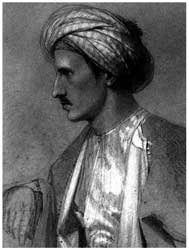 Few
Western students of the Arab world are as well known as the 19th-century
British scholar Edward William Lane (1801-76). During his long career, Lane
produced a number of highly influential works: An Account of the Manners and
Customs of the Modern Egyptians (1836), his translation of The Thousand and
One Nights (1839-41), Selections from the Kuran (1843), and the
Arabic-English Lexicon (1863-93). The Arabic-English Lexicon remains a
pre-eminent work of its kind, and Manners and Customs of the Modern
Egyptians is still a basic text for both Arab and Western students. Yet one
of Lane's most important works was never published. This was his book-length
manuscript, Description of Egypt. Few
Western students of the Arab world are as well known as the 19th-century
British scholar Edward William Lane (1801-76). During his long career, Lane
produced a number of highly influential works: An Account of the Manners and
Customs of the Modern Egyptians (1836), his translation of The Thousand and
One Nights (1839-41), Selections from the Kuran (1843), and the
Arabic-English Lexicon (1863-93). The Arabic-English Lexicon remains a
pre-eminent work of its kind, and Manners and Customs of the Modern
Egyptians is still a basic text for both Arab and Western students. Yet one
of Lane's most important works was never published. This was his book-length
manuscript, Description of Egypt. -
- Apart from the Arabic-English Lexicon, Lane worked much longer and
harder on Description of Egypt than on any other project, including Modern
Egyptians, and it probably affected his life more profoundly than Modern
Egyptians, despite the latter work's success. His failure to publish it was
a serious loss to scholarship.
- Description of Egypt, which would have been Lane's first book, was the
culmination of youthful ambition. Lane was working as an engraver's
apprentice in London in the early 1820s when his imagination was captured by
Egypt. The probable cause was Giovanni Battista Belzoni's sensational
exhibit at the Egyptian Hall in Piccadilly, which attracted enormous crowds.
That, along with Belzoni's best-selling book, inspired one of the several
waves of Egypt-o-mania that have swept across Britain, and indeed across
western Europe. Embarking on a rigorous program, Lane read everything he
could find about Egypt, both ancient and modern. He resolved to travel there
one day and write an illustrated book about it.
At some point during his studies, Lane's interests took a highly original
turn. Most people were fascinated by Egyptian antiquities, but Lane's
primary attention moved from ancient to modern Egypt, and especially to
Arabic, the language of the modern Egyptians. He also became intensely
interested in their society, or to use the term current at the time, their
manners and customs. It is unclear how he did so in spare hours in London
during the 1820s, but he made substantial progress in Arabic-and not just
classical Arabic but, even more remarkably, Egyptian colloquial Arabic as
well. Yet Lane did not abandon his interest in ancient Egypt, leading to a
duality of focus. Later, when he attempted to express his motives for going
to Egypt in an early draft of Description of Egypt (reproduced here at the
beginning of his Introduction), he had to rewrite the passage several times,
finding it difficult to put the various elements into proper relationship.
Lane applied himself so assiduously to his Egyptian studies while still
working as an engraver's apprentice that his health broke, rendering him
susceptible to a life-threatening illness. He recovered but remained
afflicted with severe chronic bronchitis for the rest of his life. Sometimes
he could not walk down a London street without stopping and gasping for
breath. Clearly he could not continue as an engraver, which required long
hours of bending over a copper plate. It was equally clear that he needed a
change of climate, both for his health and to fulfil his intellectual
pursuits. On 18 July 1825, funded by a mysterious benefactor, Lane embarked
for Egypt.
- After a long, eventful voyage, Lane arrived at Alexandria on 17
September. Mixed emotions swept through him as he prepared to land. He
remembered the moment in the first draft of Description of Egypt "As I
approached the shore, I felt like an Eastern bridegroom, about to lift up
the veil of his bride, and to see, for the first time, the features which
were to charm, or disappoint, or disgust him. I was not visiting Egypt
merely as a traveller, to examine its pyramids and temples and grottoes,
and, after satisfying my curiosity, to quit it for other scenes and other
pleasures: but I was about to throw myself entirely among strangers; to
adopt their language, their customs and their dress; and, in associating
almost exclusively with the natives, to prosecute the study of their
literature. My feelings therefore, on that occasion, partook too much of
anxiety to be very pleasing."
When Lane reached Cairo two weeks later he made good on his vow. Immediately
he forsook Western clothing for Eastern attire, dressing in none other
during the rest of his time in Egypt, for his purposes required not only
that he gain an intimate knowledge of the details of Eastern society,
including its material culture, but also that he not be readily recognized
as a European. One should bear in mind, however, that the dress and
resulting public persona that he chose were not those of a native Egyptian
but of a member of Egypt's ruling Turkish elite. That facilitated his
acceptance into Egyptian society and guaranteed him a degree of deference
within it. Nor was Lane's commitment merely a matter of outward appearances,
for he also furnished his house in Egyptian style, learned Egyptian table
manners, and became perfect in Egyptian social usages. Within a year his
Arabic was fluent. He developed a wide circle of Egyptian friends who knew
him as Mansur, the name-and at least to some extent the identity-that he
assumed in Egypt. The result fulfilled his expectations: "I was treated with
respect and affability by all the natives . . . " -
- Lane's circle of acquaintance in Egypt was not exclusively Eastern, for
he also made a few European friends, but these were people much like himself
who adopted Eastern lifestyles. Some of them, such as John Gardner
Wilkinson, James Burton, Robert Hay, and Lord Prudhoe, proved very helpful
to Lane in his work. Otherwise, he avoided the European residents of Cairo
who mostly inhabited the Frank Quarter near the city's centre. He was
especially repelled by those marginal characters who went about dressed in a
careless melange of Eastern and Western clothing: "In general they look a
most disreputable set of vagabonds," he wrote in one of the many pithy
passages in the first draft of Description of Egypt that were not retained
in the final one.' Lane lived not in the Frank Quarter but in a native area
near the north-western corner of Cairo, a short distance southeast of
present-day Rameses Square.
Lane's research in Cairo took two main thrusts. One was direct experience.
This might be through everyday activities such as shopping, dealing with
servants, or visiting friends and receiving guests-basic interactions that
can teach a careful observer much. He learned practical details about Islam
so he could enter Cairo's mosques, something a Westerner could not easily do
in those days, and pray in them, which he did both individually and with the
congregation, as the Description of Egypt explicitly states. He explored the
monuments and quarters of Cairo, becoming proficient in the city's urban
geography, a topic left vaguely in the background in Modern Egyptians, where
the focus is on society. He also visited the archaeological sites around
Cairo. The days he spent living in a tomb at the Pyramids of Giza he
remembered as the happiest of his life.
- But Lane also studied Arabic literary sources for Egypt and Islam,
accumulating a fine collection of books and manuscripts in the process. He
greatly admired the productions of the pasha's printing press at Bulaq,
becoming acquainted with its supervisor and with one of its primary
distribution agents. The latter, Sheikh Ahmad al-Khutbi, later became a
principal informant for the material in Modern Egyptians. One regrets that
the list that Lane prepared of the Bulaq press's publications, along with
any associated comments, is missing from the Description of Egypt. Of
course, many of the works that Lane needed existed only in manuscript. Two
were of special importance for Description of Egypt. The Khitat of Taqi
al-Din Ahmad al-Maqrizi, one of Lane's first acquisitions, provided
historical depth to the places mentioned in Description, while Abd al-Rahman
al-Jabarti's Aja'ib al-athar became the major source for Lane's long chapter
about the history of the de facto ruler of Egypt, Muhammad All. Lane was, in
fact, one of the first to appreciate al-Jabarti's historiographical
accomplishment. These manuscripts, along with the many others that Lane
purchased, must later have constituted one of the finest personal
collections of Arabic manuscripts in 19th century Britain.
- During this first trip to Egypt, Lane made two extended voyages up the
Nile as far as the Second Cataract in Nubia. The first, in 1826, covered
seven and a half months, from mid-March until the end of October. The
second, which extended for six months from mid-June until mid-December 1827,
he made in company with his friend Robert Hay. The latter voyage included an
excursion of two weeks into the Fayyum. On both, though hampered by illness
on the second, Lane repeatedly displayed his capacity to accomplish
prodigious amounts of work within short spaces of time as he stopped at most
of the major archaeological sites then known in Egypt and Nubia. One should,
however, also note the limits to Lane's travel experience. He did not
journey into Egypt's Eastern or Western Deserts, thereby missing the
wonders, especially of the former, that so enchanted his colleagues Burton
and Wilkinson. Lane also failed to visit the eastern Delta ("scarcely worthy
of detailed description"), forcing him to rely on secondary sources when he
wrote his chapter about it. These sources were not entirely trustworthy. Had
Lane seen Tanis for himself, for example, his fine eye, so evident at
Thebes, for the reuse of ancient building materials, probably would have
saved him from his error of accepting the site as coeval with Rameses II.
Nor did Lane ever travel in any Middle Eastern lands other than Egypt,
forgoing the comparative perspectives he would have gained thereby.
- The primary purpose of Lane's journeys into Upper Egypt and Nubia was to
satisfy his persistent interest in ancient Egypt; as he wrote, "I had long
entertained a wish to examine the antiquities of that most interesting
country." The account of his travels on the Nile therefore expresses a
little-known dimension of his intellectual life, for Lane was once among the
foremost in the nascent science of Egyptology. Only a few years earlier had
the secret of the hieroglyphic script been solved with Champollion famous
"Lettre a M. Dacier." Public fascination with Egypt was at a high pitch. Yet
with the exceptions of Champollion's and Lepslus' expeditions, fieldwork in
Egypt during the early nineteenth century depended almost entirely on the
initiative of private individuals like Wilkinson, Hay, and Lane. Had it been
published when it was intended to be, Lane's Description of Egypt would have
been a landmark in Egyptology.
- Lane's Egyptological accomplishments assume even more impressive
proportions when one considers their slight foundations, for the general
state of Egyptological knowledge in his moment was rudimentary indeed.
Lane's chronological framework for the Egyptian past extended only feebly
into the Middle Kingdom (a term not yet invented) where he identified two
monuments of Senusret I. The monarchs of the Old Kingdom were but a list of
unknown kings to him. His linguistic resources were scarcely more
efficacious, for although the hieroglyphic script had been deciphered-and
not everyone agreed even on that point-the ancient language was far from
translated. At best, and only later in his studies, Lane could identify some
royal names within cartouches and analyze the morphology of a few ancient
Egyptian words. Even many basic Egyptological terms and conventions (such as
the word 'cartouche') had yet to be standardized, compelling Lane to invent
descriptive terms on his own, which he did creatively, if sometimes naively.
Hence it is not surprising that Lane made many Egyptological mistakes, so
many that it would be specious to annotate them all in his text. His king
"Horus" (Horemheb), for example, certainly was not the immediate successor
of Amenophis III, as Lane repeatedly asserts him to have been; but Lane
could not have known that, so successfully had the record of the intervening
Amarna period been erased. On the other hand, we see Lane at Tuna al-Gebel
and Tell al-Amarna straining against the boundaries of current knowledge as
he attempted to interpret the remaining, fragmentary evidence of Akhenaten's
revolutionary innovations. Much the same could be said about his encounter
with Hatshepsut, likewise unknown to him, whom he identified as a regent for
Tuthmosis III and placed in the correct place in his list of kings (fig.
16o). In a note added at a later date, he accepted Wilkinson's
identification of her as a Queen-Regent named "Amun-Neit-Gori." Of course,
one of Lane's most important Egyptological contributions was to describe the
condition of the monuments when he saw them; in some instances they were
being destroyed before his very eyes.-
- Though mostly motivated by antiquities, Lane's record of his Nilotic
travels reveals another dimension of his research experience that found
little expression in Modern Egyptians: life outside of Cairo. These chapters
are not just an itinerary of antiquities, but also of the towns, villages,
and countryside along the way. One finds descriptions of the appearance of
towns, their productions, and the state of their markets. The picture is
dynamic: Fuwa flourishes because of the recent opening of the Mahmudiya
Canal, but Rashid declines for the same reason, while Manfalut literally
washes away, less of it remaining each time Lane sails past. Lane noted
differences in the appearance and dress of the people. Since Upper Egyptian
women tended to veil less, Lane could observe them more closely, but one
regrets to find him occasionally hiding along the riverbank to watch them
bathing. His command of Arabic enabled him to converse with the country
people, or fellaheen, although the recurring topic was the oppressiveness of
the pasha's government. Always in the background was Lane's developing
awareness of the land of Egypt itself. He realized its close identity with
the Nile and the narrow strip of fertile land along its banks. He witnessed
the annual inundation spreading across the valley.
Because Lane intended to write a book from the beginning, he kept a set of
diaries and notebooks. The main body of these has survived, preserved in the
Griffith Institute, where they have recently been catalogued. Some of the
entries are little more than hasty notes about date, place, and temperature;
others are highly detailed, so much so as to contain coherent textual
passages that Lane was able to incorporate into his Description of Egypt
manuscript with little revision.
- Lane also documented Egypt in pictures, thereby exhibiting his artistic
dimension, one of the least appreciated of his many talents. Although he
never became an engraver, his artistic training served him well by enabling
him to sketch the things that he observed and, later, to transform his
sketches into effective book illustrations. Lane, it should be remembered,
came from a distinguished artistic environment. His great-uncle was the
renowned artist Thomas Gainsborough; his brother, Richard J. Lane, was one
of the leading lithographers of 19th century Britain. This impeccable
artistic pedigree prepared him not only to execute his own work but also to
appreciate and describe the art of the Egyptians, whether ancient or
Islamic.
- Although Lane was capable of producing tastefully finished pictures, the
best of which should rank at least as minor works of art, he primarily
sought accuracy. To attain this ideal, he made extensive use of a recently
invented device called the camera lucida. Easily portable, it consisted of a
prism and set of lenses so arranged as to enable its operator to trace the
outline of a subject onto a sheet of paper, thereby providing additional
control over perspective and detail. Dozens of the camera lucida sketches
that Lane made in the field are still extant, many of them providing the
basis for the more developed illustrations in Description of Egypt.
- When Lane returned to England in June 1828, he had ample material in
hand to write his book. He entitled it Description of Egypt. This was
doubtless in both admiration and defiance of the great French Description
de l'Egypte, but it also epitomized Lane's highly descriptive literary
approach. For although Description of Egypt was basically organized as a
travelogue, it contained long passages of description that bore no relation
to the itinerary of his travels, foreshadowing the topical approach that
served Lane so well in Modern Egyptians.
- Altogether, Lane wrote Description of Egypt through three major drafts.
The first, now in the Bodleian Library, was probably composed in 18 29.
Recognizable as the inception of the initial fifteen chapters of the final
draft, it covered his journey to Egypt, impressions of Alexandria, journey
to Cairo, and first trips to Giza. Topical foci were given to Alexandria,
the physical geography of Egypt, and, most of all, to Cairo. At Giza, only
the Great Pyramid was treated. The draft also contained several interesting
enterprises in historiography: the political history of Egypt during Islamic
times, the origin and development of Cairo, and a concise account of the
career of Muhammad All. There were a few pages, organized into three
succinct chapters, about the modern inhabitants of Egypt, covering their
- 1) population and revenue
- 2) civil administration
- 3) religion and laws
- These, of course, were the origin of Manners and Customs of the Modern
Egyptians, although Lane as yet had no thought of writing such a book.
The first draft of Description of Egypt was a promising literary beginning,
especially for someone not yet thirty years of age. Often it displays a
strong, clear style; for example, the bridegroom passage, quoted above, is
as good as anything Lane ever wrote. Other passages, as he was well aware,
needed revision and development. Some of the sections with their various
topics sat uneasily together, but Lane was still experimenting with
placement and form. As notations in the draft show, it was intended to be
the first of four projected volumes that would treat the whole of his
Egyptian experience, each volume to contain approximately twenty-five
illustrations. Placement points for the illustrations are indicated in the
text, sometimes with a rough sketch drawn into the place, such as a
preliminary sketch of the Alexandrian street scene (fig. S). Another
interesting sketch shows a man peering into a cistern among the ruins of
ancient Alexandria with Pompey's Pillar in the background, but it was not
included in the final draft.
As promising as the first was, Lane was soon at work on a second draft of
Description of Egypt, the composition of which may be tentatively dated to
1830. Now among the Lane Manuscripts in the Griffith Institute,' this draft
marked a number of improvements over its predecessor as chapters became more
focused and substantial, while the manuscript grew in several areas. The
chapter on the Pyramids of Giza was extended to include all of the major
monuments at that site as well as those of Saqqara and Dahshur. The draft
closed after describing the desolate, almost obliterated ruins of Memphis
with a reflective quotation from the prophet Jeremiah.
Another major area of expansion was the chapter about the history of
Muhammad All, which grew approximately fourfold, approaching the large size
it attained in the final draft. An impressive historiographical exercise, it
drew primarily on al-Jabarti's manuscript history, which Lane had acquired
in Egypt, and on Mix Mengin's published account of the pasha-though leaning
toward the former work-in addition to Lane's own personal observations. It
shows keen discernment of source material as Lane weighed evidence carefully
before moving to judicious conclusions. For example, although he seems to
have accepted the old canard about Ibrahim not being Muhammad All's son,
Lane observed in a footnote that the pasha always referred to Ibrahim as
being so, therefore displaying unease with the unfounded yet widely accepted
story. Had it been published, this chapter would have been an important
contribution to the history of modern Egypt; it also would have hastened the
establishment of al-Jabarti's reputation in the West.
The area that grew the most, however, was the one dealing with the modern
Egyptians. The three brief chapters about population, government, and
religion and law were retained, while three new, relatively short, chapters
were added about Egypt's Turkish elite and Christian and Jewish minorities.
I But the most significant addition was a new chapter of some eighty
manuscript pages entitled "Manners and Customs of the Moos'lim Egyptians."
The need to keep the new chapter within somewhat proportionate limits
clearly frustrated Lane, but his aim was "conciseness," and the chapter's
function was subordinate to that of the work as a whole.
Lane submitted this second draft, along with a set of drawings, to the
publishing firm of John Murray in early 1831. Then under the direction of
the founder's son, John Murray II, Murray's had published Burckhardt,
Belzoni, and many other distinguished writers about Egypt and the Middle
East. Lane was aiming high. Murray handled Lane's manuscript in a highly
professional manner by sending it out to a qualified reader, Henry Hart
Milman, an accomplished scholar who had recently published a perceptive if
controversial history of the Jews in which he interpreted them in their
Semitic context. Milman's report strongly recommended publication: Lane's
was, he said, "the best work which has been written on the subject." He
expressed two minor reservations, the first being that the chapters dealing
with the modern Egyptians ought to be removed: they were good, Milman
thought, but should be the basis for an entirely separate book. Milman's
second reservation concerned the scope of the work, for he thought it should
be extended to cover Lane's travels in Upper Egypt and Nubia, as Lane indeed
intended. Murray was highly pleased with both the manuscript and the report,
as well as the illustrations-"the more the work contained of them, the
better," Murray said-which he considered the most accurate he had ever seen.
He agreed to publish the book. But he insisted on a new title and compelled
Lane to write it on the spot. So Description of Egypt became:
- Notes and views in Egypt and Nubia,
made during the years 1825, -26,-27, and -28:
Chiefly consisting of a series of descriptions and delineations
of the monuments, scenery, &c. of those countries;
The views, with few exceptions, made with the camera-lucida:
by Edwd Wm Lane
- For the sake of consistency as well as concision, however, the title
Description of Egypt is retained in this Introduction. It is also retained
as the title of this edition, along with the revised title, which is
presented as a subtitle. But a week after Lane and Murray met, the
project was delayed when the Reform Bill was introduced in Parliament on 1
March 183 t. To a degree difficult to grasp now, public attention became
fixed on that single political issue. Only publications about the Reform
Bill were selling. Murray decided to postpone publication of Description of
Egypt until the political crisis passed. He suggested that Lane use the
delay by acting on Milman's suggestions: excising the modern Egyptians
chapters and writing the new chapters about Upper Egypt and Nubia. Lane
strongly opposed the changes, agreeing to them only reluctantly. It should
be understood, however, that this constituted merely a delay in publication;
there was no question of cancelling.
Lane returned to work with characteristic assiduity. Removing the modern
Egyptians chapters was the work of a moment, doing little damage to the
textual fabric of the rest of the manuscript. A much more formidable task
was the composition of twenty-three new Upper Egyptian and Nubian chapters,
plus a long supplement about the ancient Egyptians. The chapter on Thebes
alone, by far the longest, accounted for about 50,000 words. He wrote this
portion of Description of Egypt through at least two drafts, as his footnote
references to a previous draft indicate. It is unfortunate that the
preliminary draft has not come to light, for it contained additional
material that Lane intended to publish. The structure of the Egyptian and
Nubian chapters of Description of Egypt is even more emphatically the
travelogue than the preceding ones. Yet it is a very contrived travel
memoir, containing much more artistry than might first meet the eye. Lane
compressed his two trips to Wadi Halfa and back into the narrative framework
of one southward journey, ending with the preparation of his canjiah for the
downstream journey: "The main-mast and yard were removed, and placed along
the centre of the boat: one end resting on the roof of the cabin, and the
other being lashed to the foremast. The tarankee't (or fore-sail) remained
as usual."
Lane also revised the material that he had already composed. Most of these
revisions were effective, resulting in memorable passages such as the
description of his confusing initial experiences in Alexandria, his first
impressions of Cairo, or the pleasure he took in his tomb-house at Giza. Yet
some of the revisions are to be regretted, because he shortened then
completely removed the Introduction that recounted his eventful voyage to
Egypt. Then the beautiful passage ("I felt like an Eastern bridegroom ... ")
that so memorably expressed his conflicting emotions as he prepared to set
foot on Egypt for the first time was revised into a detached statement that
diminished the personal element almost to the vanishing point: "I approached
the beach with feelings of intense interest, though of too anxious a nature
to be entirely pleasing ..." Several passing comments that expressed a
vibrant, personal point of view were removed. The third draft, presented
here, is naturally the most polished of the three, but the passages within
it are not invariably the best that Lane wrote. Close study of the other two
drafts, along with their associated manuscript materials, will richly repay
further attention by researchers.
Without doubt one of Lane's largest tasks for Description of Egypt was
preparing the illustrations for publication. The sheer number alone was
imposing, for there were more than 150 of them, though some are missing from
the manuscript and were already missing by the 1840s, when Lane's nephew,
Reginald Stuart Poole, noted their absence in the margins. In
pre-photographic days, reproduction of illustrative material was done by
engraving, woodcutting, or the newly invented technique of lithography.
Whatever medium was used-and Lane hoped to use all three-the artist's
original work had to be copied anew, whether onto the engraver's metal
plate, the woodcutter's block, or the lithographer's stone. Since Lane did
not intend to do this himself, he needed to provide pictures as highly
finished as possible to enable the appropriate craftsperson to realize his
conception. This primarily required clarity of line in the case of the
drawings destined to become woodcuts, where outline and contrast were
paramount. But Lane hoped to have as many of them as possible rendered by
metal engraving and lithography to achieve the delicacy of line and shading
that those media, especially the latter, could convey. Hence the high
artistic quality of many of Lane's sketches, with their delicate sepia
shading and, in two instances, bright coloration.
The maps alone were a formidable undertaking, for Description of Egypt
contains nine of them-thirteen if one counts each map section on the two
plates that cover the Nile Valley from Giza to Wadi Halfa. The maps of the
Delta and the Nile were based on W. M. Leake's Map of Egypt, which, despite
numerous shortcomings, remained a standard through much of the nineteenth
century.' Lane travelled along the Nile with a copy of Leake's map, from
which he made the templates for his own. But Lane's maps were more than mere
copies of Leake's, incorporating as they did his on-site adjustments and
corrections. The same is true for the two maps of Cairo, the one of the city
and its environs and the other, more detailed one of the interior of the
city, which were both based upon maps in the French Description de l'Egypte.
The most original of Lane's maps is the one of Thebes, the product of his
extended stays at that site. It strikes a fine balance between detail and
clarity that makes it an excellent reference tool for a book such as Lane's.
In Lane's cartography for Description of Egypt we see yet another dimension
of his talents that found no expression in his later published work.
The third draft of Description of Egypt constitutes a fair copy that would
have delighted any Victorian typesetter. The wording was clear and the
intent for note and figure placement unambiguous. His occasional, often
inadvertent mistakes in spelling and grammar stood out sharply and would
have been readily corrected. Only a few really rough edges remained, and he
intended to smooth most of those away, such as an illustration annotation in
chapter ten that was to be developed further, but never was. Temporary
removal and subsequent misplacement was the likely fate of the missing
appendix about the publications of the pasha's printing press at Bulaq.
Inevitably, the close reader finds the occasional faulty detail, such as the
omission of the letter J in the lettered series for the key to one of his
views of Cairo, although a notch is there for it, and it apparently escaped
his notice that he did not include the illustration for the face of the
Third Pyramid at Giza. One will also observe that some of the notes to
chapter twenty-six that Lane added after his second trip to Egypt are
rougher than the others, but there can be no doubt that he would have worked
them up to standard when the manuscript went to press, had the need arisen.
One could go on; the fact remains that Lane's was an unusually clean
manuscript. The finished work filled three volumes of text (removal of the
modern Egyptians chapters reduced it from its initially projected four) and
five volumes of illustrations. These constitute the third and final draft of
Description of Egypt, the one presented in this edition, now housed in the
British Library.
Lane submitted the revised draft to Murray, who again referred it to Milman,
who in turn declared it even better than the previous one. But political
conditions remained unsettled, so Murray continued to postpone publication.
Although Lane agreed with the wisdom of this decision, he was frustrated by
the delays, which, perhaps combined with unknown personal factors, threw him
into a serious mental malaise. His thoughts returned increasingly to Egypt,
where he had spent so many happy, creative moments. Letters to his friends
became punctuated with expressions of longing to be there again. As he sank
into depression, Description of Egypt came to his aid.
- In late spring 1833 Lane decided to write a book about the manners and
customs of the modern Egyptians, something Henry Hart Milman had suggested
earlier. He took the chapters that had been excluded from Description of
Egypt and copied them into a set of new notebooks. These he submitted to the
Society for the Diffusion of Useful Knowledge, an association that
specialized in facilitating publication of meritorious works. The S.D.U.K.
enthusiastically offered Lane a contract for the book. He accepted, but with
the proviso that he return to Egypt to gather additional material, which a
publication advance enabled him to do. In November 1833 Lane sailed for
Egypt to write Manners and Customs of the Modern Egyptians.
- When he reached Cairo in late December, Lane once again settled into his
old neighbourhood and resumed the Eastern lifestyle that was an essential
component of his research technique. Knowing exactly what he was looking
for, he worked quickly. By mid-September of the following year he had
gathered almost all of his data; before the end of December he began the
fair copy of Modern Egyptians and was preparing to return to England. At
that moment a fierce outbreak of bubonic plague erupted in Alexandria and
Cairo, causing him to flee to Thebes, where he spent an additional five
months living in a tomb-house on the hill of Sheikh Abd al-Qurna.
- Lane's time at Thebes is difficult to account for in detail. Presumably
he completed the fair copy of Modern Egyptians, if he had not done so
already, but that would not have taken the entire five months. Later, he
told John Murray III that he "carefully revised all that I had written on
its [Thebes'] monuments" while there, but the manuscript does not show
obvious signs of such heavy revision, although he may have made another
draft that is not extant. Possibly Lane was merely indulging in some
justifiable exaggeration to prompt the publisher to long-overdue action. It
was probably also at this time that Lane rewrote most of the Cairene
chapters of Description into a separate manuscript, no longer extant, that
was never incorporated into the original one.
Lane returned to England in autumn 1835. He made some inquiries about the
progress toward publishing Description of Egypt, but was met with evasion or
silence by John Murray III, who was becoming increasingly active in the
management of the firm. Lane probably should have been alarmed; instead, he
considered this just another irritating delay. Soon he was deeply engaged in
making the illustrations and correcting the proofs for Modern Egyptians. He
assumed that the success of that work would precipitate immediate
publication of Description of Egypt.
An Account of the Manners and Customs of the Modern Egyptians was an instant
success when it appeared in early December IS 36.1 The first printing sold
out within two weeks; many others followed, as did several revised editions,
culminating in the definitive fifth revised edition of 186o. Praised as "the
most perfect picture of a people's life that has ever been written,"2 the
influence of Modern Egyptians can scarcely be overstated. As Edward Said, a
strong critic of Lane's, pointed out, Modern Egyptians made Lane "an
authority whose use was an imperative for anyone writing or thinking about
the Orient, not just about Egypt."' This remarkable book grew directly out
of Description of Egypt.
It should not be assumed, however, that Modern Egyptians is a refinement of
Description of Egypt or that it represents a maturation and reconsideration
of Lane's research approach, in which he consciously turned away from the
more diffuse effort that Description represented. Lane was still thoroughly
committed to the publication of Description; the possibility that it might
not be published at all had not yet occurred to him. Indeed, Description was
likely the book that he cared about the most, having spent far more time and
effort on it. Students of Lane's Modern Egyptians should pay close attention
to Description of Egypt and its evolution, for it is the work that not only
gave birth to Modern Egyptians but also defined the limits that the latter
work assumed. There is little textual or pictorial overlap between the two.
Had Lane known that Description would never be published, quite likely
Modern Egyptians would have been different in shape and content.
Buoyed by the success of Modern Egyptians, Lane pressed John Murray III for
immediate publication of Description of Egypt. Murray responded by
withdrawing from the project and wishing him well with another publisher.
How could such a thing have happened? The possible reasons are too
complicated to set forth here in detail, but the fundamental problem lay in
the passing of too much time. Big, illustrated travel books-as Lane's was
probably if not entirely correctly perceived to be-had passed their heyday.
Also, while Lane was in Egypt, Murray's had heavily committed itself to the
publication of two books by Lane's friend and colleague, John Gardner
Wilkinson: Topography of Thebes, and General View of Egypt and Manners and
Customs of the Ancient Egyptians (1837). Investment in the two books,
especially the latter, had been heavy; Description of Egypt, also expensive
to publish, would have competed with them. Murray's made a ruthless if
unfair business decision. Lane was the loser thereby-as was the Victorian
reading public.
The blow to Lane must have been devastating, even if softened by the success
of Modern Egyptians. Efforts to place the work elsewhere came to naught. By
the late 1830s a commercial publisher would have found Description of Egypt
far too risky, while the alternative of private publication was beyond
Lane's limited financial means. Lane did, however, twice try to salvage some
parts of his work from the wreckage. The first attempt was a book about
Thebes, based upon the Theban chapter of Description, which John Murray was
considering, perhaps as a gesture of consolation. Lane set to work,
completing a substantial portion of it. Although the manuscript has not
surfaced, Lane jotted down a table of contents elsewhere, showing how the
chapter's five sections would expand into a book of eleven chapters. Some of
the later notes to the chapter, such as the references to Champollion's and
Wilkinson's books, were probably added with the projected book in mind. This
was also most likely the time when he added the two memoranda about
inserting additional material from the supplement of Description. Lane's
book about Thebes would have been a fine thing had it been realized, but
when he was about one-third of the way through, he abandoned the project,
explaining to Murray that he had no desire to compete with Wilkinson, whose
two books covered much the same material, although Lane would have dealt
with it much more fully than Wilkinson.
It especially pained Lane to see his illustrations lapse into oblivion;
therefore he made another proposal to Murray for a volume of views of Egypt
based upon the illustrations for Description with between loo to 150
woodcuts and a page or two of text to accompany each. "I think that it would
be acceptable to a large class of persons, as illustrating many works on
Egypt; especially Wilkinson's." A selection of the best of Lane's artwork
from the Description would have made a magnificent volume, although the
original works would have lost much in being translated from his delicate
sepia washes into woodcuts. The preferable alternative of lithographing them
all was probably too expensive to contemplate. A loose sheet inside Lane's
copy of al-Jabarti's 'Aja'ib al-athar appears to be a preliminary estimate
of the size and cost of such a work.2 On it Lane outlined a book somewhat
larger than the one described in the letter to Murray, consisting of two
volumes, one on the modern Egyptians and the other on "Scenery & Antiquities
&c." It would contain as many as 215 woodcuts and six lithographic plates,
although he also made a smaller estimate more in line with the size he had
suggested to Murray. But nothing came of this idea either. By 1842, Lane had
probably accepted the fact that he would never be able to publish his
Description of Egypt or any significant portion of it.
Not that these were idle or unproductive years for Lane. His translation of
the Arabian Nights appeared first in serialization and then in three volumes
between 1838 and 1841. Though largely superseded now, Lane's reigned as the
leading translation of the Arabic classic for much of the nineteenth
century. Scholars still frequently consult its copious notes, much of the
material for which Lane had gathered during his research for Description of
Egypt. Lane's other major publication during this period was Selections from
the Kuran (1843). But neither project was altogether satisfactory: the
publisher for the Arabian Nights went bankrupt before paying Lane in full,
while the Selections from the Kuran never received Lane's complete
attention. Profound changes in Lane's personal life also occurred at about
this time, such as the death of his mother and his marriage to Nefeeseh,
whom he or a friend had purchased as a child in one of the slave markets of
Cairo shortly before he left Egypt in 1828. Approaching midlife, Lane must
have wondered what direction his career might take.
At this juncture Lane was approached by his friend Lord Prudhoe, later the
4th Duke of Northumberland. Their friendship dated from Lane's first trip to
Egypt when he had been preparing Description of Egypt. Lord Prudhoe had long
admired Lane's proficiency in Arabic; he had also realized from personal
experience in the East the need for an authoritative Arabic-English lexicon.
Now he offered to support Lane in the preparation of such a work. For Lane
this was the realization of one of the youthful dreams that had impelled him
to Egypt in the first place. He readily accepted Lord Prudhoe's offer and
soon was preparing to return to Egypt for the necessary manuscript research
and collection. His one reservation was extended separation from his sister
Sophia Poole and her sons, to whom he was deeply attached. But once again
Description of Egypt came to his aid. Lane made another proposal to John
Murray: he would make the Description manuscript available to Sophia, who
would select passages from it and recast them into a booklength series of
letters ostensibly recording the impressions of an Englishwoman living in
Egypt. The money from this, or at least the anticipation thereof, enabled
Sophia and her family to go with Lane. In July 1842 Edward, Nefeeseh,
Sophia, and Stanley and Stuart set sail on Lane's third trip to Egypt.
Lane's third trip to Egypt, 1842-49, was by far the longest of the three,
but unlike the previous ones Lane travelled little during it and seldom went
out into society. So enmeshed did he become in the lexicon project that he
sometimes did not leave his house for months on end. Within the home,
however, he was an affectionate family man, and he worked closely with
Sophia, whose desk was within shouting distance of his, on her book. As
planned, she selected passages from Description of Egypt, often after he had
reread them and made changes in Arabic transliteration, punctuation,
paragraphing, and like matters. Sometimes he updated the passages, as in the
chapter about the Pyramids of Giza where Vyse and Lepsius had made important
discoveries since Lane's work there.
- Lane read the resulting letters, edited them, and made the final
decision whether to send them to London for publication. As she found her
bearings in Cairo, Sophia later acquired a stronger voice of her own,
writing about experiences that were exclusively hers, especially among the
women of Cairo. In the end, roughly one-third of her book's letters, really
chapters, were almost entirely based on the Description, while shorter
passages from it were interspersed elsewhere in the letters. Description of
Egypt was therefore the genesis of Sophia's book and provided a substantial
portion of its total text. The relationship between the two works should be
factored into any assessment of Sophia's The Englishwoman in Egypt,, which
became a classic account of women in nineteenth-century Egypt.
- Lane's nephews Stanley and Stuart were also drawn into the Description
manuscript, the volumes of which were necessarily often readily available
around the house. Their interaction with it and the resulting conversations
with their Uncle Edward were surely major factors in Stanley's ultimate
development into an orientalist and Stuart's into an Egyptologist. The
latter's annotations, signed "R.S.P.," are to be found among the pages,
especially in regard to missing illustrations. Stuart also copied, with some
updating, the mysterious manuscript in which Lane had rewritten the Cairene
chapters of Description of Egypt during the previous decade. Lane had
probably intended to replace the corresponding text in Description with it
when the work went to press. That event never occurred.
- After Lane's return to England in 1849, he devoted the rest of his life
to his lexicographical work. At his death on 10 August 1876 he was in the
midst of preparing its sixth volume. That and the remaining two volumes were
completed by his great-nephew and biographer, Stanley Lane-Poole. Lane's
Arabic-English Lexicon remains a standard reference work to this day. Like
Modern Egyptians, it has never gone out of print. There is no evidence that
Lane gave more than passing thought to Description of Egypt during his later
years. Its manuscript, along with some of his other papers, were sold by
Lane's widow to the British Museum in 1891, a few years before her own
death.
- Yet Lane's Description of Egypt did not fade into the archival shelves
without one last glimmer. This came from the posthumous Cairo Fifty Years
Ago, published under Lane's name by his great-nephew, Stanley Lane-Poole
.That book was the text of the heavily revised manuscript of Lane's Cairene
chapters that his nephew Stuart had copied in Cairo during the i 840s. The
original manuscript later disappeared, but after Lane's death Stuart gave
his copy to Stanley Lane-Poole who edited and published it in 1896.1 The
publisher was John Murray.
In 1835, when Lane was preparing to leave Egypt, one of the sheikhs who was
tutoring him in Arabic language and society took a piece of paper and wrote
on it the shahada, or profession of faith: "There is no god but God and
Muhammad is the messenger of God." He then tore it in two, giving one part
to Lane and sticking the other into a crack in Lane's house. This was to
guarantee that Lane would someday return to Egypt, for God would not allow
the statement forever to remain divided. In the event, Lane did return seven
years later, bringing his manuscript of Description of Egypt, when he began
his lexicographical studies. But perhaps the sheikh's talisman was more
effective than he imagined, for the Description of Egypt has now returned to
Egypt, thereby realizing even more of the force of the sheikh's desire, for
Description of Egypt embodies so much of Lane, his youthful experiences, and
his high ideals. Essential to any full understanding of Lane's overall life
and work, it is appropriate that his first book should after all these years
return to Cairo for publication.
-
- Description of Egypt by Edward William Lane (1820s) - Edfu
-
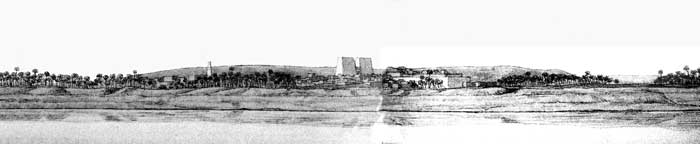 Having proceeded a little above the site of Eilethyia, the two lofty towers
of the pylon of the great temple of Apollinopolis Magna become visible.
About three hours after our first sight of these remarkable objects we arrived
before Ad'foo [Edfu], a village which occupies a part of the site of the City of
Apollo. I made a view of Ad'foo and its great temple from the opposite bank of
the Nile.' Having proceeded a little above the site of Eilethyia, the two lofty towers
of the pylon of the great temple of Apollinopolis Magna become visible.
About three hours after our first sight of these remarkable objects we arrived
before Ad'foo [Edfu], a village which occupies a part of the site of the City of
Apollo. I made a view of Ad'foo and its great temple from the opposite bank of
the Nile.'
The name of this place is commonly pronounced Ad'foo; but the literati of
Egypt, for the sake of assimilating the incipient and final vowels, make it
Ood'foo. The Coptic name was At'bo. It is a large village; the residence of a
Ka'shif. It is situated at the distance of about a mile from the river, upon the
front slope of a long and high ridge of mounds, the remains of Apollinopolis
Magna. The village contains a mosque with a ma'd'neh; and extensive groves of
palm-trees adjacent to it give it a pleasing appearance. The pylon of the
great temple rises above it like a fortress. A part of the village is built upon
the roof of this temple. There is also a second temple among the mounds, behind
the village. At Ad'foo, the manufacture of pottery employs many families. There
are a few Ckoobt [Coptic] families here; but above this place no Christians are found,
excepting a very few at Aswan.
The great temple is situated at the north-western part of the village; and so
crowded in front (that is, on the south), and also on the western side, by
modern huts, that it is impossible to obtain a good view of it from either of
these directions: but the modern huts are not the only objects which obstruct
the view of this fine building; for it is, in some parts, buried nearly to the
roof in rubbish. Though raised in the Ptolemaic period, when the arts of
architecture and sculpture had much declined in Egypt, it is a very noble
monument. -
- The great pylon, which forms the front, has a particularly grand
appearance: each wing is above a hundred feet in breadth, and the same in
height. The temple seems to have been founded, and partly sculptured, by Ptolemy Philopator
[dynastic list] - his being the oldest name found upon it - but the decorations were
continued under several of his successors - Philometor, Physcon and Cleopatra, and
Ptolemy Alexander 1st and Berenice. The pylon was decorated by Philometor.
The front is adorned with three rows of sculptured figures, representing this
king offering to, and worshipping, various divinities, at the head of whom is
always Aroeris [Horus], the god to whom the temple was chiefly dedicated: he generally
has the head of a hawk: being identified with the Greek Apollo, the ancient town
here situated was called Apollinopolis Magna by the Greeks because this god was
the chief object of worship in the place. The figures of the lowest row of
sculptures on the front of the pylon are about thirty feet high; but little
of them is seen; for the rubbish rises nearly to their heads. The king is here
represented in the act of slaying a group of prisoners before the principal god
of the temple; behind whom stands Athor [Horus the Elder]. These figures are in a very bad style;
greatly inferior to the sculptures executed under the Pharaohs. In the two upper
rows, the same king is represented offering to several series of sitting
deities; at the head of whom is Aroeris [Horus]. The back and sides of the pylon are
similarly decorated.
-
- Passing through the portal of the pylon, we enter a
spacious court, I bounded on the right and left by a wall fronted by a row of
columns, twelve in number. Eight other columns extend along the back of the
pylon. The capitals are not uniform; but most of them are rich and elegant;
and they produce, altogether, a fine effect. The walls behind the columns are
decorated with sculptures, representing the usual offerings to the gods. This
noble court is now used as a granary. It has been cleared of much of the rubbish
by which it was encumbered; and a few heaps of corn, the property of the
government, give less offence to the eye of the traveller.
-
- A fine portico, which
forms the front of the main body of the temple, is at the end of the court. It
contains eighteen columns; six in front, and three deep. The capitals of these,
also, are not all uniform; but those which correspond in situation are similar
to each other: thus the two between which is the entrance are of the same form;
the two next to these are also similar to each other; and so are the two extreme
columns. Upon the architraves of the front columns are sculptured several rows
of monkeys and men adoring the winged globe and the scarabxus [scarab]: this insect is
represented with his ball, and with his wings expanded; and is frequently seen
here, being a particular object of adoration: it was an emblem of the sun; of
which Aroeris [Horus] was one personification. The interior of the portico is filled
nearly to the roof with rubbish; therefore little can be seen of its sculptures;
but some of those which remain visible are serious, and deserve to be mentioned.
On the upper part of the left side-wall is represented a boat-sledge drawn by
four jackals: Harpocrates is seated on the prow; and the boat contains several
other gods. Before this curious procession are four monsters, each of which has
the head of a jackal, the hands and arms of a man, and the body of a bird: the
hands are raised in an attitude of adoration. Upon the opposite side-wall is
another boat, supporting a circle, in the centre of which is an eye, and above
and below the eye is a row of small sitting figures. The entrance of the
apartments behind the portico is entirely closed with rubbish. Upon the cornice
above this entrance is the winged globe; and below this is a scarabxus [scarab] enclosed
in a circle, and supported by a boat. In the upper cornice is represented the
same insect, also enclosed in circle, and with two heads; the head of the hawk,
which is common to Aroeris [Horus], and that of the ram, which distinguishes Kneph. This
device of the beetle with the heads of a hawk and ram is a common ornament on
the cornices of the temple.
-
- The roof of the interior apartments, as well as that
of the portico, is covered with modern huts; most of which are inhabited. Under
one of these huts is an aperture by which we may descend into one of the inner
chambers. It was pointed out to me by an English traveller whom I met here on
my return from the upper country; but I believe it is generally shown to
travellers: I had not seen it; for I had not completed my examination of the
temple. We descended together; and found ourselves obliged to worm along in a
prostrate position for several feet: the rubbish, at the part where we entered,
rising nearly to the roof. We observed that the chamber contained four rows of
massive columns; three in each row; and that some of the capitals which were not
covered by the rubbish were rich and elegant in form: of the sculptures we could
scarcely see anything excepting the hieroglyphics on the architraves. This
chamber we found to be the one next behind the great portico: there are several
smaller apartments beyond it. On our egress from it, the inhabitants of the hut
through which we had passed asked us for a present.
-
- The whole of the exterior of
the temple is covered with sculptures; as is also a high wall which surrounds
the whole of the main body of the building, and of which the two side-walls of
the great court form parts. This edifice is, upon the whole, a stupendous and
elaborate work. Each wing of the pylon has a well-built flight of stairs by
which to ascend to the summit. We enter each stair-case by a door in the back of
either wing of the pylon. In ascending the stairs, we pass, successively,
the entrances of a series of apartments, of which, half the number lie on the
eastern, and half on the western side. These chambers were perhaps destined for
the accommodation of the priests. They have no decoration. For the admission of
light, they have narrow apertures, like the loopholes for musketry, but
horizontal instead of being perpendicular. The whole length of the temple is
about 450 feet.
At a short distance from the south-western angle of the pylon of the great
temple is another Ptolemaic temple [birth house], almost buried among the mounds of rubbish.
This is a monument of Physcon; but the sculptures are partly by a later Ptolemy;
supposed to be Lathyrus. It is a small edifice; consisting only of two chambers,
and surrounded by a colonnade. High blocks (higher than they are wide) are
interposed between the capitals and the architraves, and have a figure of the
pigmy monster Typhon [Bes], carved in high relief, on each of their four sides. Hence
the temple has been called the Typhonium of Ad'foo. Of the cornice, little
remains. The sculptures on the interior face of the architraves in front are
remarkable: two rows of figures are here represented meeting together in the
centre: they are all armed with various instruments of destruction; and each
procession commences by a human figure with the head of a lion. The interior of
the temple is more than half filled with rubbish. We enter first a small
apartment. The principal object in the sculptures is Horus, or Harpocrates, who
is generally represented seated on the knees of his nurse Athor [Hathor], on the walls of
the second chamber, which is longer than the first. This chamber contains a
single column; opposite the entrance: there was probably another column behind
it, corresponding in situation; but it has been thrown down; and the fragments
are either buried in the rubbish or have been removed. On the left side-wall of
the second chamber, Athor [Hathor] is represented seated on a throne, from which lotuses
are springing out in every direction.
|