Olaf Matthes - Panoramic Photography - Nipan Camera
Nipan Panoramic Camera
I really like my Rusian FT-2 swing-lens cameras for their unusual image format with it's 1:4 aspect ratio. But I also like using filters for black and white photography and having pictures a tad sharper would be nice too.
One day I saw a picture of a camera called the iPan on eBay that looked like a super wide SLR camera body. What a fool, I didn't purchase it... Here is what the seller had to say:
"One of a kind, custom built, 35mm panoramic camera. The IPan has one open frame measuring 4.3 inches in length. One roll of film produces 14 panoramics with permanently mounted 65mm 5.6 Super-Angulon Lense, helical mount focus and 1/500th sec fastest shutter speed. This camera was built very tough and heavy to sustain unusual weather conditions and works well. A rangefinder mimics the panoramic view and a cable release is used for the shutter. This camera was used on two professional shoots and produces razor sharp images. It uses a thumb winder, bubble level, 1/4 tripod screwhole and 67mm filtersize."
The camera looked like this, image lifted from the eBay auction:

It seems the same camera is mentioned and depicted in the book "Panoramic Photography" by Joseph Mehan, published by Amphoto Books. It says the camera was built by photographer Michael Lawton.
The various panoramic camera history timelines on the internet mention this camera as:
"1976 - I-Pan, a stationary camera, made a 81 degree picture on 35mm film"
Searching the internet for more information finally turned up these numbers: Michael Lawton made his fist prototype in 1973. From 1979 to 1984 he sold 50 cameras. Before selling them himself he offered the concept to Canon who refused to produce it because they thought they wouldn't sell enough of them.
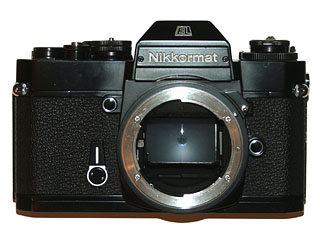
After many sleepless nights I decided to try to copy the concept of this iPan camera and make my own one by fusing two old Nikkormat EL bodies - calling it the Nipan. The lens to be used is a Schneider Super Angulon 5.6/65mm just like in the original camera (mine is an older model without the multicoating). Film format is 24x108mm, exactly like my beloved FT-2.
I decided on using the Nikkormat ELs because they are cheap and easy to get and have a back door with a rather rectangular shape, so building a new one would be easier. The Super Angulon lens has an image circle of 170mm (at f/22) so it covers the film format without any problem.
 |
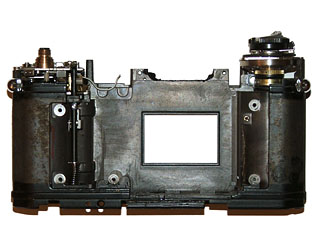 |
The above pictures show the Nikkormat EL before and after stripping down.
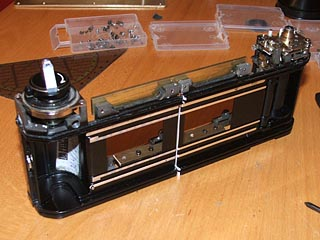
Camera meets hacksaw: After taking detailed measurements and figuring out where to best cut the cameras it looked like this:
 |
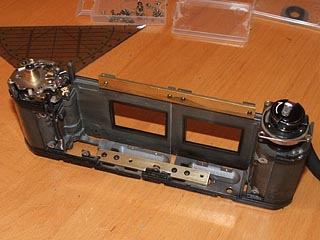 |
The two halves are held together by strips of brass for now that screw into existing holes in both parts. That way it's easy to get a body in the end that is exactly 50mm wider than the normal camera body.
The image frame will be milled out once the cameras are completely fused together. This makes it easier to get straight edges.
Next I cut a piece from black industrial plastic (Polyoxymethylen, also known under the brand-name Delrin) to form the main chamber. This was then glued in with epoxy glue and helps to give additional strength. Since the glue doesn't stick that well on this type of plastic I would probably try to find a way to screw things together in case I'd build a second camera.
It also turned out that the two camera bodies had rather large tollerances. The materials weren't of the same thickness, so I had to file a lot to get the film guides level.
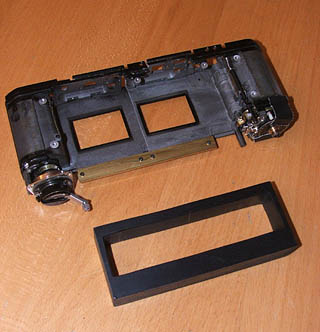 |
 |
The picture above on the right shows the camera after milling out the film frame. Also, the back doors have already been fused together. It turned out that it was rather easy to simply solder them together, so I didn't have to build a new one from scratch.
What's missing now is a lens cone that goes in between the lens and the camera body. I will hopefully get one machined from plastic or aluminum. Until I get one made on a lathe a hand made rectangular prototype has to do...
 |
 |
Since the horizontal angle of view is similar to that of a 21mm lens on 35mm film I will probably use a Voigtländer 21mm finder as view finder.
Finally, I got a lens cone machined on a lathe. With some addition of camera leather the (almost) final camera looks like this:
 |
 |