|
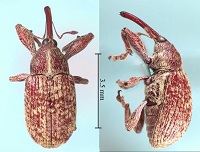
The boll weevil, Anthonomus grandis Boheman, is a native of Mexico
and Central America. It was first introduced into the United States
near Brownsville, Texas, in about 1892.
By 1922, the pest had spread into cotton growing areas of the United
States from the eastern two-thirds of Texas and Oklahoma to the
Atlantic Ocean. The boll weevil colonized northern and western
portions of Texas during a subsequent range expansion that occurred
between 1953 and 1966. By 1981, the insect was well established in
parts of California, northwestern Mexico and Arizona.
As early as 1895 the tremendous damage caused by the boll weevil was
recognized. Recommendations were made to terminate cotton production
in the infested region and to establish and maintain a cotton-free
zone along the Rio Grande River bordering Mexico. In 1903, the Texas
Legislature even offered a $50,000 cash reward for a practical way to
control the boll weevil. In 1904, Sanderson tried to hand-pick
infested squares off cotton plants to prevent weevil reproduction. The
same year Hunter concluded the boll weevil could not possibly be
eradicated. Since that time, numerous methods of control have been
tested and reported.
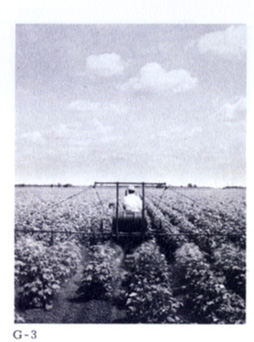
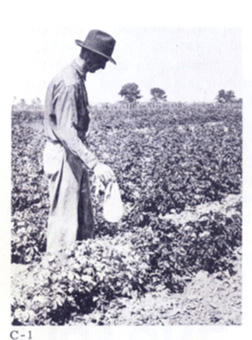
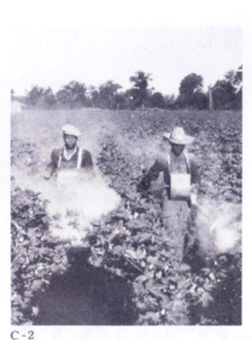
From 1917 until the late 1940s, the most effective method of control
was the use of short-season, early maturing cotton varieties and
dusting with calcium arsenate. During World War II, DDT and other
chlorinated hydrocarbons were developed and made available to control
many insect pests, including the boll weevil.
In 1955, scientists reported that boll weevils were becoming resistant
to chlorinated hydrocarbons, and within two years resistance was
widespread throughout the Cotton Belt. Concern was growing about the
destruction of beneficial insect populations and the widespread
occurrence of organochlorines in the environment. Organochlorines were
gradually abandoned in favor of organophosphate insecticides. Although
the boll weevil has shown resistance to organophospates in Central
America, it has yet to develop resistance in the United States, even
in the Texas High Plains, where organophosphates have been used in an
ongoing diapause program since 1964.
In 1959, researchers discovered that the boll weevil enters diapause
during late summer and early fall in ground trash to overcome the
absence of host plants and cold winters. In 1964 researchers noted
that temperature and photoperiod are key environmental factors
controlling the onset of diapause in boll weevils. In 1973, research
documented that boll weevil diapause is related to changes in fruiting
activity of the cotton plant. The research also showed that diapause
occurred in about 20 percent to 50 percent of adult weevils when
larval development coincided with decreasing fruiting levels and in 50
percent to 100 percent as true cutout approached.
In 1959, researchers employed insecticide applications late in the
season, as the cotton crop approached maturity, to destroy diapausing
weevils before they entered hibernation sites. The size of emerging
spring populations during the subsequent planting season was greatly
reduced.
In 1966, research showed conclusively that the male boll weevil
produces a wind-borne sex attractant, or pheromone. In laboratory
tests this boll weevil pheromone was isolated by drawing air from
caged males through a column of activated charcoal to which female
weevils were quickly attracted. Further research showed that the
pheromone of the male boll weevil both attracts females and acts as an
aggregating attractant for both sexes.
The first synthesis of a boll weevil pheromone compound was reported
in 1968. In 1972 improved synthesis produced about one kilogram of the
compound for field studies. Several improvements in synthesis have
occurred since, including development of the boll weevil pheromone
grandlure, now readily available from manufacturers.
As the techniques for formulating grandlure improved, so did the
design of boll weevil traps. Among those selected for general use were
wing traps coated with Stikem and Plexiglas, oblique funnel traps. In
1971, plywood wing traps painted dark green and metal traps painted
yellow were used in a large test in Texas. In the same year,
researchers found that weevils were most attracted to daylight
fluorescent-yellow traps. Later in the same year, the Leggett trap was
developed.
The Leggett trap is a non-sticky trap that uses the behavior patterns
of the boll weevil to ensure efficient capture. Traps baited with
grandlure were found to be eight times more effective than manual
whole-plant examination in detecting very low densities of boll weevil
infestation.
In 1980 a trap index system for weevil infestations in West Texas
cotton was developed. The system was designed to predict the need to
treat overwintered weevils, based on catches in the traps before the
cotton reached one-third grown-square stage. In the same year,
researchers reported that the application of early season insecticide
treatments reduced the number of the overwintered boll weevils before
they could establish the nucleus of an F1 breeding generation.
Research suggested that the grandlure-baited trap could be used as an
effective sampling tool for low-population densities of overwintering
boll weevils as they emerge in early spring and search for fruiting
cotton. Rummel at al (1980) suggested that 2 percent
oviposition-damaged cotton squares following the appearance of
one-third grown squares as the level of damage that was predicted to
occur between trap index 1.0 and 2.5 on untreated cotton.
About $70 million is spent annually to control the boll weevil, but
the pest still causes an estimated $200 million in crop losses each
year. In recent years, these figures may have increased by 50 percent.
A new control strategy is imperative because cotton cannot be grown
profitably unless the weevil is controlled. Yield losses attributed to
the boll weevil, the cost of insecticide control, environmental
considerations, infestation of secondary insects and insect resistance
all have resulted in an aggressive effort to develop a Beltwide
strategy for controlling the boll weevil in the United States.
Although most growers judiciously apply control measures to boll
weevil infested acreage, in almost all such areas 5 percent to 20
percent of the infested acreage may receive inadequate or no control
treatments. This uncontrolled acreage harbors populations capable of
reinfesting neighboring areas. Models demonstrate that if only 10
percent of a population remains untreated in an infested area, that
portion of the population can develop normally and redistribute
throughout the surrounding area after only four generations, or less
than one growing season. Also, judicious application of control
measures cannot protect against reinfestation from neighboring areas
the next season. Growers who treat their acreage are faced with a
continuing need to apply insecticide to control reinfestations.
In view of the economic and environmental problems posed by the boll
weevil and in recognition of the technical advances developed over a
period of almost 100 years by hardworking and talented scientists, a
cooperative boll weevil eradication experiment was initiated in 1971
in southern Mississippi and in parts of Louisiana and Alabama. This
experiment used an integrated control approach including chemical
treatment, releases of sterile males, mass trapping and cultural
control.
Based on this experiment, a special study committee of the National
Cotton Council of America concluded it was technically and
operationally feasible to eradicate the boll weevil. The subsequent
success of the three-year boll weevil eradication trial, initiated in
1978 on 32,500 acres in North Carolina and Virginia, led to the
creation of the southwestern and southeastern boll weevil eradication
programs.
The Southwest Boll Weevil Eradication Program was implemented in 1985
to eradicate the boll weevil from about 233,000 acres in western
Arizona, southern California and northwest Mexico. In 1988, the
program expanded to include 320,000 acres of cotton in central
Arizona. Eradication in southern California and western Arizona was
completed in 1987, and in 1991 in central Arizona. The Southeast Boll
Weevil Eradication Program was designed to eradicate the boll weevil
from about 500,000 acres of cotton in the remaining part of North
Carolina and in northern South Carolina. This was followed in 1987
with a program in the remainder of South Carolina and in Florida,
Georgia and southern Alabama.
The Southeast program also maintained previously eradicated areas in
Virginia and the Carolinas as part of a post-eradication plan. A
buffer zone on the western edge of the eradication area was also
maintained to prevent boll weevil populations from returning to
eradicated areas. The Southeast program has since expanded to eastern
Mississippi, middle Tennessee and the remainder of Alabama.
The Texas Boll Weevil Eradication Foundation Inc. was established by
the Texas Legislature in 1993. The cotton-producer run, nonprofit
foundation governs and oversees the implementation of the boll weevil
eradication program in Texas. For the 2002 growing season, 11 zones,
representing about 6 millions acres of cotton, will be active in the
eradication program.
The Southern Rolling Plains zone was the first area to start the
program on 220,000 acres in the fall of 1994, and was declared
functionally eradicated, the first zone to achieve eradication, in
September 2000. The Rolling Plains Central zone was declared
functionally eradicated in February 2002.

|