Henri Rousseau: The Jungles of Paris - Retrospectives - Obit-Mag.com

The Jungles of Paris
by Phyllis Tuchman
MAY 3, 2012 TAGS: ARTS, MODERNISM
ADD A COMMENT
Henri Rousseau was buried in a pauper’s grave, but he wasn’t forgotten. Although French critics regularly dismissed as childlike and amateurish the paintings he began exhibiting in 1886, many avant-garde artists of the day were his fervent fans. Two years after Rousseau died, on Sept. 2, 1910, at 66 from an infected leg wound, modernist giants Robert Delaunay and Pablo Picasso had his remains disinterred and moved to another cemetery, sculptor Constantin Brancusi carved his headstone, and poet Guillaume Apollinaire composed its epitaph.
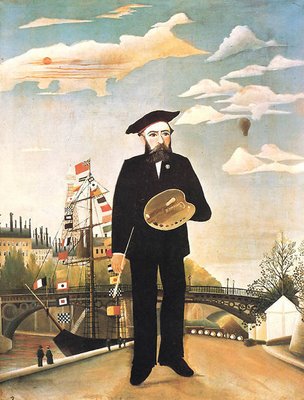 As the 20th century progressed, Rousseau’s stylized, colorful renderings of exotic jungles, scenes in and around Paris, men at play and at war, life in the desert, and portraits of upright citizens became icons of the modern age. Critics and curators lauded his compelling figures, dream-like settings, and beguiling mysteries.
In recent years, Rousseau has become even more popular. In 2001, a museum in Germany mounted that country’s first comprehensive exhibition of his large-format canvases and more intimate oils. Four years later, a major retrospective toured London, Paris, and Washington, D.C. And in the summer of 2010, for the first time in Spain, the Guggenheim Bilbao showcased his work in depth to commemorate the centennial of his death.
Rousseau never lost faith in his art. He assumed the novelty of his paintings would eventually wear off. Shortly before he suffered his fatal illness, he wrote in a letter dated April 1, 1910, “…if I have kept my naivete, it is because … I was always told to keep it. You will no longer find it [unusual] in the future.”
The painter’s day job as a clerk who imposed duty on goods entering Paris inspired Apollinaire to dub his friend Le Douanier (customs official). Before he became an artist, Rousseau led an unremarkable life. Born on May 21, 1844, in northwest France, he attended school until he was 17. His father was an ironmonger.
When Rousseau’s family moved to Angers, a larger town, in 1861, the teenager obtained an office job working for a local lawyer. After drawing lots, he wasn’t compelled to serve in the army. But when he was caught filching money and stamps from his employer, he enlisted to avoid prison. He served for five years. His regiment was based in Caen, home of the Bayeaux tapestry, which is occasionally cited as a source for his art. He never visited a rain forest, though he claimed he had, as a soldier sent to Mexico, which was another fabrication.
In 1878, Rousseau moved to Paris, married his landlord’s daughter, and joined the customs bureau. The couple had seven children, but only two lived to be adults.
In his mid-30s, Rousseau began painting. A few years later, he secured a permit to make copies in the Louvre. He rented a studio in 1885 and began exhibiting in 1886 in the annual Salon des Independents, which organized large, juryless shows.
Although little survives from Le Douanier’s earliest period, there are, from the late 1870s, a few small-sized, rudimentary Breton scenes. These include a landscape with a bridge and a church, a wagon and horse being led past a mill, and a mill with a wheel circulating water from a river where a man in a hat fishes.
Ten years later, on slightly larger surfaces, Rousseau portrayed men and women, singly and coupled off, strolling or meeting in forests. The tall bare-branched and sparingly leafed trees connect the scenes at ground level with the sky above. There are no shadows. Figures who stand in front of shallow backdrops indicate depth.
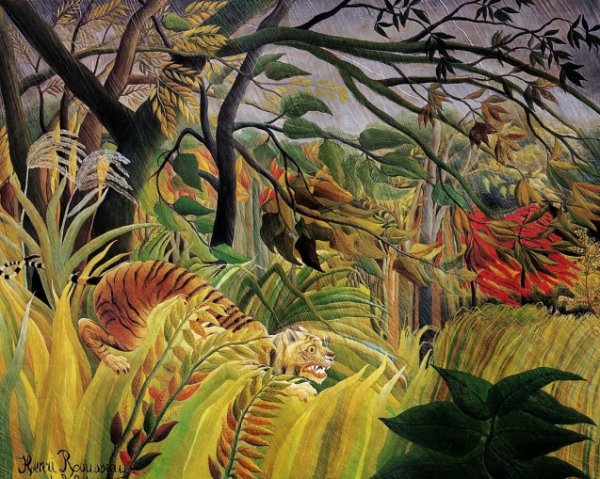 By 1891, the artist was executing work that is measured in feet rather than inches. That’s the year he executed his first jungle painting, Tiger in a Tropical Storm (Surprised!). The turbulent scene features a crouching, teeth-baring carnivore in a wind-swept forest inundated by sheets of rain falling from a gray sky with lightening bolts. The subject, a literal interpretation of the term rainforest, seemed to come out of the blue. Rousseau had been portraying scenes of leisure on the outskirts of Paris. On Sundays, however, he would visit the Jardin des Plantes, particularly its Zoology Galleries, which opened in July 1889, chockablock with wondrous displays of stuffed wild animals. In 1889, he went several times to the World’s Fair that Paris hosted, replete with exhibits from far-flung colonies in Africa and the Far East.
In 1893, Rousseau retired, intending to live on his pensioner’s salary. He ended up teaching music as well as drawing and ceramic painting. At one point, he played music on the street. He wrote two plays, A Visit to the 1889 Exhibition and Revenge of a Russian Orphan. And, he entered competitions trying to secure commissions to paint murals in various city halls. His wife died in 1888; he remarried and his second wife died in 1903.
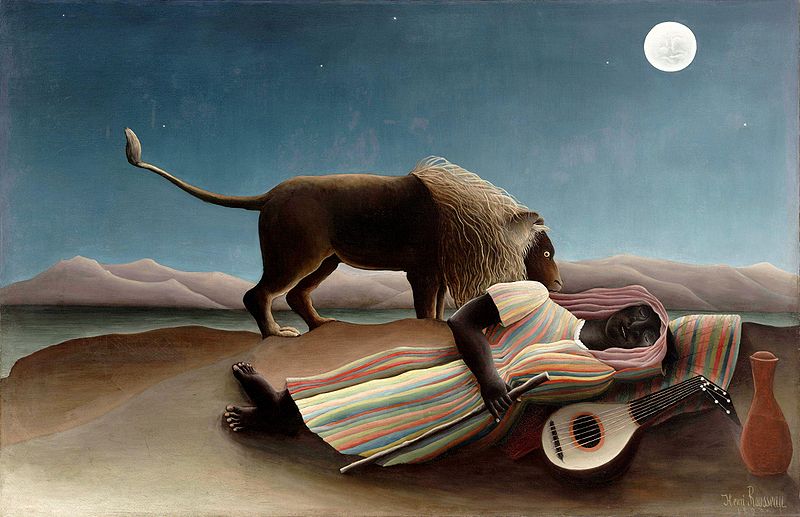
The Sleeping Gypsy (1897), among Rousseau’s masterpieces, is a simply composed painting. A brown figure with white teeth, wearing a striped garment that harkens back to Joseph’s coat in the Old Testament — and looks ahead to Kenneth Noland’s color field canvases of the 1960s — rests on sandy ground. He holds his cane; a lute-like instrument and a tall vase are beside him. Beneath a graduated, dark blue sky where stars twinkle and a white circular moon floats, there’s a sliver of river and a lilac colored mountain range. And oh yes, a lion occupies the center of the canvas. Though it appears quite docile, it adds a soupcon of mystery. Based on a bronze near an entrance to the Jardin des Plantes, this king of the jungle is a sterling example of the way Rousseau would riff on his source material. He’d appropriate images he saw out of context and then stage an imaginary scene.
That’s one way an American Indian, a figure not associated with jungle life, ends up struggling with a gorilla in a tropical landscape of 1910. Or animals play musical instruments surrounded by colorful birds and lush vegetation. Or, how the artist based his 1905 painting, The Hungry Lion Throws Itself on an Antelope, on two stuffed animals. For the latter, Rousseau even provided commentary, adding roles for additional bit players: “The lion, being hungry, throws itself on the antelope, [and] devours it; the panther anxiously awaits the moment when she too will have her turn. Carnivorous birds have each torn off a piece of flesh from the underside of the poor animal as it lets fall a tear! Sunset.”
 Although Rousseau is associated with jungles — he painted more than 25 of them — after he made his first one, he didn’t execute his exotic landscapes for almost a decade. But during the mid-1900s, about the time Rudyard Kipling was awarded a Nobel Prize in Literature for works like The Jungle Book, Rousseau returned to the theme of verdant forests.
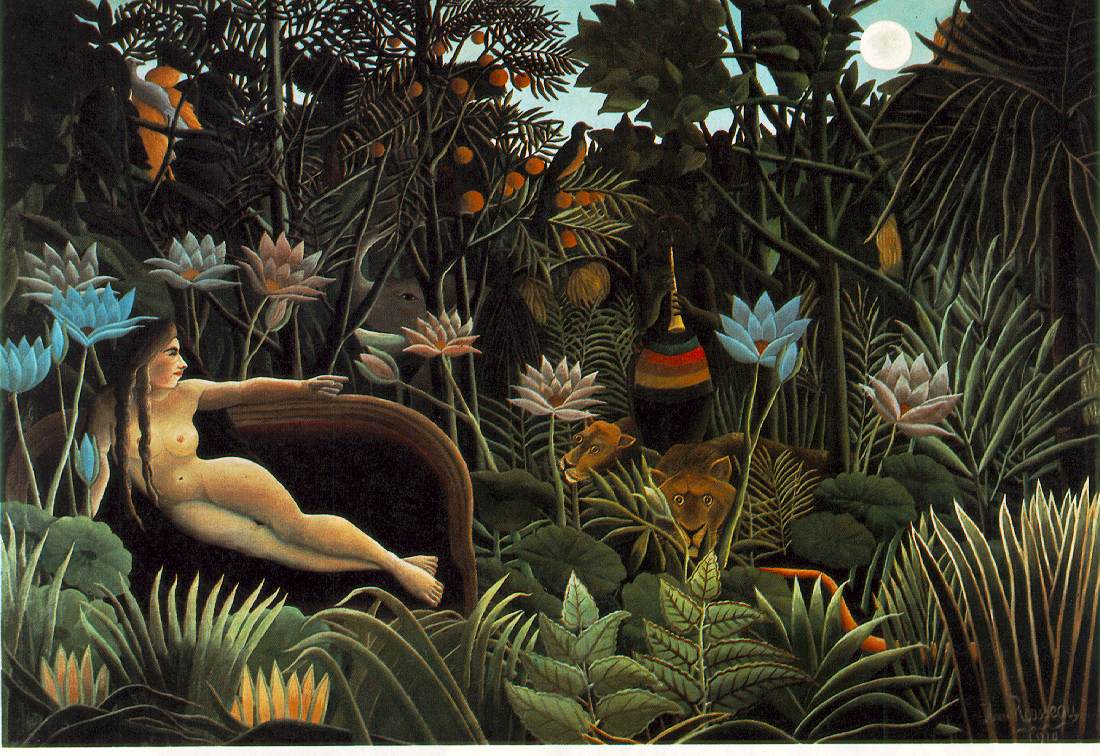
Considered his last painting, The Dream, is one of his most popular. Though he never mastered perspective, it didn’t matter because we read his art moving across the canvas as if it were a frieze. Here a series of blue, purple, and pink flowers, resembling the kind of gaslights Georges Seurat depicted, create an implied line across the center of the work, interrupted only by a monkey musician wearing a horizontally striped skirt. Tucked in among the lush, stylized green plants, oranges, and yellow bananas, Rousseau included an elephant, a jaguar, and several birds. On this elaborate set, positioned to the left, a shapely nude woman stretches across a divan. About all this, Rousseau noted, “Having fallen into a gentle sleep/Yadwigha, in a dream/Heard the sounds of a musette/Played by a benevolent magician/While the moon shone down/Upon the flowers, the green trees,/The wild serpents listened to/The instrument’s merry tunes.” Of course!
Phyllis Tuchman writes about art and artists for Obit.
As the 20th century progressed, Rousseau’s stylized, colorful renderings of exotic jungles, scenes in and around Paris, men at play and at war, life in the desert, and portraits of upright citizens became icons of the modern age. Critics and curators lauded his compelling figures, dream-like settings, and beguiling mysteries.In recent years, Rousseau has become even more popular. In 2001, a museum in Germany mounted that country’s first comprehensive exhibition of his large-format canvases and more intimate oils. Four years later, a major retrospective toured London, Paris, and Washington, D.C. And in the summer of 2010, for the first time in Spain, the Guggenheim Bilbao showcased his work in depth to commemorate the centennial of his death.
Rousseau never lost faith in his art. He assumed the novelty of his paintings would eventually wear off. Shortly before he suffered his fatal illness, he wrote in a letter dated April 1, 1910, “…if I have kept my naivete, it is because … I was always told to keep it. You will no longer find it [unusual] in the future.”
The painter’s day job as a clerk who imposed duty on goods entering Paris inspired Apollinaire to dub his friend Le Douanier (customs official). Before he became an artist, Rousseau led an unremarkable life. Born on May 21, 1844, in northwest France, he attended school until he was 17. His father was an ironmonger.
When Rousseau’s family moved to Angers, a larger town, in 1861, the teenager obtained an office job working for a local lawyer. After drawing lots, he wasn’t compelled to serve in the army. But when he was caught filching money and stamps from his employer, he enlisted to avoid prison. He served for five years. His regiment was based in Caen, home of the Bayeaux tapestry, which is occasionally cited as a source for his art. He never visited a rain forest, though he claimed he had, as a soldier sent to Mexico, which was another fabrication.
In 1878, Rousseau moved to Paris, married his landlord’s daughter, and joined the customs bureau. The couple had seven children, but only two lived to be adults.
In his mid-30s, Rousseau began painting. A few years later, he secured a permit to make copies in the Louvre. He rented a studio in 1885 and began exhibiting in 1886 in the annual Salon des Independents, which organized large, juryless shows.
Although little survives from Le Douanier’s earliest period, there are, from the late 1870s, a few small-sized, rudimentary Breton scenes. These include a landscape with a bridge and a church, a wagon and horse being led past a mill, and a mill with a wheel circulating water from a river where a man in a hat fishes.
Ten years later, on slightly larger surfaces, Rousseau portrayed men and women, singly and coupled off, strolling or meeting in forests. The tall bare-branched and sparingly leafed trees connect the scenes at ground level with the sky above. There are no shadows. Figures who stand in front of shallow backdrops indicate depth.
By 1891, the artist was executing work that is measured in feet rather than inches. That’s the year he executed his first jungle painting, Tiger in a Tropical Storm (Surprised!). The turbulent scene features a crouching, teeth-baring carnivore in a wind-swept forest inundated by sheets of rain falling from a gray sky with lightening bolts. The subject, a literal interpretation of the term rainforest, seemed to come out of the blue. Rousseau had been portraying scenes of leisure on the outskirts of Paris. On Sundays, however, he would visit the Jardin des Plantes, particularly its Zoology Galleries, which opened in July 1889, chockablock with wondrous displays of stuffed wild animals. In 1889, he went several times to the World’s Fair that Paris hosted, replete with exhibits from far-flung colonies in Africa and the Far East.In 1893, Rousseau retired, intending to live on his pensioner’s salary. He ended up teaching music as well as drawing and ceramic painting. At one point, he played music on the street. He wrote two plays, A Visit to the 1889 Exhibition and Revenge of a Russian Orphan. And, he entered competitions trying to secure commissions to paint murals in various city halls. His wife died in 1888; he remarried and his second wife died in 1903.
The Sleeping Gypsy (1897), among Rousseau’s masterpieces, is a simply composed painting. A brown figure with white teeth, wearing a striped garment that harkens back to Joseph’s coat in the Old Testament — and looks ahead to Kenneth Noland’s color field canvases of the 1960s — rests on sandy ground. He holds his cane; a lute-like instrument and a tall vase are beside him. Beneath a graduated, dark blue sky where stars twinkle and a white circular moon floats, there’s a sliver of river and a lilac colored mountain range. And oh yes, a lion occupies the center of the canvas. Though it appears quite docile, it adds a soupcon of mystery. Based on a bronze near an entrance to the Jardin des Plantes, this king of the jungle is a sterling example of the way Rousseau would riff on his source material. He’d appropriate images he saw out of context and then stage an imaginary scene.
That’s one way an American Indian, a figure not associated with jungle life, ends up struggling with a gorilla in a tropical landscape of 1910. Or animals play musical instruments surrounded by colorful birds and lush vegetation. Or, how the artist based his 1905 painting, The Hungry Lion Throws Itself on an Antelope, on two stuffed animals. For the latter, Rousseau even provided commentary, adding roles for additional bit players: “The lion, being hungry, throws itself on the antelope, [and] devours it; the panther anxiously awaits the moment when she too will have her turn. Carnivorous birds have each torn off a piece of flesh from the underside of the poor animal as it lets fall a tear! Sunset.”
Although Rousseau is associated with jungles — he painted more than 25 of them — after he made his first one, he didn’t execute his exotic landscapes for almost a decade. But during the mid-1900s, about the time Rudyard Kipling was awarded a Nobel Prize in Literature for works like The Jungle Book, Rousseau returned to the theme of verdant forests. Considered his last painting, The Dream, is one of his most popular. Though he never mastered perspective, it didn’t matter because we read his art moving across the canvas as if it were a frieze. Here a series of blue, purple, and pink flowers, resembling the kind of gaslights Georges Seurat depicted, create an implied line across the center of the work, interrupted only by a monkey musician wearing a horizontally striped skirt. Tucked in among the lush, stylized green plants, oranges, and yellow bananas, Rousseau included an elephant, a jaguar, and several birds. On this elaborate set, positioned to the left, a shapely nude woman stretches across a divan. About all this, Rousseau noted, “Having fallen into a gentle sleep/Yadwigha, in a dream/Heard the sounds of a musette/Played by a benevolent magician/While the moon shone down/Upon the flowers, the green trees,/The wild serpents listened to/The instrument’s merry tunes.” Of course!
Phyllis Tuchman writes about art and artists for Obit.
RELATED CONTENT

Latest News Delivered to Your Inbox - Sign up with our site and you will get the latest news about people and subjects that interest you.
Showing 2 comments
-
I always like Rousseau's work. Maybe because it spoke to the child in me. He is definitely different than most.
-
What a far out dude! His work was remarkable, the colors are beautiful. Please comment those of you who are so inclined.
Trackback URL