ACES Publications : COTTON DEFOLIATION : ANR-0715
Cotton Defoliation
 otton producers make harvest-aid application decisions based mainly on these four factors:
- The maturity of the crop
- The condition of the crop
- The prevailing weather conditions
- The desired harvest schedule
Once producers decide that defoliation is needed, they must determine the following:
- When the materials should be applied
- Which material(s) will be applied
- How much material(s) to apply
Crop condition and air temperatures will determine which defoliation materials and rates are appropriate. These factors vary a great deal during the season, and the choice of materials and application rates varies as well. The appropriate time for defoliation depends mainly on crop maturity and the desired harvest schedule.
Timing for Defoliant Applications
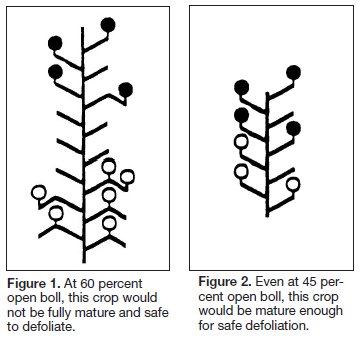
Cotton defoliation is a sensitive process. For a successful harvest, defoliation must be carefully timed and carried out. Poor defoliation can lower fiber quality, while defoliating too early lowers yield and micronaire. Defoliating too late increases the likelihood of boll rot and lint damage or loss due to weathering. Late defoliating also increases the possibility that defoliant activity will be inhibited by lower temperatures.Many people use the rule that it is safe to defoliate cotton when about 60 percent of the bolls are open. Although this strategy may work well in most situations, defoliation errors may occur where the crop is set more quickly or more slowly than normal. Figure 1 shows a fruiting "gap" that may occur in a crop set over a long period. The gap is caused by fruit loss due to stress or insect pressure at peak bloom. This type of crop may have a high proportion of immature bolls at 60 percent open. Defoliation at this time would cut short the development of the top bolls and lower yield and micronaire. On the other hand, Figure 2 shows a crop that is set in a short period, such as 3 weeks. This crop could safely be defoliated at 40 to 50 percent open boll.
The safest way to determine when to defoliate is to choose the bolls you intend to harvest and to make sure that those bolls are mature. Bolls need 40 to 60 days from setting (flower pollination) to mature, depending on the temperature. In cool weather, bolls will need extra time. A boll that is set in July or early August will mature in about 40 to 45 days, while a boll set in late August or early September may require about 50 to 60 days.
As you walk each field, examine the bolls you intend to harvest to determine if they are mature. The younger bolls will be those toward the top and outer portions of the plant. Bolls are mature enough for defoliation when
- They are hard (when squeezed) and difficult to slice in cross sections with a sharp knife. The fibers should string out when the boll is cut. If the fibers do not string out, the boll is not mature.
- The seed coat is a light brown color and the kernel completely fills the seed cavity with no jelly in the center. The seed coat is a pearly white in young bolls and turns from white to black as the boll matures. When the seed coat becomes light brown, the boll is mature enough to tolerate harvest-aid chemicals.
Another method of evaluating crop maturity is termed "nodes above cracked boll" (NACB). This involves searching the plant for the uppermost cracked boll (already cracked when found) on the first fruiting position. Bolls located 4 to 5 nodes above this point are generally considered mature, and defoliation at that time should not decrease yield or lint quality. Growers should find the uppermost first position boll they expect to harvest and make sure there is not more than 4 to 5 nodes below it to a cracked or open boll. Otherwise, cotton yield and quality may be lowered by defoliation.
A significant increase in the percentage of harvested cotton that is stored in modules has made good defoliation even more important than for cotton that is stored in wagons.
Moduled seed cotton should not exceed 7 percent moisture. Green leaves and other high-moisture plant tissue cannot be moduled without decreasing lint quality.
Coordinate defoliation with picker availability. In general, you should defoliate only the number of acres that can be harvested in about 12 days. Time your defoliant applications so that harvesting can keep up with defoliation. Defoliating excess acreage can decrease yields and expose lint to weather more than necessary. When harvesting capacity is low for the acreage involved, consider starting before the crop can be once-over harvested and plan to scrap or second-pick the acreage picked during the first week of harvest. This may improve grades and prevent losses if unfavorable weather should shorten the harvest season.
Cool temperatures at the time of application and for the next 3 to 5 days can retard the activity of defoliants and cause less-than-desirable defoliation. If possible, do not apply defoliants during cool snaps. Better defoliation will occur if you can wait for a warm period that is predicted to last at least 3 to 4 days.
Defoliation is not always justified. Cotton that is completely cut out with tough leaves may not need defoliation if harvested with care and ginned immediately. In this situation, it is important not to pick too early or too late in the day to avoid excess moisture. Producers considering picking without defoliation should pick a trailer full and see how well it cleans up at the gin. If the gin can clean the lint so it would grade a 41 or better, defoliation may not be needed.
Types of Defoliants
Defoliants fall into two general types: those with herbicidal activity and those with hormonal activity. Def, Folex, Aim, Blizzard, ET, and Resource are herbicidal defoliants that injure the plant, causing it to produce ethylene in response. Ethylene promotes abscission, or leaf drop. If these defoliants are applied at rates too high for the existing temperature, the plant is killed too quickly, before ethylene can be produced. This results in desiccation or leaf stick instead of leaf drop.Thidiazuron (Dropp, etc.) and ethephon (Prep, etc.) are hormonal defoliants that cause the plant to produce more ethylene. Ethephon releases ethylene, which stimulates further ethylene production in the plant. The increase in ethylene causes abscission zones to form in the boll walls and leaf petioles. The abcission zone is the point at which the plant tissues dissolve, allowing the fruit to open or leaf to fall from the plant. Thidiazuron is a type of hormone called cytokinin. In most plants, cytokinins promote leaf health. However, in cotton and related species such as velvetleaf, cytokinins promote the production of ethylene and act as a defoliant. Because these hormonal defoliants do not cause the injury that the herbicidal type does, they rarely cause desiccation.
Defoliation Materials
Sodium chlorate. Sodium chlorate is not generally used as a defoliant on spindle-type picked cotton. Leaf sticking may occur with high application rates, and at normal rates it is usually not as effective as other defoliants. It is not a strong inhibitor of terminal regrowth, and it is not very effective on young, immature leaves. It is used most in Alabama to defoliate older mature leaves under cold conditions. DO NOT mix sodium chlorate with surfactants, oils, insecticides, other defoliants, or ethephon.Def 6 and Folex. These phosphate-type materials have been standard defoliants for several years in Alabama. Their performance is essentially equal, and they provide effective, economical defoliation over a wide range of environmental conditions. These materials are very effective in removing mature leaves, but they do not inhibit regrowth. These materials are more effective on young immature leaves than sodium chlorate, but they are less effective than thidiazuron. Leaf removal is rapid, and a rain-free period of 2 hours is sufficient for phosphate-type defoliants. The use of surfactants and crop oil has enhanced the performance of these materials only under very adverse (cold) conditions.
Thidiazuron (Dropp, etc.) Thidiazuron products provide defoliation for mature leaves essentially equal to that of the phosphate-type defoliants. These products can also provide excellent removal of juvenile growth and are strong inhibitors of terminal regrowth. They act more slowly than the phosphate materials and are more sensitive to cool weather. When night temperatures fall below 60 degrees F, less than desirable defoliation can result. Tank-mixing with petroleum-based crop oils, methyl parathion, phosphate defoliants, or ethephon will enhance defoliation during cool conditions. DO NOT use a crop oil concentrate when thidiazuron is tank mixed with a phosphate insecticide, Def, Folex, or ethephon. Thidiazuron requires a 24-hour rain-free period. The addition of 2 to 4 ounces of Def or Folex will reduce the rain-free period required by thidiazuron alone. Follow all label instructions for tank cleanup when using these products. Failure to follow these instructions may cause premature defoliation of cotton when the sprayer is used on young cotton the following year. When tank-mixing thidiazuron with organophosphates (phosphate insecticides, Def, or Folex) the use of ½ percent non-ionic surfactant is recommended to improve tank clean-out and overall defoliation. A minimum of 0.1 pound per acre of thidiazuron will provide regrowth control for a short period (10 to 14 days). Higher rates are needed for longer periods of regrowth control.
Ginstar (thidiazuron plus diuron). This combination product contains its own adjuvant system. It provides good defoliation and regrowth suppression over a wide range of environmental conditions.
Aim, Blizzard, ET, Resource (PPO inhibitors). These low-use rate products provide defoliation activity over a wide range of environmental conditions. To obtain regrowth control and boll opening they must be mixed with other harvest-aid materials. Use rates are 2/3 to 2.0 fluid ounces per acre except for Resource, which is generally 4 to 8 fluid ounces.
Boll-Opening and Combination Materials
Boll-opening materials are often used in combination with defoliation materials to increase the percentage of the crop harvested during the first picking or to possibly eliminate the need for a second picking. Boll maturity is very important when using a boll-opening material. Lint micronaire and strength can be adversely affected if immature bolls are opened. In certain years, cotton micronaire is improved by mixing higher-micronaire cotton from the bottom of the cotton plant with lower-micronaire cotton from the top of the plant. Picking capacity, the number of unopened bolls, and the cost of second picking determine if boll opening is economical.FirstPick (ethephon plus tetraoxosulfate). This is a combination product that provides boll opening and defoliation activity. Regrowth control can be obtained by mixing FirstPick with thidiazuron or Ginstar. The addition of a defoliant such as thidiazuron or Ginstar may increase overall performance. Higher rates and/or mixtures should be used in cooler weather and on rank cotton.
Ethephon (Prep and other trade names). Ethephon stimulates boll opening by increasing the production of ethylene, which normally occurs at boll opening. Mature bolls will usually open 10 to 14 days after application. However, boll opening depends a great deal on application rate and temperature. Therefore, best results are obtained when ethephon is applied when night temperatures are above 60 degrees F. Day temperatures between 65 degrees F and 75 degrees F will require twice the rate of ethephon to produce the same speed and degree of boll opening as an application made at temperatures between 85 degrees F and 95 degrees F.
Deciding whether ethephon is necessary for boll-opening purposes is often difficult. When making such a decision, it is helpful to consider that ethephon plus defoliant mixtures usually give sufficient defoliation for harvest after 7 to 10 days. In addition, ethephon usually doubles the number of green bolls that will open within 10 to 14 days after treatment. If harvest is delayed longer than 14 days after treatment, the advantage of ethephon is often reduced. Demonstration work conducted in Georgia suggests that a crop of about 20 green bolls per 10 feet is needed to justify the expense of ethephon as a boll opener. Of these 20 bolls, about 6 would be expected to open naturally and another 6 or 7 would be opened within 7 to 14 days by ethephon. The remaining 8 bolls will probably not open until later. Therefore, a crop with 25 to 50 green bolls per 10 feet is a more likely candidate for ethephon treatments.
Ethephon can be applied with other defoliants or in a second treatment after leaf drop has occurred. If the bolls you wish to open are under a canopy of leaves, apply the ethephon after defoliation to ensure coverage of these bolls.
Although ethephon is not labeled as a defoliant, it does have some defoliant activity. Ethephon has provided satisfactory defoliation at the high rate of application (2 pounds a.i. per acre) under optimum conditions on well-matured cotton. The addition of ethephon at lower rates with other defoliants has been reported to increase the degree of defoliation under adverse conditions. Although it is compatible with most defoliants, ethephon should never be mixed with sodium chlorate (produces chlorine gas).
Finish (ethephon plus cyclanilide). This is a combination product that provides boll opening and defoliation activity with moderate regrowth control. Additional regrowth control can be obtained by adding thidiazuron or Ginstar to the spray mix. The addition of a phosphate defoliant (Def/Folex) will increase defoliation in cooler weather.
Paraquat (Gramoxone, etc.) Paraquat has been used to open mature bolls by causing outside boll injury, which leads to boll cracking and opening. It is generally used when weather conditions are cool and bolls are fully mature. During cool conditions, paraquat can be mixed with the phosphate materials or sodium chlorate. At least 80 percent of the bolls should be opened before application. Development of immature bolls will be inhibited. Paraquat is normally used at lower rates (see label) in warmer weather and when cotton is at least 60 percent open.
Additives
Accelerate (0.52 pounds per gallon endothall concentrate) can be added to Def 6 or Folex at 1.5 pints per acre to increase leaf drop by approximately 25 percent during the first few days of defoliant activity. This may allow an earlier application of ethephon to open bolls when early harvest is important. Because total leaf drop after 7 to 10 days has generally not been improved with Accelerate, the use of the defoliant alone may be preferred if early harvest is not important. The addition of ammonium sulfate at 2 pounds per acre plus crop oil concentrate at 1 pint per acre to thidiazuron and Def/Folex has resulted in better defoliation, especially under cool conditions.Desiccants
Sodium chlorate, paraquat. Desiccants are generally not used as harvest-aids for cotton harvested with spindle-type pickers. If desiccation is necessary because of regrowth or weeds, it is best to apply a defoliant, wait until leaf drop occurs, and then apply the desiccant. Desiccants can kill the entire plant and burn immature bolls. Therefore, 90 percent of the crop should be open before applying a desiccant. Plan to pick within 7 days to avoid possible bark contamination. Harvest-Aid Tank Mixtures The application of a single defoliant may be more economical than defoliant mixtures and can result in satisfactory defoliation. However, under less than desirable conditions, mixtures are likely to provide more desirable defoliation. For example, Def/Folex can be used in combination with thidiazuron or ethephon. Defoliant selection should be based on whether juvenile growth needs to be defoliated, the need for regrowth control or boll opening, and the temperature at and following application. Under some circumstances, one harvest aid may not provide all of the desired characteristics and so mixtures will be desirable. A list of products and their characteristics is shown in Table 1.
Table 1. Harvest-Aid Performance When Used at Labeled Rates
| Material | Estimated Minimum Daily Temperature for Optimum Performance | Defoliation | ||
| Mature Leaves | New Growth* | Regrowth Prevention | ||
| Thidiazuron (Dropp, etc.) | 60 degrees F | Excellent | Excellent | Excellent |
| Def 6 or Folex | 55 degrees F | Excellent | Good | Poor |
| Aim, Blizzard, ET Resource | 55 degrees F | Excellent | Good | Poor |
| Ethephon 6 Products | 60 degrees F | Good | Fair | Poor |
| Ginstar | 60 degrees F | Excellent | Good | Excellent |
| Finish | 60 degrees F | Excellent | Excellent | Fair |
| FirstPick | 60 degrees F | Excellent | Good | Fair |
| * Juvenile growth that is present when defoliants are applied | ||||
Special Defoliation Problems
Defoliating Rank Cotton. How to defoliate rank cotton is always a hard decision. Producers often have to decide whether to defoliate early in an effort to save the bottom crop and lose the top crop or to wait for the top crop to develop before defoliating. Producers who wait for rank cotton to finish a top crop may very well lose much of the bottom crop to boll rot, especially if wet weather occurs.A common tendency when defoliating rank cotton is to use high rates of defoliants in an effort to try to cover and defoliate the entire plant. Def and Folex labels suggest high rates for defoliating rank cotton. The problem with this approach is that the high rates of defoliants will tend to stick the leaves, especially on the top of the plant where most of the defoliant is intercepted. The safest approach is to apply defoliants at the same rate you would use under the same crop and weather conditions if the cotton were not rank. A second application may be necessary to defoliate the bottom portion of the crop.
Some producers may consider bottom defoliation using ground equipment in an attempt to decrease losses to boll rot in extremely rank cotton. The idea is to remove enough leaves from the middles to allow air movement and light penetration. Some research indicates that bottom defoliation can do more harm than good by mechanically injuring bolls and stems, resulting in increased chances for boll rot.
Defoliating Weedy Cotton. A weedy cotton field can present unique problems that standard defoliation practices cannot handle. Weeds not only interfere with harvest options, they can also stain lint and almost certainly increase the trash content of harvested bolls. To prevent lint staining, all weeds should be dried down before picking begins. However, the cotton crop must also be defoliated.
Research in Alabama and other southeastern states has shown that annual morningglory vines wrapped around cotton can be defoliated or desiccated using Aim, Blizzard, ET, or Resource in combination with ethephon. Glyphosate (Roundup, etc.) can be used to dry down grass weeds. Morningglory vines should be mature before this mixture is applied. Sodium chlorate or a desiccant such as Starfire can also be used to dry down-weeds a few days before anticipated harvest. Observe all precautions described in the "Desiccants" section.
Defoliation of Drought-Stressed Cotton. Drought-stressed cotton often has leaves that are thick and leathery, which may affect the plants�f ability to take up the defoliant. However, growers are advised not to use high rates of phosphate defoliants (Def/Folex) or complex mixtures. Mixtures of Def or Folex and thidiazuron at standard rates have worked well in the past under these conditions.
Regrowth Control. Regrowth is most likely to be a problem on cotton that has adequate moisture and excess nitrogen. Controlling potential regrowth with thidiazuron is more effective than reapplying defoliants after regrowth has occurred. Reapplication of defoliants is permitted, but it often provides less than desirable results due to poor coverage of small leaves and continuing emergence of new leaves. Desiccants can be used to eliminate unwanted regrowth. They should be applied at the earliest possible date to keep new leaves from growing large enough to decrease grade. Def/Folex plus thidiazuron, Ginstar, Finish, and the PPO inhibitors are treatments that show potential for removing regrowth.
Defoliation, Desiccation, and Boll Opening in Ultra Narrow Row Cotton. Ultra narrow row cotton (UNR) is generally described as cotton grown in row spacings of less than 30 inches. Row spacings of 7 to 20 inches are common and cotton is harvested with a stripper.
Since stripper harvest is a once-over operation, excellent leaf removal and boll opening are essential. Excessive vegetation can greatly affect stripper efficiency and cause "barky" cotton grades.
It is generally recommended that two harvest-aid applications be applied before harvest. A combination of defoliant plus boll-opening material should be applied when the cotton is at least 60 percent open. Allow time for boll-opening compound to open most bolls (minimum 10 to 14 days). About 5 to 7 days before harvest, apply a desiccant to dry stems and green leaves and to open the remaining bolls. With UNR cotton it is critical to time defoliation and desiccation with harvest to avoid excessive regrowth.
Defoliation Application
Coverage is very important when applying defoliants and harvest aids. Spray volumes of 10 to 20 gallons per acre are generally recommended to thoroughly cover the cotton leaves. While higher spray volumes are convenient, water is the cheapest thing you can add to enhance defoliation.Nozzle selection is also very important in defoliation. Drift-reduction nozzles are now very popular and are used when applying several herbicides. However, the larger droplets from these nozzles mean less leaf area is covered. Using drift-reduction nozzles with low pressure and low volumes can lead to defoliation problems in cotton. Flat-fan and hollow cone nozzles provide excellent spray coverage of defoliants and harvest aids. Always match nozzle sizes to pressure and volume recommendations listed by the manufacturer.
Defoliation by Aircraft
Successful defoliation by airplanes requires a uniform swath width and coverage of each leaf. The use of well-trained flagmen or permanent markers will keep uniform swath widths and result in more uniform defoliation. Typical swath widths for popular agricultural aircraft are listed in Table 2.
Table 2. Typical Aircraft Swath Widths
| Aircraft | Wing Span | Swath Width | |
| 5 GPA | 10 GPA | ||
| Air Tractor | 45'5" | 55' to 65' | 50' to 60' |
| Ag Cat A | 39'1" | 40' to 50' | 40' to 50' |
| Ag Cat B | 42'3" | 45' to 55' | 45' to 55' |
| Cessna | 42'8" | 45' to 55' | 45' to 55' |
| Thrush 600 | 44'5" | 55' to 65' | 50' to 60' |
Thorough coverage by air requires a finished spray volume of 4 to 12 gallons per acre. Coverage depends on spray droplet size, atmospheric conditions, and the amount of foliage. In general, smaller spray droplets provide better coverage and canopy penetration but are more likely to drift in windy conditions or evaporate in high-temperature, low-humidity conditions. Larger spray droplets reduce drift and evaporation but provide less coverage and canopy penetration. Medium-sized droplets by disk and core-type hollow cone nozzles with #8, #10, and #12 disks or #46 and #56 cores are recommended. These nozzles should be turned down and 45 degrees back on 100- to 120-mph aircraft and straight back on 120- to 150-mph aircraft. Removing nozzles from at least the outer 20 percent of the aircraft wing is recommended to reduce drift. Higher finished spray volumes improve coverage and give more thorough defoliation, especially on large plants with lush foliage.
Cropping Restrictions With Defoliants
Most cropping restrictions, with major row crops, following defoliants and harvest aids are generally short. Read label restrictions especially if planting a cover crop following cotton. Research in Alabama has shown that clover stands may be reduced if planted too closely following a thidiazuron defoliation application.Applying Defoliants
Good spray coverage is essential for optimum harvest-aid performance. Only the leaves and/or bolls that receive spray coverage are affected. Research in Alabama and other states has shown that spray volumes of 10 to 20 gallons per acre give better defoliation than lower spray volumes.
Harvest-Aid Rates
Boll Openers and Combination Products
It may be desirable to accelerate the opening of mature cotton bolls in order to harvest earlier or for a once-over harvest operation. Ethephon has been shown to accelerate the opening of bolls and enhance defoliation. Immature bolls will also be affected, and, depending on the stage of maturity, fiber may be immature, seed quality lower, and yield reduced. Application should not be made until sufficient mature, unopened bolls have developed to produce the desired yield of cotton. Cool, damp conditions occurring within 48 hours before or after treatment may severely inhibit the effectiveness of ethephon.| Trade Name (Product/A) | Common Name (Rate a.i./A) | Application Instructions |
| Ethephon 6 (Prep, etc.) (1¹/3 to 2²/3 pt) | ethephon (1 to 2 lb) | Apply in 5 to 50 gallons of water per acre when 40 to 60 percent of the bolls are open and when there are sufficient mature unopened bolls to produce the desired yield. Ethephon can be used 4 to 7 days before application of defoliants as a preconditioning agent, tank-mixed with defoliants, or applied after defoliation. Rank cotton will often require defoliation before ethephon application to obtain good spray coverage of bolls. DO NOT harvest cotton within 7 days after ethephon application. DO NOT mix ethephon-containing products with sodium chlorate products since toxic chlorine gas fumes will be produced. |
| Finish 6 (1.3 to 2.0 pt) | ethephon plus cyclanilide | |
| FirstPick (3.5 to 5.2 pt) | ethephon plus tetraoxosulfate | |
| Gramoxone Inteon Firestorm Paraquat Concentrate | paraquat | Apply to speed the opening of mature bolls at low rates (according to product, see label) in combination with Def, Folex, or thidiazuron. Refer to product label for rates, directions, limitations, andprecautions. |
DefoliantsThe chemicals listed below are registered for use as defoliants. They will defoliate cotton but will not kill the stalk under normal use. Some regrowth will occur with all of these products. | ||
| Trade Name (Product/A) | Common Name (Rate a.i./A) | Application Instructions |
| Aim 2EC + Crop Oil Concentrate (1% v/v) (1 to 1.6 oz) | carfentrazone-ethyl | Provides defoliation only when used alone. Make application when 60 to 70 percent of the bolls are open or according to Extension System recommendations. Use a crop oil concentrate at 1 percent v/v (1 gallon per 100 gallons of spray solution). May be applied as a tank mix with other cotton harvest-aids or in sequential application. Provides dessication of mature morningglory vines. |
| sodium chlorate (See label for rates.) | sodium chlorate with fire suppressant (3 to 3¼ lb) | Apply to mature cotton plants after the youngest bolls expected to make cotton are at least 30 days old. DO NOT apply later than 7 days before harvest or mix with ethephon. With ground equipment use 10 to 20 gallons of spray solution per acre and by air use 5 to 10 gallons per acre. |
| Def 6 or Folex 6 (1 to 2 pt) | phosphoro-trithioate (¾ to 1½ lb) | Def or Folex should be applied 7 to 10 days before anticipated picking. Use the low rate when the crop is mature and the weather is warm. When plants are still green and actively growing, when the temperature is cool, or when the weather is dry, use higher rates or a tank-mix with another defoliant. Spray mix of 5 to 25 gallons per acre should be applied. |
| Thidiazuron SC (Dropp, etc.) (3 to 6 fl oz) | thidiazuron (¹/10 to ²/10 lb) | Product should be applied in 10 to 25 gallons of water per acre by ground equipment and 2 to 10 gallons per acre by air. Use higher rates during periods of low temperatures. Apply at least 7 days before picking. May be tank-mixed with Def, Folex, or ethephon. Rates as low as 2 ounces of product per acre may be used in tank mixes. Spray tanks should be cleaned immediately after use. A non-ionic surfactant or compatibility agent is recommended when using tank mixes of thidiazuron plus Def/Folex to facilitate cleanup. See label for more information. |
| Ginstar EC (0.4 to 1 pt) | thidiazuron plus diuron | |
| Blizzard (0.6 fl oz) +
Crop Oil Concentrate | fluthiacet | Provides defoliation only when used alone. Apply when 60 percent or more of the bolls are open AND there are no more than four nodes between the highest first position cracked boll and the highest first position harvestable boll. May be mixed with other harvest aid products. This product will help dessicate mature morningglory vines especially in combination with ethephon. |
| ET 0.2EC (1.5 to 2 fl oz) +
Crop Oil Concentrate | pyraflufen (0.0015 to 0.003 lb) | Apply when 60 to 70 percent of bolls are open alone or in combination with other harvest aides. Provides defoliation only when used alone. ET will help dessicate mature morningglory vines at harvest. |
| Resource (4 to 8 fl oz) +
Crop Oil Concentrate | flumiclorac (0.027 to 0.054 lb) | Apply with 1 to 2 pints crop oil concentrate per acre to cotton at least 60 percent open. Resource can be tank mixed with other harvest aides to increase boll opening or suppress regrowth. A sequential application may be made 7 days after the initial application at up to 6 fluid ounces per acre. |
DesiccantsDesiccants primarily dry plant tissue. These chemicals usually act so rapidly that leaves are killed and stick to the stalk so that defoliation does not occur. Desiccants are generally recommended in areas where cotton is harvested by strippers. In Alabama, they should be used only as a last resort to eliminate second growth. | ||
| Trade Name (Product/A) | Common Name (Rate a.i./A) | Application Instructions |
| Gramoxone Inteon (1 to 2 pt) or Firestorm Paraquat Concentrate (0.67 to 1.33 pt) | paraquat (¼ to ½ lb) | For use as a desiccant, apply when 80 percent or more of the bolls are open and the remaining bolls to be harvested are mature. DO NOT apply within 3 days before harvest. These products may also be applied with defoliants to hasten boll opening (see label for rates). Paraquat is a RESTRICTED USE pesticide. |
Defoliation/Boll-Opening Scenarios
Listed below are some defoliation situations typically encountered in Alabama. Defoliation rates and materials are suggested as guides for use under different weather situations. Other combinations may work equally well, but these are some of the more commonly used combinations.Drought Stress—Highs: 90 degrees F; Lows: 70 degrees F
Drought-stressed cotton leaves have thickened cuticles that often reduce penetration of defoliant materials. Usually, high temperatures will enhance leaf burn and can increase leaf sticking. Under these conditions, combinations of three or more materials often result in leaf sticking. Regrowth is usually a problem when rainfall occurs. Lower rates of the herbicidal defoliants should be used to reduce leaf burn, while higher rates of defoliants controlling regrowth may be needed because of reduced penetration into the cotton plant.Thidiazuron + Ethephon 6 2 to 3 fl oz + 1¹/3 pt Defoliation, regrowth control, boll opening
| Trade Name | Formulated Product/A | Action |
| Def/Folex | 1 to 1½ pt | Defoliation |
| Thidiazuron | 3 to 6 fl oz | Defoliation, regrowth control |
| Def/Folex + Thidiazuron | ½ to 1 pt + 2 fl oz | Defoliation, regrowth control |
| Def/Folex + Ethephon 6 | 1 to 1¹/3 pt + 1¹/3 pt | Defoliation, boll opening |
| Thidiazuron + Ethephon 6 | 1.5 to 2.5 fl oz + 1¹/3 pt | Defoliation, regrowth control, boll opening |
| Finish 6 + Def/Folex | 1 to 1¹/3 pt + 4 oz | Defoliation, boll opening |
| Ginstar | 6.5 oz | Defoliation, regrowth control |
| FirstPick | 4 pt | Defoliation, boll opening |
| Sodium chlorate* | 3 lb (Note: this is a.i./A) | Defoliation |
| * Under these conditions, sodium chlorate is less effective than other applications. | ||
|
Normal Cut—Out.Highs: 90 degrees F; Lows: 70 degrees FCotton with a good boll load, normal cut-out, and warm day and night temperatures generally defoliates well. Regrowth is often a problem, depending on boll load, soil moisture, and night temperatures after defoliation. | ||
| Trade Name | Formulated Product/A | Action |
| Def/Folex | 1½ pt | Defoliation |
| Def/Folex + Thidiazuron | 1 to 1½ pt + 2 to 3 fl oz | Defoliation, regrowth control |
| Def/Folex + Ethephon 6 | 1 to 1½ pt + 1¹/3 pt | Defoliation, boll opening |
| Thidiazuron + Ethephon 6 | 2 to 3 fl oz + 1¹/3 pt | Defoliation, regrowth control, boll opening |
| Ginstar | 6.5 oz | Defoliation, regrowth control |
| Finish + Ginstar | 1¹/3 pt + 3 oz | Defoliation, boll opening |
| PPO Grp* + crop oil + Ethephon | label rate + 1 pt + 1¹/3 pt | Defoliation, boll opening |
| FirstPick + Thidiazuron | 3 pt + 2 fl oz | Defoliation, regrowth control, boll opening |
Normal Cut—Out.Highs: 80 degrees F; Lows 60 degrees FCotton with a good boll load, normal cut-out, and warm day and night temperatures generally defoliates well. Good coverage is important, and higher rates of a herbicidal defoliant can generally be used. Regrowth may or may not be a problem, depending on boll load and night temperatures after defoliation. | ||
| Trade Name | Formulated Product/A | Action |
| Def/Folex | 1½ to 2 pt | Defoliation |
| Def/Folex + Thidiazuron | 1 to 1½ pt + 2 to 3 fl oz | Defoliation, regrowth control |
| Def/Folex + Ethephon 6 | 1 to 1½ pt + 1¹/3 pt | Defoliation, boll opening |
| PPO Grp + crop oil + Ethephon 6 | label rate + 1 pt + 1¹/3 pt | Defoliation, boll opening |
| Finish 6 | 2 pt | Defoliation, regrowth control, boll opening |
| Finish 6 + Def/Folex | 1¹/3 pt + 6 to 8 oz | Defoliation, boll opening |
| FirstPick | 4 pt | Defoliation, boll opening |
| Ginstar + Def/Folex | 4 to 6.5 oz + 1 to 2 pt | Defoliation, regrowth control |
| *PPO Grp=Aim, Blizzard, ET, or Resource | ||
|
Late Season—Highs: 60 to 70 degrees F; Lows: 50 degrees FFor best results, defoliation should be delayed until warmer weather occurs, if possible. | ||
| Trade Name | Formulated Product/A | Action |
| Def/Folex | 2 to 3 pt | Defoliation |
| Sodium chlorate | 4 lb (Note: a.i./A) | Defoliation |
| Finish 6 + Def/Folex | 1½ to 2 pt + ½ to 1 pt | Defoliation, boll opening |
| Finish 6 + Ginstar | 2 pt + 4 oz | Defoliation, boll opening, regrowth control |
| PPO Grp* + crop oil + Ethephon 6 | label rate + 1 pt + 1½ to 2 pt | Defoliation, boll opening |
|
Regrowth Removal | ||
| Trade Name | Formulated Product/A | Action |
| Ginstar | 3 oz | Defoliation |
| Aim + Crop Oil | 1 oz + 1% v/v | Defoliation |
Rotational Crop Restrictions
The application of some harvest aids in the fall can present problems for small grains and/or legumes planted immediately after cotton harvest. The following table shows label restrictions for recrop following harvest-aid applications. (There are no restrictions on other labeled products.)| Material | Recrop Interval Following Application for Small Grains and Legumes |
| Thidiazuron (Dropp, etc.) | 14 days |
| Ginstar | 30 days |
| Resource | 30 days |
| Ethephon (Prep, etc.) | 30 days |
| FirstPick, Finish | 30 days |
ANR-0715 Web Only, Revised September 2009. Charles Burmester, Extension Agronomist; C. Dale Monks, Extension Agronomist, Professor; and Michael G. Patterson, Extension Weed Scientist, Professor, all in Agronomy and Soils, Auburn University.
Use pesticides only according to the directions on the label. Follow all directions, precautions, and restrictions that are listed. Do not use pesticides on plants that are not listed on the label.
The pesticide rates in this publication are recommended only if they are registered with the Environmental Protection Agency or the Alabama Department of Agriculture and Industries. If a registration is changed or cancelled, the rate listed here is no longer recommended. Before you apply any pesticide, check with your county Extension agent for the latest information.
Trade names are used only to give specific information. The Alabama Cooperative Extension System does not endorse or guarantee any product and does not recommend one product instead of another that might be similar.
For more information, contact your county Extension office. Visit http://www.aces.edu/counties or look in your telephone directory under your county's name to find contact information.
Published by the Alabama Cooperative Extension System (Alabama A&M University and Auburn University), an equal opportunity educator and employer.
If you have problems loading this document, please email publications@aces.edu for assistance.