Steinheil-Munchen Culminar VL 85mm, f2.8 LTM
Steinheil-Munchen Culminar VL 85mm, f2.8 LTM
DIY CLA

Typical user sample with front element cleaning marks, mild haze and some dust specs. I shot a few frames and this was the best I got. I suspected the susceptibility to flare and muted colors (like the shot below) was due to the haze.

Before cleaning @ f4
Dismantling is pretty straight forward - remove the lens head from the focusing mount.
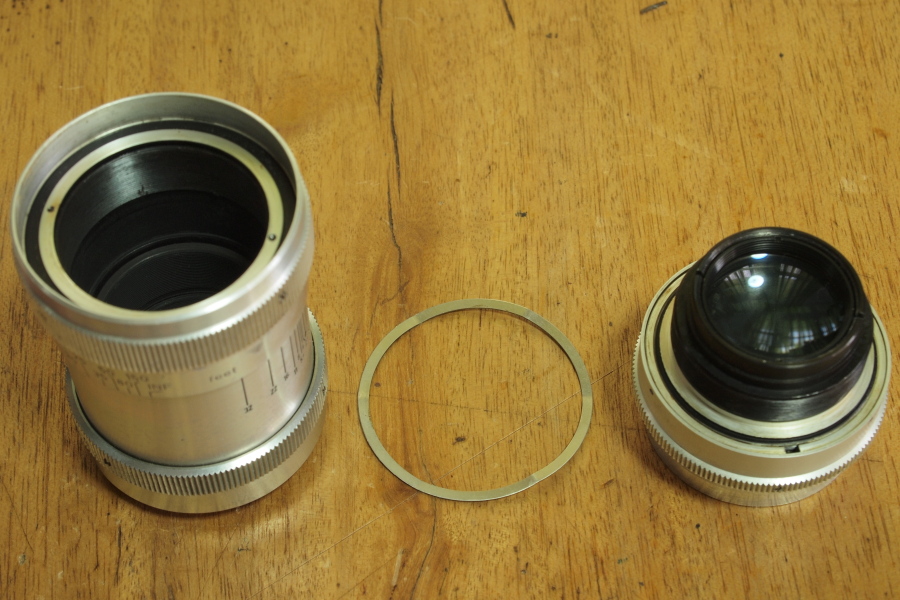
Rear element taken off

Cleaning the haze from the middle element

Front element off

Reverse the procedure for re-assembly

After cleaning @ f4

Steinheil LTM lenses were offered by Sears Roebuck in the 50s as cheaper alternatives to Nikkor for their Tower (Nicca) RF cameras.
Posted 31st May 2011 by JE
0
Add a comment
-
It is with great sadness that I learned of Art Dudley's demise. I was very honored when he gave me credit on the Altec 755C/Open Baffle article he wrote for Stereophile many years ago. Even if we never had the chance to meet, we had exchanged a few emails and private messages. Aside from being an audio and music lover, Art was a true gentleman!From one idler turntable enthusiast to another, here's to you Art!🍻
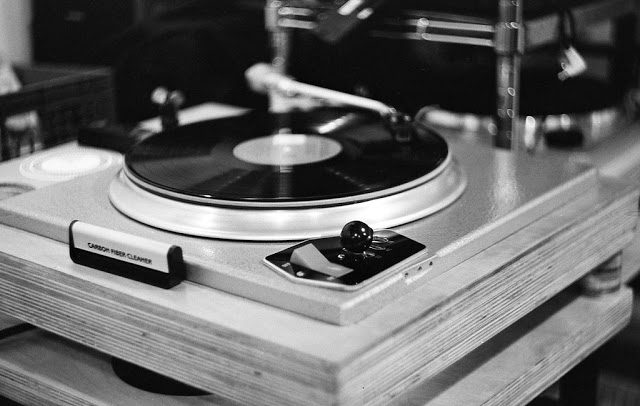 My first exposure to this "stick-shift" controlled turntable was back in the late 90s when Ding scored a Gates CB77 at a Hamfest for next to nothing. These broadcast units were still under the radar then and I was confident that I'd be just as lucky. But as time passed, I had to resort to the auction site to add one to my collection.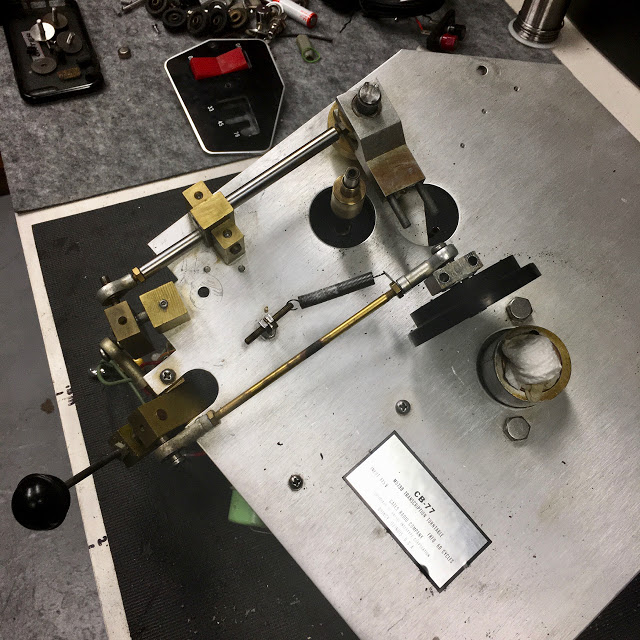
Drive train sub-chassis built on 1/8" aluminum plate Aside from the motor mounts which were showing signs of aging, my unit was mechanically sound.Replacing the motor mounts

remove motor bracket drill out rivets fresh rubber mounts
installed
from
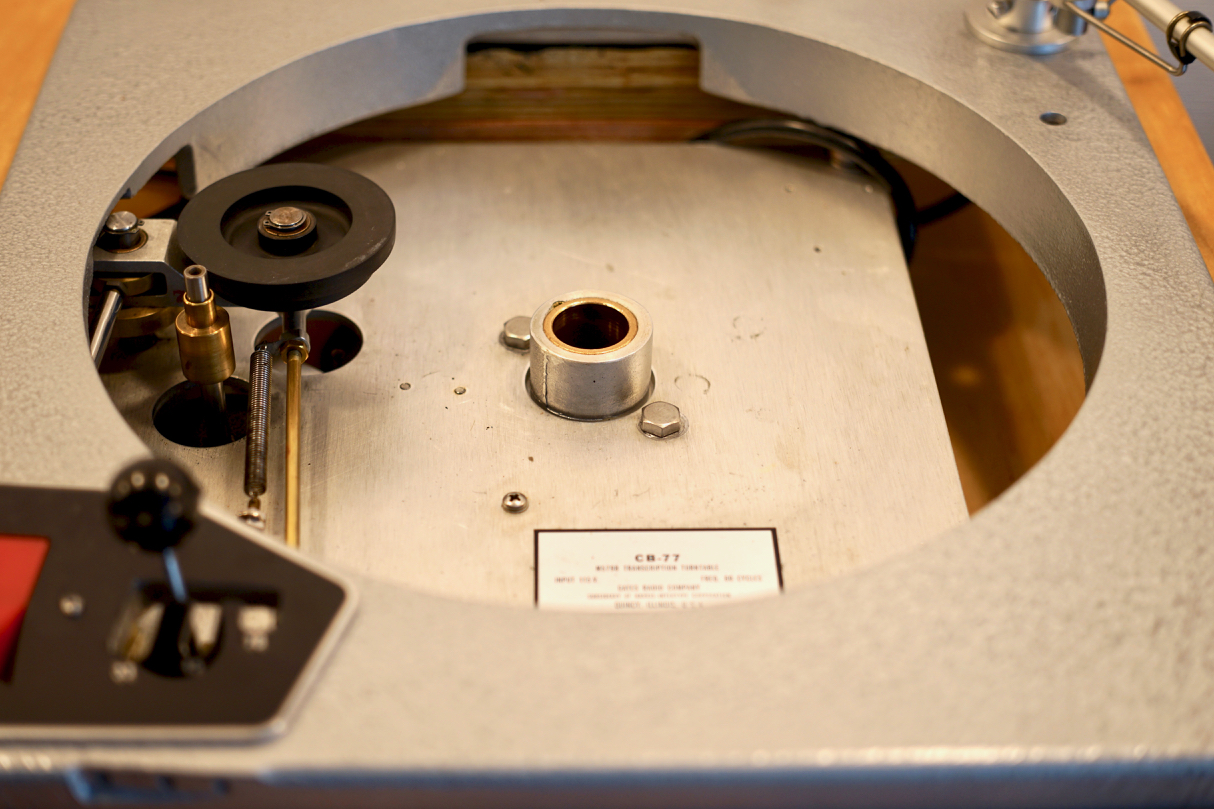
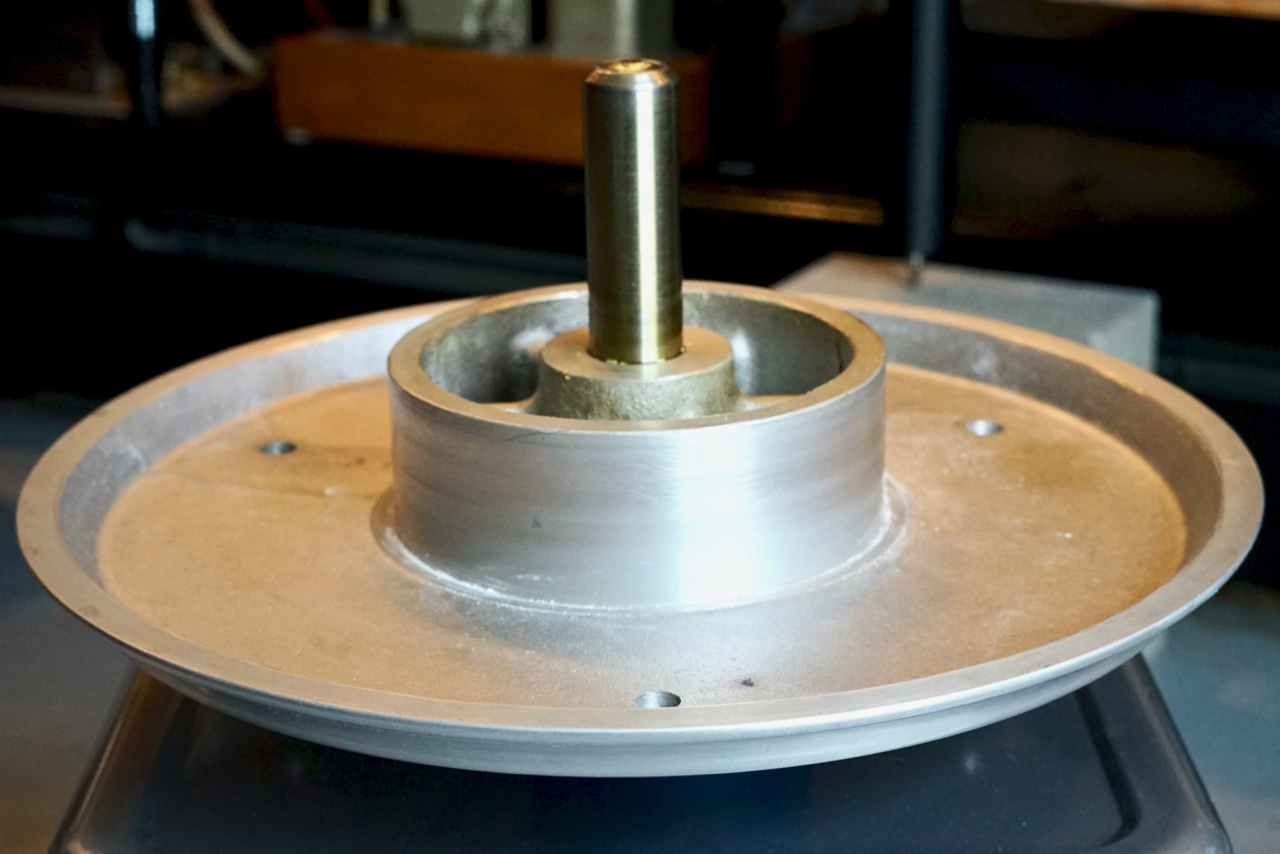
McMaster-CarrMy idler wheel was in excellent condition but it's always good to have a spare. I ordered an idler from Serge at Karmadon. Highly recommended!L = original idler, R = Karmadon idler Since the unit was already stripped down, I decided to repaint the chassis.1/4" thick cast aluminum chassis The heart of this machine is the mighty Ashland hysteresis motor also found in the top of the line Rek O Kut machines like the Rondine Deluxe B12H.CB77 Ashland motor However, due to the unconventional drive configuration (see the platter below), the Ashland motor is wired to turn at 600 rpm instead of the usual 1200 rpm.Drive train view with the platter off Compared to the more sophisticatedly engineered Garrard 301/401 and Thorens TD124/MkI-II, the Gates CB77 is a simpler machine. It utilizes a massive 1/4" cast aluminum main chassis. A rigid 1/8" sub-chassis plate carries the main drive train. The finely machined 1" main bearing slips into an Oilite sleeve. The heavy platter/inner hub is driven by a heavy-duty 3-phase Ashland hysteresis motor running in single phase mode.
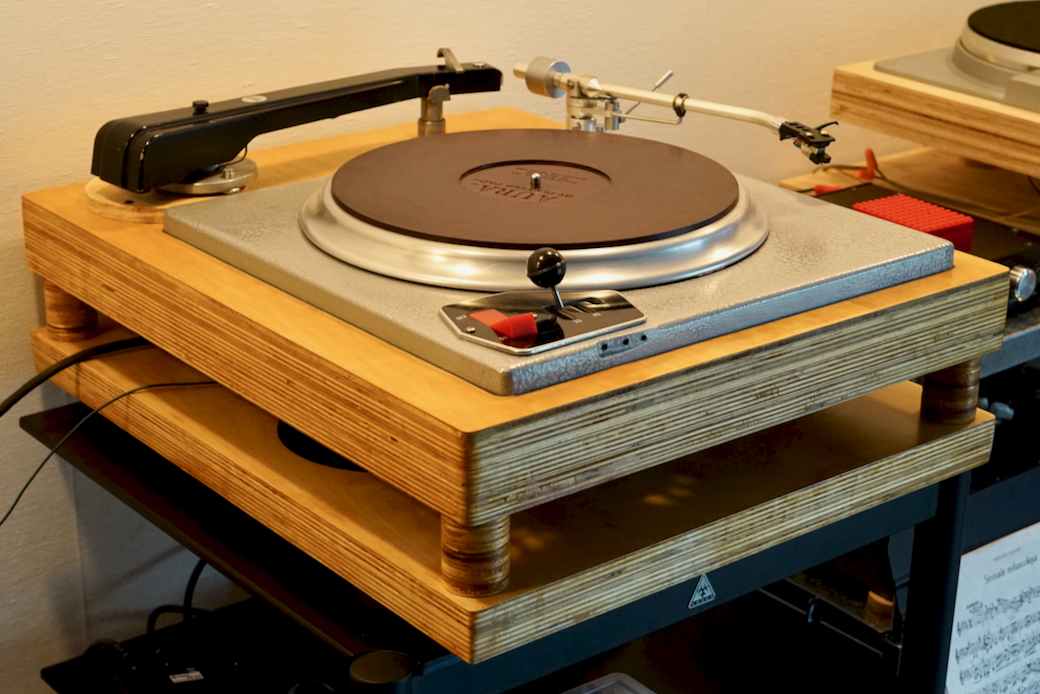
After following the required adjustments in the service manual, I mounted a Fidelity Research FR54 tonearm. I used it sans plinth for several months.Massive platter with the idler driven inner hub and 1" bearing Despite the lack of an eddy current brake/speed control, pitch stability is solid.Low frequencies go deep with excellent definition. This motor unit exemplifies the bold and powerful dynamic authority at micro and macro levels of well engineered idler driven turntables.I'm not sure if my DIY two-tier medium mass plinth improved its overall performance 🤔 given its already massive stature. Regardless, the option of mounting another tonearm like the Gray Research 108B currently installed, is indispensable for my purpose.😊 Since the design relies solely on rudimentary rubber motor mounts and mass to mitigate noise and vibration, it ultimately lacks the finesse of the Garrard 301/401 and Thorens TD124.Despite that, the value of this motor unit is on the rise. Its bigger brother, the 16" transcription CB500, has already broken the thousand dollar mark. Perhaps there are enough aficionados who really value the aforementioned dynamic authority over the black background of a high-end belt drive or the digital-like silence of a top-of-the-line direct drive.0Add a comment
-
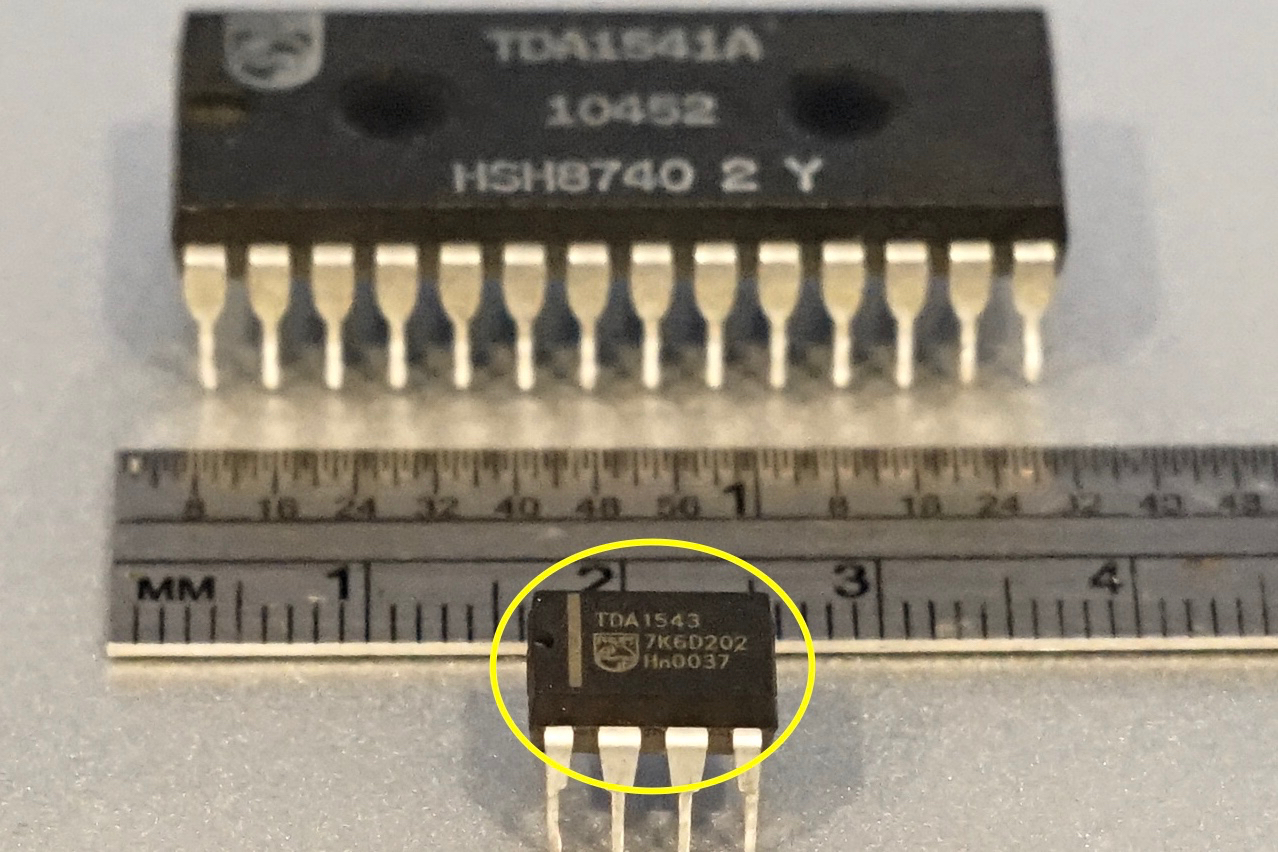
In spite of its humble origins, I praised the musical abilities of the Philips TDA1543 DAC chip found in late 80s to early 90s budget CD players. Below are two affordable (under $30) Non-OverSampling DAC boards I sampled that use this ubiquitous chip.
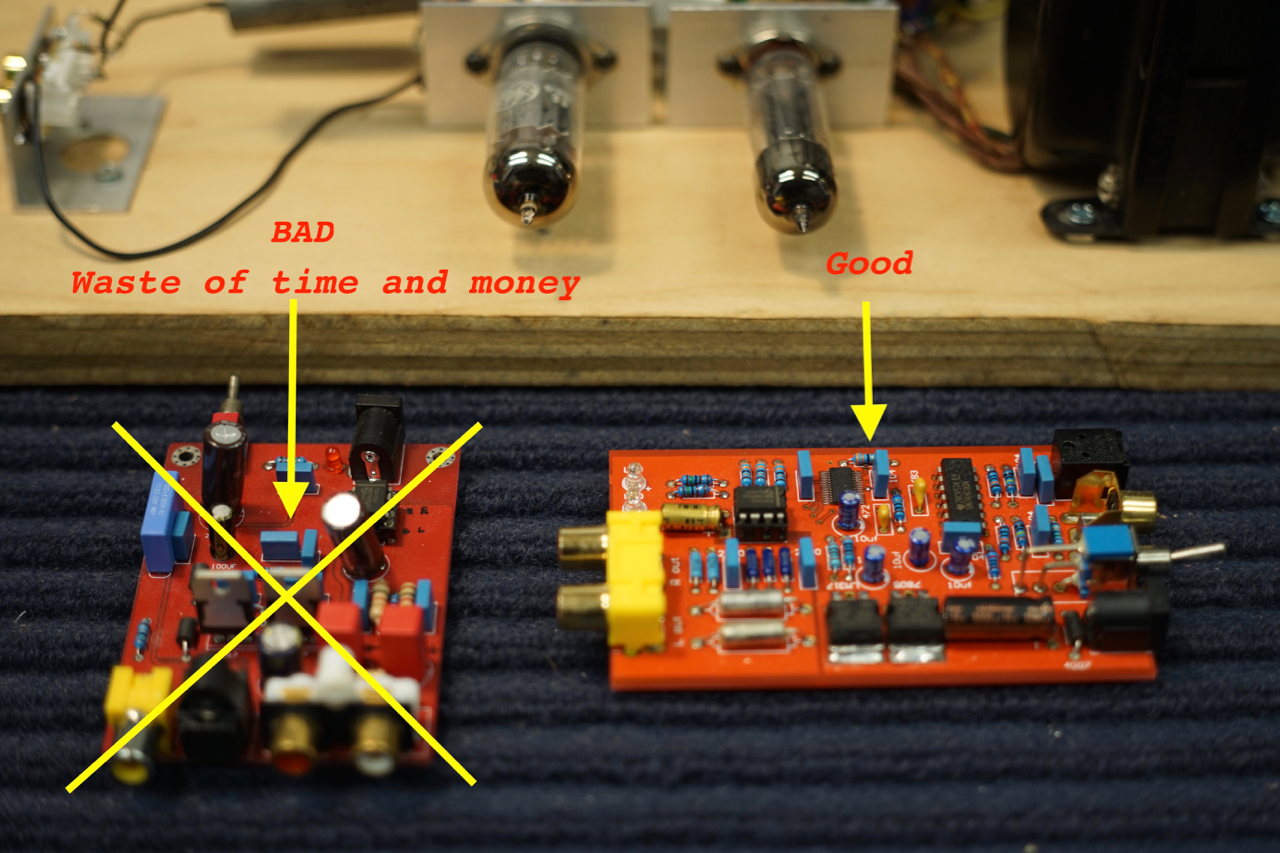
Non-Oversampling 16bit/44.1kHz TDA1543 DAC Boards Don't even consider the DAC board to the left, which can be found all over eBayfor $16-$20/shipped. Powered by this beefy linear wall wart PS, this is by far the worst-sounding DAC I ever heard! It has no redeeming qualities whatsoever. Enough said. 😣For another $10 + the same linear PS, the DAC board to the right is a decent music maker. Unfortunately, it went out of stock as soon as it was delivered to my doorstep. Even if the Muse Mini TDA1543x4 (more info) sounded dynamically more appealing, this single chip'd DAC board seemed harmonically purer and more authentic. In hindsight, I should have hoarded all the units offered by that lone seller. 😆!!!WARNING!!!
The voltages found in this circuit can be lethal! Build at your own risk!!!Tube Buffer Circuit (one channel) Since this TDA1543 DAC was configured with a passive I/V converter that already has a decent voltage output, I thought a med-mu 6CG7 tube buffer/cathode follower might mitigate the slight opaqueness in the midrange, improve both dynamics and the (lack of) definition in the frequency extremes - qualities which betray the budget origin of this rather musical DAC chip.The Ugly 😄 Even if the TDA1543 was [and always will be] a budget DAC chip, the experiment paid off, taking this NOS DAC board to another level. 😊Listen to lots of music, build a project or better yet, do both!
Stay safe! 🍻6View comments
-
The title is a tribute to James May's series on Amazon Prime. I've been a fan of this classically trained musician turned TV presenter, author, and journalist since his Top Gear UK days.👍
However, this blog entry isn't about cars, reverse engineering or fine wine. It's about the other man in Japan.😄JP in Akihabara
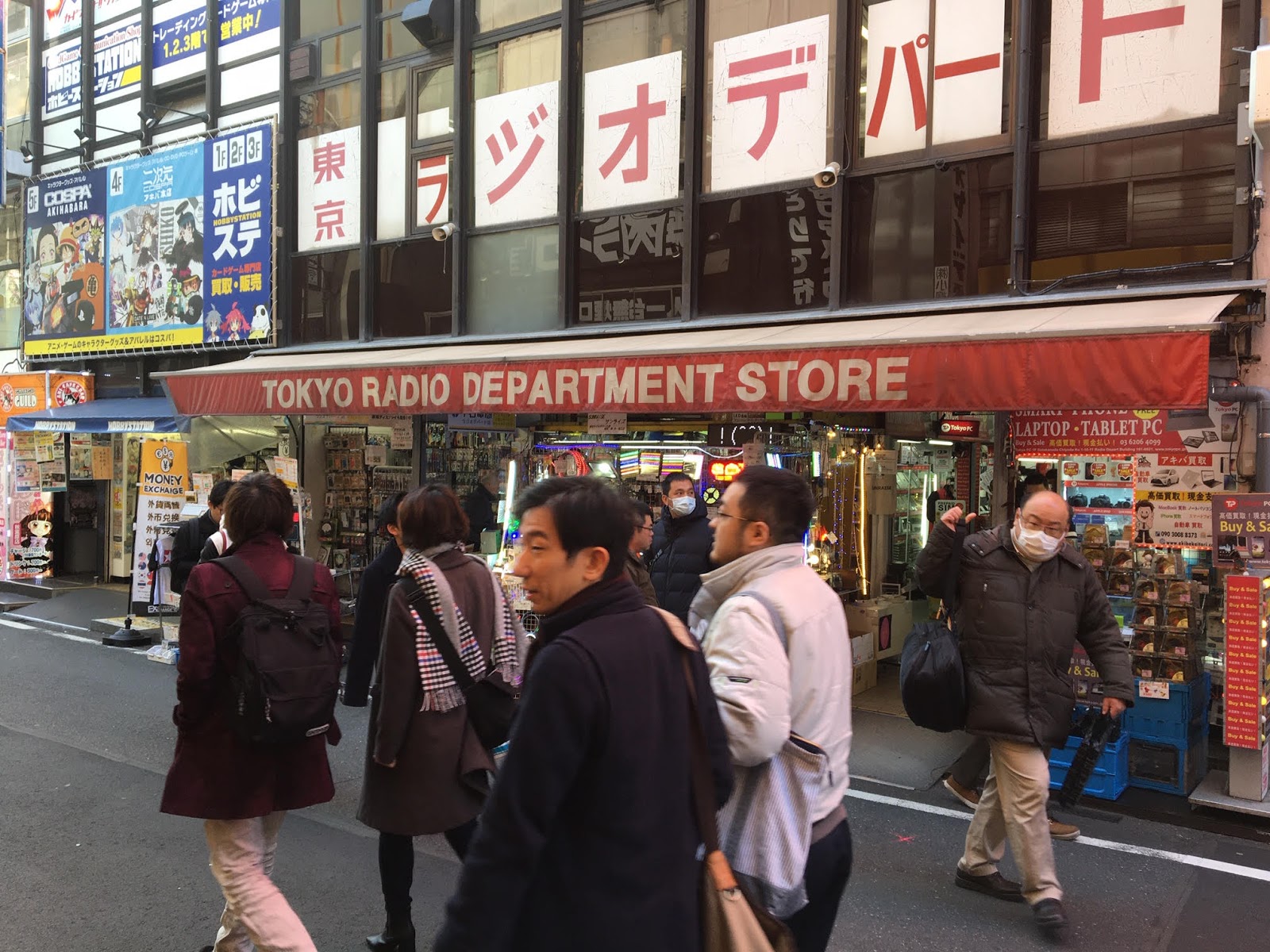
The man is John Piro. Right before the COVID-19 outbreak, he chronicled the Japanese audio hobby scene to share with us. This came as a timely follow-up to my Tokyo adventure almost half a decade ago.JP's view of the basement from the escalator in early 2020As I saw it in late 2015The former Noguchi stall in the basement is now occupied by General Transformer Sales Co. Ltd or Gtrans. Based on this, we can conclude that Power Max is the transformer manufacturer formerly represented by Noguchi and now distributed by Gtrans.Gtrans still has speakers and amplifier kits but the inventory is not as extensive as it was beforeFinemet and regular type Power Max transformers are still available but less models are stocked. Most Finemet models are now made to order.The auto-former volume control at the bottom shelf reminds me of a Teramoto I wired for a friend.Much less Hashimoto models, only a handful of old stock Tamura and no more TangoBut there's some good news. The recently reorganized ISO (ex-Tango ISO) transformer company is distributed stateside by TubeUSA.Take note, Gtrans is only open Tuesday - SaturdayAnother source of transformers across the street from Tokyo Radio Department Store under the rail road tracks is Kasuga Wireless.Kasuga Wireless has their own line and can also supply any Hashimoto model within a day's notice.JP's Jazz Kissa adventures
Western Electric 22 horn + Eltus TA 4181 woofer inside the WE753 style cabinetRCA Theater AmpsBut according to their website they also use an Eltus custom modified Altec 1567 preamp + Altec 1569A power ampTurntable: RCA 70DTonearm + Cartridge: Eltus modified Western Electric 5A + 9ALeft: Western Electric WE555 field-coil compression driver
Middle: Field Coil Power Supply
Right: Eltus 596 field coil super tweeterJP's Souvenirs
Thanks JP for the virtual tour! Glad you and Patricia got home safe!🍻2View comments
-
In the early 2000s, I spoke highly of the Shure M3D and M7D in retro cool tonearms and cartridges. Being an inveterate collector, I've acquired a couple more early stereo phono cartridges that came with turntables and tonearms I purchased in the ensuing years. I'm revisiting the two Shures in this long overdue follow-up and will compare them to a few more cartridges from the dawn of the stereo LP era.Front: Shure M3D
L > R: Pickering 380, Stanton 371, Empire 888, Shure M7DThe cartridges were evaluated in my main system and also in my audio playground. Turntables used include the Garrard 401, Gates CB77 and Sony TTS2500, fitted with the Audio Technica 1501-II, Fidelity Research FR64fx, FR54 and Grace G565 tonearms.Shure M3D and M7D
These two models were engineered from the same blueprint. While the M3D was manufactured to closer tolerances, the less stringently built M7D was marketed towards budget-conscious listeners. If forced to split hairs, I'll admit to hearing more refinement, better stereo separation, slightly better resolution and extension in the frequency extremes from the M3D. But in all honesty, I'd much rather enjoy their music-making abilities.Shure M3D
The key attribute of this cartridge design (which sadly Shure veered away from until they completely exited cartridge manufacturing in 2018) is its lifelike presentation of the midrange. I stand by my earlier assessment that these are the moving magnet equivalents of the Ortofon SPU.Shure M7D Empire 888
I'm not sure if the stylus in this cartridge body is an OEM or a generic replacement. But I deemed it was fair enough to include it in this survey since it tracked like a champ at a moderate 2 grams of Vertical Tracking Force (VTF) and subjectively, it offered a very smooth and probably the most extended treble response in this group. Even if this cartridge seems to already be shying away from a tonal balance that emphasizes the midrange, the tinge of midrange warmth was still most welcome!
Bass quality is very much in keeping with the overall character of this cartridge which is clean and well defined. In spite of this cartridge's very refined character, it lacks dynamic contrasts especially at micro and macro levels. I find myself cranking the volume control up for it to boogie but I still end up wanting more. Resolution of detail is at par with others in this survey while the slow transient response across the audio band, keeps it behind the others in this survey.Empire 888 Pickering/Stanton 371 and 380
Based on this ca. 1960 catalog pages, the 371 and 380 were marketed simultaneously by Pickering/Stanton. Despite both being Stereo Flux-valve (moving iron) designs, these stablemates sound diametrically opposed.
Except for the 4 gram minimum VTF, I thought I found a cartridge from the dawn of the stereo era in the 371 that would appeal to 21st century standards of neutrality, transparency, detail and resolution. There was a striking presence and immediacy from this cartridge. However, as I went through my favorite LPs, I detected peakiness from the upper midrange to lower treble which gave that fake analytically transparent vibe. Soon the upper midrange glare became very fatiguing, especially with female vocals. Further listening also confirmed a rapid roll off in response above that peak, which prevents the listener from getting a true sense of air and space.Stanton 371
My long time hamfest/radio show buddy, Larry R. clued me in to the 380 after reading my original article eons ago. This cartridge is not easy to set up due to its weird body shape. Fortunately, I had some threaded spacers and screws, which came with my Stanton 500. This facilitated installation on a modern IEC/SME type head-shell. Using an original red stylus tracking at 3.5 grams, this sounded warmer, smoother and sweeter than the M3D/M7D. The midrange is spacious, airy and the 3-dimensional presentation is quite beguiling, even more SPU-like! Mid to upper bass definition is at par with the two Shures. However, it rolls off earlier and doesn't possess as much heft and weight. In spite of its excellent handling of micro and macro dynamics, transient response is a tad slower.Pickering 380 Coda
The Pickering 380's 3-D midrange and refinement were definitely alluring. But if I were forced to choose between the 380 and the M3D/M7D, I'd sacrifice a bit of midrange refinement in favor of the better bass extension and dynamics offered by the two Shures. Although the Stanton 371 tried to leap far ahead of its time, to my ears, it had fatal flaws. On the other hand, the Empire 888 was forecasting what was to come, for better or worse.On another note, I'm happy to report that even after 20 + years, not one stereo LP from my collection has been harmed by the 2.5 to 4 gram VTF 😱 by my favorite stereo cartridges! 😁3View comments
-
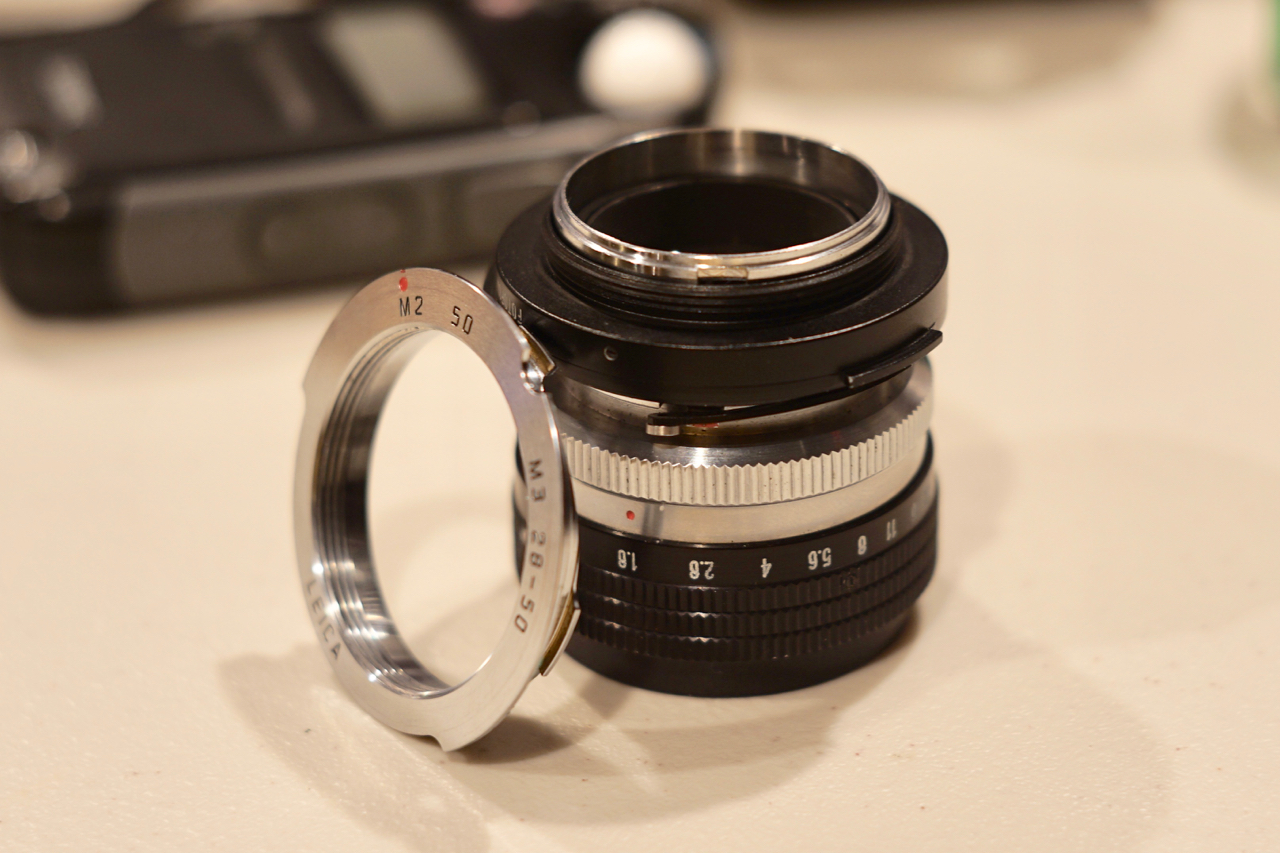
While shopping for a Contax RF inner-bayonet type > Sony E/NEX-mount adapter, I came across this Fotofox adapter which claimed RF coupling on Leica Thread Mount (LTM) compatible camera bodies.
The Good
Canon P + Fotofox CRF + Zeiss Opton Sonnar At about $60 landed in the USA, the Fotofox is a lot more affordable compared to the more deluxe Amedeo or Kipon equivalents. I'm glad to report that my gamble paid off. My Contax/Kiev RF mount 50mm lenses - Zeiss-Opton Sonnar, Jupiter 8M & Helios 103 - mounted successfully on my Bessa R, Canon P and 7s bodies.Bessa R + Fotofox CRF adapter
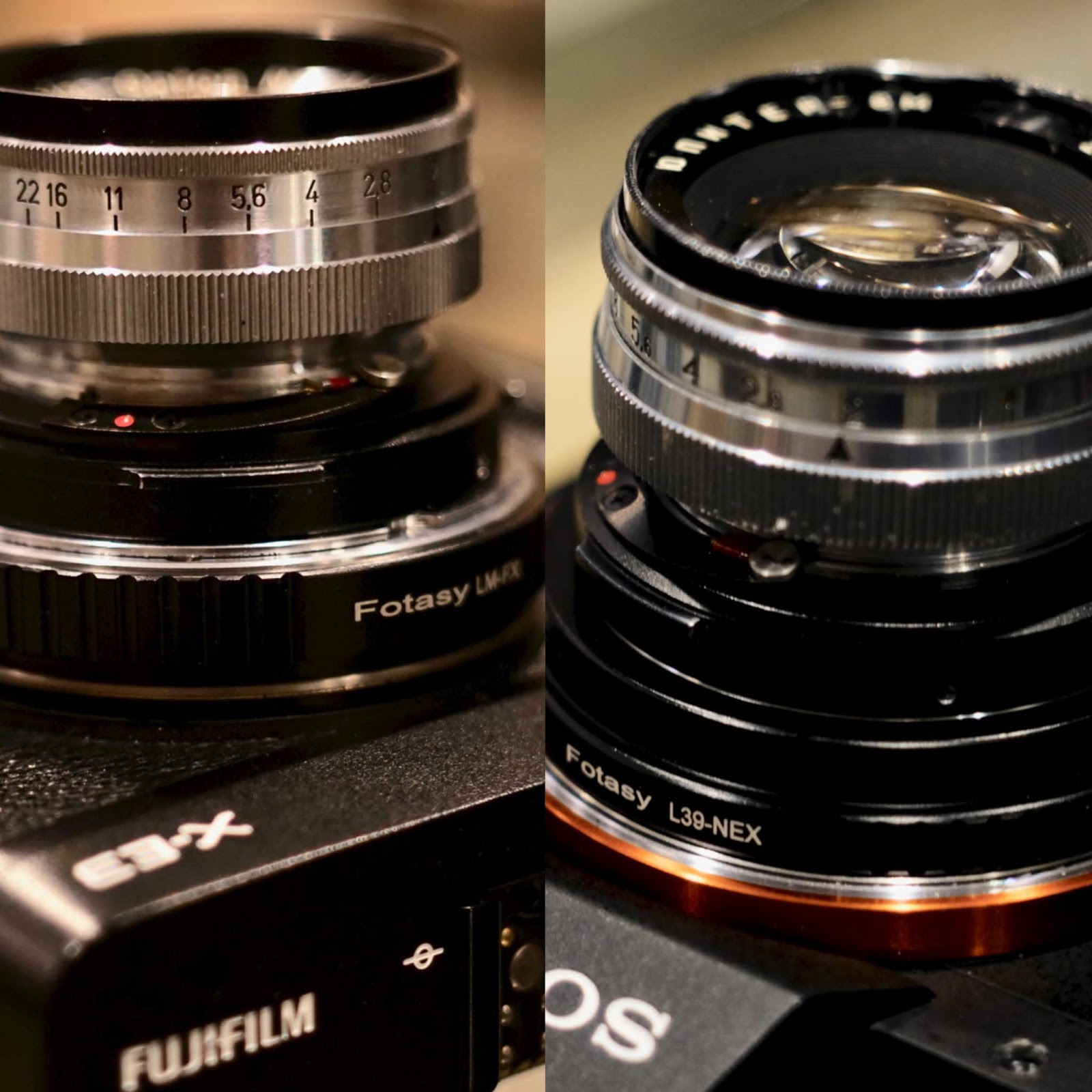
Jupiter 8M in the foregroundLTM>M + Fotofox CRF + Helios 103 By adding an LTM to M adapter, the Fotofox adapter functioned just as well on my Leica M6 below.Leica M6 + LTM>M + Fotofox CRF adapter + Helios 103 Using the appropriate adapter, the Fotofox also mounted the aforementioned Contax and Kiev 50mm RF lenses to my Fuji X-E3 and Sony A7II.👍The Bad
Left: Jupiter 12 + Right: Zeiss Sonnar 135mm f4 Sadly, my efforts to make it work with my Kiev RF mount Jupiter 12 and Contax RF mount Zeiss Sonnar 135mm f4, were all in vain. 😔The Ugly
Zone focusing is out of the question since there's no distance scale and no infinity lock/stop either. 😏Sample Pics
Canon P + Zeiss Opton Sonnar 50mm f2
Ilford FP4+ in RodinalCanon P + Zeiss Opton Sonnar 50mm f2
Ilford FP4+ in RodinalCanon P + Zeiss Opton Sonnar 50mm f2
Ilford FP4+ in RodinalBessa R + Helios 103
Ultrafine eXtreme 100 in Rodinal + HC110Bessa R + Helios 103
Ultrafine eXtreme 100 in Rodinal + HC110Leica M6 + Jupiter 8M
Fuji Neopan 400 in Kodak HC110Canon 7s + Helios 103
Ultrafine eXtreme 100 in Rodinal + HC110Canon 7s + Helios 103
Ultrafine eXtreme 100 in Rodinal + HC110Click here for more samples.Is it worth 60 something bucks? Let your eyes decide.😊Posted 14th February by JELabels: Photography2View comments
-
When John emailed me a picture of his WE753 clone cabinets, I had to have a pair! JP in the man cave with my freshly minted Altec 753A boxes JP's System (in constant flux)
Thorens TD124, Marantz 7T, Garrard 301
DIY Stuff
Marantz 8B, REL Precendent
DIY amps
Wharfedale SFB3Garrard 301 + Karmadon Viscous Damped Tonearm WIP - Gray Research HF-500 Turntable Hey JP, are you prepping this for a Schröder BA tonearm? 😎JP repurposed a WE chassis for his preamp JP's preamp is based on JE Labs Circuit JP's Simple 45 amp using James 6113HS OPTs JP's Stereo SE300B with James 6123HS OPTs visited the man cave,
it's based on the JE Labs circuit
JP's Vintage RCA CollectionRCA Theatre Amps RCA Theatre Amps RCA Compression Drivers RCA Horns Altec 614 cabinet
by JPOpen Baffle by JP Open Baffle by JP JP's handcrafted multi-cell horn made from wood,based on the Western Electric WE26AREL Precedent 646B with a DIY front faceplate by JP JP's take on the Dr. Bae/Silbatone 755A cabinetUnlike my friends in Manila who have reported good things using the Altec 755C in this box, JP prefers the Lafayette SK98/Pioneer PIM8LIf you want to contact John for a commission, please leave a comment with your email address. Your comment will not be published, instead, I will reply with his contact info.Coming Soon
JP757A2View comments
-
AKA Piezo PU-402 or Sparta ST220
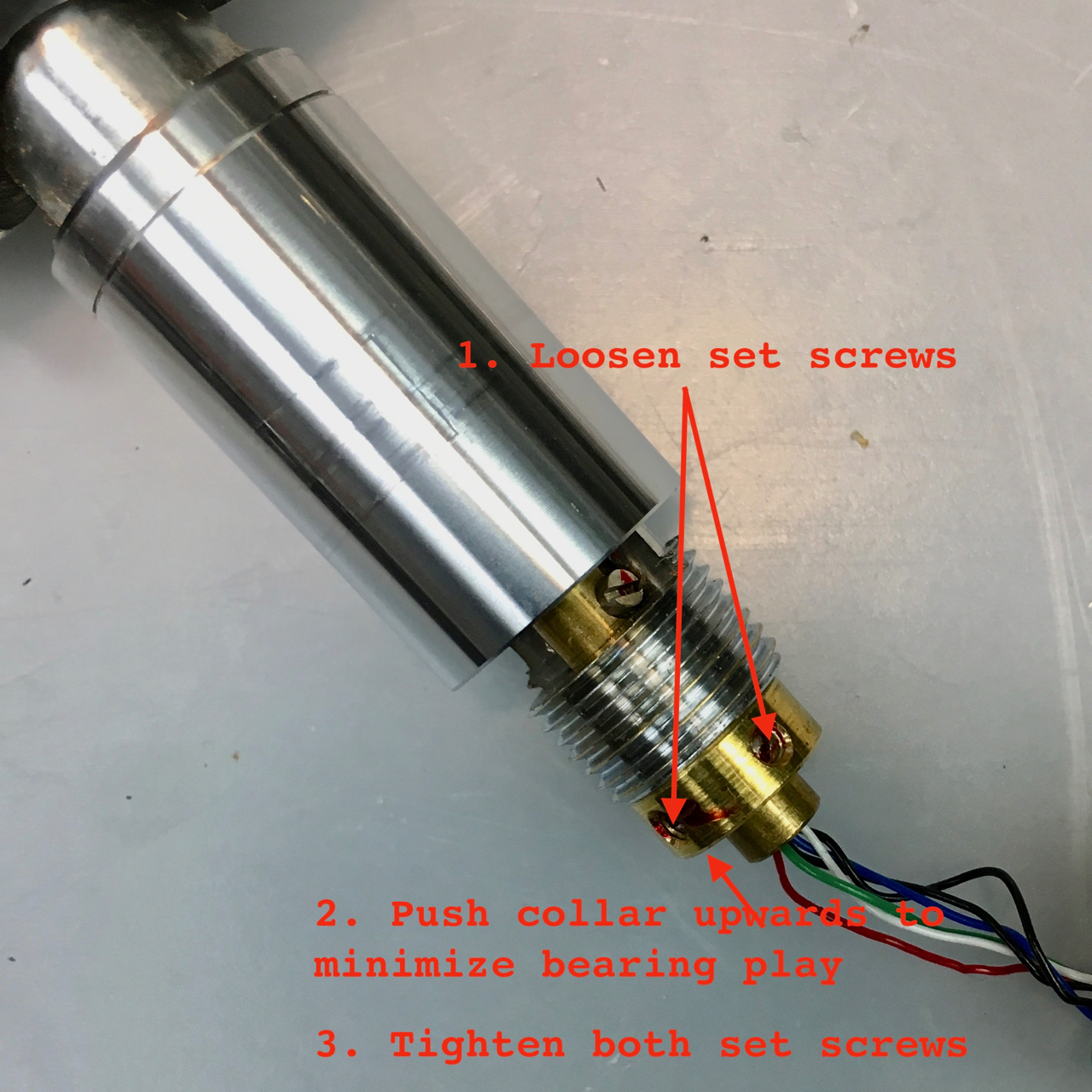
I've handled a few of these through the years and the horizontal bearings usually have too much slack. I've yet to encounter a sample that had vertical bearing issues though.
Follow the tips below on how to reduce horizontal bearing slack.
This is a highly underrated tonearm that works great with medium to lower compliance cartridges!Happy Listening!
0Add a comment
-
I'll start the new decade with scanned negatives of my DIY Audio projects from the mid to late 90s. Most of these pictures were taken either with my Pentax K1000 or Leica M3 + Rigid 50mm Summicron, loaded with either Agfa Vista or Kodak Plus X, processed by a local lab. I didn't know how to develop film yet back then. 😉
ca. '96
My last Dyna PAS hack
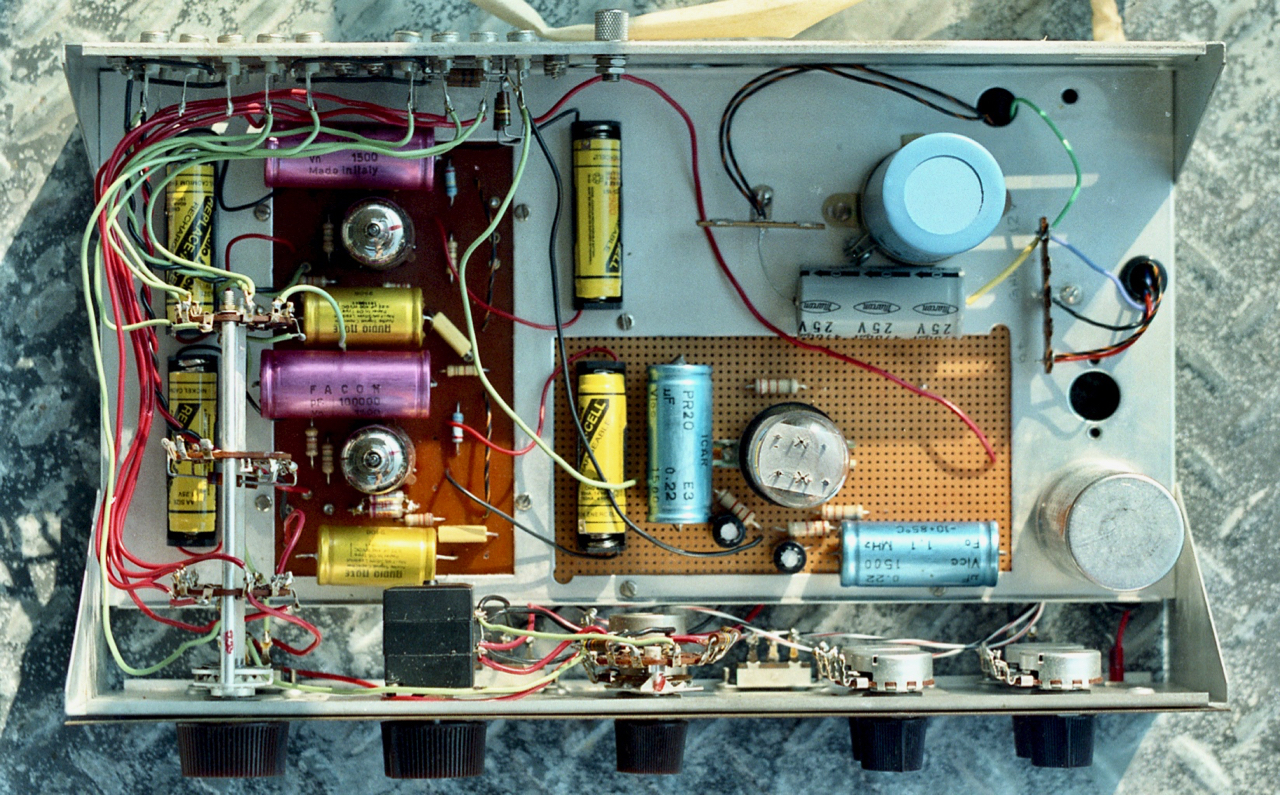
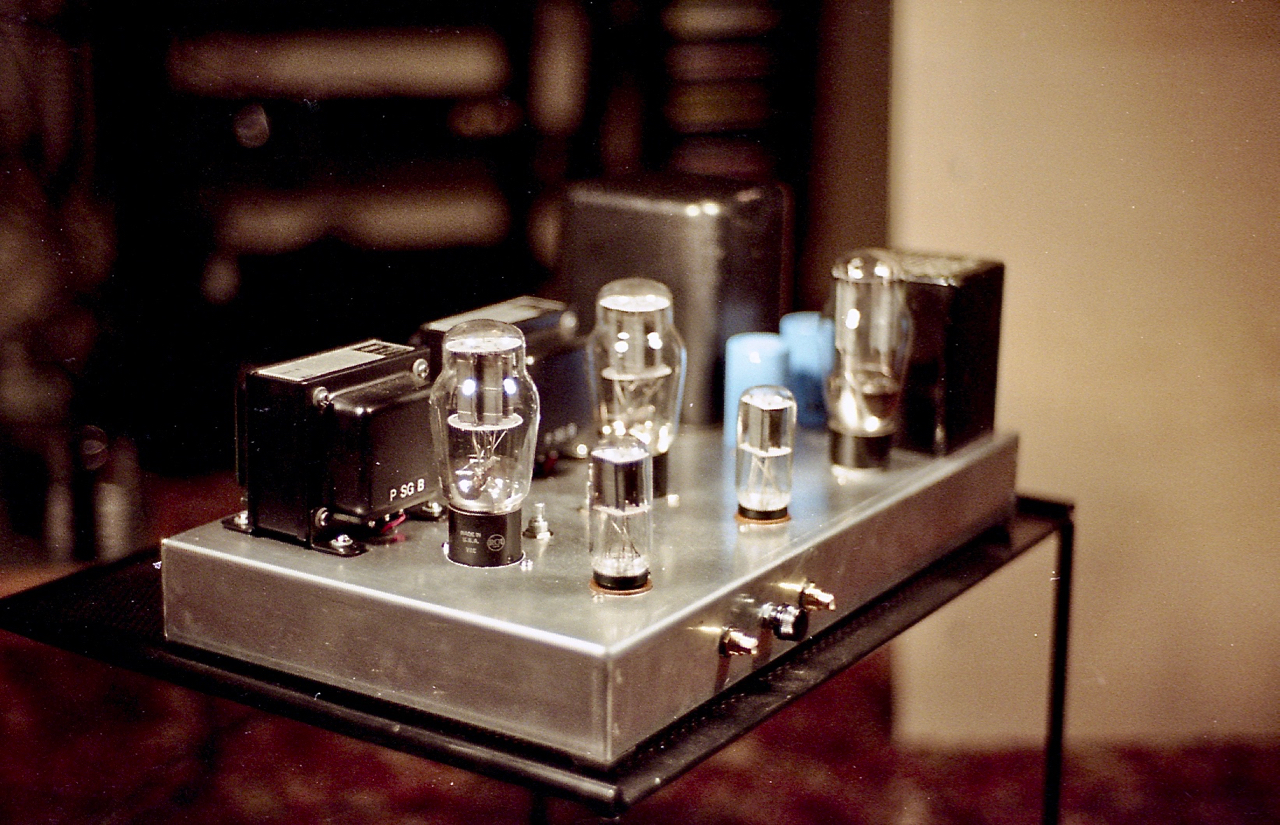
This Dyna PAS 2 chassis sports an RCA phono circuit with Ni-Cad batteries for cathode bias. Check out those wonderful (then) anti-high-end paper in oil caps from Jensen, Facon and Icar. Too bad they get leaky after a couple of years.Yup, that's an octal socket in the line stage for the mighty 6SN7!Under the hood of the outboard power supply is a choke for the B+ for better filtration. Connection to the main preamp is via an octal plug/socket.By this time I was already a firm believer in tube rectification. I retained the original PAS transformer for B+ supply duty only and relegated DC filament duty to another power transformer.JE Labs Stereo "Classic" SE300B with Audio Note UK 2.5K OPTsA Thorens TD124 + a (then) newly-acquired ($60!) Grace G540L tonearm + Grado 8MZ on my very first laminated plywood plinth project. All these components are still in service.The original Simple 45ca. '97
JE Labs Stereo SE2A3 with Tango U808 OPTsJE Labs Classic SE300B mono-block with Audio Note UK 3K OPTI briefly owned a pair of AES/Soliloquy 5.2 TQWT speakers. Coming from Spendor LS3/5As, these sounded lean and weren't more efficient either - probably in the high 80s rather than the claimed low 90s.😏Fortunately, I snagged a pair of Altec 755Cs at a hamfest and quickly whipped out a pair of small open baffles. I was hooked!The Altec 755Cs in open baffles based on dimensions published by Stereo Sound "Tube Kingdom" Issue No. 3/1996. And yes, I added a Garrard 301 to my system!I got my Garrard 301 in the early summer of '97 along with the Altec 755Cs.This was the block diagram of my system before the end of the millennium as a featured "Home-brewer" in Sound Practices. I can't believe 20 years went by so quickly!4View comments
-
I've become so busy the last few months and wasn't able to upload as much as I intended to. So here's what's in the pipeline for the coming year.
My one and only... The JP757A - a John Piro (re)creation, amongst others... Revisit MM/MI phono cartridges American Classics Japanese Idler Drive(s) '68 G401 Tonearms are like violin bows my camera adventures Happy Holidays and a Great New Year to Everyone!5View comments
-
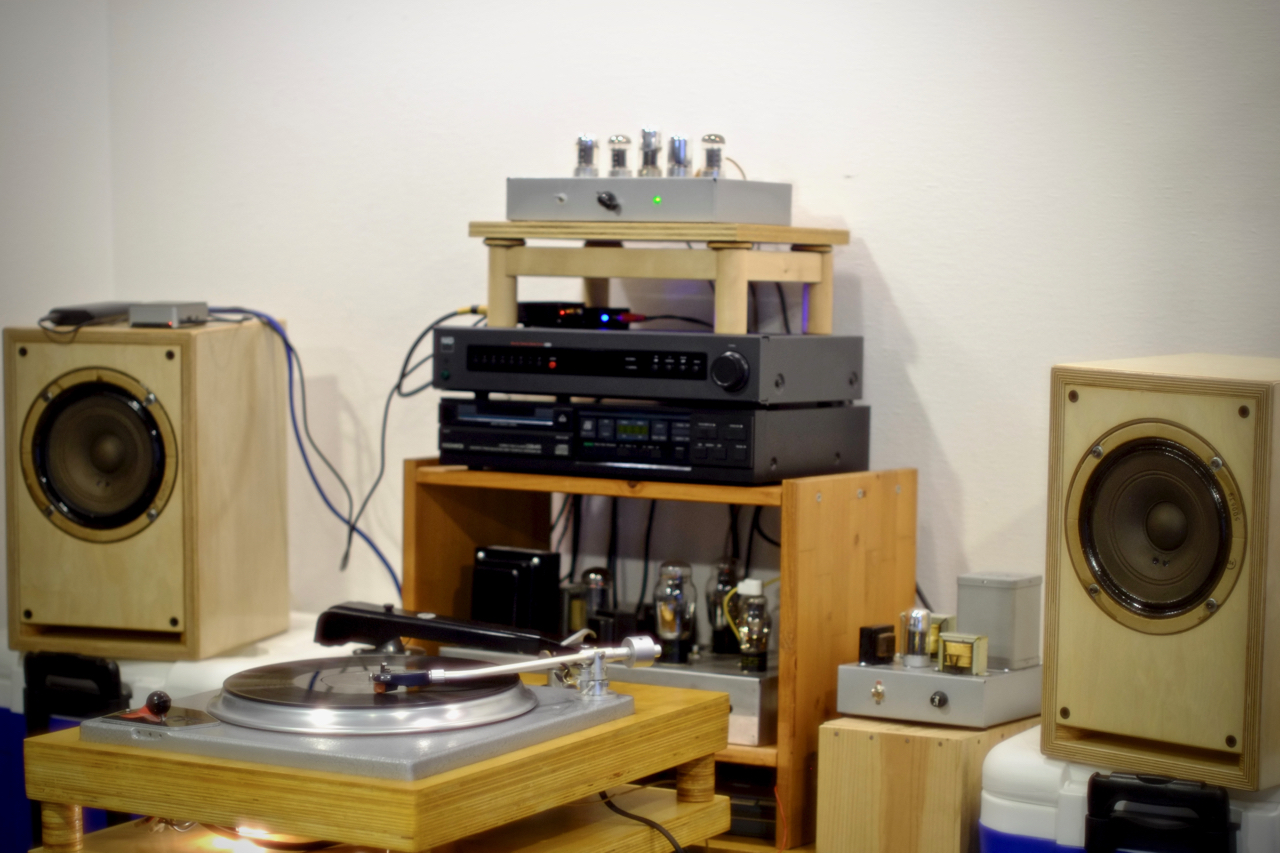
My main system has remained pretty constant for over 20 years, except for a couple of milestones. However, the same can't be said about my audio playground which sits beside my home office, in which the only thing constant is change. 😉Testing a few flea market/thrift store finds: a Kenwood KT880D tuner, a Sony DVP NS900V, a Magnavox CD2000, comparing a pair of Electro-Voice Sonocaster portable speakers vs. Lafayette SK98s, revisiting a Rek O Kut L34 + S160 tonearm + Shure M3DTrying a pair of Sansui T-104 horn tweeters on top of Altec 755Cs in Altec 618 cabinets, Denon DP1250 + Rega R200 tonearm + Audio-Technica AT3600L, comparing the Scott LT110B vs. the Kenwood KT880D vs. the Yamaha T-2Since I blogged about the Altec 755A in Dr. Bae/Silbatone cabinets, this system has remained pretty consistent with a Gates CB77 + Fidelity Research FR54 + DL103 + Shure MC transformers or a moving permalloy Nagaoka MP10 serving LPs + the JEL Loctal Preamp and JEL Simple 46 or Dyna ST35 doing preamp/amp duties.At the end of summer, the boss decided that it was time to mitigate the flooding problem during heavy rain and snow in the lower level of our home.Since this entailed removing the drywall in the hifi man cave, everything had to be stored or relocated and dust-proofed.It's been over a month since the retaining wall was sealed with waterproof coating. We've had a couple of strong rains and it's been dry so far. But we're in no hurry to replace the drywall. We want to make sure that it'll stay dry through the worst precipitation Mother Nature sends our way.Meanwhile, even if I have a nice mono hi-fi in the living room, I miss stereophonic sound.The boss was kind enough to allow the re-commissioning of the near-field system. To make unpacking simpler, I minimized the use of tube electronics.I'm currently DJ'ing between a Denon DP1250 + DA50 and a Sony TTS2500 + Grace G565 with various MM and MC cartridges. Line level sources include a Raspberry Pi 3B+/Volumio > Musical Fidelity V-Link USB to S/PDIF* > NOS'd Arcam Delta Black Box DAC and an NAD 4300 AM/FM tuner.
*I acquired this for less than half the cost of an Allo DigiOne and it sounds just as good!A Realistic 32-1100A Stereo Mixer I found at a flea market for 10 bucks is doing preamp duty. It has provisions for three line level inputs or 2 x magnetic phono + 1 line level. I thought the magnetic phono inputs were pretty decent on this discrete transistorized unit (no op-amps) until I got another discrete solid-state Radio Shack product, the 42-2109 phono preamp. This unit produced a warmer, more vivid midrange with even better extension in the frequency extremes.To warm things up further, I inserted a pair of UTC A20 line level transformers between the Rat Shack Stereo Mixer and the Nobsound NS-02g. Connected via Belden 9497** speaker cables, a synergistic vibe occurred between the Altec 755Cs inherent lack of snap, which softened the slight edginess betraying the solid-state DNA of the JLH 1969 Class A amp clone. The Altec 755Cs in Altec 618 cabinets sounded snappy with this combination!**this cable sounded mushy and lacking
in definition when used in an all tube set upJudicious mixing and matching of yesteryears' solid-state audio components employing discrete circuitry with the line transformers and a cable tweak inserted in between, mimicked the musical experience I typically enjoy only from an all vacuum tube set up. It's akin to the Fuji Acros film simulation setting in my Fuji X-E3 camera. But there's still no substitute for the real thing. 😉0Add a comment




















Loading
All rights reserved. Dynamic Views theme. Powered by Blogger.