Zwoje (The Scrolls) 2 (39), 2004

Notes of a Harpist, Part II.
It describes the history, usage and iconography of the harp in Ancient Egypt.
About the harp
NOTES OF A HARPIST (II)
Harp of Gods and Pharaohs, Priests and Priestesses
LILIANA OSSES ADAMS
Something, which we have seen in a dream,
Is the earthly side of life.
Harper's Song, c. 1160 BC
The remnants of great civilizations of the third millennium BC in Mesopotamia, Egypt, China, and Harappan (along the Indus River on the Punjab and Sindah Plains) share many characteristic features and cultural achievements of almost mythical status. Those complex urban centres stimulated various historic inventions such as cuneiform and hieroglyphic writing, and were the places of the most creative artistic expression in the fine arts – music, dance, drama, literature, painting, ceramics, sculpture, carving, and architecture. Often the purpose of the artistic output (the kind of message) was to demonstrate devotion to the gods who had granted authority to kings and pharaohs – the embodiment of divine power on earth.The more than 3000 year-long ancient Egyptian civilization of 31 Pharaonic Dynasties has been divided by Manethon, an Egyptian priest-historian of Alexandria from the Ptolemic Period (3rd century BC), in his treatise in Greek Ajgyptiaka, into three basic periods: Old Kingdom (2800-2250 BC), Middle Kingdom (2040-1640 BC) with Thebes as its capital, and New Kingdom (1550-1070 BC).
In the fertile land, watered by the Nile – perceived as a majestic gift from the god Hapi – the archaic Egyptian history begins with the unification of Upper Egypt, to the south, and Lower Egypt, to the north (at the Nile Delta), under the legendary King Menes (identified also as Narmer), the founder of the First Dynasty of Pharaohs 1) (c. 3100-2884 BC). The newly established capital at Memphis became the sanctuary of the state-god Ptah. The shape of the Nile River resembling of a lotus flower with its petals open to the sun each morning, symbolized the ancient Egyptian beliefs in reincarnation and spiritual regeneration of life. Just as life rose from the waters, the annual flooding of the river deposited nutrient rich silt over the land, creating ideal conditions for growing wheat, flax and other crops. The region became a paradise for exotic birds and plants and for nature, in all its splendors.
Hymn to the Nile
Hail to Thee, Oh Nile!
We bless and worship Thee –
For all the benefits you give us daily.
A festive song is raised for you.
Let crooner praise your glory
Playing the strings of his harp.
Hymn to the Nile (excerpt),
written by an unknown Egyptian scribe
during the reign of Pharaoh Ramesses II,
XIX Dynasty, 1304-1273 BC, New Kingdom.
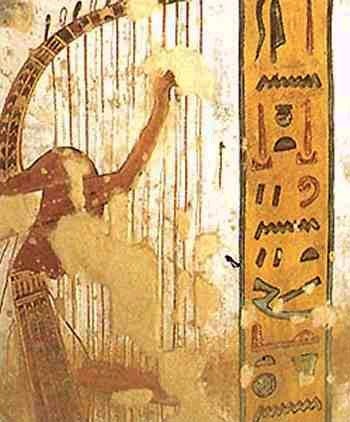
The harpist chants laudation of the Pharaoh before the god Shu,
symbolizing the space between Heaven and Earth, who wears an ostrich feather headdress
and holds a scepter Was, symbolizing the power and domination, and the sign of life – The Key Ankh.
Tomb of Pharaoh Ramesses III, XX Dynasty, 1185-1070 BC, The Valley of the Kings, Western Thebes.
Sketch after James Bruce, Travels to Discover the Source of the Nile, 1813.
The religious beliefs of the ancient Egyptians greatly influenced their daily lives and were the dominating force in the development of their culture, although a "true" religion, in the sense of a unified theological system never existed. The Egyptian faith was based on an unorganized collection of ancient myths, nature worship, and innumerable (more than 2,000) deities, able to explain the mysteries of life and the beauty of nature. In the most famous of these myths, a divine hierarchy developed – the pantheon of gods, by which the creation of the Earth was explained.
- The Creation Myth of Divine Power
At the beginning – according to the Egyptian beliefs – there existed only the chaos of the pre-oceanic water, called Nun. At the ancient city of Heliopolis, on the Nile Delta, from the turbulent depth emerged the god of cosmic deities, the Sun God Ra, the "Creator". The chief god in the Egyptian pantheon, later called Amon-Ra, brought with him four children: the god Shu (air) and the goddess Tefnut (water-moisture), the god Geb (earth) and the goddess Nut (sky). The god Geb and the goddess Nut had two sons, Set and Osiris, and two daughters, Isis and Nephthys. From this myth of creation came the conception of the divine ennead – Pesedjet (i.e. group of nine) worshipped as the state religion. In addition to those already named, the important divinities included the gods Amon (Amun/Amen), Ptah, Ra-Harakhte, Horus, Thot, Hapi, Atum, Anubis, Abis, Sokar, and the goddesses Hathor, Meret, Mut, Neith, Ma'at, Nun, Hesa, Bastet, Bashat, and Sekhmet. Their importance increased with the political ascendancy of the localities, where they were worshipped. The local, domestic deities generally originated from other religions, and were mostly the animal gods of prehistoric Africa. The Egyptian gods were represented with human (male or female) torsos, and human or animal heads, which expressed the enigmatic power of the god. Hundreds of creatures like swallows, falcons, hawks, jackals, baboons, crocodiles, fish, frogs, turtles, rams, lions, bulls, cows, serpents, scarabs, and cats became living images of divine patrons as they ruled over the people and their needs and desires like: love, joy, happiness, pleasure, marriage, singers, musicians, dancers, artists, writing, learning, books, sciences, medicine, judgment, law, fertility, harvests, merry-makers, vine, beer, digestion, stomach, lungs, good times, physical comforts, illness, mental power, prosperity, family, childbirth, sexuality, revenge, war, healing, compassion, magic, the dead, and eternity. Many of them combined their duties with each other, in a great number of ways, and took on many of the attributes (and even the names of others, like Ptah-Sokar-Osiris) as the Egyptian myths evolved. They protected the believers and were shaped as amulets, totems, sculpted statues or tattoos; their shrines covered with fresh flowers adorned temples, households, and tombs.
- The Life Beyond the Grave
The ancient Egyptians believed that the vital life force (Ankh – The Key of Life, the eternal sign of life) was composed of several psychic elements, of which the most important was the soul (Ka). The ka accompanied the body throughout life and after death. The final departure to the Kingdom of the Dead could not have occurred without the body. Therefore every effort had to be made to preserve the corpse. Bodies were embalmed and mummified. For the final journey of the deceased to the Underworld (Khert-Neter), the squarish mound mastabas of brick or stone were built above the burial chambers (called Amentet – The Hidden place). The place was protected by the goddess Amenti who welcomed the deceased to their new dwelling place. Inside the tomb, the offering chapel for the soul (Ka) and body (Ba) was filled with food and drinks, meal and milk, tools for pleasures and professional work, domestic wares, treasures, musical instruments, perfumes, clothing, cosmetics, jewelry, and hairdressing supplies, luxury items, and every day necessities. (Later on, the mastabas developed into the step pyramids – symbolizing "stairways" to ascend the heaven, which became more memorial, cult, and religious, than a burial place). In addition, in a secret cubicle a wood or a stone replica of the deceased body (Ushebti) was concealed in the event that the mummy was damaged or destroyed. It was placed next to the canopic jars – embalming urns containing the intestines extracted during the process of mummification. During the Underworld route, the souls of the dead were supposedly beset by innumerable dangers. To help them to overcome the passage to the eternal life, the tombs were supplied with rolls of papyrus copies of the Book of the Dead, a "guide" to the world of the dead. Its also included the book of Coming Forth by Day, a series of spells and enchantments serving to "guide" the deceased through the Underworld, and to explain to them how to overcome the evil-force and demons – the "guardians" of the Gates to the Elysian Fields, the symbol of the eternal fields of peace.
At the mouth of the canyon at Abydos, where archaeological remnants from all periods of ancient Egyptian history are to be found, the main cult centre of Osiris became a pilgrimage site, believed to be the ancient entrance to the Underworld, where the sun sets in the Land of the West.
- The Book of The Dead
The Book of the Dead was a large collection of various religious texts, spells, and passwords written in papyrus manuscripts (sometimes called the mummy-scripts), embellished with beautiful garlands weaving, designs, vignettes, and paintings. It began to appear in Egyptian tombs around 1600 BC, at the end of the Middle Kingdom (2040-1640 BC). It contained the magical formulas, hymns, litanies and prayers to enable the soul ka to pass the Last Judgment Day in the Pillar's Hall – The House of Osiris, the God of Underworld, Prince of Darkness. The text was intended as one to be repeated by the deceased during hazardous navigation into the afterlife. At the end of the ordeal, with the promises by the deceased to sin no more, the now virtuous men found truthful, passed through the Gates of the Elysium, and were finally worthy to enter the Afterlife – to be reborn again in paradise.
The earliest funerary texts of the Book of the Dead were cut into the hieroglyphs in the walls of pyramids; later were painted on coffins, and subsequently inscribed on papyrus scrolls placed in the mummy case; these papyri were from 15 to 30 m (50 to 100 ft) long with multi-coloured illustrations. Copies of the Books of the Dead were found in many Egyptian mastabas belonging to the royal descendents, high priests, military officers, privileged temples officials, their wives, and family members.
During the archaeological excavations at the turn of the 20th century, many papyrus scrolls of the Books of the Dead were discovered in the tombs of Hunefer, Nebsany, Padiamen, Nefer-uben-f, Inherkhaou, Nakhtefmut, or Patenemheb.
The Book of the Dead; the beginning of Chapter CXLV (145)
The Userhatnes Papyrus, XXI Dynasty.
The Egyptian Museum, Cairo.
Source: François Daumas, Od Narmera do Kleopatry.
Panstwowe Wydawnictwo Naukowe, Warszawa, 1973.
Although there were many publications of the Book of the Dead, the best known English translation of the Egyptian Book of the Dead and The Papyrus of Ani (now preserved at the British Museum), written by the scribe Ani (Thauenany) from Thebes (c. 1400 BC) was translated from the hieroglyphs in 1895 by Sir Ernest Alfred Willis Budge (1857-1937), anthropologist and one of the foremost Egyptologist (who collected a large number of Egyptian papyri manuscripts), and the author of more than thirty books on the Egyptian antiquity.Recently, the beautifully illustrated Books of the Dead of Ancient Egypt have been translated into a number of languages, sometimes under different titles, and are available with colour and black and white illustrations.
- Bes – the God of Dancing, Musical Instruments, and Merry-Maker
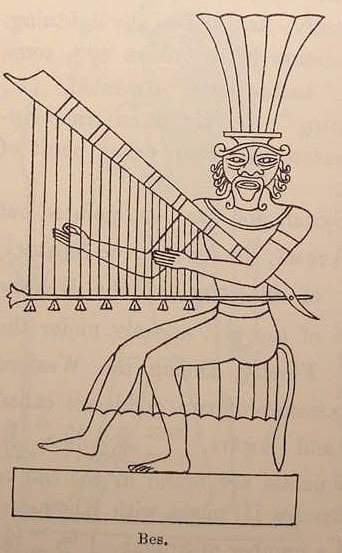
The god Bes, a domestic deity worshipped at small household shrines, was the most popular god among the common people of Ancient Egypt. Almost of comical, grotesque appearance, he became associated with music, mirth, and dance. He often was pictured playing the harp, flute or tambourine. Even though his name was properly Egyptian, his origin was likely to have been African, resembling a sort of pygmy shaman with the leonine head, wearing a tiara made of feathers. He was a dwarf in figure, plump with a flat nose, bushy eyebrows, and large ears, wearing a leopard skin. Reputed of musical skills, he became a protector of the goddess Hathor (the goddess of love, joy, beauty, and music, playing the sistrum – sort of rattle used to ward off evil spirits). During the Hathor's reluctant travels from Nubia to Denderah, he kept her in good spirit, and brought her joy and good humour. In the Temple of Hathor at Philea, at the Biga Island in Aswan, the image of dancing Bes playing the angular harp is carved on the temple's column. In the Temple of Hathor at Denderah, (north of Luxor; until the 1800's buried in sand), the raised painted relief of Bes sits near the Roman Gate.
One of the earliest portraits of Bes – the protector of childbirth and fertility, women and children – was carved at the Maatkare Hatshepsut's Mortuary Temple (1473-1458 BC, at Deir el-Bahari, in the Valley of the Kings on the Nile's West Bank) as a symbol of the queen's mother Ahmose, who gave birth to a child, a female pharaoh of Egypt. The god Bes was especially protective of children: he fought with knives, and maces when they were in danger; he made them laugh and dance playing the flute and tambourine; he amused them, and made them quiet and calm playing the harp; he watched over them, put them to bed, perhaps even playing lullabies.
One of the earliest known tattoos (viewed as the tribute to a deity or as a connection with the divine) was the picture of Bes (made after the terracotta amulets) on women's bodies, dancers, acrobats, and musicians. Tattooing Bes, sometimes on the women's intimate parts, seems to have been for erotic purposes.
The picture of the harp shown below, played by the god Bes, is a rare representation of the vertically held, triangular harp with the sound-box placed against the player's chest. This angular instrument in which the strings are placed vertically, and the neck and resonator formed an acute angle, was played by both hands in seated (or standing ) position. The angular harps with acute (or right) angle, were developed simultaneously with the arched harps with the curved neck rising away from the resonator. Originated in the Near East, during the centuries the angular harp has spread throughout Eurasia, and is believed to be an older instrument than the arched harp.
The god Bes dancing and playing the harp.
Carving on the pillar at the Hathor Temple at Philea, Biga Island, Aswan.
Ptolemeic Dynasty, 332-30 BC, Greek Macedonian Rule.
Detail of the above Bes carving at the Hathor Temple.
The seated Bes playing the harp.
Sketch by E.A. Wallis Budge from The Gods of the Egyptians, vol. 2, p. 285.
First edition by Methuen & Co., London 1904.
- The Archaeological Evidence of Music in Ancient Egypt
Hieroglyphic and papyrus texts – the records of Egyptian mythology, the archaeological discoveries of the last two centuries, and the literary art and historical treatises by Homer, Herodotus of Halicarnassos, Plato, Plutarch, Diodorus Siculus, and Dio Cassius from Nicaea (today's Iznik in Turkey) revealed that the music played a very important role in the ancient Egyptian society at all its levels. The sound of music, which can be characterized as divine or secular (sacred or profane), found its way into many temples, palaces, workshops, harems, farms, battlefields, tombs, gardens, and into at-home conviviality. The most important aspect of the music was its connection with the gods and goddesses, who presided over its usage during the religious ceremonies. Those who spoke to the gods and goddesses were the priests and priestesses, called the Servants of the God. They were appointed by the Son of Ra, the pharaoh – the highest priest for all gods, who himself alone was not able to perform ceremonies at all temples at the same time. The priesthood (like almost every strata of the Egyptian society) was hereditary, and often passed down from father to son or daughter, or mother to daughter or son. Female priestesses performed the religious rituals, especially for cult centres of female goddesses, Hathor, Isis, Neith, or Bastet. They were of equal rank to the priests, and alike the latter ruled the theocracy. They were often represented as women playing musical instruments, mainly harp, lute, lyre, and sacred sistrum (as shown on the papyrus painting of priestess Anhai, from the XX Dynasty, dated 1100 BC, now preserved at the British Museum). Their knowledge about the Creation Myths was based on the religious beliefs and philosophies of the times, which often changed with different Pharaonic dynasties. The priestly duties included not only caring for the gods, but also for teaching at the religious schools, called the House of Life (Per-Ankh), often serving as the libraries with rich archives. (It is generally believed that the House of Life with its sacred character carried the seed of the mystery and magical tradition, which produced the fabled sagas of Egypt). The priests also supervised the various groups of artists, craftsmen, and workers employed at the temples. Each city had a cult temple – The House of God – built in honour of their god, which was a centre of communication between the macrocosm (the world) and the microcosm (the men). The massive mud brick structures were built over the years by successive kings. The funerary temples of Karnak and Luxor were set on the East Bank of the Nile where the sun rises, then travels across the sky and sets ("dies") in the west. There, vast necropoles – the Cities of the Dead – spread over large mountainous area, known under the collective name of Western Thebes 2).
The worshippers were never allowed into the cult temple, where the statue of the god (Neter) was kept at the sanctuary, called The Holy of Holies. However, they crowded Thebes, on the banks of the Nile, from Karnak to Luxor, during grandiose religious festivals, like the Feast of Opet, lasting several days, or during the secular festive days, like the First of the Month, the New Moon, or the New Year's Feast. On these occasions the god's statue was carried in the procession through the city before the crowd, who chanted and clapped to the rhythm of drums, tambourines and castanets, while dancers twirled graciously their bodies, and singers and harpers chanted their songs. During the daily Rituals of Offering the instrumental ensemble and ritualistic performers were in charge of the musical accompaniment to the hymns and worship psalmodies to the deities. Especially great celebrations were held to commemorate the Sacred Marriage of Hathor and Horus at Denderah. In those, everybody took part, even the members of the Royal Family, High Officials, and Nobles. Their wives, frequently employed by the temples, became greatly esteemed professional singers, called the Chantresses of Amun, and ritual dancers, and harpists, called the Harpers of Amun with their fashionable, noble harps. For sociable banquets of the Nobles the dancing girls and musicians were often selected from among the servants, slaves, or artistically trained women in the royal harem. Some extant imaginary scenes from the pharaoh's Royal Harem – a dwelling house of the First Queens, called God's Wives (sometimes pharaoh's half or full sisters or daughters), and of many of his lesser wives and concubines – depict the amazing feasts filled with song, music and dance.
- Iconography of the Harp in Ancient Egypt
The unknown artists of Ancient Egypt created most pictorial images of the harp throughout the period of the Pharaonic Dynasties during more than three thousand years. Numerous images have been found in papyrus manuscripts, wall paintings, reliefs, and carvings on tombs. The ancient Egyptians painted the most glowing and beautiful scenes around the walls of the tombs, on the sarcophagus, and on the papyrus scrolls that would magically come alive in the Afterlife. The scenes showed the gods and goddesses – the patrons of the dead – welcoming them to the Gates of the Elysian Fields. Musicians and dancers, singers and clappers entertained the family members at the eternal banquet. (Apparently, the male harpers were often blind as can clearly be seen in the tomb paintings and the carvings.) Servants and slaves worked in the fields harvesting the wheat, and carried food and drink. Resting in the bed, after the day's exertions, noticeable enjoyment was provided by the wife of the deceased who sang and played the harp. Her songs were everlasting; her hands plucked the strings forever. It was a perfect picture of life to live... an Afterlife!
In Ancient Egypt one of the favourite and most widely used musical instruments was the harp. Harp parts and even some, almost complete, original harps have survived – thanks to the dry climate – and are now on display at museums worldwide, and in private collections. Most of these instruments were found to be carefully wrapped in cloth, before there were buried.
Our knowledge of the harp in the Ancient Egypt's civilization comes from the archaeological discoveries in the tombs of pharaohs, servants of the gods, officials of the kings, prominent personalities, private individuals, and artisans. On the walls of their tombs the deceased have immortalized the harp's great historical importance and remarkable artistic individuality.
- The Tomb of Pharaoh Ramesses III – "Born of Ra".
The Valley of the Kings, Western ThebesThe most important of all of the Egyptian harp discoveries was made in the mortuary temple complex of Ramesses III (c. 1198-1152 BC) from XX Dynasty, in the Valley of the Kings at Medinat Habu (City of Habu), Southern Necropolis of Western Thebes in Upper Egypt, symbolized by the White Crown (Hedjet). While we know that Ramesses III likely died (or was assassinated) during the trial of the harem conspiracy, his reign (1182-1151 BC) did mark the approaching end of the New Kingdom. The tomb, discovered in 1768 by Scottish explorer James Bruce (1730-1794), was named The Tomb of the Harpists, or The Tomb of the Harpers 3) (sometimes called Bruce's Tomb) due to a bas-relief representation of two blind harpists playing the harp before the gods to please or charm them in return for their help and protection. Because of the faded colors of the wall paintings (and because of some claims that his "discoveries" were simply imaginary), James Bruce in his Travels to Discover the Source of the Nile (3rd ed., 1813) included several of his drawings of the harpers depicted in the tomb's walls. The figures were rather fashioned on the European concept of antiquity and bore little resemblance to the originals.
Bruce's drawings show two large vertical arched "floor" harps played by two men dressed as priests. The harp's sound boxes are decorated with the pharaoh's heads wearing the Red Crown (Deshret) of Lower Egypt, and the Double Crown (Pshent) of Upper and Lower Egypt (the symbol of the god Ra or the god Horus). One of the first publications of the drawings by James Bruce was included in the Napoleonic Reports About Egypt. By looking at the pharaoh's pictures, one can detect a slight resemblance to Napoleon's features. Recent photographs from the tomb of Ramesses III show the wall paintings to be in very poor condition. The following six pictures (photos and drawings) detail the wall paintings at the Mortuary Temple of Pharaoh Ramesses III at Medinat Habu, Valley of the Kings, Western Thebes, XX Dynasty, 1185-1060 BC, New Kingdom.
(Images after Ippolito Rosellini, I Monumenti dell’Egitto e della Nubia. Monumenti civili, Pisa 1832-1844, or Edda Bresciani, L’attività archeologica dell’Università de Pisa in Egitto, Pisa 2002.)
Blind Harpist playing harp with the Red Crown of Lower Egypt.
Detail, photograph.
Blind Harpist playing harp with the Red Crown of Lower Egypt.
Drawing after James Bruce, detail.
Publication by Ippolito Rosellini.
Blind Harpist playing harp with the Double Crown of Upper and Lower Egypt.
Detail, photograph.
Blind Harpist playing harp with the Double Crown of Upper and Lower Egypt.
Detail, photograph.
Blind Harpist playing harp with the Double Crown of Upper and Lower Egypt.
Drawing after James Bruce, detail.
Publication by Ippolito Rosellini.
The two harpists playing the harps with Red and Double Crown.
Drawing after James Bruce.
Publication by Edda Bresciani.
- The Tomb of Nakht – "The Strong One".
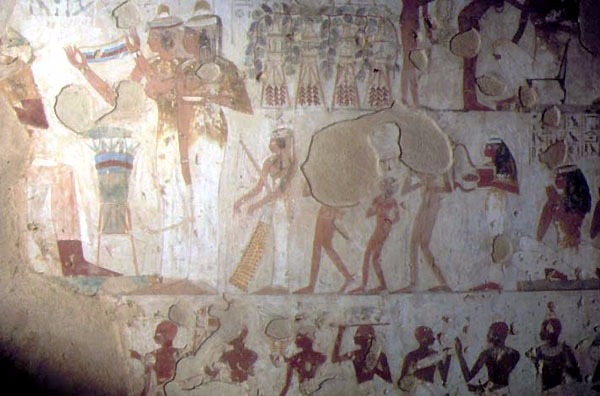
Valley of the Nobles, Western ThebesThe private tomb of the Royal Scribe Nakht, who held the title of the Astronomer of Amun at the Temple at Karnak, and his wife Tawy, the Chantress of Amun was found intact in 1889 on the West Bank, Valley of the Nobles, within the area of the Sheikh Abd el-Qurna Necropolis, close to the entrance to the Valley of the Kings. The walls of this burial chamber were painted about 1425 BC, during XVIII Dynasty (dated at the Tuthmosis IV, or the early Amenhotep III reigns), and were retouched and restored after the drawings published in 1907 by scientists and artists working with the Metropolitan Museum in New York.
Wealthy Egyptians, in addition to furnishing their tombs with the abundance of funerary offerings (bread, wine, and other food), commissioned artists to make colorful reliefs carvings in their tombs to ensure their well being in the Afterlife. Also, by giving an accurate and vivid (and sometimes idealized) image of their everyday life, they wanted to ensure in that way their posterity.
The tomb of Nakht is famous mostly because of the beautiful funeral banquet scenes showing three gracious musicians playing the reed pipe (double flute), the large "floor", eleven stringed arched harp with boat-shaped resonator embellished with inlay from an elephant tusk, and norva (or bandore), a three stringed instrument made of a turtle shell with a long neck, a prototype of lute, guitar or banjo The young instrumentalists are lightly clothed in transparent banquet attire with long flowing tresses; they have incense wax cones on the tops of their heads to perfume their hair and body. This delightful and harmonious composition has been reproduced and copied on many contemporary papyruses and in the variety of copies of the Book of the Dead. In addition to this scene of eternal entertainment for the soul of the deceased, a young blind harper with crossed legs pluck the strings of a smaller arched (bowed) "knee" harp, next to the musicians playing sistrum and castanets; a little servant is helping to fix the jewelry and ear rings of the singer.
Musical Banquet. Three musicians playing instruments in modern times named flute, harp and lute.
Tomb of Nakht, a scribe at the Karnak Temple, and his wife Tawi.
XVIII Dynasty, 1570-1320 BC. New Kingdom.
Necropolis at Sheikh Abd el-Qurna, The Valley of the Nobles, Western Thebes.
Blind harper, a dancer, and Tawi – the singer with lotus flowers.
Tomb of Nakht, a scribe at the Karnak Temple, and his wife Tawi.
XVIII Dynasty, 1570-1320 BC. New Kingdom.
Necropolis at Sheikh Abd el-Qurna, The Valley of the Nobles, Western Thebes.
Blind harper.
Tomb of Nakht, a scribe at the Karnak Temple, and his wife Tawi.
XVIII Dynasty, 1570-1320 BC. New Kingdom.
Necropolis at Sheikh Abd el-Qurna, The Valley of the Nobles, Western Thebes.
Source: François Daumas, Od Narmera do Kleopatry.
Panstwowe Wydawnictwo Naukowe, Warszawa, 1973.
Banquet scene from the Tomb of Nakht with three musicians and a blind harper.
A papyrus copy from the Book of the Dead and Elysian Fields, c. 1925.
Source: The edition revised and expanded by Mark L. Troy, London.
- Harp as Solo and Ensemble Instrument in Ancient Egyptian Necropoles
It is almost always impossible to create the objective picture of the musical life in Ancient Egypt because of the mythical symbolism involved in every aspect of Egyptian artistry. However, without the pictorial evidence of the harp in the literary and visual art works by skilled ancient engravers, and without the funeral musical scenes found in the tomb and mastaba wall paintings, frescos and reliefs, our knowledge of music in Ancient Egypt would be less than complete. Many of these musical scenes visibly show the hands of a harp player plucking certain strings, which clearly indicate musical ratios, such as the fourth; its converse or inversion, the fifth, and the octave, suggesting the fundamental knowledge of musical system – the tetrachords. The ancient art of music, in which the most inflected were cadences, was invariably an adjunct of poetry, song, and dance. From the position of the harpist's hands on the harp strings (i.e. the notes higher or lower on their instruments) the musicologists derived the tonal relationship between the degrees of the basic modes, including the relationship between a series of the musical intervals, which they recognized as a perfect concordant tetrachord.
Very often the instrumentalists were controlled by a so-called chironomist (cheironomist), a chief conductor, an ensemble leader, and often a singer, who could lead, and "sing" a music ensemble by means of his hand and/or finger gestures, pointing to a variety of instrumentalists a specific chironomy played in unison, and possibly in octaves, inverted chords, and in the primitive polyphony (term applied to many sound music, i.e. "many-voice" music.) The symbols of chironomy indicated the tones of the pentatonic scale (a 5-note scale), mainly used in the Orient, and its accidental notes (sharp or flat keys.) The cheironomists were often portrayed as keeping one hand by their ear, as if to "hear" the pitch better (still done by some singers) or as pressing the hand against the throat to alter the sound of his singing voice (the technique still used in the Middle East.) The musical singing was characterized by a particular glissando effect, a technical execution carried to the present day.
There were many attempts to reproduce music of the Funerary Art. Musical notation of ancient Pharaonic Egypt is almost unknown, excerpt for a few remnants, like the Hymns from the Pyramid Texts (the oldest sacred book from the pyramid of the King Unas (Wenis) from the V Dynasty, 2375-2345 BC, Old Kingdom), Invocation to the god Horus, and Processional Hymns to the Goddesses Hathor and Isis. (Perhaps the High Priest Cod would not permit the written musical notation used in liturgical-ritualistic temple service while music was a sacred, and guarded secret performed only by the initiated. (op. cit.; emphasis mine).
The Egyptian musical "orchestra" (instrumental ensemble) consisted generally of strings, wind (wood/brass), and percussion instruments; harp, lyre, lute, pandoura, guitar, flute, pipe, double pipe, clarinet, trumpet, horn (oxhorn), drums, bells, tambourine, castanets, and a special group called clappers. The solo harpists were often singers, for in the surviving art works they are shown clearly moving their lips, and they also played with other instruments (flutes, lyres or lutes) in duo or trio ensembles.
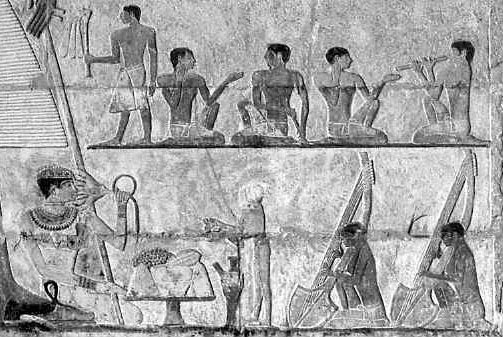
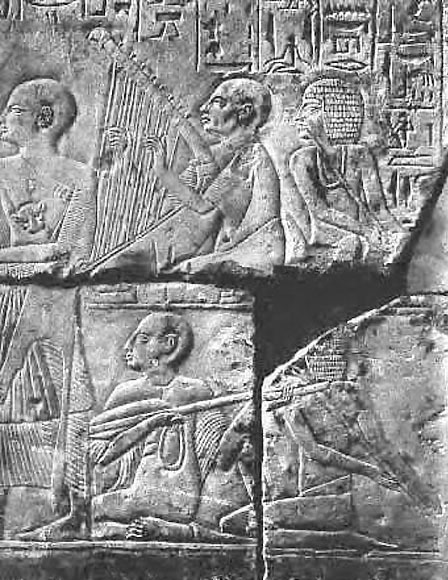
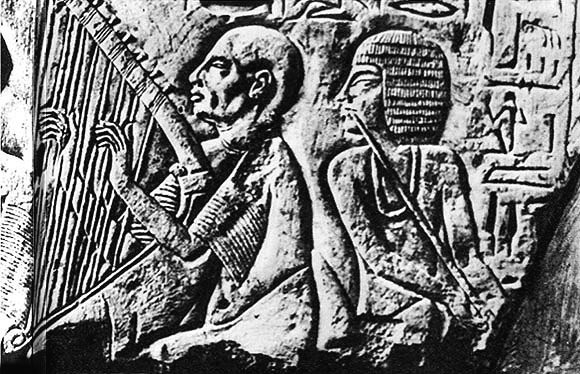
In the mastaba of the professional singers, Nefer and Kahay, built during the rules of the last King Unas (Wenis) from the V Dynasty, Old Kingdom (2700-2200 BC), the funeral stela at the vestibule is composed of two registers (panels). The lower register shows two instrumentalists, seated, side by side – a woman and a man, playing elongated arched harps of shovel-shaped bodies made of wood with vertical strings; while on the upper register the cheironomist "conducts" a singer, and a musician playing a double-clarinet or reed-blow pipe (end-blow flute). The harps stood upright on the floor, with the players kneeling behind the instrument. The term benet have been written in hieroglyphs next to the representations of the shovel-shaped harps, and was used also as a term for other types of harps portrayed in the same mastaba. (Latter, the benet described any variant of the harp). The mastaba of Nefer and Kahay at Saqqara, built under the fields and gardens at the edge of the Nile Valley on the long causeway, called Wenis Causeway, was a non-royal tomb of two esteemed musicians, a father and a son. They attracted the attention of the royal court by the beauty of their voices during mundane festival performances as well as religious ceremonies. They were bestowed with many titles and recognitions, and conferred the privilege to build their tomb within the funerary complex of the King Unas. The mastaba used to represent a last testimony concerning the identity and the aspirations of the tomb owner. * * *
Two seated harpists playing for the tomb owners Nefer and Kahay.
Stela, detail. Tomb of Nefer and Kahay. V Dynasty, 2498-1245, Old Kingdom.
Memphite Necropolis at Saqqara.
Source: A.M. Foamed and H. Altenmüller The Tomb of Nefer and Kahay.
Verlag Philipp von Zabern, Mainz, 1971.
Musicans, singers and dancers – men and women – are carved on the bas-relief (stucco and limestone) at the mastaba of Ny-kheft-Ka, at the ancient necropolis at the Saqqara Plateau on the West Bank of the Nile, where the best limestone quarries were found, just opposite to the Western Desert. This architectural decoration shown below from the V Dynasty, Old Kingdom, is on exposition at the Egyptian Museum in Cairo. It is noteworthy that on this entertainment relief, a single harpist playing an arched harp with the vertical strings attached to the elongated sound box in a kneeling position is "conducted" by two cheironomists (acting as the ensemble and section leaders), allowing the possibility of some kind of harmonic accompaniment, i.e. playing in harmony, probably using a simple heterophony (the simultaneous playing of two separate melodies.) * * *
A harpist playing harp and two cheironomists.
Tomb of Ny-kheft-Ka. V Dynasty, 2498-2345 BC, Old Kingdom.
Bas-relief, detail. Stucco and limestone.
Necropolis at Saqqara.
The Egyptian Museum, Cairo.
In the Northeast sector of the Memphite necropolis at Saqqara, at the edge of the plateau, the diagonal form of the pyramid rises, built by Pharaoh Teti, the founder of the VI Dynasty (2345-2181 BC). Not far from there, where the veritable, imposing mastabas were built, the tomb of the official Mereruka emerged, containing 32 chambers, from which six were designated for his wife, the musician and princess Wadjet-khet-hor, a daughter of the King Teti. Out of a dozen titles held by Mereruka, that of Vizier of the King of Upper and Lower Egypt, Teti is worth remembering. The wall paintings made references to a funerary pilgrimage of the deceased to Abydos, the Holy City of the South..., although we will never know if he actually made his pious voyage. Close to the entrance to the final room where the sacred scene of his "coming forth by day" is played out – the scene of the marital bed depicted the vizier listening the to harp played by his wife. This type of shovel-shaped harp was created probably by observing the gardens, or field tools, and occurred only between c. 2800 and 1640 BC, in the Old Kingdom or Middle Kingdom; later on it was replaced by the so-called ladle-shaped harp, the most played instrument in the subsequent New Kingdom. The painting below shows Wadjet-khet-hor playing the harp before her husband, vizier Mereruka, made by the American painter Joseph Lindon Smith (1863-1950), a member of the Harvard-Boston Expedition to Giza, who recorded with a paint brush the ancient artwork as it was found by archaeologists. * * *
The wife of Vizier Mereruka playing the harp on the marital bed.
Mastaba of Mereruka. VI Dynasty, 2345-2181 BC, Old Kingdom.
Necropolis at Saqqara.
Source: Joseph Lindon Smith, Paintings by Joseph Lindon Smith: Egypt at the Thorn.
Thorne-Sagendorph Art Gallery, Keene State College, New Hampshire.
In almost every ancient Egyptian tomb and mastaba, between the motifs depicting the whole range of daily activities from agriculture to... pedicure, there were scenes entirely devoted to music, entertainment, and harps of various styles and sizes with 6-22 strings, sometimes beautifully adorned. The simple, primitive few-stringed bowed harp had been in existence long before in the pre-historic civilizations. * * *
The cultural history in ancient Egypt written on papyrus scripts, carved on temples, and inscribed in the necropoles recorded the names of the musicians and their professional life, even though some references are fairly scanty and obscure. During the millennia, the creativity of unknown artists and craftsman became the most important part of the development of the harp, as the harpists, themselves held the most special place within the hierarchically organized Egyptian society, being very often connected with royalty. In Egypt, there was no gender restriction for harpists, the instrument was played by both men and women. Some pictures show male harpists with shaved or bald heads, suggesting physical purity; others depict the harpists with large bellies and bulges on their stomach, obviously well nourished by their owners. A special category of musicians was of those with impaired vision or complete blindness, often referred to as the blind harpist (harper). It appears that in some periods of Egyptian history the musicians performing at the temples and pharaoh's palaces were intentionally blindfolded, or even willfully blinded. The reason can have been of both practical and symbolic nature. Strangely enough, the male players were "deprived" of their eyesight with a white band, as during sacred ceremonies they were not allowed use of their eyes in the presence of gods or kings. Sometimes it was symbolically important to show the power of the god to make "blind" the ordinary mortals. Or maybe the closed eyes showed only the moment of divine inspiration during a performance at the temple by the musician portrayed on the painting? To the contrary, the female musicians were never blind or blindfolded. Because of their femininity, they were allowed to approach their divinities closely, as to deify, adorn or "pacify" them.
The following illustrations, some from sources not quoted, will mention several harpists by their names. * * *
In the large mastaba of Prince Nikaure (Nekauwra), the oldest son of Pharaoh Khafre (Chepren) –: the builder of the Great Pyramid at Giza and the Great Sphinx (having his facial features) – the famous singer Iti was commemorated. It was a rare honour to an artist, who may have delighted Prince Nikaure, an accountant, during his lifetime. The picture below shows the singer Iti, sitting and singing, with one hand behind the ear, as she would have performed the gestures of the cheironomist. Next to her, the first harpist, mentioned by name Hekanu also spelled Hekenu ("Praise"), played the slender arched harp having an elongated neck. These two musicians became the best known performing duo during the V Dynasty (2498-2345 BC), in the Old Kingdom.
Performing duo: Singer Iti and Harpist Hekanu.
Tomb of Prince Nikaure. V Dynasty, 2498-2345 BC, Old Kingdom.
Stela. Necropolis at Saqqara.
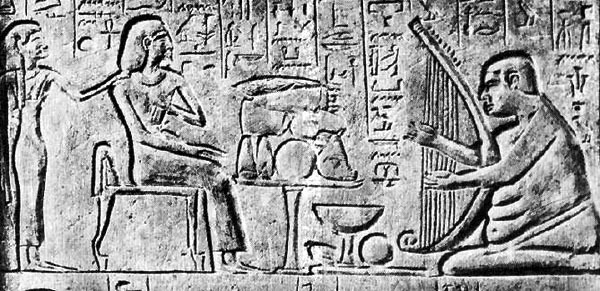
During the period of the Old Kingdom (2800-2250 BC) the records at the temples preserved mostly the names of sacred musicians. On the contrary, it seems that in the Middle Kingdom (2040-1640 BC), the names of musicians performing mundane and courtly secular music gained much importance. One of the most interesting iconographic examples, is the funerary stela depicted the harpist named Neferhotpe (sometimes spelled Neferhotep), the head archer from XII Dynasty (1991-1782 BC), during the reigns of Pharaohs Amenemhet I-IV (First to Fourth). The picture below shows a corpulent Neferhotpe, sitting on both feet in front of the offering table with his eyes narrowed, as he might be blind. With one hand he plucks the strings of the small arched, eight-stringed harp, oval in shape, and supported by his belly. With the other hand he reaches the table with an intention to take food, symbolizing, perhaps, the eternal gourmand. The stela was erected by his friends, the artisans Nebsumenu and Sunebau, and intended to show the harpist, perhaps chubby, but in the way they remembered him. * * *
Harpist Neferhotpe playing small arched harp.
Tomb of Nebsumenu and Sunebau. XII Dynasty, 1991-1782 BC, Middle Kingdom.
Stela. Necropolis at el-Khokha, Western Thebes.
In the tomb of Patenemheb, a High Priest of Re, who served during the reign of Pharaoh Amenhotep IV from XVIII Dynasty (1570-1293 BC) in the New Kingdom (1570-1070 BC), a limestone relief, composed of upper and lower registers, shows a blind harper playing with an "orchestra". It seems that music was indispensable to the enjoyment of the eternal banquet by the deceased. Even though the iconographic convention during the thousands of years did change little, the form and style of the harp varied through the centuries. The picture below shows harpist sitting on both feet played a small harp, held close to his chest. * * *
Blind harpist playing with "orchestra" for the tomb owner Patenemheb.
Tomb of Patenemheb. XVIII Dynasty, 1570-1293 BC, New Kingdom.
Relief, limestone, detail.
Necropolis at Saqqara.
Rijksmuseum, Leiden, The Netherlands.
Source: H. Hickmann, Music History in Picture. Egypt. Vol. II.
VEB German Publishing House, Leipzig, 1961.
Blind harpist playing with "orchestra" for the tomb owner Patenemheb
Tomb of Patenemheb. XVIII Dynasty, 1570-1293 BC, New Kingdom.
Relief, limestone, detail.
Necropolis at Saqqara.
Rijksmuseum, Leiden, The Netherlands.
Source: François Daumas, Od Narmera do Kleopatry.
Panstwowe Wydawnictwo Naukowe, Warszawa, 1973.
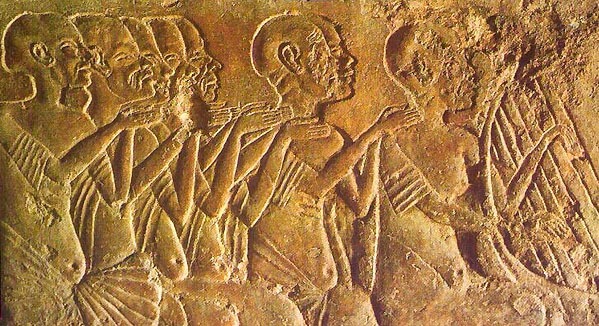
The tenth king of the XVIII Dynasty, Pharaoh Amenhotep IV (better known as Akhenaten or Echnaton) was perhaps the most controversial ruler in Egyptian history. The beginning of his reign marked no great discontinuity with his predecessor. Not only was he crowned at Karnak, in the Great Temple of Amun but, like his father Amenhotep III, he married a non-royal woman, the beautiful Nefertiti. In the early years of his reign, he realized the power of the priesthood of the god Amun, and soon introduced a new monotheistic cult of the god Aten, the life-giving Sun Disk. He changed his name to Akhenaten or Echnaton, and moved the capital from Thebes to the desert city of Amarna, on the East Bank of the Nile River, in Middle Egypt, where he was born. Akhenaten not only led religious reform in ancient Egypt, but he also broke an existing convention of Egyptian art by introducing an artistic style that reflected the king's unusual physical deformation. The result was a stylistic trend to portray him with his physical deformities (and including his family, his wife Nefertiti and his entourage normal in appearances), ignoring idealistic portraits of the royals from the earlier periods of Egyptian history. In the tomb of the High Priest Merire from Amarna, a blind harper is striking a few strings of the hemispherical harp with the accompaniment of a chanting and clapping man. Their long faces of sharp chins, long necks, arms and fingers, heavy bellies, and enlarged breasts are characteristics of the Amarna Period. * * *
Blind Harper from Amarna Period.
Tomb of Merire, XVIII Dynasty 1570-1293 BC, New Kingdom.
Relief, detail.
Necropolis at Tell el-Amarna, East Bank of the Nile.
According to present theories it appears that it was only the upper class of ancient Egyptian society that accepted the new Akhenaten’s religion; the ordinary people continued to worship their deities and gods. The only occasions when they had to be a part of the new religious establishment was during grandiose holidays, when the god Aten's statue would be carried in procession from the sanctuary outside the great temple walls. At the end of Enchaton's reign, his high civil and military officials exerted strong influence on the kingdom. The generals Ay and Horemheb (both man would become pharaohs before the end of XVIII Dynasty) took the lead of the country while Pharaoh Akhenaten pursued his own philosophical and religious interests. Meanwhile, Patenemheb, the High Priest of Re (cited above), who witnessed the fall of Amarna, surrendered the province to local leaders. * * *
At that time, in the highly structured military organization of the New Kingdom, the military leaders were granted tombs befitting their ranks and actions. Below, a few examples of wall decorations in their chapels will show the musicians and harps depicted (some badly damaged) in still usual funeral settings with emphasis on the deceased's honours, and military recognitions. The impressive passages of their military career were often very much enhanced, evidently on the request of the tombs' owners. Their private mastabas were mainly built at the necropoles at Saqqara, and Sheikh Abd el-Qurna, on the West Bank of the Nile River, approximately 500 miles apart. The similarity of the decorative styles and motifs resulted partially from a small number of workshops, and probably a lack of training of the artists. It seems that just one painter, or a small group of artists, did all the funeral art. The harpists are largely represented with beautiful, boat-shaped harps played often in standing position. The harp, formerly a solo instrument, now became mainly an instrument played in ensemble. The flutes and the singers of the past were replaced by musicians playing lutes and lyres (even though the singers and flutist were still employed).
In the private tomb of Horemheb at Saqqara, the last Pharaoh of XVIII Dynasty (1570-1293 BC), the chief general or generalissimo of the Egyptian armies under King Tutankhamun, with whom he was credited to have restored the cult of the god Amun, the funeral scene (today nearly completely missing) represents the harpist playing a large bowed-harp in a music ensemble with two lutenists. This colorful yet modest, Horemheb's burial place at Saqqara necropolis was later replaced by a new funeral temple complex with much richer décor built at the Valley of the Kings in Western Thebes.
Pharaoh Horemheb's Musical Banquet.
Harpist and two lutenists.
Private mastaba of Pharaoh Horemheb.
XVIII Dynasty, 1570-1293 BC, New Kingdom.
Necropolis at Saqqara.
At the Sheikh Abd-el Qurna necropolis, the military official Nebamun, who served under the reign of the kings Tuthmosis IV and Amenhotep III from XVIII Dynasty (1570-1293 BC), and who during his long career was granted the honour and the title of the Standard Bearer of the Royal Bark, built four tombs. In those the biographical notes about the deceased were the testimony not only of his life, but also about the important military events in the New Kingdom. The funerary banquet scene is almost a copy of the Horemheb's mastaba. This detail shown below from the painted fresco is damaged; the musicians' faces have been desecrated, erased, and covered with graffiti. * * *
Military Official Nebamun's Musical Banquet.
Harpist and two lutenists.
Private mastaba of Nebamun.
XVIII Dynasty, 1570-1293 BC, New Kingdom.
Necropolis at Saqqara.
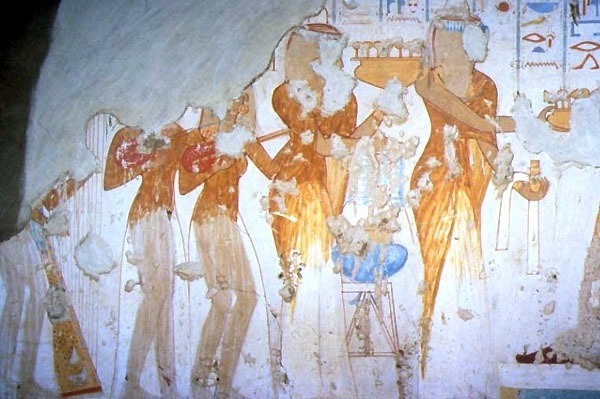
The tomb of the state official Djesekareseneb, built at the necropolis Sheikh Abd el-Qurna, on the West bBank of the Nile at Thebes, although unfinished and damaged, can still tell us much about its owner’s life and work. The pastels of the tomb's painted walls are often reproduced as examples of ancient Egyptian art. This tomb can be dated to the reign of Pharaoh Tuthmosis IV (1419-1386 BC.), in the middle of XVIII Dynasty. The themes chosen for the painted scenes follow the stereotype conventions of tomb painting by portraying the activities of the deceased on earth and a strong touch of realism and humour. The tomb walls (divided into horizontal registers) show many offering scenes to the gods, and the traditional funerary banquet without which no respectable Egyptian tomb would be complete. In the illustration below, the four musicians in this tomb are all females, playing the lyre, double pipes and a lute; the leader of this ensemble is a harpist, playing in standing position an eleven stringed harp with the boat-shaped resonance box covered with leopard skin décor. This scene, also known as a Harem banquet, shows a little dancer in the centre, suggesting a relation between the deceased and the girl. * * *
State Official Djesekareseneb's Musical Banquet.
Harpist, lutenist, lyre player, and child dancer.
Tomb of Djesekareseneb. XVIII Dynasty, 1579-1293 BC, New Kingdom.
Necropolis at Sheikh Abd el-Qurna, Western Thebes.
Oriental Institute, Chicago
State Official Djesekareseneb's Musical Banquet.
Harpist, lutenist, lyre player, and child dancer.
Tomb of Djesekareseneb. XVIII Dynasty, 1579-1293 BC, New Kingdom.
Necropolis at Sheikh Abd el-Qurna, Western Thebes.
Copy derived from the wall painting by an unknown painter.
The iconography of the harp in Ancient Egypt, enriched by the greater variety of the harps especially during the period of New Kingdom (1550-1070 BC.), can be classified – depending on the shape of the sound box (resonator or body) and the line of the neck – as arched, boat-shaped, crescent-shaped, ladle or spoon shaped, shovel-shaped, portable footed, and angular (or angled). Although no examples of these harps have survived, the instrument was frequently represented on wall paintings. The funeral scenes of musical banquets are full of important information about the development and the history of the harp. It is almost impossible to estimate the great contribution to the fine arts by thousands of unknown artists, painters and craftsmen who have shared their extraordinary talents, creativity, vision, and initiative to the whole then and now civilized world. * * *
During the reign of Pharaoh Tuthmosis II (1518-1504 BC) from XVIII Dynasty, for a short time there appeared a ladle-shaped portable harp with a large hemispherical neck decorated with the head of the pharaoh or the god Amun-Re. The band décor of lotus flower separated the polar end of the sound box from the neck. This type of harp (called a footed harp) with five to eleven strings was played in kneeling position, and was supported by player's knee, and by a slanted brace or stand (foot). Such a harp was probably introduced by a harp player and singer named Bakit (not pictured here). This type of instrument was in use not for a long time, even if it was painted in many tombs until the introduction of the new artistic style, known as the Amarna Period.
In the tomb of Rekhmire, vizir and governor of Thebes during the reign of Pharaoh Tuthmosis III (1504-1450) from XVIII Dynasty (1570-1293 BC), at the necropolis at Sheikh Abd el-Qurna, the wall painting representing the funeral scene can indeed bring a lot of joy by listening to a lady "orchestra" playing the lute and the tambourine (this detail not shown in the picture below), and the arched, ladle-shaped portative harp, supported by foot. This is probably the best artistic work in the tomb, where both male and female musicians wear bright clothes and play diverse instruments to entertain the guests. * * *
Governor Rekhmire's Musical Banquet.
Harpist and lute player, detail.
Tomb of Rekhmire. XVIII Dynasty, 1570-1293 BC, New Kingdom.
Necropolis at Sheikh Abd el-Qurna, Western Thebes.
Governor Rekhmire's Musical Banquet.
Harpist and lute player, detail; B&W photograph.
Tomb of Rekhmire. XVIII Dynasty, 1570-1293 BC, New Kingdom.
Necropolis at Sheikh Abd el-Qurna, Western Thebes.
Source: Kazimierz Michalowski, Teby. Arkady, Warszawa, 1973.
In the tomb of Amenemhab, a lieutenant-general during the reign of Pharaoh Tuthmosis II (1518-1504 BC.), the fourth pharaoh from XVIII Dynasty, married to his half-sister, Queen Hatshepsut, the relief shows a male harper playing the arch, ladle-shaped portative harp with foot supporter. It is a detailed scene from a larger funerary musical banquet painted on the tomb's wall. The name of General Amenemhab should be not confused with the name of a singer Amenemheb, called Mehu, who during the reign of Pharaoh Amenhotep II (1453-1419 BC) held the title of the Servant of the King with the glorious harp of Amon. * * *
Lieutenant-General Amenemhab's Musical Banquet.
Harpist playing the harp, detail.
Tomb of Amenemhab. XVIII Dynasty, 1570-1293 BC, New Kingdom.
Necropolis at Sheikh Abd el-Qurna, Western Thebes.
Kingston Lacy House, Dorset, England.
In the tomb of Amenemhab another banquet scene is depicted on a wall painting: a musical ensemble of four musicians plays the lute, double-pipe (reed) and two vertical bow harps commonly used in Ancient Egypt in the times of all Pharaonic dynasties. This scene, arranged as a long processional avenue, commemorated the sacred ceremony of the Opt Festival during which the High Priest carried the shrine of Amon of Thebes from the Temple of Karnak to the Temple of Luxor in the times of the imperial splendour of Ramesses II (1304-1237 BC).
Lieutenant-General Amenemhab's Musical Banquet.
Two harpists, a double-pipe player, and a lute player, detail.
Tomb of Amenemhab. XVIII Dynasty, 1570-1293 BC, New Kingdom.
Necropolis at Sheikh Abd el-Qurna, Western Thebes.
Source: Hassan el-Saady, The Tomb of Amenemhab No. 44 at Qurnah (1997).
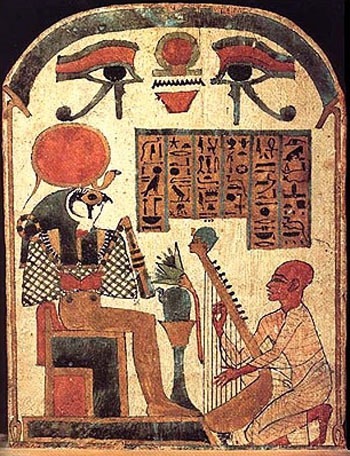
During all periods of ancient Egyptian history of music, the instrumental music would have been performed also as an accompaniment to the songs. In the funerary arts the harpists were employed to celebrate the gods by singing the hymns in favour of the deceased. The beautiful stela at the Louvre Museum, from XXI Dynasty (1069-945 BC), represents the harpist by name Dsched-chonsu-ui-ef-anch. He plays the harp before the Offering-table. In kneeling position he is singing the hymn to the solar god Ra-Harakhte, (meaning Re (is) Horus of the Horizon), to whom the Haroëris (Horus the Elder) is associated, who, like the god Osiris, or his son Horus (meaning "He who is above"), presided over the destiny of the deceased. The falcon-headed god Horus with the solar disk - the guardian of the pharaoh - is wearing the pharaonic regalia: flail – the symbol of Osiris, and a crook - the hieroglyphic sign meaning "king". The powerful Horus' sacred "sound eye" (Udjat), frequently found in tombs, on coffins and painted reliefs, symbolized healing and protection. The harpist shown below, depicted with ladle-shaped harp decorated with pharaoh's head, is singing Harper's Song, of which only two versions exist in the ancient Egyptian literature. * * *
The original version of the Harper's Song was found near the figure of the harper at Pharaohs Intef's burial tomb at the necropolis Dra Abu el-Naga at Waset, (within the Western Thebes necropolis site on the West Bank of the Nile River). The oldest version of the song, or rather dirge, known as Song of the Harper (c. 1160 BC), from the Third Intermediate Period (1069-945 BC), under the reigns of the High Priests, was first written on the wall of the chapel of the Thebian king Inyoted (known also as Antef or Intef) from XI Dynasty (2134-1991 BC), Middle Kingdom (2040-1782 BC). The Song of the Harper, which was sung with the harp accompaniment during the funeral banquets to entertain the guests, has survived to the New Kingdom (1570-1070 BC). In this poem two names are linked:
- the name of the Grand Vizier and High Priest Imhotep, a physician and an architect under King Zoser (Djoser), and the builder of the great Djoser Step Pyramid at Saqqara, c. 2800 BC; his mastaba at the necropolis at Memphis no longer exists, buried under the sand;
- the name of Hordedef, who was a prince during the IV Dynasty and probably son of Khufu (Cheops), the master-builder of the Great Pyramid of Giza.
The Song of the Harper, translated by Miriam Lichtheim, was published in the Ancient Egyptian Literature, Vol. 1.Below is an excerpt from Harper's Song:
He is happy, this good prince!
Death is a kindly fate.
A generation passes,
Another stays
Since the time of the ancestors.
The gods who were before rest in their tombs,
Blessed nobles too are buried in their tombs.
(Yet) those who built tombs,
Their places are gone,
What has become of them?
I have heard the words of Imhotep and Hordedef,
Whose sayings are recited whole.
What of their places?
Their places are gone,
As though they had never been!
Until we go where they have gone!
Follow your heart as long as you live!
Harpist playing and singing before the god Ra Harakhte.
XXI Dynasty, 1069-945 BC, Third Intermediate Period.
Stela. Louvre Museum, Paris.
- Footnotes:
- The name "Pharaoh" :
The most powerful person in ancient Egyptian Kingdom was the ruler who held the title Pharaoh. This word can be transferred as the supreme political ruler, and simultaneously the supreme religious leader. As The Lord of the Two Lands, the pharaoh was the ruler of Upper and Lower Egypt and hence, in modern times, is sometimes referred to as king. As The High Priest of Every Temple the pharaoh represented the gods on Earth. He performed rituals and built temples to honour the gods (and often himself). The pharaoh was also considered a god – the greatest god on Earth – and was viewed as a man with a supernatural power. The term "pharaoh" has been derived from a collective word meaning The Great House (Per – aa); that meant Per – house; aa – great. According to the belief of the ancient Egyptians the first Pharaoh was the god Ra, and subsequently every pharaoh was the "Son of Ra" who had the falcon-headed Horus – the sky god, living within him. (return)- Thebes is the historic name of the capital of the Upper Egypt. The city began as a coalescence of several villages and had an old-Egyptian name of Waset. It was was referred to by Homer in the Ninth Song of The Iliad as "The city of a hundred gates." In this city the great temples of Karnak and Luxor were the symbol of Ancient Egypt's grandeur and power.
Karnak and Luxor are located on the eastern side of the Nile River on the site of the southern part of the city of Thebes. Today's Eastern Thebes is divided by a canal into two parts where the ruins of two complexes of temples have survived: Karnak (in the north) and Luxor (in the south)
The name Luxor, originated from the Arabic word al-Qusur (meaning "the castles" or "the palaces"), is a later name of a fortified camp built in this area by the Romans in late antiquity. The ancient Egyptians called Luxor "The Temple of the Nativity" thus it was regarded as the southern residence – "the southern harem" of the god Amun where he resided as the ruler.
Karnak, north of Luxor, is yet a later name of an Arab village set after the Arabic invasion of 641 AD. In Ancient Egypt, Karnak, named Ipet-Ishut (The Most Selected of All Places), was the largest temple complex ever built in honour of the god Amun-Ra.
The temple of Karnak (Opet-Suet) was linked with the Luxor temple (Opet-Reset) with a long stone-carved alley aligned with forty sphinxes having the heads of sacred rams – god Amun's symbols. Six small shrines were erected along this alley. It was believed those were being visited by Amun during the Opet festival.
On the west bank, across the River Nile, there are a large number of necropoles – the Cities of the Dead – known under the collective name of Western Thebes, where magnificent funerary structures were erected that have survived in quite good shape. Best known are perhaps those in The Valley of the Kings, opposite to Karnak. The names of other necropoles in Western Thebes, such as Szeik Abd el-Gurna, Dra Abu el-Naga, etc., have been derived from the later Arabic names for these areas or from the names of the land owners, or the topographic features of these sites. The name of the oldest Memphite necropolis at Saqqara, in the north, on west bank of the River Nile, south of Giza and close to Cairo, was derived from the name of the funerary god Soqar (Sokar) or the word for plateau. (return)
- Some harp researchers attempt to discern between the terms harper and harpist. In general, harper is more likely an advocate of the older traditions, in some way an archaic musician praising gods, or a bard (sometimes blind) telling stories, and playing a less developed and smaller non-pedal harp; while a harpist is a classically trained pedal-harp player, a professional musician, a soloist and recitalist or an orchestra member in an opera or a symphony. (return)
© Liliana Osses Adams
California, April 2004.Biographical note on the author
Articles and poems by Liliana Osses Adams published in Zwoje – The Scrolls
- Liliana Osses Adams: Notatki harfistki (II) (in Polish), Zwoje 2/39, 2004
- Liliana Osses Adams: Notes of a Harpist (II) (in English), Zwoje 2/39, 2004
- Liliana Osses Adams: Notatki harfistki (I) (in Polish), Zwoje 1/38, 2004
- Liliana Osses Adams: Notes of a Harpist (I) (in English), Zwoje 1/38, 2004
- Liliana Osses Adams: Harfistka z Ur (in Polish), Zwoje 2/35, 2003
- Liliana Osses Adams: Harpist from Ur (in English), Zwoje 2/35, 2003
- Liliana Osses Adams: Celtycki bard Osjan, Zwoje 1/34, 2003
- Liliana Osses Adams: Srodlesny cmentarz w Laskach, Zwoje 5/33, 2002
- Liliana Osses Adams: Polskie cmentarze, Zwoje 5/33, 2002
- Liliana Osses Adams: Placz Artemizji, Zwoje 5/33, 2002
- Liliana Osses Adams: Parafraza / Paraphrase (in Polish and English), Zwoje 3/31, 2002
- Liliana Osses Adams: Konspiracyjny film w okupowanym Poznaniu, Zwoje 3/31, 2002
- Liliana Osses Adams: Jan Lechon – Poeta romantyczny, Zwoje 3/28, 2001
- Liliana Osses Adams: Pamieci Jan Lechonia, Zwoje 3/28, 2001

Copyright © 1997-2004 Zwoje