The Paradox of Tolerance: Chillida’s Dream and the Sacred Mountain | ArtSHIFTING

The Paradox of Tolerance: Chillida’s Dream and the Sacred Mountain
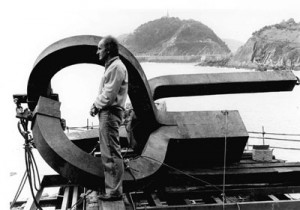
Eduardo Chillida- Peine del Viento, 1976 (All rights reserved by www.admsp.org)
It’s no surprise that Eduardo Chillida chose a mountain for his magnum opus. His work is monumental because for Chillida the backdrop or context of his works were just as significant to his message as the piece itself. His work “Wind Combs” and his eulogies to water and the horizon pay homage to the elements of nature. While at the same time he emphasizes the harsh relationship between man and nature by placing steel and iron structures against the solemn backdrop of wind, water and the horizon.
Chillida is perhaps one of Europe’s most prolific sculptors of the 20th century.
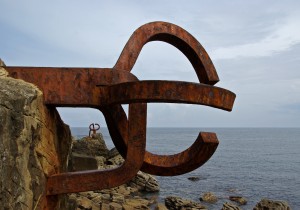
Haizearen Orrazia / Peine del Viento, Eduardo Chillida, Donostia (Some rights reserved by Sebastià Giralt)
His work is installed throughout Europe, Iran, Japan and the United States. His preferred medium was iron, but he also sculpted in clay, wood, plaster, alabaster and concrete. He was born in the Basque city of San Sebastian in 1924 and left only to study architecture in Madrid in 1943. Disenchanted with his studies, he decided to move to Paris in 1948 and work as a sculptor.
In 1984, he and his wife bought the Zabalaga farmhouse in the town of Hernani, just outside of San Sebastian. They would slowly expand the property and restore the farmhouse until it was ready for unveiling as the Chillida-Leku Museum in 2000. Unfortunately, Eduardo died in 2002 due to complications with Alzheimer’s disease.
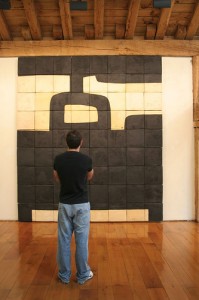
Chillida Leku (Some rights reserved by jandiano)
Eduardo’s death and a sharp economic downturn in 2008 seemed to take the life out of the museum. The next two years would be difficult for the museum and the Chillida family. The museum appears to have made modest attempts at soliciting external funding, producing special exhibits and participating in public outreach. By 2010 the museum would be forced to close its doors even though over forty prominent Spanish artists demanded that the Basque government keep it open. Twelve of Chillida’s sculptures are on sale in an effort to recover the losses incurred by the museum.
Eduardo’s death also came before he was able to begin work on his dream project, a mountain cave roughly 40 meters (131 ft) on each side that would be accessible from an 80 meter long tunnel. He started planning this project in the mid-1980′s and had several offers from Italy, Finland and Switzerland before he settled on Mount Tindaya on Fuerteventura (poulation 103,492) in the Canary Islands. He called this project a “Monument to Tolerance”, which seems rather ironic because there’s nothing ecologically, culturally or archaeologically tolerant about it. The project, if completed, will destroy about 64,000 cubic metres of rock from within the mountain. The mining rights alone cost 250 million euros. If that’s not enough, it will also threaten the integrity of roughly 100 podomorphs (foot carvings) that were discovered in 1978 and date back to the Majoreros who were a Neolithic people that arrived on the island sometime between 1,000 and 300 BC.
In fact, Chillida admitted that the project had caused him nothing but depression and insomnia as the controversy over the Tindaya
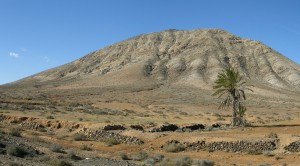
Tindaya (Some rights reserved by mataparda)
mountain project progressed. Perhaps the mystical powers of the podomorphs were already influencing the artist when upon first sight he claimed that they resembled his signature. He also noted that they were neglected and sometimes defaced because the local government was not protecting them. The ultimate paradox of this story is that Eduardo Chillida’s effort to honor tolerance by pompously excavating a mountain created a backlash of intolerance towards his work that “worships” the environment.
In January of this year a protest against the project was held outside the Canary Islands Parliament. Participants held banners saying “Tindaya no se toca” (“Do not touch Tindaya”). Similar protests were held in Fuerteventura and Gran Canaria. The Facebook group Cadena Humana Tindaya is also encouraging people to form a human chain around the proposed construction site and defend the mountain.
15 Responses to The Paradox of Tolerance: Chillida’s Dream and the Sacred Mountain
-
Melissa says:
Haizearen Orrazia / Peine del Viento, Eduardo Chillida, Donostia. This piece of art I found to be very beautiful and unique. To bad Eduardo never got a chance to start his dream project. I am sure it would have turned out amazing, like all of his other art work.
-
Whitney Freeman says:
I can’t say that I completely agree with Eduardo’s “dream project”. But his other works of art are truly stunning. Haizearen Orrazia, caught my attention right away. I love how his pieces are in natural settings, and to me they seem to resemble wreckage and ruins. The article discuses Eduardo’s aim to capture the “harsh relationship between man and nature”, and I think that was executed wonderfully here. The way the steel is twisted almost mangled even, is quite beautiful. It looks to be very old, as if it has been on that cliff since long before anyone living today. It looks to me like what our building today would look like if left unattended to for hundreds of years. I think that it serves as a reminder to us all how small and insignificant we are in the big picture of the universe. Ultimately nature is in control and more than likely one day our buildings, no matter how mighty they seem no, will one day look like Eduardo’s sculptures.
-
Cinthia Q says:
Eduardo Chillida was a very interesting sculptor his peaces had a unique and symbolic meaning to him. The creation of his art was a combination of time, space, gravity, the elements and nature. Some of his peaces had to be in a specific way and place in order to connect and had the representation that he wanted to project to his viewers. For example, “Wind Combs” it is a very interesting art piece, not only because of the shape, but because he placed it on a very unusual place which made it unique and special. I found very fascinating how he always thought about the different elements, the position of the horizon, the sun and the moon to decide where and how he was going to place the art piece. Also, I notice that some of his creations had the same kind of shapes, which from my point of view seems like he is trying to reach for something. I think it is a shame that the museum where some of his art work was on closed and also that he never got to finish his dream creation on the mountain.
-
Victor M says:
Eduardo Chillida was a very unique artist and i appreciated his works of art because there simple yet they find a way to be completely intricate. I think his last project was totally contradictory because it was supposed to portray a “Monument to tolerance”, but the project would have ruined a whole mountain side and many old cave drawings. I think Eduardo did this on purpose and was showing what he thought the world thought of tolerance. I found it amusing because the name of the piece and what had to be done for it to be made went against everything it was supposed to stand for. I believe his dream was to create controversy with the monument.
-
Emilie says:
These are very interestng pieces. They arent just something that can be loooked at once. Each piece really draws you and and makes you wonder what was going through the artiest head when it was being created. Its kind of cool because in the first picture it shows a very large metal thing sticking out the side of a cliff over looking the ocean. This almost eases the roughness of the work on viewers eyes and makes it more visually pleasant.
-
unahlisa7@gmail.com says:
Initially, I see the project in the eyes of the simple observer of talent and I think to myself, “Wow! What a concept!” but after giving it a little more thought and delving deeper into how I feel about the environment, I feel as though his “dream plan” is something that would be magnificent. That being said, I do not think this work of art would be consistent with his idea of “worshipping” nature. Nature is being worshipped by the CONCEPT alone of his pieces, but the actual act of excavated a mountain would be highly counter-productive. For me, I would suggest other media to get the point across, but who am I to try and tell someone what their “dream plan” is and how to go about doing it without contradicting their initial points being proven.
-
It always makes me sad to read about an artist who was never able to finish his dream, even if it was different than most sculptors would want to do. I cant say that I totally understand what he wanted to do with his “dream project,” but his other sculptures are beautiful. The scale at to which they are is amazing that at such an early time he created such amazing art. The Haizearen Orrazia, is so different but remarkable. I love how it is just protruding from the side of the mountain with the ocean or body of water behind it. It is beautiful. One thing I noticed is that he had some of the same shapes repeated throughout his pieces. It is sort of a have circle, looking like a “C,” intertwined each other. Eduardo’s story is such a typical tragic one of an artist, but so touching.
-
Christina says:
I think it’s awesome that the Spanish artists tried so hard to keep his museum opened. The government even tried raising money to keep it open because of how important and amazing it was. This artist seems really popular and well known. On another note, it’s sad that he died right before starting his dream project, although this “dream project” seems like it would have cause nothing but problems and would get rid of hand carvings and art that was found a long time ago. I believe that would have been the worst part because old art is cherish able.
-
Megan says:
I like how he uses clay, wood ,and iron for his mediums instead of paints or oil on wood panel. His works are super creative and different from a lot of other sculptures that
I have seen.I also enjoy how he uses nature to contrast with his works of art. It makes the piece look beautiful and allows it to become aesthetically pleasing to the eye. I don’t agree with his project ” Monument to Tolerance”. It would have cost a lot of money to construct and it would have distorted sacred foot carvings found there years ago . Many other agree that this mountain should be protected and that it shouldn’t be harmed. -
Eduardo’s work was really fascinating to me, how he could put nature and art into one. not only did his art look awesome it looked really difficult. you can tell this man enjoyed doing what he did by how much work he put into it. i was sad to see that he passed away and his museum couldn’t stay open, but that also just shows me his work couldn’t be duplicated and no one could do what this man accomplished. you can tell he was a very smart man because the way some of his pieces were placed he had to make sure it was in the right spot and had to make sure everything would connect in the right ways, and an iron piece hanging off the side of a mountain would probably be a little difficult to do with having to put the weight, length, and space into perspective all at the same time. it was really sad that he didn’t get to finish this piece.
-
Megan Stroud says:
This piece of art is very unique! when i first saw this it really caught my eye and i wanted to see more. Eduardo Chillida chose a really out of the ordinary spot to do this. He chose to do this on a mountain and i never would have thought of that. The rust on the piece of art and color make it look like it is very old and has a lot of history behind it. I am very pleased with this piece of artwork!
-
Megan Schneider says:
This art work is really incredible. I love how the rusted metal looks so majestic out in a natural setting. Expecially off a cliff, it really adds to the dramatic effect and makes it really unique. His work has such simplicity, but yet is so complex. His work really does combine different elements and morphs them so beautifuly into one. This man is a truely gifted sculpture. Love his work.
-
Katherine says:
I think it is very interesting that Eduardo Chillida was wanting to build a mountain cave as an art project and the fact that he was going to call it the “Monument to Tolerance” is funny to me because it seems like a lot of people were not tolerant to the idea of taking a part of such a big rock area and turning it into what Chillida had envisioned and planned out. Especially when they found the podomorphs in the stone and the fact that to make Eduardo’s plan happen it would cost about 250 million euros just to destroy the rock from the mountain. It is sad to me that he seemed to have a lot of support and people really enjoyed his artwork but then the economy hit and Eduardo died and it all seemed to go downhill from there to the point where his museum could not even afford to stay open. I think that Eduardo Chillida’s artwork was very fascinating after looking into some of it and I think he was very creative in his meaning behind his pieces and they way that he executed them.
-
Laura C says:
I believe this work of art is extremely amazing and surreal. I would probably would have never know what the artist Eduardo Chillida wanted us to know about this work “wind combs”. The beautiful art of the shape and the beautiful scene being in the edge and horizon of the water.I am very amazed by the way he thought before he did some sort of art. In a way he went threw it and try to think in a way that it would benefit it in the future.I also can observe that Eduardo’s art will be in a really unknown awkward kind of place. He wouldn’t just put his art in a museum but like in a nature kind of way.His art being outside,where everyone could see it. Wanting us to know their was a more meaning to his art placements beyond the normal thing.
-
Alex says:
I personally find artists with similar interests to Chillida’s to be the most fascinating. The contrasts between the environment and the man-made intrusive pieces of art really bring to light the impact humans have had on shaping the world into what it is today. Would it have been right for this man to fulfill his “dream project” and almost completely destroy such a significant portion of such a small island? If not, what makes it alright for anyone else (government or not) to urbanize these types of small islands? I have to say though, if it had been completed I’m sure it would have been just as awe-inspiring as his other pieces of work.


Leave a Reply
Your email address will not be published. Required fields are marked *
Name *
Email *
Website
Comment
You may use these HTML tags and attributes: <a href="" title=""> <abbr title=""> <acronym title=""> <b> <blockquote cite=""> <cite> <code> <del datetime=""> <em> <i> <q cite=""> <strike> <strong>
