|
|
|
|
|
|
|
 |
|
|
|
|
|
Poetry of Poverty
|
|
|
|
Throughout
his life Rousseau tried to conceal his private circumstances behind the
mantle of the artist, beneath the surface of his pictures. Yet the
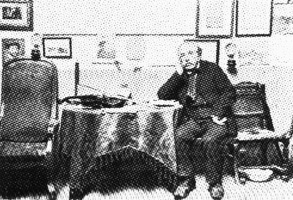
photograph taken of him in his studio about 1908 reveals much: the restrictions imposed
by poverty, in spite of late financial rewards; the isolation of the
outsider who yearned for bourgeois security and yet had nothing to call his
own except his painting, which enabled him to forget his bleak surroundings.
In the centre is his violin, with which, from time to time, he eked out his
little pension of 1019 francs as a street musician; and with which he also
entertained his guests at the soirées in this studio from 1907 onwards. Here
the glittering world of the cabarets and cafés of the Belle Epoque is not to
be found. It is a far cry from the superabundance on which Rousseau's
near-contemporary, Auguste Renoir, could draw. Everything that Rousseau
undertook, as a painter, as composer of the Clemence Waltz and as a
playwright, reflected in some sense the reduced circumstances in which he
lived.
|
|
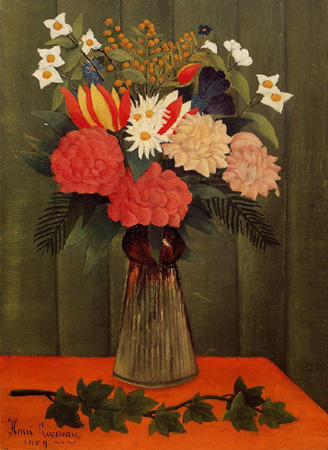 |
About 1890 he painted the
Flowers of Poetry. Grass and garden
take up the popular friendship cult expressed in the verses and garlands of
albums and cards at the turn of the century. Meticulous as a botanist,
taking pains over the smallest detail, Rousseau aligned his plants in a
single plane. The red curtain and the clear blue sky transpose the poor
man's bouquet to a reality in which the humble table becomes a balustrade
and there are no confining walls. The rigorously frontal pattern is
reminiscent of the millefleurs weaving that he may well have seen during his
youth in Angers, and perhaps even have copied in Paris in the Musee de
Cluny. The two-dimensional structure without air or light gives the still
life a contemplative quality. Taking a close look at what is apparently
without value, Rousseau celebrates the kitchen lyric and at the same time
his own ideals, at one with the ideal of nature. |
 | |
Bouquet
of Flowers with an Ivy Branch, 1909 |
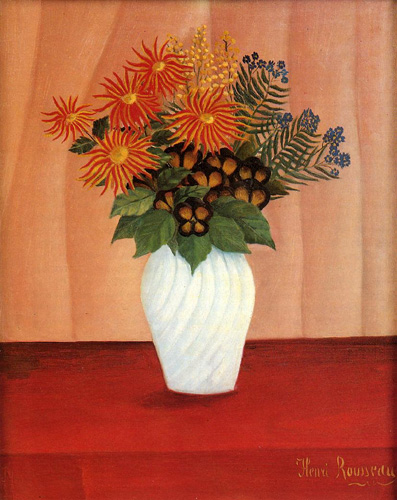
Bouquet
of Flowers, 1910 |
|
In an interview with the critic Arsene Alexandre given in 1910 he commented:
"Nothing makes me so happy as to observe nature and to paint what I see.
Just imagine, when I go out into the countryside and see the sun and the
green and everything flowering, I say to myself,'Yes indeed, all that
belongs to me!'" More even than Rousseau's desire for social recognition,
this avowal leads to the very centre of his creativity. The sequence of
twelve still-life flower pictures which have come to light so far explains very clearly why the Douanier attached
prime importance to the object and not to the process of painting as
did, for instance, Edouard Manet and Odilon Redon. For him the object,
in this case the plant, embodies the portion of beauty and happiness
that he finds outside and must encapsulate within his four walls as a
protection against drab constraints. He makes a fetish of the open
countryside, of public parks and gardens; brush and paint promise him
part-ownership. Dispossessed, he paints into his pictures what should by
rights be his. This motivation sets Rousseau apart from those artists
who laboured to convey an illusion or a notion. Like the painters of the
fifteenth century, he was at pains to take possession of reality;
painting is a tool. All means serve to emphasise the concrete closeness
of the object. Each form is observed individually, given precise
delimitations and spread out frontally - planted, as it were, in the
picture.
The painter proceeds as if he were a collector, sorting the flowers
according to species and colour groups, arranging them decoratively in a
vase which he always places in the central axis of the composition.
Nothing is left to chance. At no time is the viewpoint of the observer
taken into consideration. The horizontal table-top, the folds of the
curtain, the fluting of the vase, the forget-me-nots, pansies, dahlias
and mimosa aligned in a single plane, all draw attention to themselves
only, creating something clear and static for the observer to behold.
The apparent lack of individual characteristics and the neglect of space
relations make the still life look at first like an impersonal
stereotype. Symmetry, addition, enumeration are the regulating factors.
The resulting bouquet provides an inventory of reality. So resolute is
Rousseau's treatment of each detail that it almost seems possible to
dismantle the flower arrangement. It is the montage principle itself
that resolves the sense of transience. Each tiny detail asserts itself
as an independent object, only identifying itself with the concrete
surface of the picture. The shimmering light of the Impressionists is
replaced by the structure of the object, which conjures up a magic
counter-world. The familiar becomes strange; the pot with flowers in it
hovers before coloured squares; the table is a band of colour; the
curtain turns into an imaginary wall; external reality is less real than
the picture; beauty becomes an everlasting possession.
It is significant that the still lifes, usually painted in thick layers,
are considered to be the most clearly intuitive of Rousseau's works. No
ambitious claims are imposed; the simple object, by contrast with the
major themes, belongs to an intimate sphere. The tension between aim and
achievement, often an essential consideration in lay painting, is no
longer a concern. One with the possibilities at his disposal, free from
problems of representation, Rousseau develops a rigorous planar
structure which declares the picture unequivocally to be a flat surface.
His naivete, his unbiassed and unencumbered rendering of the object
perceived, can be regarded as a style in itself. Every detail is
executed with such concentration that it takes on an independent
existence as an ingredient of pure form. The object becomes an element m
the composition, a sign. Playfully and energetically Rousseau assembles
his signs. He has a basic flower still-life scheme, on which he creates
new variations, achieving a near-abstract effect by denying precedence
to the theme and placing the balance of colour-shapes in the foreground.
At the same time, the variations extend exploration to the boundaries of
the imagination. The beauty of nature becomes increasingly important to
the artist; towards 1910 it takes on strange, exotic features, which are
manifested in the jungle pictures of his last years.
Rousseau attached particular importance to these still lifes, which were
remarkable even in the context of post-Impressionism. Flower
watercolours, painted swiftly and decoratively, have survived from his
time as teacher at the Association Philotechnique. He shows a routine
which is not in the least naive, demonstrating clear awareness of the
difference between china-painting and the inventive experiments in form
which are his very own. Moreover, there is no contradiction between the
construction of nature as the quintessence of beauty and the wish for
symbolic ornamentation of a theme.
|
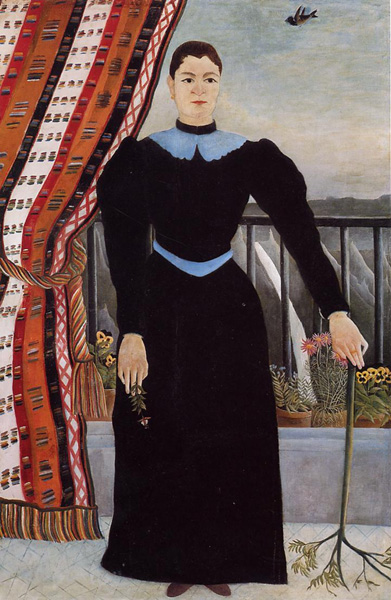
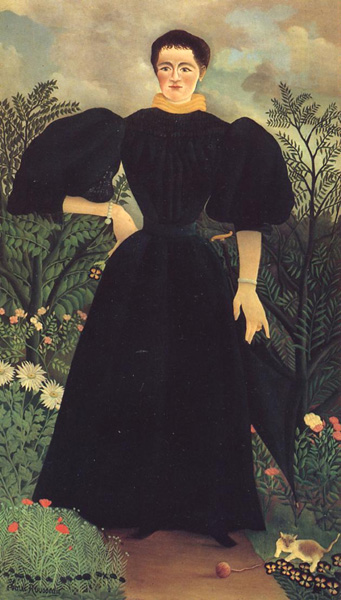
Around
1895 Rousseau painted two pictures of women (Portrait
of a Woman)
which belong to the sequence of portrait-landscapes although
they were commissioned works. For both pictures the painter made
only slight alterations to the basic scheme of his self-portrait
of 1890. He surrounded the dark silhouette of the figure with
motifs indicative of the subject's life. In each case the milieu
makes itself felt: the respectable suburban life of the petite
bourgeoise on the balcony, the elegant world of the lady walking
in the park. Since the figures are almost life-size, however,
their surroundings take on a more strongly allegorical
character, as if Rousseau would like to celebrate womankind, to
find in close proximity the fulfilment of his yearnings for
security and beauty. In his eyes, it is woman who tends the
garden, embodying union with nature. With flowers planted
carefully in pots she creates a barrier to protect the peace of
the home against the barren hills outside, probably a
representation of the fortifications around Paris, and yet
extraordinarily reminiscent of the background to Leonardo da
Vinci's Mono Lisa or Madonna of the Grotto . The
colourful flowerbeds in the park become an extension of domestic
peace, transforming the world outside into an earthly paradise.
|
 |
 | |
Portrait
of a Woman, 1895 |
Portrait
of a Woman, 1897 |
|
Autobiographical importance has been attached to both pictures. The
portrait of the woman on the balcony - purchased by Picasso in 1908 from
Pere Soulie - has been said to represent Rousseau's early love, the
Polish woman Yadwigha who appears in his play "The Vengeance of a
Russian Orphan" and in the jungle picture The Dream . The lady
with puff sleeves and umbrella is supposed to be his first wife,
Clemence. It is striking that the first picture has a bird and a broken
bough as attributes instead of a conventional surround, which might
indeed be taken to suggest a lost love. Behind both pictures there seem
to he Rousseau's poverty and his loneliness as a widower. After his wife
Clémence's death in 1888 he tried to fill the emptiness by leading a
bohemian life and engaging in diverse love affairs. From 1893 he lived
with Gabrielle, an officer's daughter. In 1894 he relinquished his
eighteen-year-old daughter Julia to relatives in Angers; she was no
longer willing to share her father's dubious milieu. He wanted to
protect her against the tuberculosis which had sent his wife and four
children to their graves. In the portraits, as in the still lifes, he
banished this everyday world of misery and disease, and paid homage to
an unproblematic reality, poetically exalted. All the magnificence that
his art could conjure he put into the ornate curtain, the hands
overdrawn in Gothic style and the figures themselves, intent on
competing with the classic coolness of masters such as Ingres.
In the two portrait-landscapes Rousseau indulges his penchant for allegory
only in minor motifs such as the plucked pansies, but other pictures are
more patently symbolic. The relatively simple composition The Present
and the Past is dated 1899, but partial overpaint-ing suggests that
it could have originated as early as 1890. Dora Vallier makes this
suggestion in her catalogue raisonne. If that is the case, Rousseau
would first have painted this picture as a tribute to his beloved wife
Clemence and then brought it up to date on the occasion of his marriage
to Joséphine-Rosalie Nourry, widow of one Le Tensorer. It would,
however, be a mistake to interpret the basic scheme of the picture as
indicative of an earlier phase of Rousseau's work, since his
compositions were occasioned by events, not shaped by formal
considerations. The rather prim portrait of the Girl in Pink is
less successful stylistically than the two earlier paintings of women.
It has been shown to date from 1907, although it used to be dated
earlier, and it portrays Charlotte Papouin, the sister of Rousseau's
Breton god-child.
It has been said that the Douanier did not produce the intensity of his
ambitious exhibited works when he undertook private commissions unless a
commensurate fee was forthcoming. This cannot be said of The
Present and the Past. The occasion was a personal one, perhaps
requiring the fifty-five-уear-old bridegroom to provide moral
justification for himself. He entwined himself and Josephine, whom he
married on 2nd September 1899, with clinging plants, seemingly in
repetition of Henri's avowal in "The Vengeance of the Russian Orphan":
"... love binds me to you, just as the ivy climbs up centennial oaks, to
be separated from the tree only when it is torn away. . ." The posy of
forget-me-nots in Rousseau's hand strengthens his pledge of faith. Yet
the declaration is made less to the second wife than to the first. In
the clouds hover the heads of the couple's late spouses, Le Tensorer and
Clemence Rousseau. The stiff and solemn newly-married couple unite in
the oath which subtitles the painting in 1907:
"Divided one from another,
From those whom they loved,
They joined together,
Faithful to their memory."
This is the Rousseau who ascribes magic power to painting. Like primitive
or non-European votaries of the cult of ancestors, he conjures the
spirits of the dead to appease them. He has good reason to do so for he
is superstitious. With the Rosicrucians and the symbolist poet Catulle
Mendes he took part in seances, and in 1898 even organised such sessions
in his studio at 3, Rue Vercingétorix. He felt Clemence's presence close
to him to the end of his life, reporting that she often guided the brush
in his hand. No doubt these inner forces prevented Rousseau from giving
full rein to his imagination in this picture; instead he had recourse to
the votive form, easily understood at a trivial level.
|
 |
|
|
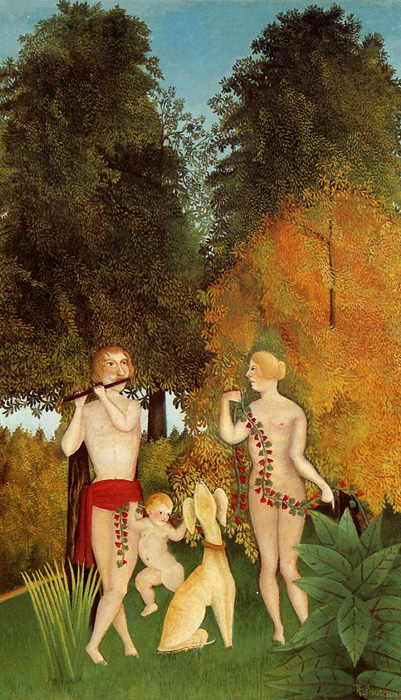
There
is another possible explanation of this touchingly naive
picture. In a late interview with Arsène Alexandre, Rousseau
insisted that everybody should be able to comprehend his
allegories. In order to clarify his meaning, he often
provided subtitles. Rather than trust the picture, he wanted
to say what the meaning of the narrative was - an absurd
undertaking since allegory depends on multi-layered meaning.
The moralist found a highly individual way of resolving the
dilemma of wanting to convey messages which were at once
cryptic and concrete. Conscious in this matter of his status
as a lay artist, he had recourse to techniques and practices
of popular art and folklore. Whereas The Present and the
Past draws on the custom of decorating photographic
portraits with floral motifs, so the composition Happy
Quartet bears a resemblance to stage backcloths or
painted curtains. It may have been modelled on the picture
Innocence by the Salon painter Jean Leon Gerome, one
of Rousseau's acknowledged advisers in his early days. It
was exhibited in 1900 m the exhibition "One Hundred Years of
French Art" which ran concurrently with the World
Exhibition - an important opportunity for the Douanier's
work to be compared with officially recognised art. The
result is highly informative. With regard to the model he
takes great liberties, quite apart from the fact that he has
difficulty with the nude figure. Alongside the traditional
figures of bourgeois culture he places his concrete
allegory, the landscaped park as earthly paradise, the ideal
figures of the little bourgeois family complete with child
and dog, joyfully entwined in the oath of love and
faithfulness. Each motif is complete in itself. The artist's
only purpose is to suggest to himself and others a happy
world, in harmony with the piper's tune. This childish need
for an unsullied reality knows no bounds. It is in this
spirit that many of tlie genre pictures, svich as the
numerous portraits of children, undergo an involuntary
transformation into metaphor.
|
| |
Happy
Quartet, 1902 | | |
|
|
|
 |
|
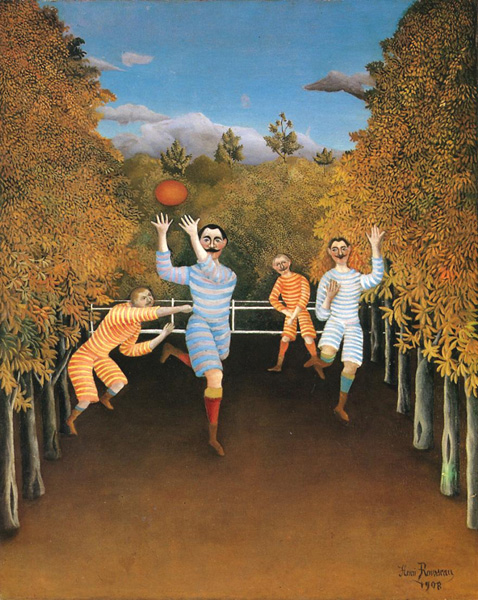
The
peak of startling joviality is achieved in the amazingly
modern work The Football Players of 1908. The
sportsmen hover like cut-out figures in their striped suits
before an avenue which might well be in the Pare
Saint-Cloud. The composition is radical: there is no
transition between bird's-eye perspective and frontal view;
the avenue is defined as playing-field by the white fence;
the figures are mounted in collage style, like puppets. The
picture was painted just at the right moment to commemorate
the first international match between France and England,
which took place in Paris in 1908; rugby football was still
a young game. Yet this profession of faith in popular
culture has its share of individual mythology; centre-stage
in the choreographic contest Rousseau paints himself,
victorious, dreaming as ever of success on all fronts.
|
| |
The
Football Players, 1908 |
|