|
| |
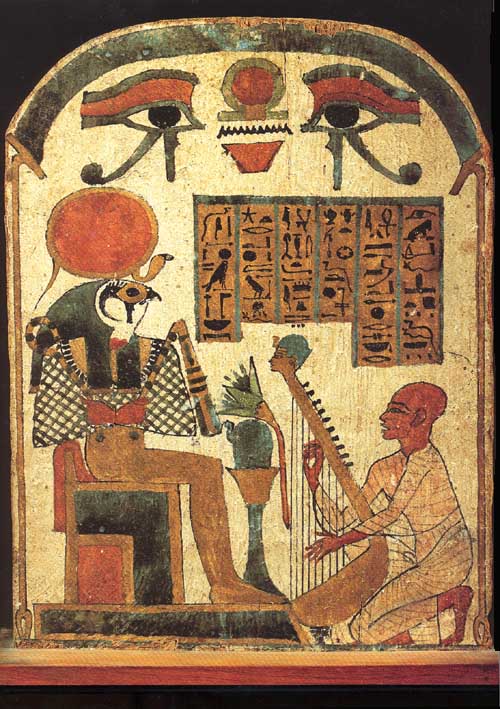
One of my favorite forms of Kemetic art is stelae, slabs of stone or
wood with inscriptions, paintings, or reliefs. There are funerary, votive,
commemorative, and boundary stelae, all with different functions. Votive stelae were
usually placed in temples and were decorated with painting on a thin layer of plaster or
with a painted relief. Most of the scenes on this type of stela show an individual
worshipping or presenting offerings to a god or goddess, usually the deity from which
he was seeking assistance.
The following are particularly beautiful expressions of this form of
personal piety, with examples dedicated to Het-Hert's father Ra. I plan to add
descriptions of the iconography and translations of the hieroglyphs in the future.

(1) Stela of Djed-khonsu-ius-ankh, Singer of Amun, plays the harp
before Ra-Heru-Akhety, Thebes, Third Intermediate Period, stuccoed and painted wood.
In Andreu's Ancient Egypt at the Louvre, p. 173. Translation
and description.
(2) Stela of Taperet, Third Intermediate Period, stuccoed and
painted wood. In Andreu's Ancient Egypt at the Louvre, p. 172.
(3) Stela of Djed-amon-iu-ankh, Thebes, Deir el-Bahari, Third
Intermediate Period, stuccoed and painted wood, in Saleh's The Egptian Museum Cairo:
Official Catalog, pl. 243
(4) Funerary stela of Den-iuen-khonsu, Mistress of the House and
Musician of Amun, Third Intermediate Period, painted sycamore fig wood (33 cm high),
London, British Museum, in Gay Robins' The Art of Ancient Egypt, pl. 245, p. 204.
(5) Stele of Dief-ankh, Thebes, Ramesseum, Dynasty 22 or 23,
plastered and painted wood, in Silverman's Searching for Ancient Egypt: Art,
Architecture, and Artifacts, pl. 98, p. 284.
(6) Funerary stele of Mer-Hathor-ites, Early Ptolemaic Period (end
of 4th c. BCE), Vienna, Kunsthistorisches Museum, in Schulz and Seidel's Egypt: World
of the Pharaohs, pl. 45, p. 313.
(7) Funerary stela of Djed-khonsu-es-ankh, from the Luxor Ramesseum,
Third Intermediate Period, wood gesso and pigment, 22nd Dynasty, in the Oriental Institute
Museum. (OIM 1351) (Photographed by NeferuHethert) Translation and
description.
(8) Funerary stela of Ankh-ef-en-khons, the priest of the sacred
staff of Amun, probably from Thebes, c. 600 BCE, painted wood, British Museum, in Malek's Egyptian
Art, pl. 233, p. 371.
(9) Stela of Iri-ka-Ra from Luxor, ca. 945 B.C.E., Third Intermediate
Period, in the Oriental Institute Museum (OIM 1352). (Photographed by Neferuhethert)
(10) Stela of Padi-khonsu, from the Theban area, Late Period, 25th
Dynasty, c. 700 BCE, painted wood, Berlin Museum, in Schoske's Schönheit Abglanz der
Göttlichkeit: Kosmetik im Alten Ägypten, p. 71-72.
(11) Stela of Nes-khonsu-pa-khered, Dynasty 20-21, painted wood, in the
Museum of Turin, Scamuzzi's Egyptian Art in the Egyptian Museum of Turin, pl.
XCII
(12) Stela of Tentesamun, Chantress of Amun, Third Intermediate Period,
Dynasty 22, from Thebes, in the Fitzwilliam Museum, in Vassilika's Egyptian Art,
p. 44.
 Text and original graphics copyright ©
1999-2007 by Neferuhethert. All rights reserved. All graphics which are not original works
have been credited to their source or used with permission, and their copyright remains
the property of the source cited. No use of any original written or graphical material is
allowed in any form whatsoever without prior written permission. Questions
should be directed to neferuhethert at aol.com. This is a non-profit website for
educational purposes only. Last updated 01/27/10.
|