Aramco ExPats Articles | In Search Of Oil

Aramco ExPats
Category Archive: In Search Of Oil
“Dear Folks”: The Webster Letters From Arabia 1944-1959
7 September 2007 | comments (0) | In Search Of Oil | by Aramco ExPats
CHAPTER 10: “There is a rumor of a big stir-up out here!” Another job change and more responsibility for Ken Webster, the family’s first local leave, the opening of the Trans-Arabian Pipeline, the continued expansion of Aramco in all parts of the Kingdom, and worldwide headlines for a former company secretary who swims the English Channel.
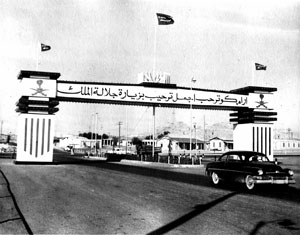 Dhahran’s main gate, early 1950s.
 Photo courtesy Judy Webster Bauer.
During the summer of 1950, war breaks out between North and South Korea, resulting in the acceleration of the Cold War. The turmoil in Palestine continues. And overall, the world seems a menacing place in many corners. But to Americans living and working in Saudi Arabia, global conflicts seem far removed from their comfortable suburban lives in the midst of the desert. Aramco’s growth and prosperity continue and the company’s investment in the infrastructure of Saudi Arabia – and the education of its people – moves full-steam ahead. (The company also agrees to King Saud’s demands concerning “profit sharing.” Beginning in 1950, Aramco agrees to pay the government 50 percent of all income from oil.)
In October of that year, the Websters enjoy their first-ever local leave, visiting Beirut and the Holy Land. Mildred Webster writes a very lively report of the journey, excerpted here and illustrated with her own color slides.
This chapter features excerpts from August through December 1950.
Dhahran
August 11, 1950
Dear Folks:
Aramco again breaks into the news with former stenographer Florence Chadwick swimming the English Channel in record-breaking time. She was the leader of the Aquacade [Aramcocade] in 1948, which was such an outstanding success here in the Fall Swimming Pool Season.
(Editor’s note: Florence Chadwick had come out of ‘nowhere’ to set the new women’s record for swimming the English Channel, beating out a young American woman named Shirley May, who had become a sort of “media darling” for her past attempts.)
From Time magazine’s issue of Monday, August 21, 1950:
“Somebody else had gone into the water a few minutes before Shirley May, but nobody had paid much attention. She was also an American, a professional swimmer named Florence Chadwick, 31, from San Diego, Calif. There had been almost no build-up for her at all. Florence had not been able to pay for the trip and training expenses, so she had taken a job as a secretary with the Arabian American Oil Co. The company had paid her way abroad; Florence had kept in practice with after-work swims in the Persian Gulf.
Florence’s plan for conquering the Channel was fairly simple: just to get in and swim “as fast as I can.” Her father, a retired San Diego policeman, and Trainer Henry Gunter agreed. They had watched her win the 21/2-mile race at La Jolla, Calif., ten times in 18 years; they thought she had the power and stamina for the Channel grind.
For the first hour, Florence swam fast —60 strokes a minute—to get away from the inshore current. Then she settled down to an eight-kick, 32-beat pace, broken only by pauses for lumps of sugar four times an hour. At 11:30 a.m., her father, following in a trawler, chalked a cheerful message on a blackboard: “Only three more miles to go.”
…Those last three miles were the toughest for Florence. Much of her protective grease coating had washed off. The Channel water was numbing, the currents and choppy water off the Kentish coast had reduced her stroke to arm-dragging agony. Just 500 yards from her goal, Florence was cautioned to rest a bit. “Don’t worry, I’ve got it made now,” she shouted back. The last-minute half-pull, half-paddle up the rocks cut gashes in her hands and knees. But she scrambled ashore.
She had swum the Channel in 13 hours and 20 minutes, faster than any woman had ever done it. The old record: 14 hr. 31 min., set in 1926 by Gertrude Ederle. “It’s my lucky day,” said Florence Chadwick.”—Source: Time magazine’s free online archives.
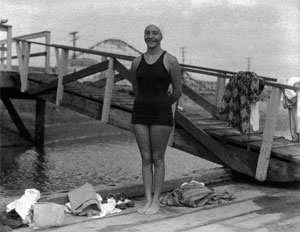 Florence Chadwick, circa 1950. She spent some time as an employee of Aramco (as a steno) and directed the successful “Aramcocade” water ballet show in Dhahran in 1948. Both Judy and Susan Webster were among the young girls featured in the program. Chadwick not only broke the speed/time record in 1950, two years later she became the first woman to swim the English Channel both ways.
 Photo from San Diego Historical Society, courtesy the Internet.
Temperature 111 here and 118 at Abqaiq, with low of 92 here and 80 at Abqaiq and max humidity of 22 percent. When the humidity is about 100 percent, we have trouble here as in New York.
No special activity this week. Mildred had some coffees for 50 or so, and we had ten in for dinner last Saturday. This Thursday next we are having a cocktail party buffet for two of my office personnel being transferred to Ras Tanura and to welcome four new ones. Will also work off some obligations at same time. . .
[A] returning home-leaver brought this political joke to us. Hope you haven’t heard it:
Dear Mr. Anthony: I am a sailor in the U.S. Navy and the main support of my father who is an epileptic and my mother who has syphilis. My older brother is in prison for murder and my younger brother is being tried now for rape. My two sisters are prostitutes while their husbands are in prison for rape and arson. I am going with a girl who is working in a house here at the Base, and as soon as we have enough money saved up and my enlistment is over, we want to get married and have a house of our own in Detroit. My question is, do you advise I tell her before we are married that I am a Democrat?
Love, Ken
(Our new boy, Francis, is good. He is a Christian Indian…Machmoud will be back in about two months. . . . Tomorrow I go to a coffee in the morning then we go to dinner that night with the [F.W.] Moores [President of Aramco]. They are such a nice homey couple. They have a 12-year-old daughter, too. They will be leaving in a little while. We hear a lot of war news, but no one seems alarmed as far as we are concerned. There are new wives coming out every plane. We feel certain that in any event of necessity we would all be evacuated in plenty of time. In case of total war, guess it wouldn’t make much difference where one was . . . We are all so proud of Florence Chadwick. She really is a wonderful swimmer. We plan to go on local leave in October – weather will be better then for travel. Love, Mildred.)
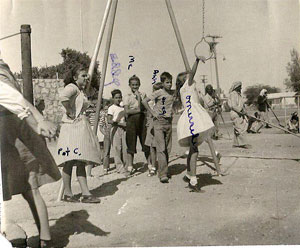 Aramco schoolchildren at recess on the playground, Dhahran Senior Staff School, circa 1950.
 Photo courtesy Patricia Dale Watkins, pictured in the center wearing dark pants rolled up to the knee.
Dhahran
August 19, 1950
Dear Folks:
We didn’t get the weekly letter written yesterday, as the day was a bit involved. In fact, all last week seemed on the busy side. The Moores (Company president and his wife) left this morning for the States and so, of course, there have been a lot of last-minute parties. We had a Department party here Thursday night for 28 people – with buffet. Turned out very well and all seemed to have a good time.
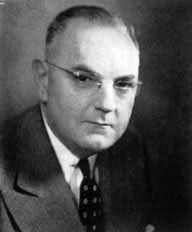 F.W. Moore, president of Aramco, circa 1950. His twelve-year-old daughter, Ginger, was good friends with Judy and Susan Webster. Ken and Mildred Webster entertained the Moore family in their home several times.
Photo from the Internet.
Friday Judy and Susan took Ginger Moore (the president’s 12-year-old daughter) and two other girls to dinner at the Dining Hall and on to the movies. We went to the cocktail farewell party for the Moores out at Davies’. Came back and the girls were here making fudge – then played Canasta.
We had a big surprise – Gladys Underwood came in Wed. night and the cable didn’t get here, so no one was there to meet her. Bob [her husband] was out playing Duplicate. Her ship was doing so much maneuvering around between ports and it was getting hotter and hotter – so she got off at Madras and flew over to Bombay and on up the next day. It is nice to have her back, but didn’t expect to see her until September late!
The girls are enjoying their vacation but it will be over the 2nd. Judy [is] practicing hard for the water show the 7th and 8th. Susan is taking swimming lessons in a group. She swims very well now but her form wasn’t too good. She likes it so much. . .
We are all delighted that Florence Chadwick made the Channel and we weren’t too surprised. She is the one who taught Judy and the girls all the stuff in the Aramcocade –and holds the world’s backstroke record, lacking ¼ of a second. I mean she lost by that margin for the Olympics.
Our new cook is very good and I am glad we took him.
[We] had several babies this week and one wee one that didn’t make it – too bad. Our infant mortality rate is very low, but we sure have plenty of babies. In fact, two middle-aged women with big children have just discovered they are expecting and are furious. Must be something in the climate!
Well, I don’t seem to have written much of interest, but didn’t want to let the time get by without writing – we are all well. Ken has slimmed down a bit. I’m getting fatter by the minute and the girls are growing up.
Bye now. Best love to all of you,
M&K.
Dhahran
August 25, 1950
Dear Folks:
Our new theater opened last Sunday and it really is very swanky – seats 650 and has lovely leather seats – powder room – stage with dressing rooms for plays, etc. Two riyals (45 cents) for adults and one riyal for under twelve.
Ken has just moved his office from the first to the second floor of the Ad[ministration] building and has a very nice layout of several offices and a large general office. He keeps quite busy but isn’t under such a driving pressure as before – and am I glad! He looks very well and with working on the yard over each weekend keeps his ‘figger’ pretty well. . .
I would rather all of you who want to send a box concentrate on the kids as we have to pay duty on almost everything. They always need barrettes for hair, paints and such, jacks – Judy is getting pretty grown up now, though. Lynn will bring back or send out with their things some clothes for us.
…I guess I told you one of our wives is the daughter of Secretary Johnson (Editor’s note: U.S. Secretary of Defense Louis A. Johnson of the Truman Administration), didn’t I? So, I have decided as long as Kay stays out here there is no cause for us to be worried!
The Stapeltons won’t be back until December. He [Vic Stapelton] is being sent to Harvard on a special three-month course – three men from here who are in the States are going. There will be more to follow. Wonderful idea – hope Ken gets sent, but that is just my wishes.
Allyn and Lynn are practically packed and ready to leave [on Home Leave]. We are having them for dinner tomorrow night – it is their anniversary. Then the 2nd we are having 18 for buffet dinner as a farewell party for them.
We plod along but the time goes pretty fast. We have been back almost 11 months and still haven’t decided abut returning next tour or not, but will have another year to make up our minds. We will be back next July probably anyway. . .
Guess I am nearing the end of my paper so bye now. We look forward to all your letters.
Love, Mildred.
Dhahran
September 8, 1950
Dear Folks:
You probably haven’t had any mail from us for two weeks. Last week we didn’t get the letters written and the mail from the week before we believe went down with the TWA plane disaster out of Cairo. All that week’s mail was lost. Terrible thing – there were no passengers from Aramco, but three Army men from the base here. (Editor’s note: This was Trans World Airlines Flight #903, named “Star of Maryland,” which crashed on August 31, 1950 near Wadi Natrun, Egypt. It was en route from Cairo to Rome, caught fire, turned back for an emergency landing, but crashed and burned. All 55 people on board were killed. Source: www.planecrashinfo.com.)
Well, Allyn and Lynn are on their way and should be either in the Holy Land or Damascus today. We put them on the plane Tuesday morning. They were fortunate to be able to take the Gazelle out from here. There is a new airport in Beirut and when they have Company business passengers out of here, the two big Co. planes stop there. We are hoping we will be as lucky when we go – it is much more comfortable than in the small local planes . . .
There is a rumor of a big stir-up out here, but that remains to be seen. Nothing stays the same here for very long – always something popping. . . Ken keeps busy and if I do say so myself he has done a marvelous job on this transportation deal. He really has straightened that department out. We are curious to see what comes next.
Our four little pullets are beginning to lay now and when it gets a little cooler, I think we will be getting 6 eggs a day. I really don’t think stateside chickens could survive the summer here. These are much bigger than the average chicken . . . so think it is a matter of diet. They are much bigger than the three regular hens we have. Susan takes complete care of them.
Love to all, Mildred.
Dhahran
September 13, 1950
Dear Folks:
Gee, I am tired – but guess Ken is a lot tireder [sic]. We worked out almost all day in the yard. Planted flower seeds and got some more space in the garden ready to plant. Gardens are very discouraging here. I planted some a couple of weeks ago and the birds or something ate it off as fast as it came up and nothing is left but a few radishes. Used up all my good seeds, too. I’ll cover this new stuff till it gets a chance to grow. The birds are very bad, but after it is up a certain amount, they don’t bother so much.
Susan has had a little black donkey to play with since yesterday – will have to let it go tomorrow but she sure has had fun these two days with him. She also has a new baby bunny. Seven chickens and two cats complete our menagerie.
I am enjoying bowling again, but don’t ever expect to be a whiz at it. There is a group of us that go ever so often – about three times a week. 1½ riyals a line and we usually play three lines a time. Some of the girls are very good. Ken used to play a lot but doesn’t have time anymore.
Love, Mimi
Dhahran
September 16, 1950
Dear Folks:
Back at the old stand but with little news today. No letters from anyone at home this week, so nothing to answer. Did get a letter from Allyn and Lynn from Beirut today, advising they did get the boat okay last Tuesday and were looking forward to a fine boat trip and good food. A week of the Middle East food apparently did not appeal to them.
We are due to go to Beirut [on the] October 24 plane and wish we were going to Switzerland or Rome, but the round trip fare would be something like $1,500, plus hotels and meals, and I prefer to save my floos (Editor’s note: “money”) and spend it in the USA . . .
This is the second year that Aramco has sent fifty promising [Saudi Arab] employees to Beirut for summer school. They just arrived back and are loud in praise for Aramco and the Beirut University staff. It is such a plan that is changing this entire country by letting a few see how the other people live.
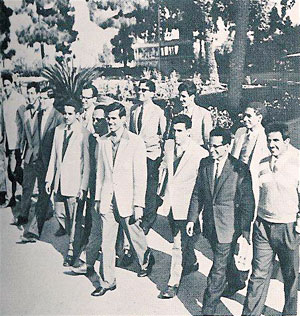 Promising Saudi Arab employees were sent by Aramco to Beirut for higher education, part of the promise the company kept to King Saud to use oil profits for education and the overall advancement of Saudi Arabia – with the ultimate goal of creating a highly educated Saudi Arab workforce.
Photo from the Aramco Handbook.
Sent Sister, by a friend, a Photostat copy of July [1950] issue of McGraw-Hill Digest, as the cover picture is of Judy and Susan and the article ARAMCO IN SAUDI ARABIA is very good. Sister, please send one to each family for us.
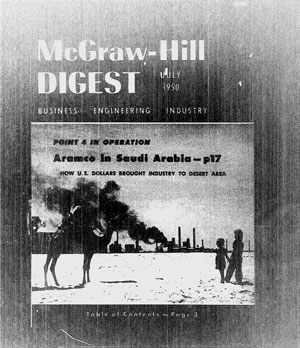 Cover of July 1950 issue of “McGraw-Hill Digest,” with photo of Susan and Judy Webster standing in front of the Ras Tanura refinery on the cover. This is a variation on a similar photo taken in 1946, which was used in other articles about Aramco, including a spread in Time magazine.
 Microfilm archive scan from the Salisbury University Library, Maryland. Used with permission.
Judy is spending full time in swimming pool practicing for the show, “A California Blond in the Court of King Neptune” which will splash in Sept. 21 and in Dhahran Sept. 22 and 23. ‘Tis said – “Woven into the psychiatric wanderings of the California Blond are some gorgeous water routines, bewitching music, graceful diving and seasoning of comedy and humor.”
We don’t know for sure, but feel you folks are missing some of our letters due to a plane crash in Cairo. . .
This is really a slim note, but will do better next time, love to all, and be writin’ you next week.
Ken.
Dhahran
September 23, 1950
Dear Folks:
Yesterday was ‘Id al ‘Adha, or rather the first of the three-day start of the pilgrimage part or ceremony of the “Festival of Sacrifice” of which I have told you in past letters. This holiday starts on the tenth day of the pilgrimage month, DHUL HIJJAH, when the pilgrims enter the GREAT MOSQUE, and circumambulate the KA’ABAH, and then slay a ram, a he-goat, a cow or a camel, in the vale of MUNA in commemoration of the ransom of ISHMAEL with a ram. . .
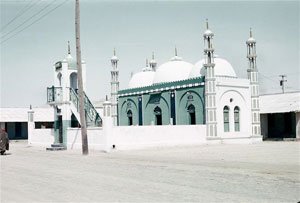 A Saudi Arab mosque, 1950s.
 Photo by Mildred Webster.
I spent the morning spading the garden, or rather about twenty-five percent of it, and will hope that Brahim will spade the rest by end of next Friday. We pay him 36 cents a day for about two hours and he does a fair day’s work watering the shrubs and trees, raking up the lawn, etc., weeding flower beds, etc. . . I had to wear shoes to spade with, as my feet are not yet hardened to that extent. About noon when Mildred and I actually planted radishes, lettuce, spinach and carrots, the ground was so hot I had to put my sandals on again. We plant many things about three times, such as lettuce, radishes, carrots and beets, and are glad to have them, although the urgency is not as bad as before, as we now have many such things in the freeze locker and good brands of canned vegetables. They always taste a little better from the garden and I for one am glad to spend a little time with them to have that fresh taste.
Tonight is the last of three showings of the annual water show or Aramcocade, and Judy can then start to again eat when we do and get a little more sleep at night. It is a grand water ballet and show, taking about one and a half hours and has many humorous parts . . . Our Judy is getting some valuable experience as well as fun out of such things, and they are one of the reasons she doesn’t want us to leave here. Lots of people drove in over 50 miles to see a performance and I suspect that almost all of the 2,200 American employees and 1,800 wives and children will see one of the three showings.
First eight months of 1950, actual average production was 510,313 barrels, with August being 585,831. This compares with last year actual average of 476,736. WE have had a number of days when production was in excess of 600,000, but the average is what counts.
Sam Shultz’s daughter, Frances, married an American of Lebanese decent and will live in Beirut until further notice. None of you know Sam except Mother, but he is a Pennsylvania Dutchman who worked with me in Port Arthur and has been here with me for almost two years now. (Editor’s note: The Shultzes and the Websters were very close friends and traveled together with their children in Europe many times during their years in Arabia.) Some families don’t want to send their daughters to Beirut to school or college for fear they might meet and marry in same manner. We met the groom and he is very nice and his Mother and Father have been in USA since 1912 and 1900 respectively and are therefore practically Americans.
Temperature was high of 106 and low of 76 with few humid days. Summer is definitely going out and soon all days will be less than 100. Will write again soon.
Love, Ken.
Dhahran
November 24, 1950
Dear Folks:
. . . I am working over half my time and soon will most of it at a location almost 200 miles away up the Gulf at Ras El Misha’ab. It only takes an hour and 10 minutes by DC-3 (C-47) and I have been commuting, so far. I leave home at seven thirty, the airport at eight, arrive Misha’ab office at nine thirty, leave Misha’ab five to five thirty and arrive home at six thirty to seven. Just like working in New York office and commuting from Connecticut.
I am heading up the purchase of some $8,000,000 in Automotive and Construction equipment now surplus from $225,000,000 Trans-Arabian Pipe Line Job, recently placed in operation, and there are many details in appraising value, arranging overhaul, loading on barges for transportation here, and planning the organization to take over this location and run the camp for at least another year.
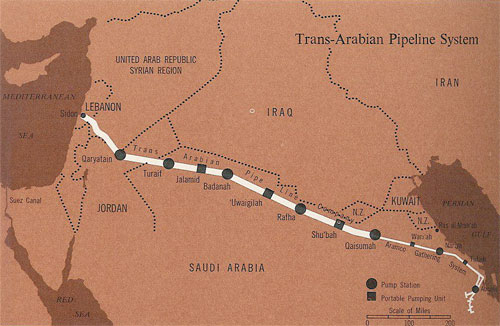 Map showing location of Trans-Arabian Pipeline System, which was completed in 1950. The pipeline transported oil from Aramco’s Persian Gulf operations to the Mediterranean Sea, where it was shipped to European nations.
Graphic from the Aramco Handbook.
Mildred could go with me, but there are no schools there yet, but maybe Allyn and Lynn will watch the kids a few days at a time, so we can spend time together. I’ll probably stay overnight several times per week, but don’t want to be like a traveling salesman and away from home very much. . . I am still as active as possible in Transportation here, but leave many details to Alec MacKenzie, my assistant. All part of the game here and it will, as usual, all come out in the wash as to why. I shall spend two to three days each week here in Dhahran anyway.
Love, Ken.
Dhahran
December 1, 1950
Dear Folks:
…Wednesday I visited the Aramco pump station, Nariya, about 75 kilometers west of Misha’ab. The pump house itself is a huge affair, and the windows are of green glass to remove the glare from the sun. There are five pumps for crude oil, four being needed to pump the expected maximum of 330,000 barrels (almost 14 millions gallons) per day, and one is a spare. There is the fanciest control room I ever saw, and all electric operation of the valves, which are all sizes, including 31-inch. There are three 1,000 kva generators, a 100-ton air conditioning unit, a distilled water generator, treated water facilities, etc. . . Around the station are small shops, offices, firehouse, storehouses, commissary, recreation hall, seven family houses, two bachelor houses and Arab dormitories. The station has to be self-sustaining as there is nothing to be obtained except from here [Dhahran] or Misha’ab. The seven families, plus possibly fifteen other Americans, with about 100 Arabs, will operate and maintain the station except for major work when additional forces will be sent there.
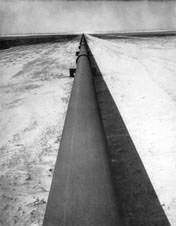 A portion of the Trans-Arabian Pipeline, circa 1950.
Photo from the Internet.
I have completed all my pioneering days and do not care to be in such a small community, but there are plenty of people who want to go. At Misha’ab now there are about 350 people, but by next March I expect there will only be about eighty or less, which will make a small community and be fun for a while, but Mildred and I prefer Dhahran for the remainder of our stay in Arabia.
(Hi, Beverly and Pop – If you can get the book “Red Flannels and Green Ice” by Arthur Pocock, I think you would get many a laugh out of it. He lives out here and the book is very funny. We enjoyed it so much. We know him, but not very well. I think he is underway to write a new one now – I’m not sure, but think he wrote this one after he came out here. . . (Editor’s note: Published by Random House, “Red Flannels and Green Ice” was a humorous account of the U.S. Coast Guard’s Greenland Patrol during World War II.)
I’ve been doing a lot of sewing, mostly fixing. I have been able to let out several of my things and so can manage. Bought one from a friend and sold some of mine. I had one cocktail dress made in Beirut by Madame Loula, a French dressmaker. It was fun having the experience and it really is a good-looking dress. There are lots of them up there [dressmakers], but this is one so many of the girls from here go to. . .
Christmas is all too close. I asked Judy about books and she thought she would like “American Girl.” Some of the other girls take “Seventeen” and she really isn’t quite old enough for it – but will be soon. Susan thinks she would like “Jack and Jill”. (The Curtis Publishing Co., Independence Square, Philadelphia, Pennsylvania.) I think it is a very nice idea and they would love to have them. The only one they get now is “Children’s Activities” and Judy is [too] old for that now. . .Ken says why don’t you shop around a bit and see how much a television set would cost – of the kind you would like. We are so out of that sort of thing we don’t know prices – and let us know about it. . . Best love, Mimi.)
Dhahran, Saudi Arabia
October 20, 1950
Dear Folks:
Read in the news that Greenwich, Ct. charges $2.00 for shave and haircut and I just had one for thirty and a half cents, plus six and a quarter tip. That will be one difference when we come home to live.
Our Girl Scouts just sent off individual bags to Palestinian refugee girls, containing clothing, toilet articles, etc. They then had a candy sale at the theater and made almost a hundred dollars. The candy, of course, was made and donated by the parents.
First nine months this year, the average production was 519,605 barrels and month of September averaged daily 594,871. . . it isn’t too difficult to envision 1,000,000 per day if the world market can absorb it.
Last week there were six babies and this week only one, but the “Stork” club across the street is always containing evidence of near future additions to the baby crop. There is no fear of not meeting our forecasted quota.
Read an article last week on the permits to allow Trans-Arabian Pipeline Co. to cross the Lebanon. “Sixty-seven square feet of thumbprints – over 1500 of them on a scroll 40 feet long – were needed to seal the agreement with Lebanese tribal chiefs which allowed the pipeline to cross their lands on its way from Saudi Arabia to the Mediterranean Sea. The manner of handling this agreement was in compliance with Islamic law, which was an effective instrument of justice while Europe was still in the Dark Ages and America an uncharted wilderness. Its precepts, derived from the Koran, have guided all activities of the Faithful for the last 12 centuries. More than just a law code, it forms a comprehensive philosophy regulating an entire mode of living, a way of life.”
Although each Moslem country is governed by Islamic law, not all of their legal codes are identical. Varying interpretations of the Koran by scholars have led to the development of four main schools of thought, each with its own national adherents. Saudi Arabia, along with Yemen and Afghanistan, practices what is generally agreed to be the “purest” form – the one most distinct in character from Western systems. One of the leading legal concepts of this form is expressed in the famous proverb, “an eye for an eye, a tooth for a tooth.” In former eras, this rule was taken literally – if someone killed your brother, you had a legal right to kill his brother. In the last hundred years, however, it has been applied with increasing substitution of less grave penalties. Jail sentences, fines and damages settlement are no considered proper satisfaction for many wrongs. It is interesting to note that if a person’s car were stolen here and became involved in an accident, and if stolen through the owner’s carelessness, the owner is liable for the civil damage suit AND a charge of criminal negligence. Also, it is noted that a rich man pays more for satisfying a judgment than a poor man, and a poor man winning a suit is awarded a greater amount than a rich man would [be].
More than 5,000 pieces of mail a day are handled in our mailroom in the New York office. Ten times a day couriers leave on their gathering and distributing duties. Starting at eight o’clock in the morning and working until six at night at top speed, they process mail from the six continents, for Aramco and its affiliates operate in almost every part of the globe. Every five days mail pouches arrive and depart from New York aboard our two DC-4’s, the “Camel” and the “Gazelle”, which provide one of the main channels for Company correspondence. Equal in size to the postal facilities of a small city, the thousands of pieces of mail a day add up to an impressive nine tons per month. Here on this end we have three main “post offices” called “mail centers” as the only post offices recognized in Saudi Arabia are those run by the Saudi Arab Government and the USA Airbase. Mail is distributed by us to distant field camps and the farthest at this writing is 950 miles. Some mail goes by car and most by plane. Four times weekly we have mail to and from Beirut, 1,100 miles from Dhahran.
That is about all the news from here. We are all well and happy and hope to leave for vacation on Tuesday, [the] 24th. It might be delayed one week in order to let us ride the Camel or Gazelle, and when we are sure, we shall let you all know.
Love, Ken
(Hi – Tomorrow is Stateside Mail. Perhaps we shall have a letter. I’ve been sewing like mad – all the winter things for the three of us [the girls] had to be fixed for our trip. I’ve been fortunate in being able to fix mine – mostly just lifting skirts and letting out tucks! Susan went on a Scout breakfast hike yesterday and is still out now at a beach picnic. She’ll really be pooped when she gets in. Bye now. Love, Mimi.)
Editor’s note: At this point, the Websters left for a three-week vacation in Beirut and the Holy Land. The letters resume with a brief one from Mildred while wrapping up the last of the trip at the Hotel Normandy in Beirut, then continue with a full report on all they saw and did on their first local leave.
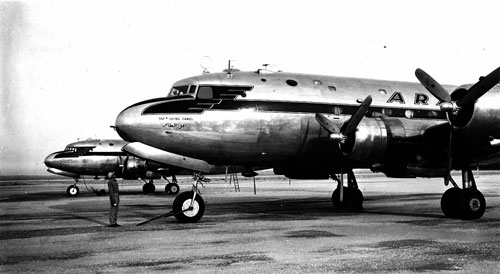 One of the Aramco company planes, “The Flying Camel,” in the foreground. It is believed that the aircraft behind her is “The Gazelle.” This photo is from the early 1950s.
Photo courtesy Judy Webster Bauer.
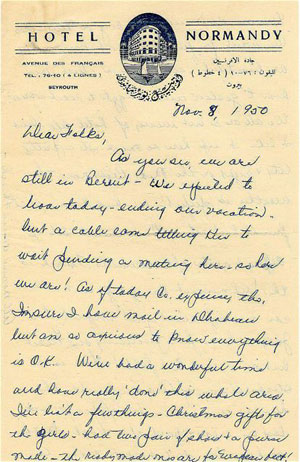 First page of Mildred Webster’s handwritten letter from the Hotel Normandy, Beirut, November 8, 1950.
From Ken Slavin’s collection of Webster papers.
Beirut, Lebanon
Hotel Normandy
November 8, 1950
Dear Folks:
As you see, we are still in Beirut. We expected to leave today, ending our vacation. But a cable came telling Ken to wait pending a meeting here, so here we are! As of today Co. expense, though.
I’m sure I have mail in Dhahran but am so anxious to know everything is O.K. We’ve had a wonderful time and have really ‘done’ this whole area. I’ve bought a few things – Christmas gifts for the girls – had two pair[s] of shoes and a purse made – the ready-made ones are for European feet! We are dickering for a rug or two – ones we want for future use at home. They are beautiful – some of them – but you have to go slow and haggle to reach a price.
We all are a bit weary of hotel life, but I like it up here so much. It’s a pretty city [and] right on the Mediterranean. Right now the weather is perfect. We had dinner with friends last night – have been to lots of different sorts of restaurants. French is the predominant language but you can manage with just English, too. Judy and I have fun practicing our French, but mine is a bit feeble!
There is a steady stream of Aramco people through here so we’ve seen lots of people. I lost an inlay and part of a back tooth, so have two dentist [appointments] today. A very nice Lebanese, Dr. Attyyah. He graduated from the American University here and had two years at Northwestern, Chicago. The average young Lebanese is a very alert, smart person. Their schooling is much more advanced than American schools. . .
Ken finds time heavy on his hands – said if he could only find a lawn to mow he’d feel better. Of course, I’m perfectly happy wandering about in the shops and suks. I love my topaz ring and necklace – they are very lovely. I want to write a “travel letter” about all the places we have been, so I’m waiting until I get back to Dhahran – and the typewriter.
We don’t know how much longer we will be here. Probably till Monday – this is Wed. We’ve been up here two weeks but out on trips most of the time.
I am about to go out with a friend to find her some drapery materials. There are millions of cubbyholes selling every and anything. A little Arabic and French will get you by. I bought American nylon girdle and bras – more expensive, of course. Beautiful sweaters and materials. I’ve rambled on through this talking meanwhile with a family (Lt. Col. in Navy) on their way to Teheran, Persia, to live.
Bye now and best love, Mimi
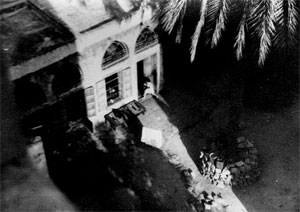 View of rear of Hotel Normandy, Beirut, Lebanon, circa 1940s. The Websters stayed there during their first local leave in the fall of 1950.
Photo from the Internet.
Dhahran
November 17, 1950
Dear Folks:
We arrived back from our vacation Wednesday night – having been gone 23 days. I want to try and tell you all about the many things we saw.
We went up to Beirut by Company plane – the Gazelle – one of the two C54’s that make the big hop. Once in a while they have to let off Company passengers for business in Beirut and so we were able to snag a ride instead of going up on the regular Co. flight there in a smaller plane and one that they call the Milk Run, as it stops all along the pipeline at the various stations.
We were there by noon and all checked in at our hotel. We started out right after lunch to do all the many errands for ourselves and others. Everyone has a million things to have done when someone goes to the city. So, we left watches to be repaired, prescriptions for nine pairs of eye glasses – only one for our own, for Susan – bought material, etc.
Next day we spent doing the same and that night went to dinner with some friends who are transferred up there and have a lovely apartment. It was fun seeing old friends as they had in some others to see us, too.
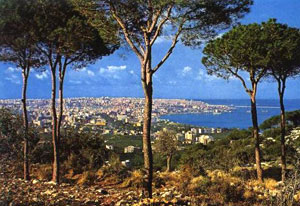 A view of Beirut, Lebanon.
Photo from the Internet.
Beirut is a very lovely city – right on the Mediterranean and with the most gorgeous flowers and trees. It reminds us a lot of Lisbon. Most everyone lives in apartment houses – there are some lovely villas on the outskirts, but all rooms open onto balconies in all types of buildings and they live outside most of the year. It is a colorful, noisy city and a bit on the dirty side in spots. 500,000 people and you still see some of the very bright native costumes, but they are people from outlying districts. The town is right at the base of the Lebanon mountains and the scenery is lovely.
Thursday morning we left at 7:30 with our guide, John Ghourie, a Lebanese – and driver with a lovely Chrysler 7 passenger car to go to the Cedars. We drove up the Lebanon Mountains from sea level to 9,000 feet through some very picturesque villages and some with such interesting histories – past all the fashionable and beautiful summer hotels. Everyone, even the poor, go[es] to the mountains in the summer.
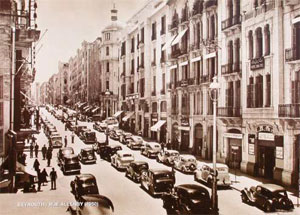 Beirut, Lebanon, circa 1950.
Photo from the Internet.
We arrived at the Cedars of Lebanon at about noon and walked up the slight incline to the last remaining stand of the beautiful Cedars. There are only 50 of them left and they are tremendous. The oldest one in the group is 2,000 years old. You will recall in all your Bible histories and in your Middle Eastern history mention of the cedar wood from these trees. . . After a delicious Arabic meal we started back – and just down the hill we took the girls through a grotto. We stopped in Tripoli again on the way back . . . on down the lovely shore drive to Biblius where we went through the old ruins there of the castle and the port of the Phoenicians. The pilings of this port are of the cedar wood and are still good. It has great Biblical history – and of course all these places were occupied by different nations through the centuries.
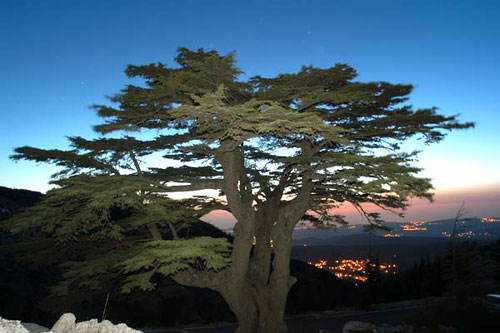 One of the historic Cedars of Lebanon. At the time of the Websters’ first trip to Beirut, only 50 of these ancient trees remained.
Photo from the Internet.
All along the coast we saw the beds were they get salt – rock terraces very shallow which they fill with seawater and let it evaporate.
We arrived back in Beirut at 6 PM – very weary but having enjoyed every minute of it. I wouldn’t advise anyone squeamish about mountain driving, however, to make the trip – nothing but hairpin curves the last few miles.
The industry of the country used to be mulberry trees for silk worms and that was where your silk came from. With the discovery of rayon it ruined all that and now bananas take the place of the mulberry – first bananas we had seen growing.
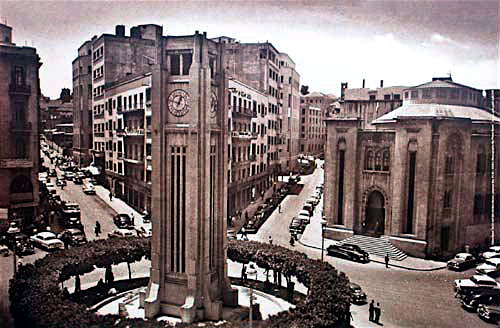 Old Beirut de l’Etoile-Le Parlement.
Photo from the Internet.
Friday, Saturday and Sunday we spent doing other shopping and visiting with people. We know quite a few up there with Tapline. Also visited the American University and the American Community School where our children go to school after the ninth grade here. There were 35 to go up this year. They are in new buildings which Aramco and Tapline were instrumental in having built. The courses are very steep and the kids were working like mad. No less than 3 hours [of] homework every day. I will have to admit that foreign schools – even under American supervision – are much more advanced than the average American school. Judy will either go there or to Switzerland. The Co. supplies transportation free for two trips a year to school in Beirut. Quite an item out here.
 Arab Airways poster, circa early 1950s.
Image from the Internet.
Monday morning we left by Arab Airways for Jerusalem. It was a little 6-passenger, two-motor plane and the trip only takes 1 hour and 15 minutes. English pilots. We arrived in Jerusalem airport about 11 where our guide, Antonio Nassar, met us with a nice car – took us through customs and swished us to the Azzahra Hotel. It is run by Arabs – but not the kind we have here. It was very clean and attractive. We had fine accommodations – with a lovely balcony across the front overlooking the garden where we ate most of our meals.
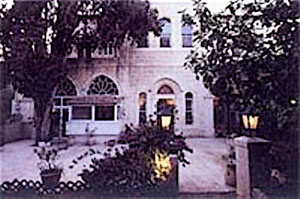 The intimate, 15-room Azzahra Hotel as it appears today. The Websters stayed here on their first visit to Jerusalem during local leave in the fall of 1950. The 100-year-old building, initially built as a private home, was turned into the first hotel in East Jerusalem in 1948.
Photo from the Internet.
The British were in Jerusalem for 30 years and everyone you meet speaks English. . . we were sorry we hadn’t planned to stay a week at least, as it was so very nice and clean – perfect weather, etc., besides being so interesting. But, we didn’t know just what we were getting into when we made our plans. The barbed wire division is right in the middle of the city, dividing the old from the new. (Editor’s note: This division happened during the Partition of 1948.) All of Israel is visible – but we didn’t even dare to try and cross – it can be done but we could not return to Arabia with an Israel visa on our passports. Some went through on Religious Pilgrimage passport visas, but we couldn’t.
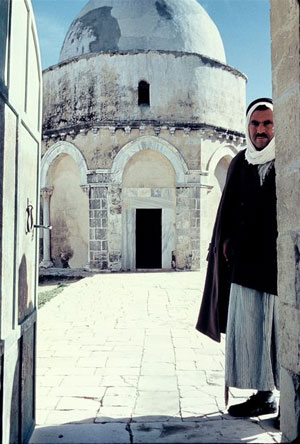 Entrance to the Chapel of the Ascension, Jerusalem, 1950. Construction of this church was funded by several nations and is purported to be the spot where the Virgin Mary ascended into heaven.
Photo from the Webster travel slide collection.
So we started off by car. Our first stop outside the gates of Herod –and of the city into the Valley Jehosophat and up the side of the Mt. of Olives was the garden of Gethsemane. It is a small garden beautifully kept and with about 12 of the old olive trees that have been standing all through the years. They are grotesque and gnarled into queer shapes and some still bear olives. It is beside the Chapel of the Ascension, which was built by money from all nations. The original pillars are inside and the larger church as been built around the old . . .
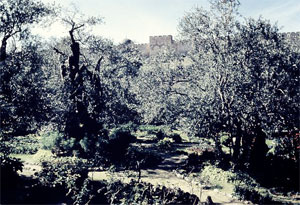 View of the Garden of Gethsemane, with Old Wall in background, 1950.
From the Webster collection.
Then we went out and across the cobble or stone road, which Jesus rode on when he rode the ass into the city. Standing there you see across the small valley the city of Jerusalem and the old walled city with the old gates through which [Jesus] passed. . . Right across we went down into the chapel to the Tomb of the Virgin Mother. Almost everyone lived in caves in those days – except the very rich, so most of the Holy places are in what were caves and then the churches were built over them. Back into the car and a long ride through the Mts. of Jericho – up then down into a barren valley and up again on the other side to Bethlehem.
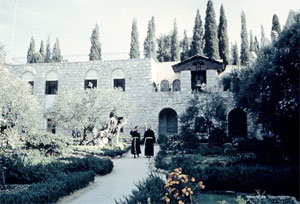 Another view of the Garden of Gethsemane, 1950.
From the Webster collection.
All is very arid and rocky, however the rainy season was about to start and they say it gets green then. We drove through the fields of Boaz on either side of the road – up past the Church of the Nativity and through the village to the other side from which we could get a wonderful panorama view of the whole thing. Then we went back to the Church of the Nativity and through all of it.
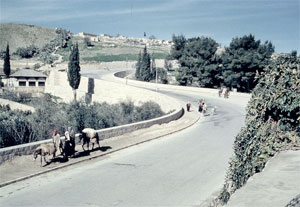 The road to Bethlehem from Jerusalem, 1950.
Photo from the Webster collection.
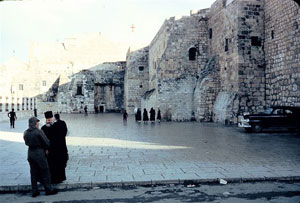 The Church of the Nativity, Bethlehem, 1950.
Photo from the Webster collection.
The same holds true here. The approximate place of the birth was in a cave which was part of the inn and part of the cave was for the cattle. You go down with lighted tapers to the small area below. There is the small spot dedicated to the place of the birth and you kneel down and light your candle from the candles inside and place your hand on the spot. When a few steps around the side and down is where the manger was and where he [Jesus] was laid so the warmth of the breath from the cattle would keep him warm as there was nothing to wrap him in. These candles we brought back and are to be used on Christmas Eve. . . we went across from the Church to a shop where we bought some mementos – also bought the girls and me a lovely Crusader jacket each. They are lovely. Susan’s is dark red velvet, Eton style, with heavy gold thread embroidery. Judy’s green velvet and mine is black – all with gold, however mine is fingertip and I will use it for an evening wrap. They all have pouch bags to match. Ken bought some Masonic things. We visited the Crusaders Cloister and the Milk Grotto – then were on our way back.
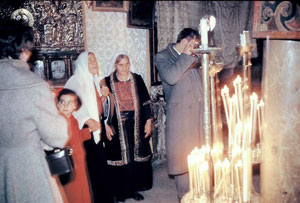 Inside the Church of the Nativity, 1950.
Photo from the Webster collection.
[Next] morning we made the tour of the Old Walled City. We drove to one of the gates and walked the rest of the way . . .then over to the big open square around the Dome of the Rock – but we had to report to the Surete first for permission to go through the area. (Editor’s note: “Surete” is a French term for “security” or “civil police force.”) The Dome of the Rock or Solomon’s Temple dates from 685 A.D. but was destroyed by earthquakes and rebuilt in 1099 by the Crusaders – retaken by Moslems and restored to a place of worship—Most of the very center about the rock is still from that time. It has changed hands and been changed through the years, but many of the tiles, marbles and decorations are intact. This is the rock where Abraham was going to sacrifice his son and this is the spot where Jesus sat as a boy of 12 answering the questions of the sages of the time. It all has great Masonic significance but I don’t know all about that. Ken was allowed to touch and do things that we were not. It is such a magnificent place you simply cannot describe it. Even the rugs in the outer area are over 100 years old and were sent from Turkey – hundreds of people must walk over them every day – barefooted or with felt slippers over their shoes, as we did.
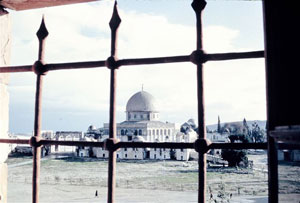 View of Mosque of Omar, from the First Station of the Cross, Jerusalem, 1950.
From the Webster collection.
Then [on to] the smaller Mosque of Omar – the Jews have bombed this area and I didn’t know why, but they visit the Wailing Wall – which we went to next – to pray that the present temple will be destroyed and the Jews can set up their King and rebuild the temple just for themselves. The Wailing Wall section was very crowded and very narrow streets. People still live in several floors below the streets. All the streets are narrow and are of rough stones as in biblical times all through the walled city.
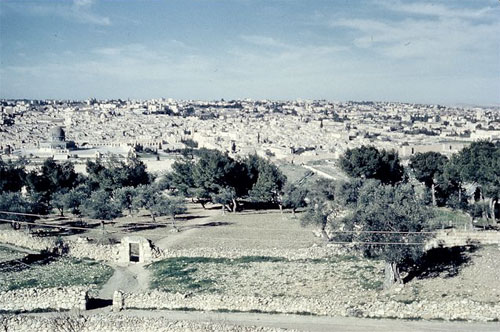 View of the Old City, Jerusalem, 1950.
Photo from the Webster collection.
Next we went to the Dolorosa (Way of the Cross). You start at the chapel where the stone pillar is that Jesus was bound to and flogged – and from there you go to the 14 stations of the cross all through the streets and on to the top of Calvary and the Church of the Holy Sepulchre. It was a long way and we had been walking for hours. I was ashamed that I was so weary I could hardly drag the last way.
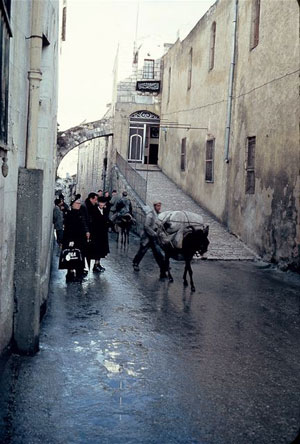 Via Dolorosa (Way of the Cross), Jerusalem, 1950. This is the section that weaves past the palace of Pontius Pilate.
From the Webster collection.
The Holy Sepulchre is very large . . . you go down into the cave where Jesus was buried. (ALL these spots are approximately, you must realize) . . . and you light your taper at the altar built over the place. These tapers we also have to burn at Easter time. . . then up narrow stairs through rooms and rooms to the spot that was Calvary and there is the cleft rock and also one that is supposed to be the one that held the cross. The interior of the church is lavish with solid gold pictures, etc., and all have priceless tapestries and tiling and gifts from all over the world. It seems sort of unreal at the time – as if you were dreaming you were there. Afterwards, we went across the street to a shop where we bought some things, among them some rosaries of olive seeds and crosses, which were taken back to the church and blessed by the priest for our Catholic friends – they give you the certificates, too. Back to the hotel and lunch and a little rest.
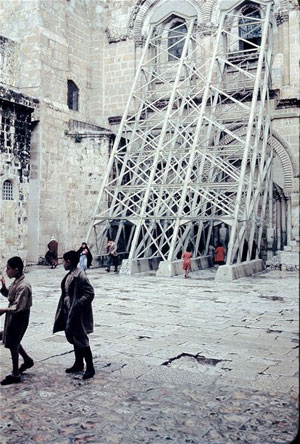 Entrance to the Church of the Holy Sephulchre, 1950.
Photo from the Webster collection.
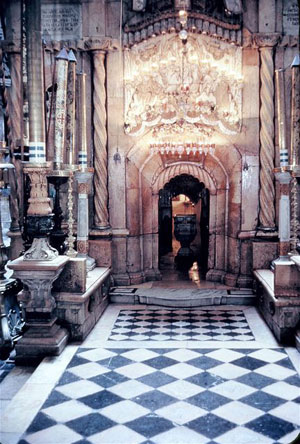 View of the Holy Sepulchre, inside the church, 1950.
Photo from the Webster collection.
We left the Walled City through the Damascus gate . . . [on to] a Carmelite Convent beside which a beautiful new church is being built over a spot recently discovered. It is the cave where Jesus came after the resurrection and called his disciples together and taught them the Lord’s Prayer – Drove on to Bethany where we visited another place recently discovered and still being worked – Lazarus’ tomb and the House of Martha and Mary . . . on up the Jericho Mountains and down into the Valley to Jericho itself – a busy little village with wonderful oranges and fruits – also the site of a tent city of 100,000 Arab refugees. We went on to the River Jordan through this fertile valley, backtracked to Jericho and out to Elisha’s spring, which is still the main water supply of the village – and saw also the walls of Jericho where they are tumbled down. . Then on our way to the Dead Sea – It is 42 miles long and 12 miles wide and is 1,300 ft. below sea level. Fortunately, we were there in cool weather, as it is 140 degrees in summer. We went wading in it and Judy brought back some water and stones. . . history has it that Sodom and Gomorrah [are] under the sea.
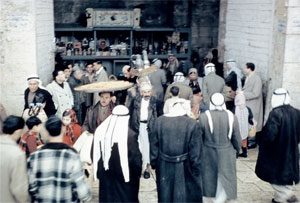 Street scene inside the Damascus Gate, Old City, Jerusalem, 1950.
From the Webster collection.
Then the drive back – you pass on the road and the site of the Inn of the Good Samaritan. It is a police building now, but they say there has always been an inn of some sort ever since the time of the Good Samaritan. Back to the hotel and dinner and fell into bed.
Next morning Ken and I wanted to go back to shop and the lady in the hotel took the girls to a refugee school for girls to which our Girl Scouts sent “Friendship” bags. Each girl made one and filled it with necessities – toothbrush, paste, soap, etc., as well as some frivolous things – then they collected $130 and through channels we heard of this particular school so decided to send out our things to them instead of to the Beirut Refugee centers, where they would be practically a lost cause.
In the shop, Ken bought me a beautiful topaz ring and necklace – also a very old gold belt from Turkey. It is the end of the tourist season and also the end of the Holy Year and you can get things very reasonably. I am so thrilled with them. Our plane left at 11:30 and we were back in Beirut for lunch, tired but very happy and very much impressed. We would like to go again and have more time.
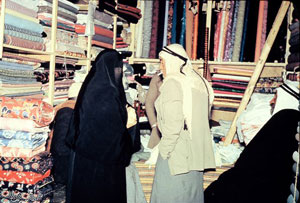 Market scene in the Old City, Jerusalem, 1950. Veiled woman speaks with Arab man smoking a cigarette.
From the Webster collection.
I forgot to tell you about one of the most interesting things! On our way back to the shop in the Walled City, we saw a procession that will never be seen again and hasn’t been done for 2,000 years. The Catholics believe that the spirit of the Virgin Mary ascended to heaven when she died, but that her body was buried. After all these years, the Pope sent out word through the world that it was decreed that her body had also ascended when she died and the day was the feast of that occasion. So, we saw the procession there in the city down those old streets. There were representatives from all the schools – all the convents and monasteries, people of all ages and types and at the last the Bishop in his scarlet gown and long, long train – right behind were 8 girls all in white who carried a platform with a 5 ft. statue of the Virgin sent from Rome for the occasion. It was celebrated all over the world, but was very effective in that spot. (Editor’s note: The feast day recognizing Mary’s passage into heaven is celebrated as The Feast of the Assumption of the Blessed Virgin Mary by Roman Catholics. This doctrine was defined by Pope Pius XII on November 1, 1950 in his Apostolic Constitution, “Munificentissimus Deus.” The new dogma was celebrated worldwide on November 1, 1950, including the procession witnessed by the Websters in Jerusalem. Source: Wikipedia – the free encyclopedia online and Time magazine’s free online archives.)
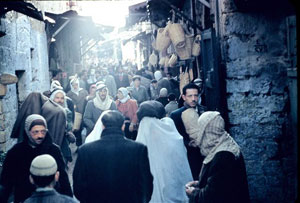 Crowded street scene, Jerusalem, 1950.
From the Webster collection.
…After we returned to Beirut we spent the day going to Damascus . . . then to see the tomb of Saladin. There are some 260 mosques in Damascus. We only hit the high spots but saw enough of the city to satisfy us. We went to the Brocade factory and, of course, I succumbed and bought a piece. . . There are 9,000 threads of silk and gold and sliver, etc., in the looms in each piece. It is fascinating to watch them scoot the shuttles back and forth. We also bought an inlaid box for which work the place is famous. . . .drove down to Sidon . . .Sea of Galilee . . .
We were all ready to come home when a cable came for Ken to remain for some meetings and so we had an extra week, which we spent in shopping. We bought two perfectly gorgeous 9 by 12 matched Kerman rugs. Something we hadn’t the least notion of doing, but ran into a good deal. We brought them back with us and love them. I didn’t even want any before! Also, two smaller ones we shipped to the States. We seem to have blown ourselves – but have something we can have forever and a good investment to boot.
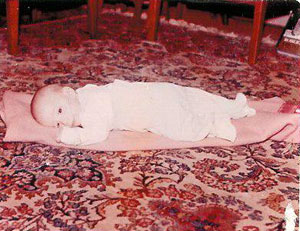 Ken Slavin (the editor) as an infant, 1961, relaxing on one of the matched Kerman rugs the Websters bought in Beirut in 1950.
Photo by Mildred Webster.
This was our first local leave and to say the least, we had a wonderful time. Whether we ever go again remains to be seen and it isn’t likely we would go back to Beirut again, anyway.
I’ve written this at one sitting and so there are many mistakes in typing – but wanted to get it all down while it was fresh in my mind. The girls go back to school tomorrow and we settle down into the old groove again. Ken has been assigned a busy project and so will be on the run.
Bye now and love to all of you – hope you have enjoyed reading all about our trip.
Love, Mildred
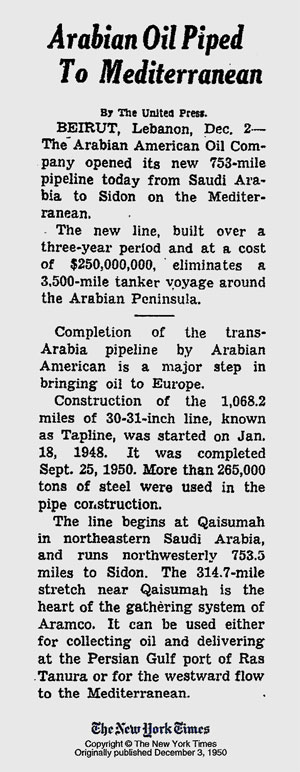 New York Times article reporting that the new Trans-Arabian Pipeline (Tapline) opened on December 2, 1950. It was 1,068.2 miles long and cost $250 million to construct.
Article courtesy New York Times online archives.
Dhahran
December 8, 1950
Dear Folks:
…[W]e are soon to have dinner when Susan comes home from the double feature Westerns and Judy returns from a football game at Ras Tanura. Snappy weather here is football weather, although the coldest so far was 52 and a high this week of 79.
I spent Sunday and Monday in Misha’ab plus Wednesday. Also on Monday went to Qaisumah, a pipeline station 160 air miles north of Misha’ab, to inspect some equipment we are contemplating buying. . . I had expected to take the “Milk Run” daily C-47 plane, but weather in Beirut delayed past darkness its arrival and it wasn’t going to stop at Misha’ab, so took the Navion, a three-passenger.
While flying to Qaisumah and back there was little to see on the ground except desert sand, the pipeline and road alongside it, an occasional nomad’s tent every 50 to 100 miles, numerous herds of camels, the largest one having over 125 animals, numerous camel trails (for caravans, we guess) that stretched for miles in a straight line from coastal towns or villages to some westward towns possibly Riyadh, and very infrequently a car or truck. . .
Returning Wednesday night, we made an unusual stop at a place called Abu Hydrya, to pick up a drilling foreman whose car had broken down in the desert. He had walked ten miles to an Exploration Camp, then radioed Misha’ab to have the plane stop, and we made what we call a “taxi stop” and picked him up. We didn’t stop the engines, and then plane only came to a stop, waited three minutes, and started again. We could not do our work here half as well if we didn’t have radio and plane service. Our District Manager at Ras Tanura often visits a Geodetic boat offshore, and arrangements are made by radio telephone and then he is picked up at his front door on the beach by the ship’s helicopter. He returns the same way. . .
While were buying our rugs in Beirut, one merchant told us this story and said it was true. His father bought a four by five foot remnant of old carpet from a poor man on the street in Damascus for a few gold coins, not wanting it, but just to help this poor man. Some years later, J.P. Morgan and party were in Beirut and asking for old rugs, meaning several hundred years old, and the merchant remembered this remnant. He showed it to Morgan and noting the look on his face, asked $10,000 for it. Morgan said OK, and took it with him along with many others. Some months later ther merchant was invited to attend a Morgan showing of all his art collection but couldn’t go, so sent his New York Representative. Upon arriving at Morgan’s, the latter noted that the “piece de resistance” was the remnant and the learned judges at this gathering valued it at $50,000. The merchant’s representative cabled this information to the merchant, who rushed to Damascus, and after searching for several weeks, found the old man who had sold him the remnant. He asked him if he had any more of the rug. The old main said, the rug used to be 30’ X 90’ and I have cut pieces from it for selling, etc., over the years, and just a few days ago used the last piece to mend his saddle bags. Who won?
Last night was [the] annual Woman’s Club Formal Dance, to which we went and had a fine time. To bed at one, up at seven (first time) and final time up at nine for all as Sunday School is held on Friday. Hobby Farm to see the horses, ride around the camp, visit from some Construction and Transportation people for some answers which took three hours, watered the lawn, fixed the rabbit hutch so they can’t dig out, mowed Allyn’s lawn, checked garden which has onions, lettuce, radishes, potatoes, tomatoes, carrots, chard and others up and looking fine. The eggplants are doing the best and are wanted the least.
We are debating our vacation date for next year, as don’t want the girls out of school too long. Actual eligible date is October First. First thoughts lean toward July First departure so will return by October First, keeping girls out of school month of July end of school term, and month of September first month of new term . . .
Love, Ken
Dhahran
December 15, 1950
Dear Folks:
We are beginning to wonder what has happened to everyone. No mail from you for over two weeks. Did any of you except Uncle Albert receive the Travel Letter, about our trip, which I wrote the 17th of November? We did have a letter from Uncle Albert written Nov. 26th. Actually, that is the last we have heard from anyone – except a bank statement and note from Alice. . .
The weather is wonderful – nothing at all suggestive of Christmas. I got the tree out today and the decorations – will have to get them up or it will be time to take them down! We will have a few in for early dinner on Christmas Eve – but have to break it up early as that is the night the Messiah is being given. Judy is singing in it again and so we will go, of course. Judy and Susan are both singing in the Carol group on the 20th and Susan this Sunday night in the Women’s Club group, the director of which has a singing class for children under 12.
I have been making robes all week but have them all finished now. There is something going on every minute. Both girls go to school an hour a day to make up work they missed [while we were on local leave]. Susan has dancing lesson once a week — we have a very good French ballet teacher. Judy a piano lesson besides all the other stuff. They don’t have much time to fool around.
We had a very sad accident today. A 12-year-old boy was killed in a car accident. They lived at Abqaiq and I didn’t know them – but the boy died after they brought him in here in the ambulance. It’s hard to understand why these things have to happen – and they could always happen to any of us. This is the first child to die or be killed out here except a [Down Syndrome] baby 9 months old – and they knew it would die.
Ken . . . is running around between here and Misha’ab. I don’t like it for he is away too much. But it is quite a job and an honor to be asked to handle such a big project. He’s the guy what can do it, too!
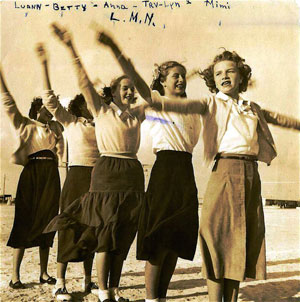 Dhahran Senior Staff School cheerleaders, early 1950s.
Photo courtesy Patricia Dale Watkins.
Ken is at the office and I must stop for now and get something to eat. This is my day to cook. We are going to have fried chicken and fresh frozen corn on the cob, etc., and pie or ice cream. The kids just came in from the football game – we won — the kids’ team playing [the] Ras Tanura school. We have cheerleader[s]…and all the trimmings of the games at home – even pom poms.
We send all our love and best wishes for a wonderful Christmas and all the joys to come. Let’s hope the world situation will clear up and we can stop all this fighting. Hope all of you received your Christmas cards – mailed from Jerusalem.
Love, Mimi
(Mildred is frying chicken so I will add a note or two while awaiting dinner. Judy and Susan are anxious about Christmas, but I think more about the things they are in than the gifts they expect to receive. . . Spent a good part of the day watering our farm, front, side and rear lawns, and then the main garden. . . Susan and our cook planted another garden near the back door and it is beginning to show signs of coming through. . . we wish all of you a very Merry Christmas and hope you are all well and happy. . . Love from us all, Ken, Mildred and Girls.)
Dhahran
Friday, December 29, 1950
Dear Folks:
Christmas is over and New Year’s about with us – I for one will be glad. I never did really get into the spirit, even though we had a very good Christmas and everyone certainly seemed to enjoy themselves. I think were in Beirut so late that I had to hurry too much. There were so many things for the children – things they were in and things they attended – that we spent most of that time on that.
We had our dinner on Christmas Eve. There were 10 of us. We had to eat early, as Judy was singing in the Messiah tat evening. We all went over the performance and them came back here. It was nice having Allyn and Lynn back with us again.
Christmas day was spent with caller or our calling ourselves. There have been many parties, as usual – too many for me. But we always have fun, just the same. Everyone will be really pooped by the time New Year’s is over. The next weekend is a holiday, too – King’s Coronation Day.
We had our tree Christmas morning and Allyn and Lynn came up for it. Thanks loads for all the lovely things that either came in the boxes or Lynn brought. We do appreciate all the bother and work that goes into those boxes. They are a nuisance. The girls loved the skirts and sweaters, as well as the other things. They will write you about them.
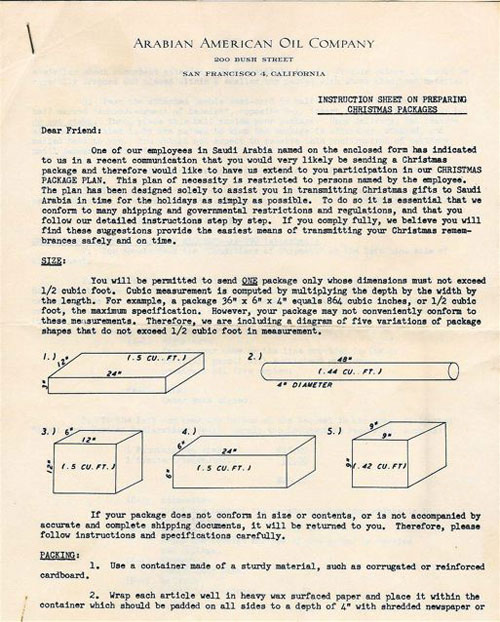 Aramco’s “Christmas Package Plan” in the early days was a very involved process that allowed only one package per person and required shipping deadlines in October. According to the four-page, single-spaced typed memo of instructions sent to family members, “If your package does not conform in size or contents, or is not accompanied by accurate and complete shipping documents, it will be returned to you.” Signed by the Personnel Department, Arabian American Oil Company, the memo closes by stating, “Your wholehearted cooperation in participating in this Christmas package shipping service will be very much appreciated by us, and will enable you to provide a ‘Merry Christmas’ for those whom you wish to remember in Saudi Arabia.”
Memo from Ken Slavin’s collection of Webster papers.
Judy has grown up so much you wouldn’t believe it. She is 5ft. 3 inches [tall]. I had to let the hem in the green skirt out completely, but it is fine now. She goes to Abqaiq this afternoon to sing the Messiah out there tonight. That will be the end of the singing things for a while!
Ken gave me a lovely ivory figure to add to my collection. I have five now besides the eight that are Chinese. The five are from India. Also have some from Africa and other small pieces. The work on all of them is exquisite.
The blouse and slip fit fine. I held back one of Judy’s slips and one of Susan’s blouses for future use. Ken was very happy to get the shirts. He hasn’t had any and they will be grand for traveling.
Love, Mildred
Mildred didn’t tell you she gave me a grand Rolex wristwatch and Allyn and Lynn gave the stainless steel band. Later on an Arab friend gave me a Schaeffer pen and pencil set and from two sources I received from Arabs three purses for Mildred similar to the ones we sent you or took you from India.
Numerous friends came in on Christmas Day, including two Christian Arabs from Palestine and one local Arab. I offered them wine and asked if they wanted red or white. The last Arab asked if I had any “Vermouthy.” He drank it like he wanted it, but I wonder if maybe he had heard others talk about it, as Americans normally only drink it with martinis. Vic [Stapelton] gave me a dozen bottles of wine, rum, brandy, Van Der Hum liqueur, scotch and bourbon. That will more than suffice for Christmas and New Year’s and as the price is three times what it used to be, as we now pay customs on liquors, it is a real item. We don’t have the large cocktail parties much anymore, although after the first of the year we may give one to pay back those who have had us.
I think my nicest gift was duck for dinner instead of turkey, as we have had so much turkey. There were Long Island duckling from home, and three big fat ones served ten people on Christmas Eve, and lunch for us Christmas Day.
Just found that the carbons were in backwards and you’ll all have to hold the first page up to a light to read it, as I can’t possibly retyped it. Also, only four copies available and the Riverside [Connecticut] letter will have to be shown the Norwalk Websters. Sorry.
I am still traveling back and forth to Misha’ab several times weekly, and hope to take Mildred there for a visit next week. Sam Shultz has just been transferred there and is arranging to send Anna to Beirut to compete the school year so he and Mim can move to Misha’ab.
We were very happy to hear about the evacuation of our boys in Korea and hope that this whole war will soon be over, but it sure looks bad and is causing much unhappiness in the world. We are so lucky to be here and not near there.
Starting last October 13th (the first day of Moslem New Year) we shall pay an income tax to Saudi Government of 5 percent of wages exceeding 20,000 riyals (about $5,000) and starting January First will again be included in Social Security at 1 ½ percent of $3,600. We expected the former sooner or later, but the latter was a surprise. It helped the men retiring from here who had not bee at home long enough to be accredited under Social Security regulations. In some cases, it doubled the retiring monthly allotment for individuals.
Never the Christmas morning, Never the Old Year ends, But somebody thinks of somebody – Old Times, Old Days, Old Friends. That is an old Christmas card greeting, but it is still true and we thought of all of you and many friends in the old USA.
In addition to our tree in the dining room, we strung some thirty lights across the eaves of the front of the house, and had a winker cut them off and on about every ten seconds. Many people spoke of them and thought at first that there was a short circuit.
Went to see “The Three Musketeers” the other night and enjoyed Gene Kelly I think as much as when the part was played by [Douglas] Fairbanks, Senior.
The manager of Producing and Drilling sent this humorous message to his friends in other departments:
“Dear Fellow Workers: Habit and convention have decreed that at this time of the year, we shall deviate from our normal tendencies of exuding sentiments of Brotherly Love, and undying affection toward you and your associates. Although our small Producing Headquarters Group has striven humbly to remain dry-eyed amidst these waves of emotion, we find that we can withstand the general sweep of Schmaltz no longer. With trembling lip and moistened eye, we assure you that we sincerely hope that in the year ahead, we will be able to get along with you more satisfactorily than in the past. If we have given you a bad time in the days departed, we hope we will have less reason for such behavior in the days ahead. Moreover, for the moment at least, we are dominated by the wish that in the year before us, we will be better able to rise above our naturally cantankerous natures, and to a degree, cease to be the stinkers you have considered us in 1950.”
A boy and a girl born this past week were welcome presents to two families, and we still expect a few more before the year ends. It will be interesting to see the totals for the year.
All in all, we had a grand Christmas and hope all of you did, too. A Happy New Year to all of you and write and tell us about it.
Love, Ken
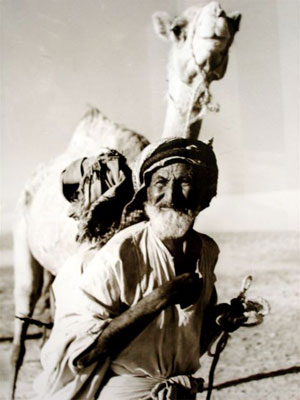 Two Bedouins with a camel, in the desert near Dhahran, circa 1950. Look closely and you’ll see the second man behind the first—the effect is like a “two-headed” person.
Photographer unknown – photo courtesy Susan Webster Slavin.
“Dear Folks”: The Webster Letters From Arabia 1944-1959
30 July 2007 | comments (0) | In Search Of Oil | by Aramco ExPats
CHAPTER 9: “THAT’S OIL, FOLKS!” — Ken Webster begins a series of detailed reports on Aramco departments, camp life, the Muslim faith and more; the Crown Prince and his entourage visit for a month; Ken travels to the Empty Quarter and the King’s farms; Aramco rolls out the “Applied Leadership Series 1950 Training Program” to promote better understanding between management and employees; currency switches from U.S. dollars to Saudi Riyals.
As Acting Manager of Aramco’s Transportation Department, Ken Webster embarks on many travels throughout Saudi Arabia in 1950 and describes them in detail to the folks back home in the States. From observations on the new Dammam deepwater port (a project to which his brother, Allyn, an assistant engineer, is assigned) to interesting descriptions of visits with Aramco exploration teams in the Empty Quarter, to tours of the King’s farms, to “lessons” in Muslim law and religious ceremonies, his fascination with and respect for the Arabs and Aramco shine through in every word. He is very obviously a man in love with his work. Given his restless nature, he somehow also finds time for extensive yard work, family activities and enormous amounts of entertaining – all part of an Aramco executive’s daily life in the Dhahran of the 1950s.
This chapter covers January to August 1950.
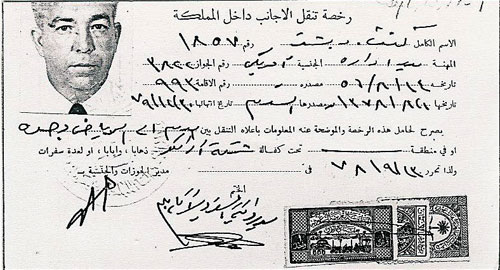 Ken Webster’s company ID card – in Arabic, early 1950s.
Photo Courtesy Susan Webster Slavin.
Dhahran
January 13, 1950
Dear Folks:
Friday the thirteenth and all is well in Arabia.
Went to Ras Tanura Tuesday night to a meeting of all the managers, and five miles out from here a severe windstorm struck, and the sand in the air looked like a Montana ground blizzard. It was a forty to fifty mile [per hour] wind for a short time, and then strong winds all night. Turned some of our boats, barges, launches, etc., upside down and did damage that will cost about $150,000 for salvage and repairs.
This brings marine activity to mind, so I shall today describe briefly our marine fleet…
We have three 1,000 [horsepower] tugs called Abqaiq 1, 2 and 3 that are 105’X30’X14’6”, with a draft of 12’05”. They cost nearly $300,000 each and are equipped with firefighting apparatus. Steam engines are the prime movers, but diesel would be better. They are used as necessary to moor and unmoor tankers and freighters at Ras Tanura piers, and to make tows of barges from ship to shore and up and down the Persian Gulf.
Then we have six tugs, 250 and 350 [horsepower] . . . costing $36-$77,000 [each] for towing barges from ship to shore, Saudi Arabia to Bahrain, Ras Tanura to Al Khobar, and for moving off shore drilling and exploration craft coastwise. These are all diesel.
There are seven smaller tugs, 120 to 160 [horsepower] for service as above.
Passenger launches to transport eight to 65 people range from 37’ to 107’ and from 165 to 1300 [horsepower]. We transport Arabs, Americans, Italians, Indians, etc., in generally separate boats, to and from Bahrain offshore work, ship and shore, etc. They are almost all diesel but a few are still gasoline. In all there are 45 powered craft, including two sea mules, to terrapins, fishing boats, etc.
There are twenty-six sea worthy barges, 13 wood and 13 steel . . . One of the above is 126’X49’X12’ derrick barge, capable of handling heavy lifts from ships up to 100 tons, and is used mainly for small boat repair.
These craft are insufficient for our needs, and therefore we hire tugs and barges as necessary. Most of the activity is at Ras Tanura or between there and Al Khobar, which . . . is the port for Dhahran. Soon the new Dammam port will be in operation, and business will fall off as the new railroad will be used [whenever] possible. Radio contact between all piers and marine activity helps greatly. Over 100 tankers per month and eight to fifteen freighters call at our ports, and it is big business.
We have two deepwater piers at Ras Tanura, a sea island at Ras Misha’ab, a shallow pier for barges only at Ras Tanura and Al Khobar, and as mentioned, will soon have another deepwater pier at Dammam halfway between Ras Tanura and Al Khobar. Our large craft repairs are to date made at Basrah, several hundred miles away, but we have ordered a dry dock to handle all our craft, and will do the repairs ourselves in the future.
[The] total [number of] 42-gallon barrels of oil shipped last month was 9,952,131, which is not a record, but high. Total tonnage handled of dry cargo nature, 16,202. We have had as much as 31,000 tons enter Arabia in a single month when construction was at a peak. . .
Mildred will write a word, so I’ll close, Ken
(Did I ever thank you for getting the dresses, Beverly? One of the girls has them coming out in her trunk and I am sure they will be fine. I have checked in with a new doctor out here. He is very fine and from Johns Hopkins. He has me on a new kind of hormone in tablet form and I think it is helping me to feel better. It will take a while to build up to the strength I need, but so far, so good. I certainly hope so – I would give anything to feel like a human being again. He put me in the hospital overnight and gave me a thorough going-over . . . and his decision is Menopause, definitely. I guess I wasn’t cut out to breeze through it without any trouble, but no doubt will get over it some time – hope it is sooner than later! The girls are fine. Judy is growing up much too fast for me – she is quite the young lady. Her [shorter] hair is very becoming. Susan is still just the same – full of beans. She is really very sweet and lovable. It is late and there is school tomorrow. Everyone is in bed but me, so guess I’d best be on my way. . . Best love, Mimi.)
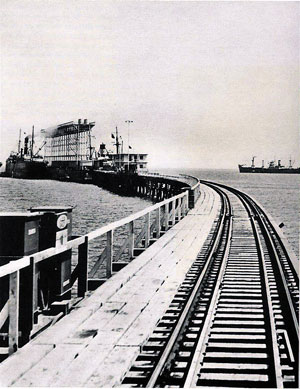 The Dammam deepwater pier that opened in 1950. Ken Webster’s brother, Allyn, who was an assistant engineer with Aramco at the time, worked on this project.
Aramco photo from Ken Slavin’s collection of Webster papers.
Dhahran
January 19, 1950
Dear Folks:
Took the family to Hobby Farm for an hour, while Allyn and I inspected progress on the new Dammam Port. The earth fill is almost complete and soon after next weekend, they expect to start laying railroad track on it. There are still 150 thirty-foot bents to drive on the trestle, which is going slowly, due to weather, and as the main pile driver sank in a storm last week. It hasn’t yet been salvaged, due to rough water, but hope to float it in next few days. Allyn is working on this project and needs all the clothes he has to keep warm.
Temperature dropped to 42 several days ago, and is in high forties or low fifties every night. That is quite cold here, but won’t last long.
All of us in Arabia are very happy to hear that Ed’s operation was successful. (Editor’s note: Ed Webster, Ken’s other brother, in Connecticut. He had back surgery to repair a vertebrae problem.) With all the value we put on worldly things, good health is worth all the rest. We have colds and such here now and again, but generally speaking, we are lucky so far in having good health. Someday I hope they make some substance that will really give relief to hay fever and allergies. Maybe we can all retire to Arizona, where there are no winds, it is always the temperature you want, and my seafood can be flown in daily.
When I am president of Aramco, I intend to put into effect a new policy. Employees will only be required to work until they are thirty. They will be retired at full pay for twenty years. At age fifty, they will be required to return to work for their remaining working years as health and desire permits. There will be no 65 retiring age, everyone will have seen the world and enjoyed themselves at an age when they could best do so, and industry as a whole will benefit by having happier employees who never face the future with regret or insecurity. So far, this plan has met with approval of all but the Board of Directors, who may not yet have been contacted.
Both the girls are at the afternoon show, Mildred is frying chicken, at five we go to the [Alex] MacKenzies for tea, then home to chicken dinner. The garden looks good, but isn’t growing very fast. The lawns and shrubs, though green, are more or less dormant, apparently. . .but the first spell of warm weather should give all a spurt. The tomato plants are lagging the most, but some people who planted their gardens a month earlier than we did, have tomatoes not yet ripe but looking very promising.
Love, Ken
Dhahran
January 27, 1950
Dear Folks:
Today is Susan’s birthday and we shall have a cake with nine candles on it for dinner tonight. That will be a surprise for her, as she doesn’t expect anymore birthday activity, [since] we had a party for her yesterday. 21 boys and girls from her room at school came to the house at ten thirty, opened the presents, played games, I told them some stories, then at a little after eleven I had a large bus take us all for a drive around camp and then to the eleven-thirty movie. After the show, Mildred and I took them to the Fiesta Room of the family club, and fed them hamburgers, cookies and milkshakes. All in all, I think she had a good birthday.
Mildred and I gave her a new wristwatch, and from the others she received candy, five dollars, games, etc. The knitting bag and skirt Gram made for her [were] not given at Christmas Time, but held for the birthday, and pleased her very much. . .
The Crown Prince, Amir Sa’ud ibn ‘Abdul ‘Aziz ibn ‘Abdul Rahman Al Faisal, arrived for a month’s visit. He was accompanied by some 100 of his people, including fifteen sons whose ages are 19, 18, 16, 15, 10, four at 8, two at 7, three at 6, and one 5. Also a grandson by a daughter, age 9. The children’s tutors were brought with them so that they would not get behind in school. Three to four thousand met him at the airport and a reception was given in his honor. Then that night a dinner was given for him at Dammam, the center of government in this area. The next night, Aramco gave a dinner for him at the Dhahran Dining Hall, for about 450 guests.
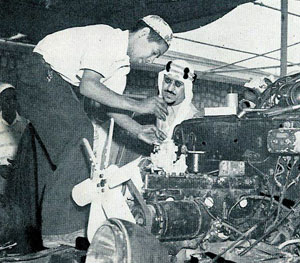 Crown Prince Saud watches a young Saudi Arab mechanic working in a machine shop in Dhahran, circa 1950.
Photo from Ken Slavin’s collection of Webster papers.
[We] opened up a new Machine shop in the desert town of Abqaiq this past week. It is 195 feet long by 90 feet wide. Being too large to air condition economically, the air is changed and filtered frequently by keeping a few ounces of pressure in it — the dust and sand are . . . kept out. This building contains the latest equipment of any shop east of New York, and combines Machine shop, Electric shop, Instrument shop, Sheet Metal shop, Welding shop, Plumbing shop, and one for the Pipefitters, as well as a Central Tool Room. At the same location, we opened a new garage and will place it in service this week. It will be able to service the Abqaiq Motor Fleet of 275 light cars and pickups, and 155 heavy trucks and buses.
Speaking of buses, here’s one: The Abqaiq bus stopped with a jerk –and he got off.
Latest movie here is “When My Baby Smiles At Me,” with Betty Grable. The kids saw it and liked it. We are getting better movies all the time now, and when our new 600-seat theater opens in about four months, Mildred and I probably will go more often. I went twice in the past two years.
The girls just came in from the show, so will close and set table for dinner. Love to all, Ken
(Several social activities this past week and more scheduled, including a [birthday] party for Ken. Bye now. Love, Mimi.)
Dhahran
Undated
The girls just walked into the room dressed in two of my suits and pillows stuffed in the front. They sure are a laugh, looking like gnomes. They both delight in dressing up in costumes and entertaining us or company, and are surprisingly original at times.
We are trying to get Machmoud a new passport, and the information furnished the Khartoum office reads like this: "Tribe–Dunguluayi; Gov't representative–Ahmed Taan al Malik Dungula; born Dungula about 1928; Father—Mursi abu Bakur; Mother—Layla Bint Haag; hair black, complexion black, eyes brown, facial tribal scars. There are no vital statistic records in this part of the world, but instead info is passed down by word of mouth.
Love, Ken
Dhahran
February 3, 1950
Dear Folks:
No special news, but will recite the week’s events. Lowest weather temperature 46, highest 68. Lowest all winter so far 36 and that is cold here, as it is in windy New York, Chicago or in Port Arthur [Texas].
Today was warm and we went to the Hobby Farm so Susan and Judy could ride horses for an hour or so. There is a lot of pressure being brought to bear on me to buy a horse, but so far I have been able to hold off. . .
The population figures released this week show Americans at 2,955, plus 652 wives and 519 children. Approximately 258 children are in school here, 20 are in Beirut, India, Switzerland, etc., and the rest are below school age. No births this week, but several are due any minute.
I am getting some reports together to list the quantities of food consumed here by Americans and others and will have the figures next week. They are interesting to those who never think of them when they only have to call the corner store and get what they need, but we have to plan at least six months ahead in order that we don’t go hungry.
I still don’t have the Exploration Dept. info or drilling list to quote, but will give it in subsequent letters as a brief outline of what we are doing in an area larger than Texas and California combined. To work properly in this area, we travel over much more territory, as Saudi Arabia is much larger than most people think. We who are so used to taking a train to anywhere in the States, and having taxis to take us from station to house, can’t understand a place like this where we have to provide all transportation. Our new railroad is half serving Aramco now, and by September 1951 will be all the way to the King’s Palace, and therefore will take much of the truck cargos now required. When the new Dammam Port is completed in April, many trucks now needed will be available for other work.
This country is being developed fast, and the railroad will be a main implement as it was in opening up the U.S. Our fleet of 2,500 vehicles, cars, truck and trailers does a really big business now. Portable service stations, portable garages, etc., are part of our business at locations up to 900 miles from the main town or camp.
Last night we had 20 in for dinner and a party, for my birthday and Louise Clausen’s. I received Indian ashtrays from the girls, cigarettes from Ally, phizz bombs from Lynn, and a new Remington Shaver from Mildred. It was a very nice birthday for me . . . We sang to Bob Underwood’s piano playing, danced to radio, and had a big evening.
Love, Ken
(I’m pooped tonight and am off to bed. No letter from you [folks] in some time. Hope all is well. The girls are fine and so is Ken. I am better – hope this new medicine continues to help. Love, Mimi.)
 One of the etched brass Indian ashtrays given to Ken Webster by his daughters, 1950.
Photo by Ken Slavin, from his mother’s collection of family items.
Dhahran
February 10, 1950
Dear Folks:
The big event this week will be the Women’s Club tea for the Crown Prince, tomorrow. Lynn will be one of the tea pourers and about 500 women, including stenos and nurses, will attend. Will report in detail next week.
The visit of the Prince hasn’t bothered me too much, although we had to provide about 25 cars for the party, even though they bought or rented some 25 to 40 cars from local dealers.
A few nights ago my new assistant from New York office [Alex MacKenzie] called to ask for help in finding his 7-year-old son, who hadn’t been seen since 5 P.M., and it was then after eight. I called Identification and drove around camp, checked all the Arab tents, etc., and found the boy with a friend in the movie. It doesn’t happen often, but boys are boys no matter where it is in the world. They had ridden the Prince’s horses, visited the soldiers’ tents, and then gone to the show. . .
Still no second birth this year, but from the looks of the laying in house across King’s Road from us, there will be plenty soon. The average last year was four per month, and here we are with only one so far in 1950. With a Winchell nose to the ground (Editor’s note: humorous reference to the famous American gossip columnist, Walter Winchell, of the now-defunct New York Evening Graphic), I can assure you the average for 1949 will be beaten. If this cold weather continues, we should have lots of happy events before October. As you remember, it took 40-below weather [in Montana] to make a Benedict of me, and we lost no time after that. . .
School enrollment in Dhahran has gone up to 156 and each plane brings new children with families to swell the ranks. . . We have ample teachers now, and from all I read in the papers, have more teachers per child here than in the States. We think our children get better individual attention than I ever had or that is expected in the average school at home today. Judy has always been good, being a whole lot like her Aunt Alice was. Susan is better all the time and really takes an interest in her work. Both are well liked by the teachers and other children, and I am reviewing many subjects about which I am quite rusty. Our Encyclopedia Britannica comes in very handy, and both Mildred and I gain knowledge from looking up subjects with the girls.
Love, Ken
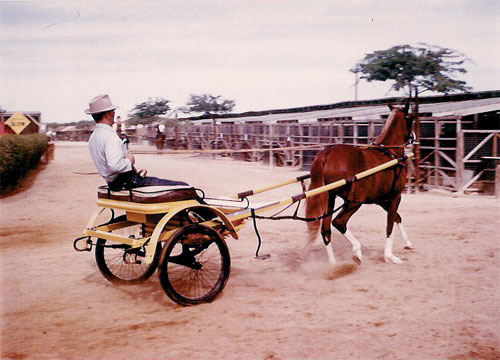 View of Hobby Farm, early 1950s.
Photo by Mildred Webster.
Dhahran
February 17, 1950
Dear Folks:
Just came back from the Hobby Farm where the girls rode horses for one and a half hours and Mildred held her breath.
It is a fine day with very little wind.
The Crown Prince is still here, but leaves in two days. I think the best entertainment for him was the magician, one of our telephone men, who had all the Royal Party completely confused. One observer said, if he appeared to draw money from the nose of one of them, he would probably go to his tent and blow his brains out to get the rest of the silver coins!
Had a dinner for him in the Dining Hall here, about 365 Americans and 50 Arabs. The menu consisted of: stuffed tomatoes with chicken salad, French fried shrimp, tartar sauce, roast tom turkey with dressing and giblet sauce, cranberry jelly, roast loin of beef au jus, roast leg of lamb with wild rice, buttered beets, peas, roast potatoes, relish tray, dinner rolls and butter, assorted preserves and fruit, egg custard, cookies, nuts, Napoleon cake, coffee, tea, milk. I filled up on the shrimp and almost burst, and was so sleepy I went to bed at nine o’clock.
 Crown Prince Saud, circa early 1950s.
Photo from the Internet.
Sent eight more Arabs to New York for one year, to train new American recruits at the Long Island Training Center. It is wonderful for the boys who get to go, and the things they tell about when they get back is all part of the change taking place in this country as the American influence is expanded.
The Dhahran Women’s Club had a tea for His Royal Highness and Lynn was one of the four tea pourers. Nearly 500 women attended and shook the hand that rules Arabia.
Bob and Gladys Underwood left Wednesday for home leave. They took a British India boat from Bahrain to Basrah, then will visit Baghdad, Damascus, etc., before taking the same boat we did from Beirut, arriving in New York about March 17th.
The second foreign bank opened here this week – The British Bank of Iran. The first one was the Indochine Bank.
Four babies [were] born this week, three boys and one girl. The pregnant women are practically standing in line for the delivery room and the monthly average is bound to take a big rise soon.
The girls are at the 3:15 show, “Street With No Name,” and Mildred is frying chicken. I doubt that I shall last until dinner time . . .
Allyn and Lynn went over to Bahrain [yesterday] on a shopping tour, [but] had to stay overnight [because] a forty-mile wind came up and the boat didn’t come back until today.
I had promised to tell a brief story about drilling here, so [I] will do so. Hopefully, no remarks will get into print, as I would be subject to criticism. Most of the information in general is in magazines, but details are lacking.
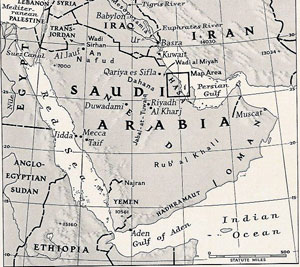 Map of Saudi Arabia, circa 1950.
From Ken Slavin’s collection of Webster papers.
You all must remember that Saudi Arabia is about 1,200 miles wide and 1,400 miles long, covering over 1,000,000 square miles. For those who think there is no place larger than Texas, let me say here that our concession for drilling exceeds the states of Texas and California combined, in area. At first we drilled at Dhahran, into what is called the Dammam Dome. The first well was brought in [successful] in early 1941, and is still producing. We do not drill in this field any longer, have 30 producers, one sweet gas, two shutin, and eight abandoned. About 90,000 [barrels] monthly is produced, although more could be if needed. Abqaiq is 40 miles southwest of Dhahran, has 44 producers, one drilling, 13 completed and awaiting connection to oil gathering systems, and three are used for observation of water rise, pressure, etc. Twenty-five miles south of Abqaiq is Ain Dar, with 7 completed but not yet connected, and one is drilling. 95 miles south of Ain Dar is Hardth, where four are completed waiting for connection. Twenty miles north of Dhahran Is Qatif. The field has 4 producers, one abandoned, one shutin, three completed awaiting connection, and one drilling.
We are continuously north, east, south and west in all fields to learn extent of the reservoir. Quite possibly this is all one field, and extends north to and through the Kuwait and Abadan fields.
Total production still exceeds 500,000 barrels per day, which is a lot of oil in any language. . .
One 12-inch underwater line, believed to be the longest underwater oil line, takes oil to Bahrain Island to a refinery owned by our owners. Two other underwater lines go to Ras Tanura to our 160,000-barrel refinery and to load ships at two piers. The 30-31 inch line to the Mediterranean will be finished next year and will take about half of our production, about 300,000 a day. This line is 1,060 miles long. (Editor’s note: This is a reference to the Trans-Arabian pipeline, which was under construction at the time. It was completed in December 1950.)
Wells are drilled through sand and rock, almost entirely by rotary drills. Most wells last year took 38 days, but some isolated locations take over 100. Men live in the desert and work 24 days, then come to town for four days.
In addition to oil wells, we are drilling five to ten water wells all the time, either for the Government to serve the oil well drilling, or for Trans-Arabian Pipe Line Construction amps and pump stations from here to the Mediterranean. . .
That is a brief picture of the drilling group.
Love, Ken
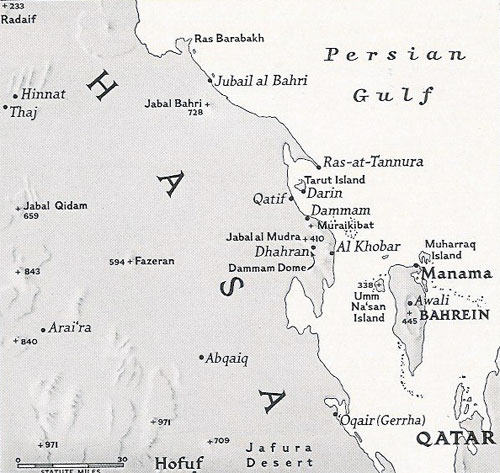 Map of the Hasa province in eastern Saudi Arabia, circa 1950.
From Ken Slavin’s collection of Webster family papers.
Dhahran
February 24, 1950
Dear Folks:
Today ye Editor will take you on a trip south to the Rub al Khali or Empty Quarter.
Six of us left Dhahran a little after seven A.M. in a C-47 and flew southwest for an hour and a half to a point over Al Kharj, the farm run by Aramco for his Majesty. It is about sixty miles east of Riyadh, the so-called capital of the Kingdom. Then south on the west side of the Tuwaiq Mountains. These mountains are over 5,000 feet elevation, have a limestone cap, and the rest appears to be gravel. . . a very rugged appearance. It would have been impossible to take off again, were we forced to land there. On both sides were open desert stretches, drifting sands, and little vegetation . . . On south we flew, for a total trip of almost 600 miles.
We arrived at the most southerly base camp at eleven thirty. This camp is composed of two Americans, nine Arab drivers, cooks, houseboys and mechanics, and thirteen Arab soldiers. The soldiers are for protection, as this part of Arabia has not been traveled by many foreigners and the wild tribes are unpredictable. These two Americans leave here in September, return for two weeks at Christmas, and then stay out until July. They make contact daily by radio, are taken food, gasoline, etc., once to twice a month, and the rest of their time are on their own. They use the camp as a base or SPIKE point, and spike out for one to ten days in all directions with minimum equipment. Their work is to follow and measure formations, outcroppings, etc., and interpretations of these tells the story of subsurface materials, probability of oil, etc.
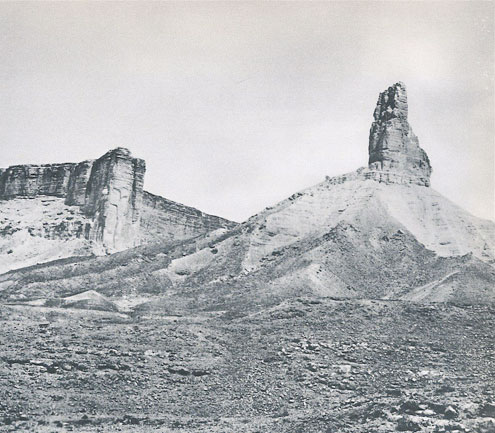 The Tuwaiq Mountains, west of Riyadh, 1950s.
Photo from the Aramco Handbook.
Most of this area is completely unexplored and reputed to contain ruins of settlements of ancient times. We drove twenty miles south of camp and came to an apparently abandoned city . . . the size of Dhahran, covering some 320 acres. Some walls were still standing, many foundations were visible, acres of broken pottery, many grain mortars of solid stone, pieces of alabaster, etc. I brought back one stone about six inches square that appears to have Himyarite writing on it. The Himyarites were supposed to have come into prominence about 115 B.C. and recently someone has interpreted writings found in Northern Arabia. After I take a picture of this stone, I shall give it to the group who follow up on such matters. We are not allowed to keep them.
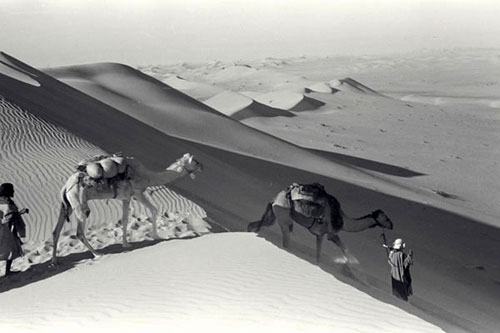 View of Empty Quarter, 1940s.
Photograph courtesy the Internet; photographer unknown.
We took pictures of another stone about two feet square that had inscriptions similar to Greek or Egyptians and which probably are Phoenician. This city was located in a valley surrounded by two hundred-foot-high stone rim rocks, and on many of the walls were writings, carvings, etc. One was of a man about my height with a stone arrow or spear through him. One coin found there last year was said to be one from 200 A.D., according to the Chase National Bank in New York.
As we stamped our feet on the ground, it sounded like a hollow drum, and maybe [it] is a buried city. This location is a hundred miles below the Tropic of Cancer, and only a few hundred miles from the Yemen. It is on the “Oregon Trail of Arabia”, as it has an important water hole still being used, but no one is allowed to excavate to find out more about it.
Then we had lunch of canned chili, tea and coffee, homemade bread, canned peaches and cheese. These boys have no ice, fresh vegetables or meat, except the gazelle and Arabian pheasant they kill. You have to be really interested in your work to spend the year in these camps.
We came up the East side of the Tuwaiq Mountains, which area is [entirely composed] of moving sand dunes. . . It was only a 1,200-mile trip, but showed me new country and how some of our people have to live.
Several days later I went to a luncheon for visitors from another oil company up north. The head man was Sir John Cunningham, former head Admiral of the British Navy. It was very unusual for us, a cocktail party from noon to one, then a steak dinner for lunch from one to two thirty. Drinking and eating heartily in the middle of the day is not normal for us, but might be gotten used to if necessary. . .
Company [talk] and looking over the Middle East oil situation. Rather a nice group of English people, and they talked British politics the entire time, with emphasis on the good points of Churchill and the bad points of all others. We should know tomorrow how the elections came out, but it doesn’t look good for England . . .(Editor’s note: A very slim victory in February 1950 by the Labour Party over the Conservatives in the British Parliament resulted in the call for a general election again in 1951. Sir Winston Churchill, out of office since 1945, won the premiership again in the Conservative victory of 1951, serving until 1955. Source: Wikipedia.)
Love to all, Ken
(Dear Folks: This was a rather busy week – several teas and coffees. The Women’s Club had their Founder’s Day luncheon, too. Last night Judy had her birthday party – 26 boys and girls from 7:30 till 10:45. They played games and danced, then had cake, punch and sandwiches. Seemed a huge success, but sure was a bunch! Allyn and Lynn came up, too. Today the kids rode at the Hobby Farm for about an hour. Ken made [a] trellis and worked in the yard. Bye now. Love, Mimi.)
Dhahran
March 3, 1950
Dear Folks:
Had a long rain before we awoke this morning, which was very unexpected, but welcome for the lawns and garden.
Our tomatoes don’t look too good, but may make it yet. Pulled some carrots today and was surprised to find them six to seven inches long with very small tops. The beets are almost ready, had cauliflower once and more coming nicely, and the cabbages are heading up. The bronze lettuce stays plentiful and is enjoyed mainly by me, but sometimes by the girls . . .
The outstanding event of the week was one of our vice presidents, Floyd W. Oligher, receiving EXCEPTIONAL CIVILIAN SERVICE AWARD from the U.S. Air Force for promoting the USA interests in aviation and through his long friendship with His Majesty King Ibn Sa’ud materially made possible the establishing here of the Dhahran Air Base by the USA. This base vitally linked the two theaters of [World War II], and made possible the first non-stop ‘round the world flight. Not many of these have been awarded and we are very proud of Floyd for his work and being one to be so recognized. After dinners at the Air Base, speechmaking in our office when the award was announced, our senior vice president held a cocktail party at the Executive House for Floyd last night. We went and had a fine time, then after dinner, watched Judy and her group square dance for an hour or so. This is now a weekly event for the teenagers, and is sponsored by several families and led by some of the mothers.
Today we went to the Air Base at one P.M. for the wedding of one of our stenos and a Captain of the base. After a fine reception, the groom took his bride on a honeymoon to Teheran in Iran, flying her there in one of the Air Rescue planes, specially equipped with a thirty-foot boat which can be launched from 400 foot elevation and slowly dropped to the water with two sixty-foot parachutes. He flew the plane and it was [a] very romantic setting to see them take off into the sun. . .
Went to a show this afternoon, saw “Pale Face” with Jane Russell and Bob Hope. A very zany picture, but I had many a laugh from it. This makes three times in five months. If I don’t look out, I’ll get to be a regular theatergoer.
I have the wanderlust, and would like to be planning a vacation. Maybe we shall take our local leave in August when the girls don’t go to school. [We] are checking now to see what trip is best for our pocketbooks, climate for Mildred and the girls, and the most interesting for all to remember. Five months already gone by on this tour and the mid point will be here before we know it.
Love, Ken
Dhahran
March 10, 1950
Dear Folks:
The first scheduled passenger train between here and the interior and return became an actuality March first. There is one train each way in morning and again at night, for the first 90 miles. The locomotives are 1,000 horsepower…diesels, each radio equipped…
Col. [Robert R.] McCormick, publisher of Chicago Tribune, with wife, daughter-in-law and party of twelve, including crew, visited in his converted B-17 for overnight, as he goes around the world. (Editor’s note: Robert R. McCormick, a controversial and high-living legend in publishing, was the grandson of the founder of the Chicago Tribune and became publisher in 1914. He played a major role in American journalism in the first half of the 20th century and built the Tribune from a single newspaper into a major media organization of newspapers, radio and TV stations, and newsprint manufactories. Under his leadership, the paper had the greatest volume of advertising of any newspaper in the world. He died in 1955, five years after his visit to Dhahran. Source: Internet.)
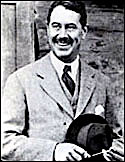 Colonel Robert R. McCormick, legendary publisher of the Chicago Tribune. He stayed in Dhahran overnight in March 1950 while on an around-the-world flight on his personal plane – a converted B-17.
Uncredited photo from the Internet.
The first ship berthed at our new oil pier at Ras Tanura this past week, and it was the “Kentucky” one of the Texas Company super tankers with capacity of 240,000 barrels.
If all goes well, we shall see a movie today, “Spring in Park Lane,” one of the best British films of 1949.
Recitation: Spring is sprung – the grass is riz – I wonder where the birdies is.
Two boys born this week, one 9 pounds 11 ounces and one 6 pounds 14 ounces.
Lynn’s birthday today, so we went to Al Khobar shopping this morning and bought her some brass and a headdress called Gutra. Will see her and Allyn a little later before or after the show.
Did I tell you about my gift from the Crown Prince during his present visit? It is a dagger about seven inches long, steel blade with gold filigree hilt, and the scabbard is eleven inches long and covered with gold leaf and filigree. It is worn at the waist, is “L” shaped, and a wicked looking thing – but ornamental. The King’s guards still wear them. It will be something to remember this place by.
Went to Hobby Farm at one, but no horse owners were there, so couldn’t ride. Fed Susan’s former dog “Buttons,” the girls slid down some sand dunes just like we used to slide down snowdrifts at home, then we came home and will go to movies in about 45 minutes.
I am not keeping up with my series on Saudi Arabia [Aramco] groups but should have some information on the remaining departments soon. I have been busier than usual with visitors and meetings and couldn’t prepare for these weekly fireside chats like I want to.
Love, Ken
Dhahran
March 17, 1950
Dear Folks:
St. Patrick’s Day and raining, and as it is Sunday and day of rest, we shall not see many people and therefore will not know if they are wearing the Green or Orange in camp.
The children are still at Sunday School and Mildred has walked over to meet them with umbrella and capes.
Wednesday night [we] went to a cocktail party at Executive House for Colonel McCormick (publisher of Chicago Tribune) and wife. He is an impressive old man, and obviously a man of his own convictions. After dinner, Mildred and Judy, with Lynn and Allyn, went to a concert by Professor Julian Hertz, pianist, from Damascus. The local chapters of Aramco Employee Association arranged for his visit by plane some 1,100 miles away. All who were there spoke very well of his performance. I stayed home with Susan, as I had been on a trip south all day and was tired, and am not a concert fan anyway.
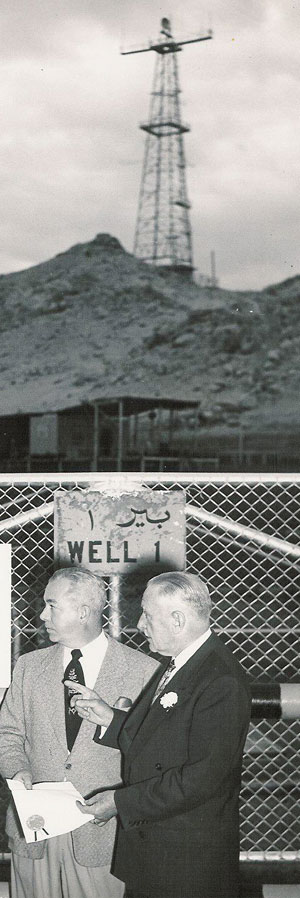 Ken Webster, left, with J. Rives Childs, former U.S. Ambassador to Saudi Arabia, during a visit to the Aramco camps in 1952, when Webster was serving as Dhahran District Manager. This picture was taken in front of “Well Number One” at Dammam.
Aramco photo from the Webster family collection, courtesy Susan Webster Slavin.
The trip south was to two desert camps, one a gravity meter and one a double structure drill. . . We left [to come home] at three thirty, taking fifteen Arabs back for days off. We usually stop at Hofuf, the capital of…the Al Hasa Province, going and coming, but this time all the Arabs were coming here and we flew straight to Dhahran, almost 300 miles. The Arabs were as glad to be getting back to the “flesh pots” of civilization as the Americans, after 42 days, and chattered like monkeys all the way.
Enroute, we flew over a new oil field in the Shaikdom of Qatar (pronounced ‘gutter’) being explored by Iraq Petroleum Co. It is a very barren peninsula, and we counted ten wells operating. There are about 13 Americans, 70 to 80 Europeans, and probably 300 Arabs. It was a pretty picture from the air, but seemed to us even more desolate than here.
Arrived Dhahran 5:20 and drove to office first. One American said, “Gee, look at that lawn, we didn’t have that when I was in camp before.” They are always hungry for green lawns, gardens, trees, etc., and after five and a half years here, I know what they mean. . .
We have a program on to have every manager tell all employees what he does, how his department works and why, and in general to improve operations by removing the mystery of Big Business. I take my turn in November, and to give you an idea of what it means, I quote the first manager’s talk: “Conducted 75 meetings, spoke to 1640 employees, talked 112 hours, answered 1556 questions, traveled 180 miles between camps.” The program is four talks a day for six days a week, for three consecutive weeks. Very informative, but who does your work while you are gone?
Certainly, when it is over, all employees will know all managers and will have gained an intimate knowledge of our objectives here
“It’s simply great to be a part of all the surging world alive; And lend a hand in field and mart, a worker in this human hive; To live and earn and dare to do, Nor ever shirk or deviate; from course or purpose we pursue! Until the goal is won – it’s great.” (By Sidney Mase.)
That’s oil, folks!
Love, Ken
Dhahran
March 24, 1950
Dear Folks:
Mr. J. Rives Childs, U.S. Ambassador to Saudi Arabia, visited us from his post on the Red Sea at Jedda. He brought with him Mr. George S. McGhee, Assistant Secretary of State. They were taken on a full tour of our facilities and fed by us as well as by the local Amir Abdul Musil bin Adullah bin Jaluwi. (Editor’s note: J. Rives Childs succeeded Col. William A. Eddy as U.S. Envoy Extraordinary and Minister Plenipotentiary to Saudi Arabia in 1946. He served as U.S. Ambassador to Saudi Arabia for two years, 1949-50. McGhee was a Texas oil millionaire who served in numerous senior foreign relations posts for the U.S. State Department. Source: U.S. State Department roster online.)
 George S. McGhee, who toured the Aramco camps with U.S. Ambassador J. Rives Childs in March 1950. At the time he was U.S. Undersecretary of State and later became the American Ambassador to Turkey.
Photo courtesy the Internet.
At the first Boy Scout Court of Honor last Saturday, numerous boys received with their merit badges a letter from the Governor of the state from which they came here. . .
This morning we awoke late for us, and after yard work, walked over to see Scotty and the baby. While there, a neighbor from next door was having his hair cut. The Indian barber comes to his house every Fridays, as this man claims he doesn’t find time to go the barbershop. I had tried to get mine cut several times this week, but always there were too many people ahead of me and I wouldn’t wait. So in turn, four of us had our hair cut in a canvas lawn chair out in the front yard. Many passersby laughed about it and pictures were taken. Because the barber came to the house, he charged double, so we paid 60 cents apiece. How will I ever get used to a dollar or more haircut after so many years here at 30 cents? We get good ones, too. . .
Love, Ken
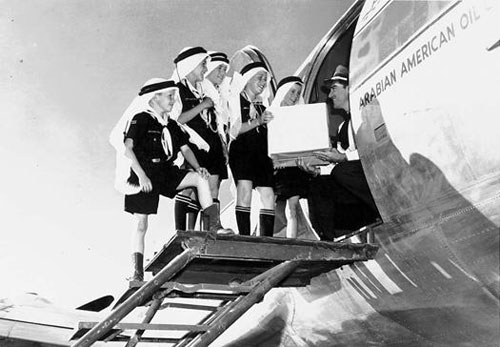 Aramco Boy Scouts receiving a package from one of the company planes, circa early 1950s.
Photographer unknown, from Ken Slavin’s personal collection of Aramco memorabilia.
Dhahran
March 31, 1950
Dear Folks:
High of 85 and low of 56 this past week and no babies. Lots of wind and sand-laden breezes and starting to blow now at one P.M.
Forgot to set clocks ahead one hour at midnight last night, so the girls missed almost all of Sunday School today. . .
Did you know that the true Arab Time is daily sun time, and therefore you have to set your watch every day in order to be on time? In about another month, we shall set our time ahead one more hour for the summer, which will take care of the Ramadan period of fasting and utilize maximum daylight. In the future, we expect to change clocks twice a year, just before April First and just after Sept. 15th. This will eliminate trouble by not interfering with Arab prayer time, eating times and work schedule.
You can see from all I write that we govern all activities to the best interests of the Arab.
…Girl Scout Investiture at eight, where Judy will take part in making a group of young scouts full members, Susan being one of the young ones.
Love, Ken
Dhahran
April 7, 1950
Dear Folks:
Went to a party last Saturday night for three 30-year service men. There are twenty men in Arabia with more than 30 years’ service, and one is in his 38th year. In another eleven years and three months, I’ll have a thirty-year party here, if I am here then, although such is not expected by me or my local family.
Judy wants to stay here always, Susan wants to go home and live on a ranch, Mildred wants to live where there is no wind nor heat but not in a city, and I want to live near clams, crabs and lobsters and make wadjid floose and be not more than one mile from my work. Maybe we’ll come home in 1951 and stay until the girls are grown and married, and then return here for the closing years of our work period.
Of all the environmental diseases that have caused trouble here, the worst has been LOCATIONAL PSYCHONEUROSIS, which has been cured only by the person’s going home to their family. Now that we are all together, and Lynn is here, there is none of this disease in our Arabian Websters. . .
Love, Ken
Ras Tanura
April 10, 1950
Dear Folks:
It’s my fault these letters weren’t mailed on time, but didn’t get around to my part of them.
We came up to Ras Tanura yesterday and plan to stay until Saturday. Ken is “doing” the Marine Dept. – and would have had to drive back and forth for several days. It’s school vacation, so we are having a little time at the beach.
We have a house and are only [cooking] for breakfast and lunch – eat dinner out. The beach is wonderful now and warm in the middle of the day and cool at night.
The Scout uniforms arrived and are fine – thanks so much. They were in a trunk up in Customs the last 6 weeks – some sort of snafu.
Love from all, Mimi
Dhahran
April 21, 1950
Dear Folks:
Didn’t write last Friday, as was in Ras Tanura and no typewriter handy. Actually, left here a week ago last Monday for Ras Tanura to spend a few days to a week while I reviewed all Marine activities and all of us had a change of scenery. The beach was wonderful, but could have been a little hotter. The water temp is in high 60s, so no one went swimming but me — and Susan once waist deep.
Took Biedlebalm (our tiger cat) with us, probably the only cat to ever take a local leave at the beach in Arabia.
[Bill] Cooper came back from a business trip to New York . . . Carl Renfer is arriving here with his family by July or early August. Don Wasson wouldn’t even talk to Cooper about coming here.
(Editor’s note: Carl Renfer came to Arabia to be Assistant General Manager of Aramco operations. Don Wasson was Ken Webster’s classmate and good friend at the University of Pennsylvania and they graduated together in 1931. He eventually did move to Saudi Arabia and become a senior Aramco executive and his son, also named Don, later held senior posts with the company, as well.)
A new airline, KLM, now stops here regularly enroute [to] the Orient from Europe and USA. This [is] in addition to Pan Am Charter, TWA two to three per week, Middle East Airlines twice a week to Beirut, Saudi Air Lines and our own regular flights to Beirut and USA. The airport of Dhahran is on all maps for air, postal, etc., and becoming known as a very important link in world travel systems.
Latest listing of personnel here shows 2,193 Aramco plus 622 Contractor Americans, 697 wives, 557 children. Italians 900, Arabs and others 12,000, plus Arab contractor men 4,800.
This is becoming more and more an international group, as many of the boys marry girls enroute home or on local vacation in Germany, Italy, Lebanon, Cairo, France, Ceylon, South Africa, England, Switzerland, Sweden, etc. Within two years there will be representation from almost every country living in our camps.
[For local leave] I still like the idea of going north to Beirut, Jerusalem, Damascus, maybe [the] Island of Cyprus, etc., and air travel is free. Also to Eritrea is free. We have so many choices it is hard to make up our minds, but we don’t have to for another six months or so.
Love, Ken
(Hi – Enjoyed your letters last week. I don’t write as many letters as I should . . . I really enjoyed our five days in Ras Tanura and have been pretty busy since we got back. People coming and going all the time means lots of parties. We haven’t done much ourselves, though – must get busy before it is too warm. . . The girls are fine, busy with their vacation. Judy is back to piano lessons and Susan is taking ballet from a friend’s wife here. Judy is doing very well with French. Bye now. Best love, Mimi.)
Dhahran
May 5, 1950
Dear Folks:
It was such a nice day last Friday, that I worked in the yard for the first half, then took the family and Allyn and Lynn to the beach. As a result, I did not find time to write the usual weekly letter, but will bring you up to date with this one. . .
Temperature hit 100 for first time this summer, and a low of 72 this week made all of us glad we have air conditioning. It really isn’t too bad, as you can get a good night’s sleep, but walking any distance in the middle of the day is not liked by the ladies, even with a parasol.
Last Tuesday night I went to Abqaiq to give initial address to all managers, and tomorrow start the four-a- day, five days a week, for four weeks, Chautauqua, addressing all American employees, to tell them what my department does, and what I am responsible to management for in all phases. I will talk for 20 to 30 minutes, then answer questions for an hour or so. It may get quite monotonous for me, but will be a good thing for all others. Each department head is doing this (nineteen of us) and we feel a better understanding will be had by employees of the company and its objectives. It is called Applied Leadership Series 1950 Training Program.
In one address last week, I heard this interesting item. In all oil industry, the average successful well-to-dry-hole ratio is one good one in twenty tries. One in ten is considered exceptional. Aramco in Arabia has a fifteen-year record of seven out of each ten drilled, being definitely successful.
Starting May First we stopped using dollars in camp and are now using only Saudi Arabia Riyals, half riyals, and quarter riyals. Food and canteen items were re-priced to permit this, and we have to get acquainted again with the value of a riyal. The company-pegged price is 30 cents, but the bank and market price is from about nineteen cents if you buy merchandise to about 22 cents if you buy money with your dollars. Dollars when bought by merchants needing them for payment of USA bills cost one and a half to three cents more than Americans get when they sell dollars. This is the bank side of the deal. Sometimes cashing a dollar check costs three quarters of one percent of the face value. If the merchants want dollars badly, they pay more. It fluctuates almost daily for a while, then stays the same for a while.
I used to get $128 living allowance per month, and paid $83 for rent and utilities, leaving $45 for food subsidy. Now I get $350 monthly living allowance and pay rent $200, lights, gas and water $14, air conditioning $37, furniture rental $27, which leaves me $72 subsidy on swimming pool, food, movies, etc. Allyn and Lynn do better, as they have a much smaller housing unit in the apartment than we do in the three-bedroom house. We won’t know for a few months, but we can expect to live a little cheaper than before as soon as we begin to buy almost all foods, etc., from soft currency countries. Most meats, vegetables and fruits we think will come from New Zealand and Australia, wines and cheeses from Italy, etc.
Both Bill Dunbar and Bob Norloff (Editor’s note: presumably Aramco managers from the New York office) had dinner with us this past week, their second day in on this trip. They get here about every 25 days now. . . it is handy having Bob so near Sister so that rush things can get to us with least delay and inconvenience to the home folks. He brought the lens for Susan’s glasses and the candy – thanks Sister and Gram for the trouble. I didn’t know how to put the lens in the frames, but one of my men did, which was just heating them in hot water.
Dhahran
May 12, 1950
Dear Folks:
Just came back from a visit to the nearest village, Al Khobar, seven and a half miles away. Took Daisy Cooper and two women who arrived this week without summer clothes. They wanted to buy cloth to make some hot weather dresses before they receive their personal effects, due but not sure to arrive for some time.
No sun, rather overcast, rather unusual for here, and due to sand storm somewhere and the dust settles down on here without wind. It appears to be clearing now, but still no sun.
While in the village, which has grown a lot since we arrived four years ago, we saw many new signs, one said, “Her, grees, flat tayers.” (Editor’s note: Presumably, “Here – grease, fix flat tires.”) It is the newest garage and one of nine. Visited one tailor shop, “Civil and military clothes” which had many American and English items, especially good woolens, camel’s hair, etc. These Indian tailors can copy a dress or suit that fits you, but can’t take measurements and make anything satisfactory to Americans, either men or women. Saw many American-made toilet articles in the shops and the prices not too high.
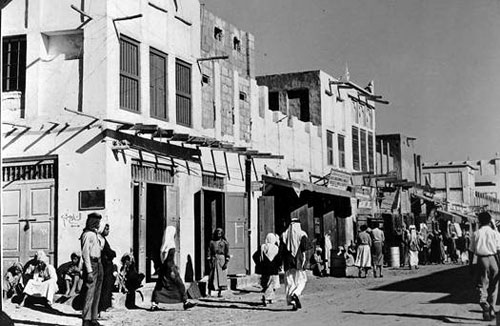 View of King Saud Street, Al-Khobar, 1950s.
Source: The Internet.
Now that we carry riyals instead of dollars, shopping requires more planning, as the silver riyals are on the heavy side. Each one weighs about the same as a 50-cent piece, about 30 pounds to the thousand. ($220.) Therefore, $22 weighs about three pounds and it gets heavier the longer you carry it. It is a common sight now to see all women carry a little cloth or leather sack, with their riyals, half riyals and quarters, and jokingly all are advised to care one in each hand to not distort themselves physically, especially children growing up . . . When rugs are bought for $1,000, or cars for up to $3,000, it takes a car or truck to carry the coins. I have a riyal account in the local Indo Chine Bank, and can write riyal checks as necessary. To date, there is no charge for the bank account.
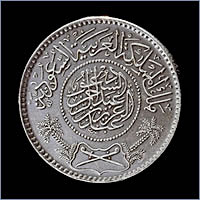 Saudi Riyal, silver, circa 1940s.
Photo from the Internet.
Yesterday the Girl Scouts went on an overnight camping trip to Half Moon Bay, about twenty miles from here. Our two [Judy and Susan] went along with thirty-five others and five or six grownups. We sent them in a 60-passenger personnel carrier with two Arabs, a four-wheel drive Dodge pickup, and ahead of them went the firewood, water, tents, etc. It took all week to get them ready, almost as much effort as if it was for the summer. I had steel grills made for them to cook on, borrowed a mess kit from the airbase, obtained canvas for a bedroll, made up two first-aid kits [the girls helped], packaged the food for four meals, borrowed water jugs and flashlights and pocket knives, added a change of clothing, bathing suit, sunburn tonic, toilet articles, sheets, pillow, blanket, etc. and when they left they looked like gypsies off for a trip.
Had word about eight last night that our two were well and happy, as we had been a little concerned with Susan, who does not like to stay away from us overnight. We should see them again by four P.M. and you know all about it then. The house has been very quiet since they left and you can be sure we miss them more than they miss us.
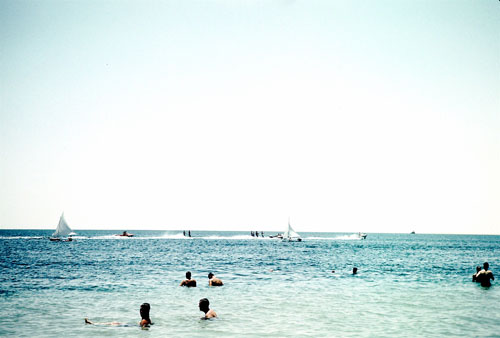 View of Half Moon Bay, 1950s.
Photo by Mildred Webster.
Did we tell you about Susan’s chickens? The gardener gave her a hen several weeks ago, but we kept it at a neighbor’s. (Editor’s note: My mother said she named it “Clarabelle” and that once, while cuddling it as she sat in her swing in the yard, it laid an egg – in her lap!) I finally had to build a pen and then a “friend” gave her another hen and twelve chicks. There are ten chicks left and growing like weeds. Apparently, seven of them are roosters, which is fine with me, as I like fryers, but we are having a hard time convincing Susan we should eat them in time. Maybe the others will provide us with fresh eggs in time, but it is a problem getting feed for them. Susan wants to feed them rice, cooked of course, and most of the bread, etc., left over goes to them. All we need now is a cow and another dozen hens, and we are on the farm again. . . we are getting good eggs from Australia most of the time and good frozen fryers, but the fresh ones would be well received.
Susan and Judy just arrived and have tales to tell of the high wind and sand storm, the rain, and all the goods and bads of a camping trip. They seem to have enjoyed it and I think it is good for kids to do this at least once in a while. It will probably take us the rest of the afternoon to clean up the kids and the gear, shake out the bedclothes, give them all a bath, and then get a late lunch or early dinner. . .
Aramco Overseas Company, a subsidiary of the Arabian American Oil Company, is planning to establish an office in Rome, Italy, it was announced by W.F. Moore, President of Aramco. This new office will be used primarily as the European Engineering Headquarters and for recruiting Italians for employment in Saudi Arabia and for the purchasing of equipment, materials and supplies for soft currencies. It may be that we would want to go there for a year or so, if we are offered the chance, as it is only 22 hours or so from New York, and is a grand place to live we think, as climate, food, facilities, etc., are the best in the world. If proper schooling for Judy should be right handy, it would have more appeal to us than sending her to Beirut, leaving her home, staying home with her until we are ready to leave foreign work for good, or any other deal such as Mildred staying home with her and my returning to Arabia for a tour or two.
This Rome office might well expand and be the main office of the company, as many qualified Italians are available for all classifications, the company wouldn’t have to provide housing, feeding, etc., as it does now in Arabia, it could pay them in soft currencies, which is very necessary more and more as we sell oil for other than dollars, and many other company expenses might be less in Italy than in the USA. We aren’t going there now, or soon, but if we don’t visit on our local leave, will plan to spend a week or so enroute home in 1951 and look the place over. . .
That’s oil for today. Love, Ken
Dhahran
May 19, 1950
Dear Folks:
Rather cool week, highest temperature 92 and lowest 72. It won’t be long before it gets hot and stays hot.
It was not too hot for the second annual flower show, which made many aware of the large variety of flowers grown here. Some displays were by children, and our two orphans entered exhibits. It would amaze you to see how nice of a show we did have. . .
Finished my forty-first lecture Wednesday and start in the other two Camps next week. Supposed to be fifteen in Abqaiq and twenty at Ras Tanura. It gets monotonous, repeating the same thing over so many times, but it gives me a chance to meet every American employee and to explain personally the duties of my department. I’ll be glad when it is over.
I hope to drive daily to Abqaiq, forty miles, give the four per day one and a half hour talks, then come back here. It may be too tiring, but will see. Then if Lynn will take care of the kids, Mildred will go with me to Ras Tanura, and we’ll stay there for almost a week. I’ll really be glad when it is over and I am back to my regular work again.
We are, like most here, talking about a vacation, and making various plans. We haven’t ever taken a local leave, but should this year. [We are considering going to] Beirut and then [taking] a trip to Jerusalem . . . Beirut . . . Jordan . . . Dead Sea . . . Jericho . . .This all-expense tour for groups of 21 people costs 85 USA dollars. Then we thought we would go to Island of Cyprus for a few days, as it is advertised as the land of Sunshine, Romance, Archeology, Sandy Beaches, Snow, Mountains and Valleys, Streams and Waterfall, Godly Wines, and Beauth Spots. That last word is spelled correctly, but I don’t know for sure what it means.
I relocated the chicken coop and cleaned up the garden spot for the summer, Mildred and Judy straightened the house, rearranged Susan’s room (a sure sign of spring) and now we are resting, while I am writing my part of the weekly letter.
Love, Ken
Dhahran
May 26, 1950
Dear Folks:
Blowing great guns today, so we are staying in after a quick trip to Al Khobar to try and find some buttons for a dress for Judy. Found the buttons, but wouldn’t pay $1.50 for some dime store material. Have had this wind now for several days, and with the sand in the air, is far from pleasant. Lucky for me, it was not blowing badly all week when I traveled for days to Abqaiq for the lectures and home at night. Mildred went with me one day and visited with friends there, but it was hot coming back at night and on the fourth day the temperature was 122 in shade. Here it has been up to 112, but the windy days generally keep it down.
Finished my 55th lecture Wednesday and go to Ras Tanura Tuesday to give three instead of twenty. It is an experiment and if successful, will be adhered to instead of the first plan. . . [I] have enjoyed telling almost all of our 2,200 American employees the story of Motor and Marine Transportation. There are fourteen managers following me, telling of their department activity, and so far most people seem interested in knowing who does what and why.
We are in the process of an old clothes drive for the Palestinian refugees, one part of the Aramco-Personnel Aid Rally. It is hoped we can collect a large amount of clothes of all kinds for the thousands of displaced persons from Palestine who are residing in Lebanon and other nearby countries. (Editor’s note: this displacement was a result of the United Nation’s Partition Vote in 1947 that ultimately created the country of Israel and led to an Arab-Israeli War of 1948-49.) Much interest is indicated and the publicity work is handled by movie, bulletin boards, mail, loudspeakers in cars, etc.
One baby born this week, a boy, weighing 8 lbs.-8 oz. most of our babies here seem to me to be heavier than most at home. Maybe it is the sand.
Dost est allus this time, Love, Ken
(No news of interest. Went to a coffee this morning and to an Arab Relief meeting. I volunteered to be my block’s captain for sewing baby layettes to go to Beirut. Love, Mimi.)
 Advertisement for one of the many tailor shops in Al Khobar, 1950s.
From Ken Slavin’s collection of Webster papers.
Dhahran
June 2, 1950
Dear Folks:
June already, how the time flies. We can remember when June meant getting ready to be able to go to Glacier National Park, and if Spring and Summer came early enough, we might make our first trip of the year in late June or early July. Now June means to us that we shall not have any more vegetables from our own garden (I dug up all the onions yesterday), that we can’t water the yard until after dark because of the hot sun, and that we must wear hats and dark glasses for four months or so, always carry [a] water jug when leaving camp with a car, and take salt tablets at least once daily.
I had to being my thermometer into the house as it only went to 100, so don’t know if the outside temp is officially above 100 or not today, but it has been to 112. I mowed the lawn and worked outside until two, in the hot part of the day, and it was too hot to stay out in for long. My feet burned on the sand and concrete sidewalk. I am a tenderfoot for fair, as when in Ras Tanura last week I walked to the beach about three blocks from the apartment, and blistered both feet on the sand. That is the first time I ever did that anywhere.
Yesterday was pickup day for old clothes for the Arab Relief in Palestine. Quite a large amount of clothing was collected and after being checked over and mended, will be sent by the company to Beirut. Mildred is a block captain and will head up families in this block sewing layettes for the Refugee babies.
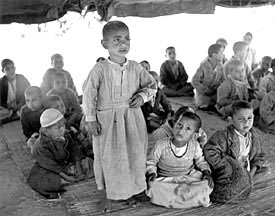 Arab refugee children, circa 1950.
Photographer unknown, courtesy the Internet.
One of the our engineers who visits the capital often on business told me a lot about the Kings and Princes’ palaces that may be of interest to you.
As the Kings’ sons grow up, they each take their mother to live with them. In case more than one son is born to a mother, the oldest son takes the mother. This requires additional palaces, each of some 50 to 60 rooms. The King’s palace is actually a group of palaces covering many city blocks in size and containing his own power generator and air conditioning units. The rooms are huge, each being about 60’ X 80’ X 20 feet high. The Crown Prince’s present palace has only 70 to 80 rooms, but a new one is being built, Western style, with 300 rooms. He also has a garden and swimming pool some distance out from the others and will have several hundred rooms and thirty bathrooms in buildings near it. The second son, Faisal, had a palace of 300 rooms, average size [of rooms] 15’ X 25’, which is not a guesthouse.
The King of Afghanistan visited the King of Arabia last Fall, and for such a new palace was built, containing more than 70 rooms. The King’s favorite sister has a palace of 500 rooms. It is reported that the Crown Prince has a modern kitchen with electric and oil stoves, refrigerators, etc. He has an American cook who serves him food cooked American style, brought from America. Most palaces have roof areas for sleeping and lounging, praying, and visiting. The new palace for the Crown Prince will be three floors and a basement, a real innovation for Arabia.
No other news.
Love, Ken and Mimi.
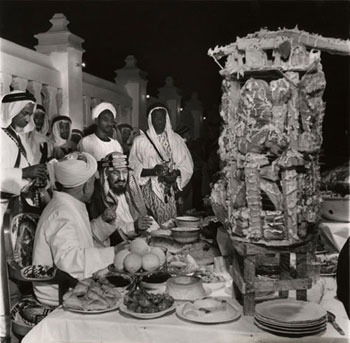 King Ibn Saud hosts a feast for King Abdullah I of Trans-Jordan. This impressive spread was held on the roof of the King’s palace in Riyadh.
Photo from the Internet.
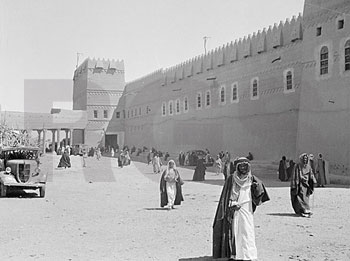 View of royal palace in Riyadh, 1937.
Source: Royal Geographic Society online archives.
Dhahran
June 9, 1950
Dear Folks:
Last Friday after writing you, we went to a cocktail party for the birthday of Dale Nix, the New York Office man taking [Vic] Stapelton’s place for a few months. About eight guests and the food was an excellent buffet. Then on Saturday we went to Stag Club for annual party of Headquarters Engineering, of which I used to be manager, and celebrated Bob Clausen’s promotion to manager and his departure on home leave. Sunday we had the Clausens to dinner, family style, and Bill Dunbar was here also. Monday went to open-air cocktail party-dinner alongside the swimming pool, by Exploration Department, who were celebrating the end of the field season for most of their men, and the boys who spend most of nine months in desert camps were glad to be in “town” for a while. Wednesday, had Chief Engineer Jim Stirton and wife, with four other guests, to dinner, and enjoyed talking with all, especially the Lebkeckers, who spent many years in the Montana-Wyoming area, both their children born in Great Falls, and they knew many of the old familiar spots. (Editor’s note: Both of the Websters’ girls were born in Montana during Ken’s work for Texaco – Judy in Great Falls, Susan in Shelby.)
Talk about Chamber of Commerce taking steps to attract tourists! Listen to this notice by General Commissioner of Tourism-Lebanon. “1. The General Commissariat for Tourism will pay part of the fares of any person residing in Egypt, Iraq, Saudi Arabia, Jordan, Yemen, Bahrain, Kuwait or Katar, who comes to…Lebanon between June 1st and October 31st with the purpose of spending the summer. 2. The return fares will be computed between Beirut and any of the following places: Cairo, Alexandria, Port Said, Baghdad, Jeddah, Amman, Bahrain, Sannaa, Taez, Hodeida, Kuwait, Dhahran or Katar [Qatar]. 3. The maximum return fares will be $50 for children and $90 for adults . . .” This is the first time such an attraction has come to my attention.
Last week we had the pleasure of hearing Donald Dame, who is [a] soloist on well-known radio programs. (American Album of Familiar Music and the Bell Telephone Hour.) . . .He was accompanied by Miss Ditmar. This couple [is] traveling around the world, stopping at Army camps and bases, and we were offered by the local Base for our entertainment.
 Booking ad for famous classical singer, Donald Dame, who was a featured performer on NBC Radio’s “American Album of Familiar Music.” He gave a concert in Dhahran in June 1950 while on a worldwide tour.
Photo from the Internet.
The girls have kites all made for the local contest, but it is again postponed due to high winds. I used linen instead of paper and a stapler instead of flour and water paste, and fear for the success of the flying when deviating from time-honored customs and materials.
Effective July First, but dating back to 1942, we have a new retirement plan which pays 50 percent more than the previous one. It costs each employee about ten percent of his wages, and pays after retirement approximately 3 percent per year of the total earnings during foreign service. It sounds good, and requires retirement at 60, which I don’t like, but won’t worry about now.
That’s all today. Love, Ken
Dhahran
Friday, June 16, 1950
Dear Folks:
Today is the first day of Rhamadhan, the month of fasting, for all good Moslems, from dawn to sunset.
The law is based on Qur’an ii. 179-184, and is as follows:
A fast has always been a part of religion. In Islam it falls in this month because in it the Qur’an was revealed, and it is holier than the others. It begins when the new moon is actually seen, and lasts until sight of the next new moon. It extends each day from the time when a white thread can be distinguished from a black one and until nightfall; it is absolute in that time as to food, drink, women. The sick and those on a journey may be excused, but should fast thereafter an equivalent number of days. The last ten days of the month are regarded as especially sacred: in the course of them falls the “Night of Decree,” or “of Power” (Qur’an xc. 1) but its exact date is not known.
Fasting in Rhamadhan (sometimes spelled Ramadan) is reckoned one of the five pillars, or absolute requirements, of Islam. It is followed by the Lesser Festival, the first three days of the month Shawwal, Arabic-speaking Muslims (Moslems) call this latter ‘Id al-Fitr, the festival of the fast-breaking, or Al-‘id as-saghir (Lesser Festival).
 A framed color print (one-sheet) of the entire Koran, printed in the 1950s.
Photo by Ken Slavin, from his personal collection of Webster/Aramco memorabilia. This family heirloom hangs in his dining room in San Antonio, Texas.
Ramadan is the ninth month and Shawwalk is the tenth month of the Arabic year. It is a time to pay official visits as well as private ones, some give and receive presents, new clothes are put on, and the graves of relatives are visited. The second or “Greater Festival” is called Al-id al-kabir, or ‘Id al-adha, freely translated as the “Festival of Sacrifice.” This falls on the tenth, and two or three following days, of the last month, Dhu-l-hijja, when the pilgrims each slay a ram, a he-goat, a cow or a camel in the Valley of Mina in commemoration of the ransom of Ishmael with a ram.
Similarly throughout the Muslim world, all who can afford it sacrifice at this time a legal animal, and either consume the flesh themselves or give it to the poor. Otherwise, it is celebrated like the Lesser Festival, but with less ardour. Both festivals, of course, belong to a lunar calendar, and move through the solar year every 32 years.
Possibly I wrote of this last year or told you of it while we were home, but repeat it here anyway. It means for our Arab employees that if they so desire, they may only work six hours a day all month, six days a week, and will get eight hours pay and seventh day pay. . . as the period is thirty days without water, food, cigarettes, etc., during the day, and as their sleep time is taken up mostly with eating and drinking, they try to sleep on the job or don’t sleep. You can well imagine the celebrating when it is over. Often they get sick when they first eat or drink. It is a time of short tempers, and we all are warned to help all we can to not irritate, etc., by eating in front of them, drinking water, smoking, etc. This period is moved forward ten days each years as their year is ten days shorter than ours. In a few years it will occur in the cool of the year for a while.
Love, Ken
Dhahran
June 23, 1950
Dear Folks:
New loading record at our tanker docks was made on June 12 while loading “The Texas” under the command of Captain S.C. Peterson of Port Arthur, Texas. Five hours and 40 minutes to load 204,076 gross barrels of crude oil, this being an average of 36,013 barrels per hour and for first hour the rate was over 43,000 barrels per hour. . .
Thought for the day: “The largest size of seamless steel pipe used mostly for pipelines is two thousand times the diameter of the smallest size of tube, used for hypodermic needles.”
On June 13th and and 15th an Air France Skymaster crashed while coming in to the landing strip at night on Bahrain Island. The passengers were mainly military from Saigon, Indo-China, and nineteen were saved from the total of 102 aboard. No satisfactory reason was officially given as yet for the double catastrophe, but it was a time of high wind and sand in the air.
Love, Ken and Mimi.
Dhahran
June 30, 1950
Dear Folks:
Two boys were born this past week and there are continued indications that we shall make our forecasted quote before the year is out.
We are sending 50 Saudi Arabs to Beirut for summer school, as we did last year. They are from all parts of Saudi Arabia. This is all at the expense of Aramco and we are the gainers when they can do better work after the advanced schooling not otherwise attainable to most of them.
If you read in the paper about a Florence Chadwick attempting to swim the English Channel, you will know that she was one of our stenos and was [the] leader in the swimming meet called “Aquacade” [Aramcocade] we wrote about two years ago.
[The] Fourth of July will be a large weekend for us here as usual. The King is providing watermelons from his private garden (which we operate), and there will be dancing on July third, then all the next day a series of contests, field events, barbeque, etc., in all camps. This is one of the American holidays observed by all employees, the other two being January First and Christmas.
May was the record month of all time for Aramco, as we produced an average of 550,846 barrels per calendar day. It looks like July will beat this, but that much is really lots of oil. The average for first five months of this year was 474,506, which for such a period is good. . .
Among the different nationalities, etc., working here for us are the following: Saudi Arabs, Adenese, Pakistanis, Indians, Sudanese, Bahrainis, Somalis (French, British and Italian), Iraqis, Chinese, Kuwaitis, Malayans, Omanis, Persian, Syrian, Hadramoutis, Muscatis, Zansibaris, Javanese, Egyptian, Italian, Palestinian, Lebanese, Celonese, Eritreans, and maybe some I have overlooked.
Love, Ken
Dhahran
July Fourth, 1950
Dear Folks:
Have just completed a safe and sane Fourth here in Arabia and really had a nice day. . .
[T]he scene of activity…briefly was as follows:
9:00 A.M. Tennis Tournament, and Baby Beauty Contest, and Bowling.
10:00 A.M. Teenage Field Events, which included three-legged race, back race, obstacle race, 50 yd. dash, tug-o-war; egg race; donkey races. Susan won the latter in her age group and I am sure that part of it was due to having tried out all the donkeys for an hour before, paid the Arab four riyals to hold that one for her, and it was the fastest, at least when she rode it. She can do anything with animals it seems.
10 A.M to 10 P.M. Bingo – continuous. Susan played this for several hours, in between buying ice cream cones and riding donkeys.
11:30-1:30 Much needed intermission for lunch, etc.
1:30 P.M The Dhahran Fire Dept. played a game of “Roll out the Barrel,” with fire hoses and a little red barrel. The idea was to roll it across the goal line and the two teams fought it out in wajid water.
2:00 P.M. – 3:30 P.M. Swimming events for girls and boys, no adults. Judy won one first, one second, one third and numerous places. While I think of it, she also won a prize in the morning Field events.
3:00 – 6:00 P.M. Dancing, Horseshoe Pitching, Pie-Eating Contest, Dancing, Free Beer.
6:00-8:30 P.M. Free barbecue, free beer, marvelous local watermelon from the King’s Farm, etc., visiting between tables on the patio, etc. Must have been at least 2,300 Americans there, plus all kinds of non-Americans.
8:30 P.M. Another tug-o-war and then the Donkey Polo Game. The latter was a riot. I’ll brief some of it for you, and will quote the first page of the program. Of course, you would get a bigger kick out of the game when you know the players, but apparently we have some wits with us.
 Donkey polo team roster for Fourth of July 1950. Ken Webster copied this roster from the printed program. Perhaps some readers will recognize the names!
Courtesy Ken Slavin’s collection of Webster papers.
The nicknames of the men and girls is obviously due to a physical or other appearance or characteristic, and brought forth many laughs as they came on the field . . . Both men and girls were constantly falling off the donkey, or hitting an opposing player or the donkey left the field, etc.
 Donkey polo match, Ras Tanura, circa 1950s.
Photographer unknown. Source: The Internet.
Several of the “younger” set finished up the evening at the patio dancing to the Air Force Dance Band. This is an Italian band imported from Eritrea by the Army to work in the canteen and dining hall, but definitely to play for any and all occasions. We have several good orchestras of our Aramco Americans and cannot complain about the music. Normally, we use recorded radio music which is transmitted over the power lines to all three main camps for eight to twelve hours per day and the very latest music plus symphonies, etc., are played.
LATER….Friday, July 7, 1950
Did I tell you that the first drive for clothing for Palestine refugees ended with a collection of 2,987 pounds of wearable clothing, much of it new, and all of it washed or cleaned and mended if necessary. It will be flown to Beirut for distribution.
Women’s Club gave a tea for our president’s wife, Mrs. W.F. [Dottie] Moore, and about 350 to 400 attended. Of course, both the Arabian Webster women [Mildred and Lynn] had a hand in it. It was quite a successful affair.Today I mowed the lawn, trimmed the hedge, spread fertilizer on the lawn, filled in holes with dirt, and had my usual sunbath. It is now one thirty and with lunch over, the Friday show time soon to take the girls’ main interest. My weekly letter almost completed, Mildred and I have nothing to do except nap, take a ride, or go visit someone. Why don’t you all drop in and pay us a visit?
Love to all, Ken
Dhahran
July 14, 1950
Dear Folks:
Today may be the last day of Ramadan and if so, tomorrow will be Id El Fitr. The month of Ramadan is 29 or 30 days long, depending on the moons, and today is the 29th day of this Moslem month. If the new moon is officially seen tonight by the properly appointed representative of the King, then tomorrow is Id El Fitr and the first day of the next month, Shawwal. [If so], Moslems get tomorrow and Sunday off with pay, and non-Moslems get Sunday off with pay.
The fourth day of next Moslem month (Shawwal) which will be Tuesday or Wednesday, will be a holiday for all in honor of the King, as it will be the 50th anniversary of the Capture of Riyadh, the capital of Saudi Arabia, by our King Abdul Aziz Ibn Saud in January 1902. It is 50 years by the Moslem calendar since that date. This is a special holiday this year only, and we have therefore seven official holidays this year. In 1945 we had an extra holiday to celebrate the return to this country of his majesty the King, after he conferred with Roosevelt and the King of Egypt in the Mediterranean.
The Moslem calendar is based on a lunar year of twelve months. Since a lunar month, that is the time between two successive new moons, is about twenty-nine and a half days, the basic length of the lunar year is 354 days (12 X 29.5). However, to take care of a slight overlap, an additional day has to be added eleven times during every cycle of thirty years, so that there are eleven leap years of 355 days each to accompany nineteen normal years. Since the ordinary lunar year is eleven days shorter than the ordinary solar year, the Moslem year begins eleven days earlier each year according to the Christian (solar) calendar. The Moslem New Year’s Day progresses steadily from the end of the Christian year towards the beginning, a process that is repeated over and over again with the rolling past of the centuries. It takes roughly thirty two and a half solar years for the process to be completed once. Consequently, for the purposes of ready calculation, it may be said that one hundred years by the Moslem calendar are approximately equivalent to ninety-seven years by the Christian calendar.
The year 1 of the Moslem calendar was the year in which the prophet carried out the Hegira (Hijrah) or Migration from Mecca to Medina, 622 A.D. The abbreviation A.H. for Anno Hegirae (in the year of the Hegira) is used in referring to a year of the Moslem calendar.
The Saudi Government considers three occasions as official national holidays. The first of these is the Feast of the Sacrifice or the Greater Feast, of which I wrote of recently. This begins on the 10th day of the twelfth month (Dhul Hijjah) and lasts for four days. The second is the Feast of the Breaking of the Fast, or the Lesser Feast, and occurs on the first three days of Shawwal (tenth month), which may be starting tomorrow. The third is the Accession Day, we call it Coronation Day, commemorating the swearing of allegiance to the King as King of the Hijaz on January 8, 1926. Since this is a day on which the King receives congratulations from the heads of other states, it is fixed according to the Christian rather than the Moslem calendar. . .
Today’s news [in the Sun and Flare] says of Fourth of July events: “Suzy Webster was the star of the Donkey Races by very definitely outriding all competition.”
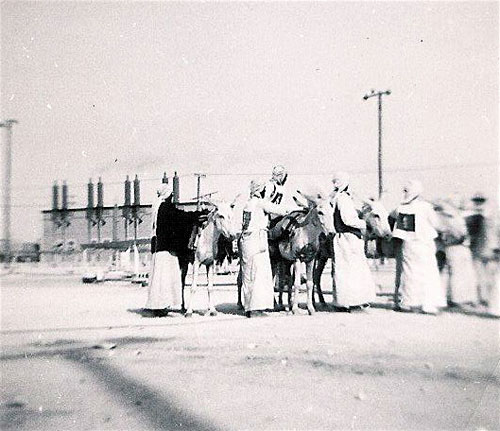 Arab donkey races, circa late 1940s.
Photo by Mildred Webster.
There is a fine shamaal blowing that one can hardly stand up against – and the dust and dirt fill your eyes and ears. We just came out of the show, which was Bing Crosby in “Top O’ The Morning.” Rather good. Guess we’ll clean up and go to the Dining Hall to eat.
Love to all, Ken
Dhahran
July 21, 1950
Dear Folks:
Had a visit this week of the U.S.S. Greenwich Bay, flagship of the Middle East Forces. It is the first United States Navy Vessel to berth in the new Dammam Port, second deepwater port of Saudi Arabia, and the local government officials had a dinner and then the ship officers returned it with a dinner. Many of the sailors came ashore and visited our camp here, while their team played the local air base baseball game at our diamond.
 The U.S.S. Greenwich Bay, which was the first Navy vessel to berth in the new Dammam Port in 1950.
Photographer unknown. Source: Internet.
[C]rude oil production should exceed 600,000 [barrels per day] by January, and every six months we could add 100,000 barrels a day as necessary. First six months of this year we produced 88,529,593 barrels or 490,000 per day average.
No babies this week, but the local Stork Club has four inmates waiting for the call. I guess we told you the laying-in house for those women from other camps is across the street from us, and we keep up with the coming events pretty well.
War news doesn’t get to us except the daily radio sheet, Time Magazine, and very little is heard about it here. We are probably better off here and at least as good in case of World War III, but aren’t worried about it. (Editor’s note: This is presumably a reference to continued fighting between the Arabs and Israelis, as well as the early stages of the Korean conflict.)
Love, Ken
(Hi – Ken left me a little space to add my few words. We kept pretty busy last week, what with a holiday in the middle. We were supposed to have another one, but the King’s sister died and he called off anything in the nature of a celebration. I went to a very nice luncheon Tuesday at Mrs. Davies’ – Resident V.P. There were 14 of us. . . Judy is practicing now for water events and a water ballet for a show in September – she swims very well. Susan swims, too, and good, but isn’t interested in “form” yet. School will be out this week for a month. Love, Mildred.)
Dhahran
July 28, 1950
Dear Folks:
Another week goes by at only 110 high and 88 low . . .
This week was the jackpot for babies: four girls here in Dhahran, one boy at Missha’ab, and two had children born in the States while on home leave, which no doubt should be credited to us as where they were planned for. The Stork Club is not empty nor do we believe it will be for some time. (Editor’s note: “The Stork Club” was the nickname given to the “laying-in” house on King’s Road in Dhahran, where women prepared to give birth in the Dhahran hospital.)
Mildred has had her usual crop of coffees and teas, and we went to one buffet dinner-cocktail party of about fifty couples at the Executive House in honor of new Assistant General Manager Storehouse and Assistant Manager Carl Renfer. . .
Love, Ken
(Hi – Judy went to Abqaiq on an early bus to be in the swimming meet today. She went with friends and will be well taken care of…She is really concentrating on her swimming and has shortened her speed for the 90 ft. pool to 37 seconds. They both [Judy and Susan] had good report cards. Judy straight A’s again – Susan All A’s and B’s – which is fine, also. Now for the 8th and 5th grades – gosh, it doesn’t seem possible! I had a coffee for 25 on Sunday and have two more lists for the same amount. . . I have Daisy Cooper’s Indian cook now and Machmoud has gone on 2 months leave. Don’t know whether I will keep Francis when he gets back or not – but he is a very good cook. Ken has worked in the yard a long time and is in the shower – the place looks quite nice . . .Love to all, Mimi.)
Dhahran
August 4, 1950
Dear Folks:
Yesterday took another plane trip to [the] interior and visited Al Kharj, Ain Dilla and Khafs Daghrah, the main three farms run by Aramco for his majesty the King.
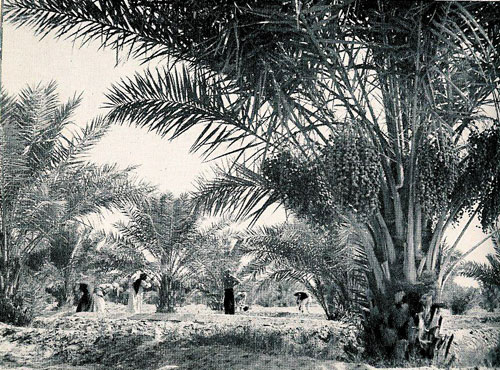 The date grove at the King’s garden at Al Kharj, circa 1950.
From Ken Slavin’s collection of Webster papers.
We left our airport at eight thirty A.M. on one of our DC-3C’s (C-47) and flew at about 155 miles per hour south and west. The air miles totaled about 229, but it is over 300 by car and will be 350 by railroad when same is finished next year.
Arrived Al Kharj, the main farm camp at ten our time, nine their time. After a cup of coffee, drove in Fords to Kafhs [Daghrah], about 30 miles west. It was a rough trip, temperature about 115, but low humidity, and we went by some palaces where the royal family reside[s] for a few months in the Fall and Spring. We were in fairly high hills and dropped down into the bottoms land over a rocky road hardly more than a trail. Saw several hundred brood mares, each chained by one front leg to the feeding trough, over 100 camels, and a herd of “first cousin to the Brahma” bulls, which are used as plow horses by the Arabs who work on the farm. Their hump was about eighteen inches long and twelve high, about half of the size of the India cattle.
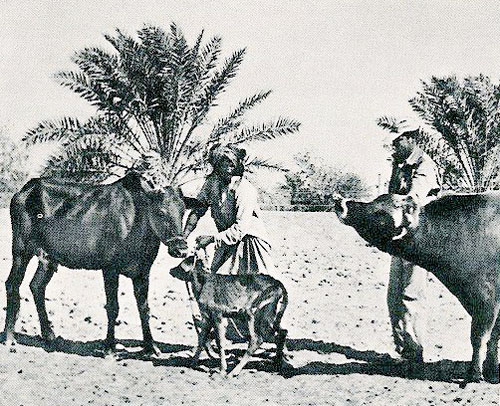 Small cattle described by Ken Webster as ““first cousin to the Brahma bulls.” He saw these at Al Kharj, one of the King’s farms run by Aramco. The cattle were used as plough horses.
Photo from the Aramco Handbook.
This farm is about 12,000 acres in size, uses approximately 5,000 gallons of water per minute, and is a producer of water and muskmelon, honeydew, native varieties, squash, onions, wheat, cabbage, tomatoes, etc. The well, or local AIN, is a natural sinkhole about 100 feet in diameter and unknown (at least 600 feet) in depth. . . the size of the farm is entirely dependent on the amount of water available. . .
After lunch, we inspected the camp shops, which included garage, heavy duty, machine, blacksmith, carpenter, paint, welding, etc. Many parts must be manufactured daily to maintain equipment so far from source of supply.
Then we went to Ain Dilla, ten miles East and South, a farm of another 12,000 acres, which with Al Kharj [and Khafs Daghrah] of 14,000 acres, is irrigated from an AIN or well and deep well pumping equipment is used. . . Until modern pumps were installed, the natives used the water raised by lowering goatskins into it as donkey, or camels, were walked to and from the edge.
One the way back, we drove through the largest date grove, and saw trees loaded with four to six large bunches of dates. Some were red, some brown, some green, some yellow. With rare exception, date trees are artificially pollinated by Arab workmen, and this year such was unusually successful, as it looks like one of the best years in past five. . .
I asked the boys about quantities of produce and was told about thirteen large truck loads daily take fresh things to the King and his retinue, reported to be about 3,000 in size. Many days they get 3,000 watermelons alone. None of this is sold, but all used by the royal families, and those 17 Americans and 700 native workmen and their families.
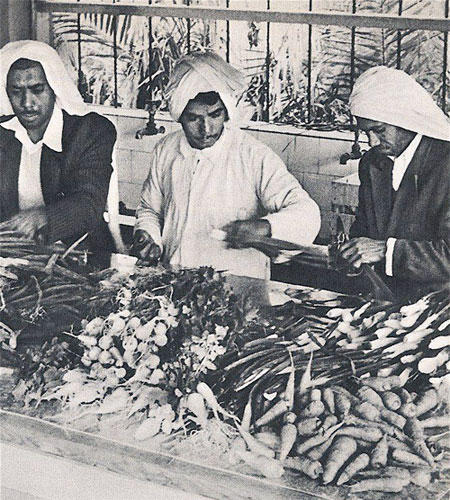 Arab workers sort vegetables grown at one of the King’s gardens, 1950s.
Photo from the Aramco Handbook.
We arrived back here about six thirty, tired, salt-encrusted (from sweat – and I don’t mean perspiration), with a good supply of produce. My share for us was two large watermelons, three each honeydew and cantaloupe, cucumbers, native melons. One watermelon is gone and the other on ice and probably will be gone before we go to bed or before I get back from work tomorrow.
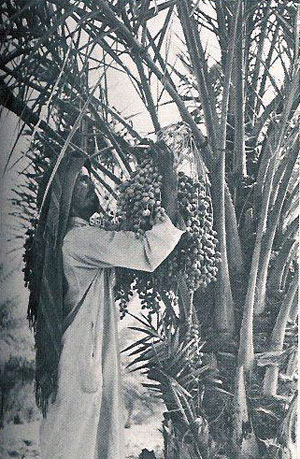 A Saudi Arab worker harvests dates at one of the King’s gardens visited by Ken Webster in the 1950s.
Photo from the Aramco Handbook.
Judy and three other girls won their 200-yard freestyle relay last Friday in swimming meet at Abqaiq, which was won by Dhahran. Judy is becoming quite a swimmer and a lot of nice remarks are made about her style. Susan is more and more liking the water and may become more interested as time goes on. We like them to be swimmers as it is good exercise and will help them have good posture. This month is holiday for the girls, not for Mildred, who has them [the girls] all day. We hear the cry – what will I do now – but they seem to stay busy regardless.
Allyn and Lynn are counting the days as they leave here September 5th to get the boat in Beirut September 12. They are going at a grand time of year and will be on same boat we were. (Editor’s note: The Exochordo, one of the famous “Four Aces” of the American Export Lines. Mildred, Ken and the girls sailed on it the year before.) I hope they have as good a time as I did, for I talked them into it and would go that way again if I could. (I had such a good time last year, but nobody else in this family likes boats.)
Love, Ken
(Things keep just as busy as if it weren’t hot. Lots of coffees and teas. I have 12 coming for dinner tomorrow and 26 for coffee again Monday. Lynn and Allyn had a very nice dinner party for my birthday. Ken and the girls gave me 8 lovely hand-carved ivory Chinese goddesses. I’ve decided to start backwards for my next birthday! Best love, Mimi.)
“Dear Folks”: The Webster Letters From Arabia 1944-1959
30 June 2007 | comments (0) | In Search Of Oil | by Aramco ExPats
CHAPTER 8: HAMDULILLAH! THE WEBSTERS GET AN UNEXPECTED HOME LEAVE; KEN WEBSTER TAKES ON NEW MANAGEMENT ASSIGNMENTS AND HELPS WITH THE FAMILY LETTERS; LYNN WEBSTER JOINS HER HUSBAND IN ARABIA; THE KING ORDERS PRAYERS FOR RAIN; ARAMCO EXPANSION CONTINUES UNABATED.
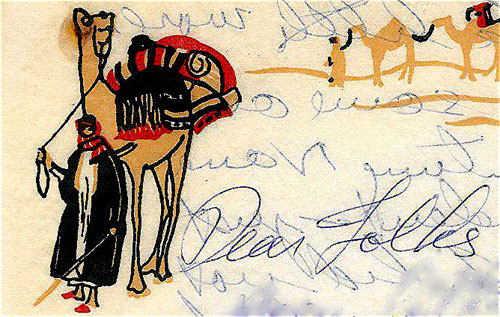 Ken Webster’s personal stationery, with a stylized color motif of a Bedouin and a camel caravan. As in all the Webster family letters from Arabia, this one opens with “Dear Folks.”
From Ken Slavin’s personal collection of Webster papers.
In stark contrast to the ongoing Arab-Israeli conflict in the Middle East and worldwide headlines describing fighting, bombings and the flight of up to half a million Palestinians from their homeland to refugee camps – sparked by the U.N. vote to partition the region two years earlier — 1949 is a year of enormous expansion and success for Aramco, professional growth for Ken Webster and exotic travel for the Webster family.
Early in the year, the family gets word that Home Leave will come a whole year sooner than expected, due to a change in employment contracts for Aramco employees living in Arabia. (Contracts are reduced from 30 months to 24 months.) The Websters enjoy a Mediterranean cruise and a trans-Atlantic crossing to visit family in Connecticut and Oklahoma. Before they depart, Ken Webster is named Acting Assistant General Manager (while Bill Cooper is on Home Leave) in addition to his duties as Manager of the Engineering Department. Then, upon return from leave, he is named Acting Manager of Transportation and reports in detail his new responsibilities, which include the management of marine and ground transportation and communications systems for an area, as he describes it, from the “Persian Gulf to Red Sea, and Old Persia to Rubi Kalid (Canada to Texas).”
Mildred keeps up with a blinding social schedule and volunteer work, as well as running her household, with the able help of two houseboys. Judy and Susan continue to flourish in school and extra-curricular activities. Ken’s brother, Allyn, is reunited with his wife, Lynn, and they begin a new life together in the Kingdom.
Dhahran continues to grow, adding ever more fantastic “Little America” features, including a snazzy new bowling alley and a “direct dial” telephone system. Aramco’s phenomenal development is seen everywhere, from hundreds of thousands of barrels of oil produced daily, to millions of dollars invested in communications, equipment, building and employee training (both American and Saudi Arab).
Late in the year, King Ibn Saud commands all faithful Muslims in Saudi Arabia to pray for rain – and it works!
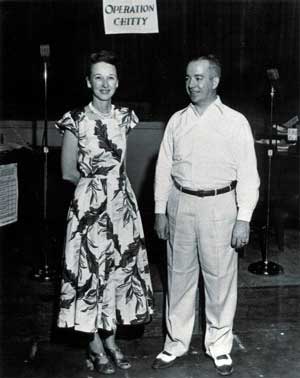 Mildred and Ken Webster at an Aramco event, Dhahran, 1949.
Photo courtesy Judy Webster Bauer.
Dhahran
January 25, 1949
Dear Folks:
We have all enjoyed our [Christmas] things so much . . . the girls got quite a kick out of the autographed photos of Judy Garland – did you see her in California?
We have a [birthday] party scheduled for Susan on Thursday. She sent out invitations and so I will have 12 little girls on my hands. There is no school that day, so [I] plan to take them to the 2 o’clock movie and back here for cake and ice cream, etc. She didn’t want any boys. She is going to be very surprised over the Mickey Mouse watch. She has grown up so much lately!
Allyn was down last weekend and plans to come again this Thursday [for the party] and stay over. We enjoy having him. I always try and have something special in the way of food for him, even if he is trying to diet. This last time I made a perfectly beautiful chocolate pie on Friday – and forgot to put in the sugar! I’ll get our rationed prime beef roast this weekend.
It has been quite cold and rainy and wet-ish for sometime – things are still not growing much, but guess it will be hot all too soon. I have zinnias blooming and we have had radishes from the garden.
Well, it seems we have some interesting news. Looks like we will have our home leave next summer, so we will see all of you about a year sooner than we expected. It isn’t all settled yet, but the Company has passed a new rule of 24 months for families instead of the 30. Because of the places we have to go – of the school months – and because Ken stayed over last time, he has an OK to go out sooner, instead of waiting for Dec. 1st, which isn’t a good time from any angle for us to travel home. We will have to let you know more about it later, but [it] looks like we will leave here about August 1st. We want to take a hop, skip and a jump through Europe so we can all see some of the sights . . .We’d like to hit . . . the high spots in Europe and then take a fast boat across from England. Neither of us wants to fly . . .
Love to all, Mimi
Dhahran
March 7, 1949
Dearest Folks:
I am behind in my letter writing this week. I usually try to get them done on Friday, but here it is Monday. Friday was so very beautiful out I spent most of the day working in the yard.
Machmoud is off duty with a badly cut foot. We have been taking him to the Arab hospital every day for treatment, so I am chief cook and bottle washer and believe you me, I will be glad when he is well again. Guess I am badly spoiled!
The Home Leave deal as of now stands that Coopers [Bill and Daisy] will leave April first and Bill says we can go July first if we can get reservations. That would be much better for shopping at home. We still plan to take the boat from Beirut and we are all looking forward to the trip. It is only six hours by air from here.
I just came from Coopers and while there they received a cable that her father was not expected to live, so don’t know what they will do. They were leaving on a week’s business trip tomorrow night for India. I think she will try to go on home now if they don’t receive any further word. He hasn’t even been sick – but the message said heart and lungs. I feel so sorry for her.
It has turned warmish the last two days and very nice out. Looks sort of blowy right now, though. Even in two days the grass and flowers have begun to really blossom.
Went to a coffee this morning – go to a tea tomorrow and Thursday, and Thursday night we are having our anniversary dinner – all the ones who came out three years ago together. There will be 8 couples of us and we are having a progressive dinner, ending up here for dessert and for the rest of the evening. It will be fun, I think.
Hamdulillah! Machmoud just came in from the hospital and says he can work. His foot is still bandaged, though. He says, “Too much my room no good.” Sudanese are very sociable among their kind and hate to be alone. They do everything in groups and like to eat together.
I look at [Susan] in constant amazement. She is wearing dresses of Judy’s I just can’t believe will fit. But she is long-legged like Judy and their dresses creep up fast, especially the waistlines. On Judy the styles have become too little-girlish and so I have brought out some new ones. She is at the stage that blouses and skirts look the best on her. They have both grown very much and you will see such a change in them, especially Susan. . .
The Stapeltons are back and have taken their precious cat, Ferdinand, home. I really miss him and still feel badly about our Tommy being killed. We have a chance to get a lovely kitten, but it is too near home leave time to start with a kitten. They talk of permitting us to bring out inoculated dogs for families – but that we will have to think over carefully. Susan is still nuts over anything with four legs.
Our new bowling alleys are open and they are really very snazzy. I haven’t seen any better at home – 8 lanes with all the newest and prettiest equipment. I haven’t had a chance to play yet, but will eventually. They are open from 8 A.M till midnight every day, all for free, too.
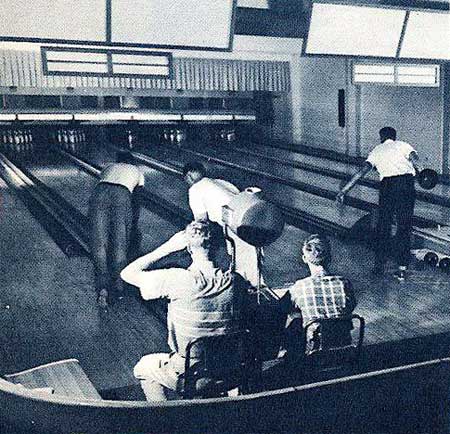 Mildred Webster described the “snazzy” bowling alley in Dhahran, which opened in 1949.
Photo from the Aramco Handbook.
After dinner….
Daisy and Nan [Cooper] are leaving at 5 AM in the morning on TWA and will be in New York Wednesday night. Those planes only stop twice to refuel and take about 45 minutes to do it. I do hope everything will be OK.
Bye now – must get the children to bed.
Dhahran
March 30, 1949
Dear Folks:
I am afraid summer has come. But we hope there will be another cool stretch before we really start in. It does this almost every year – a premature hot spell that gets everyone because it is so sudden. Practically everyone came out in summer cottons. Today is overcast and delightful.
I have done my chores for the morning – my usual rounds – commissary, laundry, PO and canteen – even the bank today. Then [I went] by the clinic for a shot. I was sort of ‘puny’ this last week and concerned the whole family by taking to my bed for two days. Nothing serious, just more of the same – but it was the second time in nigh onto 12 years that Ken has seen me go to bed. I have been taking a series of shots and feel better already. I haven’t been going anyplace for a few days. (Editor’s note: it is unclear what Mildred’s health problem was, but judging by her many references to allergies, this may be a reference to series of serum shots for allergies.)
 View of Aramco commissary checkout center, Dhahran, early 1950s.
Uncredited photo courtesy the Internet.
Our cook has arrived from Khartoum and seems very nice. [He is] a quiet, older little man – speaks no English. We haven’t his medical release yet. It takes about a week for them to clear through Ras Tanura, so, of course, he can’t do any cooking yet. He has 25 years’ experience with English people in Khartoum, but that doesn’t necessarily mean he is a good cook in American standards. Machmoud knew him and that is the way we got him, so it is a happy, friendly set up. They will room together in the domestic camp.
We are very proud that Ken has been made Acting Assistant General Manager to take Bill Cooper’s place while he is away. It was announced yesterday. Ken works so hard and is so good – always happy and considerate of everyone. He deserves it, but one never knows.
The Stapeltons [Vic and Gladys] had a formal dinner last night and we went. I’m so glad for we had a wonderful time – one of those parties that “gels” and everyone had fun. We had a wonderful dinner – sang and danced. I almost didn’t go, but glad I did. Everyone was congratulating Ken. The MacPhersons were there. The [commanding officer] and wife from the Airbase – the Cundalls – very good friends of ours. The Stapeltons and two bachelors. Gladys does things very well. She has three excellent servants – personally, they would drive me nuts – I can’t seem to keep two really busy. But I guess I am too easy on them. The Stapeltons and the MacPhersons are the only ones with three – and Mac as THE resident VP has a terrific load of social stuff to carry and Grace [his wife] is wonderful with it all.
Bob Underwood moves up as Acting Manager of Engineering and Construction to take Ken’s place and will continue while we are home. Gee, now that it is getting closer, I find the days simply drag rather than speed along as they did. We have had confirmation of reservations for July 5th.
Gladys Underwood has gone down to India – mostly for the boat ride down and back. [She] went with a friend who is going down to Kody Kanal in India to see her daughter graduate from high school next month. There is a very fine American missionary school there. Lots of Bahrain children go there and several from here.
The hot sunshine has done wonders for the yard and the oleanders are a mass of blossoms – we have 12 big bushes.
Enjoyed letters from Evelyn, Edward and Dawn. (Editor’s note: Edward Webster, Ken’s older brother, and wife Evelyn and daughter Dawn. They lived in Norwalk, Connecticut.) Thanks so much for the offer of your house. We do appreciate it and if we can’t find something closer and a little larger, we will take you up on it.
Allyn is fine and I can’t really say as to his thoughts. He talks often of going home, but whether he means it or not, I am not sure. . . I don’t like to tell other people what they should do. It all depends on what you are looking for and want out of life. Maybe the little nest egg he has accumulated is all he wants out of this and who are we to say otherwise. I know Lynn [Allyn’s wife in Texas] would like it here and it would sort of be too bad for her not to have the trip. He has done very well and is liked by all and is going steadily forward. It is a bum deal to be separated and all the talk in the world can’t really prepare you for it until you experience it. So, we will just have to see what comes.
School is out today for the April month’s vacation. But there are so many activities planned by the school board to keep them [the children] busy. They [Judy and Susan] both are members of the Swimming Club. Judy has signed up for tennis. They can have two alleys at the bowling alley for a time twice a week, with instruction. Sometimes it worries me the adjustment these children will have to make to live at home again. So much is done for them here and everyone falls over trying to think up nice things for them – plus the servant deal. Things are just handed to them on a platter. Of course, they are gaining a great deal, too, and no doubt we can work out the other side when the times comes.
 Judy Webster, late 1940s.
Photo courtesy Susan Webster Slavin, from her family collection.
Daisy Cooper’s father is much better and they think he will be all right. Bill left Monday on the Camel for a long vacation.
It is nearly lunchtime, so had better close. I have been going over summer play clothes for the girls – and letting down all hems for both. They certainly have grown. Both look very well and are so. Bye now.
Dhahran
April 20, 1949
Dear Folks:
Allyn has been permanently transferred down here [from Ras Tanura] and has a change of classification from surveyor to assistant engineer, which gives him a little more money and a few more points each month. If he could only have Lynn here, everything would be fine, but the prospects of it happening soon look dim under this new set up. . . . You see, in view of the oil situation the world over, all these big companies are cutting out all extras for the time being and that means a cut down in houses to be built, too. Something still could happen, so please don’t say a word about it. He gets very blue, naturally, but if he can only stick it out, he will be so much better off. This would have to happen when it affects someone close to us. By the looks of things in reports from home, this would be a very good place to ride out the next few years. He has nothing to lose and much to gain.
We still keep very busy. It has been very warm the last few days and we have AC now, but don’t use it all the time. Of course, it is hay fever season for me, so the family suffers by my ill disposition, I am afraid.
Judy has gone on a trip to Bahrain today with the Scouts. They have the Ras Tanura Scouts as guests and left this morning at 7 by launch to do the tours over there – taking lunches. So, I was up at 5:30 this morning getting her off. Susan is at the pool.
Next day…
We had a bad shamaal and I was quite worried about the Scouts, but they sent them home early and so they didn’t get into any rough water coming home. We have had so many [shamaals] lately. It is blowing so right now that you can’t see more than two blocks away for the sand.
I have done nothing but go all week and now there are two cocktail parties this evening, a wedding reception tomorrow afternoon, a formal dinner Saturday night, a cocktail party Sunday night and a coffee that morning – then a tea Monday afternoon. I’ve got to squeeze something in myself pretty soon. I want to give a fairly large dinner party if the weather will only clear up so I can count on using the patio – would have 24.
Sayed, the cook, seems to be working out OK. I can’t talk to him, but give my orders through Machmoud. He is especially good with meats – most of them are – but they don’t know how to make pie or cake. Machmoud is good at it now, so he can teach Sayed. They do make beautiful custards and other kinds of “sweets.”
We are in summer clothes now and so [I] have put all the wools away and sent scads of stuff to the cleaners. I had four wool suits cleaned last week for a total of $1.65.
Dhahran
May 14, 1949
Dear Folks:
Thanks loads for the candy, which arrived on the Camel on Mother’s Day. I had all sorts of nice things. Judy made me a lovely towel and gave me a little brass dish accompanied by a very sweet poem she wrote. Susan gave me a little bottle of Chanel #5. And Ken brought me a very interesting antique Arab coffee pot – not like any I had seen before. I felt overwhelmed with presents.
The Underwoods got in tonight from Beirut, Damascus, Istanbul and points all up and down. They look fine and had a grand time.
We received our beautiful nests of tables from Bombay this past week. We bought two sets of them – matching. They are of teak and have just a little carving in each corner of each table. Little by little we are getting the things we want to take home to keep. Nothing is cheap anymore, though.
 Susan Webster, late 1940s.
Photo courtesy Susan Webster Slavin, from her family collection.
Dhahran
May 31, 1949
Dear Folks:
Gosh, these days sure roll by fast. I am sort of counting them now, for several reasons – happy to be going [on Home Leave] and then have to plan the time as to what has to be done here before we go.
There is a little lull, but it won’t last long. Two people were asking to give parties for us, before we go, just this morning. I definitely am not going to accept anything the last two or three days. I was dead on my feet last time we left here and I am not going to be again.
If it all works out as planned, we will be in Beirut four days and even with sightseeing and shopping there, [we] should get a good rest.
The Underwoods . . . plan a big department party and dance for Ken before we go.
Allyn plans to leave this Friday on his local leave. Sounds like they will have a good trip. He is going with a very nice boy, one who came out with him, and [he] may stay here in the house with Allyn while we are gone. They are going up to Ras el Mashab where the Tap Line camp is – and on to Kuwait, then just where fancy leads them – probably on up to Baghdad. They have to get out of the zone of operations, beyond Kuwait, to get the Company allowance for a local leave.
Charlie Fischer came by yesterday. He brought the Gazelle out on this trip. He and Arlene were married the 10th of April . . . he is a pilot on the Co. Camel and Gazelle. We made two trips with him and Ken [had] three.
I haven’t had much hay fever but, brother, the sinus. I’d rather have hay fever any time. I can get relief from that, but can’t do much about the other.
I have never seen Ken so excited about a trip. He really is happy about it. I do hope it turns out to be all he expects. I am getting anxious, too. I have done all the sewing and fixing and have been going through all the things in the house. It will be so nice to leave Allyn in the house, for I won’t have to pack everything up. . . Machmoud is staying, too . . .can cook for Allyn and his friend and take care of everything else. He is really a number-one Boy.
This is the first day for a long time that the wind and sand [haven’t] been blowing . . . SOMEDAY I am going to live where the wind never blows. I had 6 years of it in Sunburst and 3 out here. I wouldn’t have the heart to ask Ken to leave here, though.
Dhahran
June 10, 1949
Dear Folks:
We leave here three weeks from yesterday. I still have my fingers crossed, for we are going to be very disappointed if we don’t make it as planned . . . Mr. Stirton [chief engineer of Aramco] will be out the 26th and that will make it hard for Ken to cover his stuff before leaving.
The parties have begun. There are four cocktail parties scheduled for us in the next two weeks, besides the daytime stuff – and a few dinners. It is a rat race. I have told them all, though, that we aren’t going out to anything the last few nights. Even though I have been working along and getting things organized, there still is a lot to be done at the last minute.
I dread the trip up to Beirut. It will be on the Company plane and they come down two places en route. It will be stifling hot in both places and when you start down into the heat or up out of it, there is a time when you think you will just die. I wish there were some other way to get up there, but there isn’t. It would be too hot on a boat, too.
This is my puttering day. The boys don’t come and I always have stuff to do. Washed a bedspread and some other stuff – dyed a couple of sweaters that were very dingy and faded. I think the girls will need them aboard ship in the evenings.
Dhahran
June 23, 1949
 Mildred Webster with her brother-in-law, Allyn Webster, Dhahran, late 1940s.
Photo courtesy Susan Webster Slavin.
Dear Aunt Bertha, Helen and Nelson:
We will be leaving one week from this morning. [We will] go up to Beirut, Lebanon, on the Company plane and sail from there on the 5th. We go American Export Lines – one of the Four Aces. (Editor’s note: The Websters sailed on the Exochorda, one of the four “sister ships” of this line. They were built as U.S. Navy attack transports during World War II, but converted in 1948 for passenger service. They were also the first fully air-conditioned ships in the world. In addition to Exochordo, the Four Aces included Excalibur, Exeter, and Excambion. They sailed between New York and the Mediterranean ports of Barcelona, Marseilles, Naples, Beirut, Alexandria, Piraeus, Naples, Genoa and Livorno. Source: Internet.)
From all reports, it is a very good trip and an interesting one – a Mediterranean cruise. Takes 22 days with stops in Alexandria, Egypt, Athens, Greece, Naples, Leghorn and Genoa in Italy, with several days all together in those three stops – then one day in Marseilles, France, from which we drive up through the French Riviera, then across [by ship] to Boston for a day and on into New York.
I have never been on an ocean voyage. The girls and I have flown across three times and Ken five – so we are hoping for something different this trip.
We plan to stay in Greenwich, Conn., with Ken’s family and both Daddy and Beverly and Mother and Raymond are coming East to spend time with us. Ken’s time will be very short, as we are going home 4 months early. We don’t plan to travel at all this time, unless Ken has to go to the San Francisco offices – in which case I will go with him. Only thing is the office is in the process of being moved from there to New York and if the Engineering Dept. is already moved, we won’t even do that.
I have a tentative plan to stay over a while and did think I might come back South Pacific, but have decided it takes too long and besides, too many of the ports are closed now. I’ll probably come back the same way we go, but Ken will fly.
The girls are growing up fast. Susan is 8 and Judy 11. They go into the 4th and 7th grades this next year’s term. We go to school out here all year round with three months on and one off – December, April and August are vacation months. But the year starts in September just the same. Both do well and get along fine, but are as different as day and night.
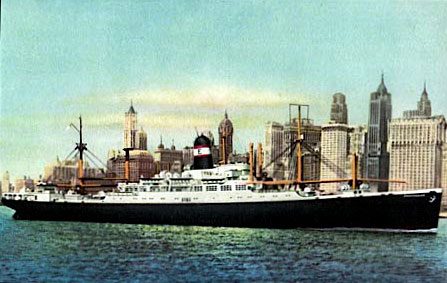 Color postcard of the Exochordo, one of the famous “Four Aces” of the American Export Lines. The Webster family sailed aboard this ship in 1949 for a 22-day voyage that included a Mediterranean cruise and a trans-Atlantic voyage to New York, where they began their Stateside home leave.
Image courtesy the Internet.
Dhahran
June 27, 1949
Dear Folks:
We are beginning to really get excited now! Just two more days!
I hope I have everything ready, but there has been so much going on, haven’t had much time. This is the party-est place I ever saw. Everyone has been so grand, but I just had to turn some of them down. . . .
Last night the Engineering Headquarters group gave a big party for us – Ken is Manager of that. They put on the cutest skit I ever saw – all about Ken. It was very funny and we had a good time. Didn’t get home until late, though, and Ramadan started today – which means we are on daylight saving time, so we actually are getting up at 5. That hour difference sure makes it tough.
Ken [sent] a letter to you with a million instructions as to how to get there [East]. Ken said he would tell you the route we took back [in ‘47] along the [Great] Lakes, which would be lovely that time of the year. Then you come into Connecticut from above, through Pennsylvania, and miss New York City entirely. The traffic there is pretty heavy and we will be going down there anyways to see things, so you wouldn’t miss seeing it on your way in. I think it is grand you can come and we will enjoy having you so much.
Don’t worry about clothes. Out in Conn. in the summer everything is very informal. You can go to any of the towns around shopping bareheaded – just like you would in the shopping centers in Tulsa. It will still be warm in September, so your summer clothes will be fine, unless you want to bring something darkish to wear at the last. Actually, anything goes in New York – we always dress for comfort.
Lynn will be out by August, we think. They have a darling apartment assigned to them in a good location. Two bedrooms, too.
Bye now. We’ll be seeing you.
(Editor’s note: At this point, the letters from 1949 stop, picking up again in October, when the Websters arrive back in Dhahran from their Home Leave.)
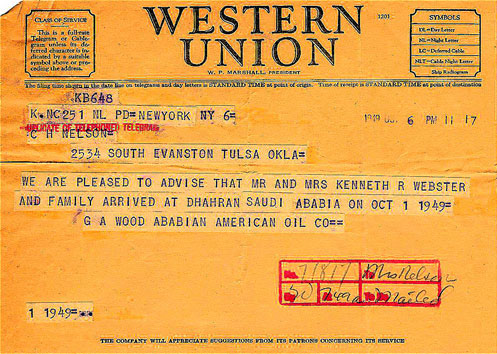 Telegram, sent by Aramco, to inform Mildred’s family that she, Ken and the girls had arrived safely back in Dhahran after their home leave in 1949.
Courtesy Ken Slavin, from his collection of Webster family papers.
Dhahran
October 3, 1949
Dear Folks:
I am not quite squared away yet, so I am up early this morning. The kids are still asleep and Ken has gone already. This is a good time to start a letter, even if I don’t get it finished in one sitting.
You get so turned around on your time flying this direction that you wake up at odd times. Yesterday morning, Ken and I were awake at three and this morning I have been awake since 4:30. I’ll more than likely get straightened out tonight.
The plane was crowded and Ken had to sit up all the way – all the men did. Then there were 7 in my compartment, so we had to double up. No one really got any sleep. We had a good rest at Lisbon, but it was the same from there on. The children folded up early and slept right through, so they are OK now.
We laughed at Susan. She went to sleep at 2 in the afternoon of the day we arrived and slept right through till 9. The rest of us, including Allyn and Lynn, went to Underwoods for early dinner, then came home to bed. Susan got up at 9:30 and read till 11 – then went out and scrambled herself some eggs and took a bath! We didn’t know anything about it till next morning. Then she slept right through till 11 AM, as did Judy.
Allyn and Lynn, plus most everybody else, were at the plane when we came in. We came right on home while Ken stayed to take the stuff through customs. Lynn had a lovely breakfast for us, but Ken was just dead and he popped right into bed without even eating and slept 5 hours. The house looked just the same and the yard is just beautiful. Allyn surely did himself proud. I was amazed at how much everything had grown.
We got the silver service through customs without any trouble — everything else, too.
Last night the Coopers were having a large cocktail party for the Engineering group out from New York – including Les Snyder – so we went for a little while, then on to dinner for 20 at the Singelyns’ for the same group. I was pretty tired and we didn’t stay very late, but it was nice seeing everyone again. They all seem glad to have us back, which is better than the other way. Ken is in heaven. He went right to work yesterday and off this morning.
Lynn is fine and seems to be very happy. And Allyn looks like a new man. They will be OK, I am sure. Last night, everyone I met told me how much they liked my sister-in-law.
There is a lot of Company STUFF going on, but I don’t know just all of it yet – a lot of changes. I will have to tell you more about it later.
Dhahran – Kingdom of Saudi Arabia
October 21, 1949 (1365)
Dear Folks:
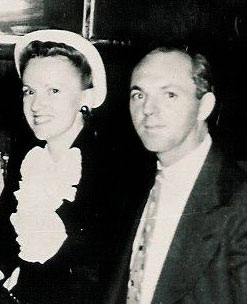 Lynn and Allyn Webster, 1940s. Allyn was Ken Webster’s younger brother and worked for Aramco for several years. Photo courtesy Susan Webster Slavin.
My turn to “columnize” for the homefolks, so will try to bring you up to date regarding the latest in “Little America.”
. . . I am now Acting Manager of Transportation instead of at the old post of Construction and Engineering. Considered temporary, per advice from the Big Wheels, but how do I know when I recall that I went to Montana on a temporary deal, stayed five years, married and had two girls. Until the next move, will dive in and see what gives.
Actually, I am outside more than if I was in Construction as of yore, drive out to Abqaiq and up to Ras Tanura at least once weekly, have to pretty well keep up with all Construction plans anyway, and have a territory from Persian Gulf to Red Sea, and Old Persia to Rubi Kalid (Canada to Texas).
The fleet consists of 1,660 light cars and trucks and 748 large trucks (up to forty tons) plus 300 trailers of all kinds. We move the drilling rigs, which in one piece (unitized) weigh over 120 tons, handle all freight at least three times (into-country freight totals 18,000 to 24,000 tons per month), transport personnel both American and non-American, and, in other words, keep the wheels rolling in and between camps.
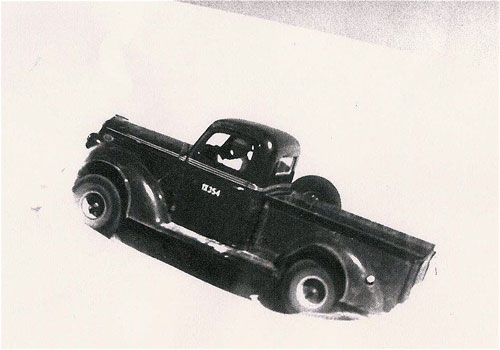 Aramco truck stuck in a sand dune, late 1940s.
Photo courtesy Patricia Dale Watkins.
The above is worth $22,000,000 on the books and we hope to increase efficiency so as to reduce it by at least $6,000,000 before the end of 1950. I shall unquestionably be very busy as long as this assignment lasts. It is fun, more or less new to me in detail, and my head is buzzing with new thoughts.
[We] have attended a few dinners, two cocktail parties, and can see that the season is underway. Looks like we men will be expected to wear coats and ties after Thanksgiving, civilization having come to Arabia, but it is still so warm here that “whites” are still the vogue now. Mildred has had at least one coffee or tea per day since arrival and more in prospect. Machmoud arrived the 15th and has taken over, so we shall have to return or pay back with affairs also.
The biggest new deal ever to strike Arabia is now on. It is called Gillitus. Dr. Gill has made everyone CALORIE CONSCIOUS, and it seems that half the people here are on diets. The Dining Hall menus are printed with notes on each portion as to calorie content, and everywhere people meet, that is the main topic. Our Medical Dept. are [sic] trying to obtain maximum good health for all, and overweight people endanger their chances to return when this present tour is over if they do not abide by instructions. The women generally don’t need instructions, but the men do, and as it is officially the thing to do, all concerned are trying to reduce that “rubber tire” in front and elsewhere. I need not worry much, Mildred not at all except to gain, but many are really in distress. . .
Getting fresh eggs from Beirut now, 5,000 dozen per week, and it sure helps. We all miss the fresh milk, except Susan. Had a chocolate milkshake today that even Mildred liked. The garden is half in and the place here looks excellent, thanks to Allyn working it over while we were away.
I am home more of the time than in my old job, [so] we are more of a family than before, and I hope it continues. I haven’t worked a night yet, and don’t intend to if at all possible.
I am sure having fun in this new assignment. I feel sure I am in a “checker” game, but can’t guess just what the “Wheel” has in mind for me. No doubt I will know more in due course, and in the meanwhile, I am having a grand time learning something new, reorganizing another department, and spending a lot of my time outside looking at operations, rather than getting bad posture at a desk.
Everybody is happy, hope you are the same.
Love to you all, Ken, Mildred and girls.
 Visiting Beverly “Nana” Nelson (Mildred’s stepmother) in Tulsa during one of the home leaves in the late 1940s. Front row, from left, Susan Webster with a dog on leash, and Judy Webster. Behind them are, from left, “Nana” and Ken Webster.
Photo courtesy Susan Webster Slavin.
Dhahran
October 28, 1949
Dear Folks:
No mail to answer, but [we] are trying to write a weekly message, even if no real news.
Took Mildred to Ras Tanura on my weekly trip, and she got the dirt and visited a few old cronies. Took her to Abqaiq also on weekly trip. Took Lynn on this last trip and the two of them needed a hamburger at three PM to give them strength for the forty-mile desert trip home.
Last night went to the Patio, taking Susan to see the costumes and fun there. Judy went to an “older” girls party. (Editor’s note: Halloween celebrations.) We walked to the scene of her party at ten thirty, to get her and Nan Cooper, and were frowned on for breaking up a good party so early. Ten thirty is our deadline, and she and Nan were stuck with it. Patty Hill stayed with Susan at the last minute, Nan with Judy, so we had four girls instead of two at breakfast. Got them all off to Sunday School, I mowed the lawn and watered the garden, unplugged stopped drain in bathroom, spent afternoon visiting with Allyn and Lynn, and one couple from Abqaiq who used to live in this house took Susan to Hobby Farm to feed her former dog, “Buttons,” to see the horses and other animals, then back for a good steak dinner. Meanwhile, I started a report on my new department and just finished it at nine thirty. It is about thirty pages long and I will type it up into about twenty-five. Soon will be off to bed, where the girls are now.
I am reviewing my geography and fractions now, and Mildred is renewing her acquaintance with spelling. We haven’t failed a test yet, but Judy says once in a while that my way is NOT the way her teacher tells her to do the problems.
New babies arriving frequently and more obviously on the way, which reminds me – Scotty Harper showed us her costume tonight enroute to a party. She went dressed as a “bay window.” Her baby due February First helped out, and she wore a window scene painted on a sheet, and a ruffled drapery down from both shoulders, as well as across the top. Quite clever and a laugh. Her husband went as a “nature” boy, and looked the part – moronic!
Love from us all, Ken
Dhahran
November 4, 1949
Dear Folks:
I was so amazed when Ken offered to write the weekly letters these last two weeks, I just let him go ahead and do it.
This new job has made a real difference in the time he is home. No night work to speak of and he is usually home by 6 – then all day Friday and usually on Pay Day afternoon, too. Makes it much nicer for us, even though we understood he couldn’t help it when he wasn’t home. He does spend two days away from home a week, but is back by dinner.
He has been working in the yard every Friday and our garden is up and coming right along. He set out a dozen tomato, cauliflower and cabbage yesterday. Sure hope we don’t have a shamaal now or that the birds don’t get them. We planted false bamboo all around the outside of the garden space, just inside the brick wall, and it serves as a wind break and, I believe, because it sways all the time, it scares the birds off.
 Front of the Webster house at 1423 King’s Road, circa 1949.
Photo courtesy Judy Webster Bauer.
Colonel Kline, president of Texas Company, and several senators with others, arrive Tuesday for a visit, so that will mean a to-do of sorts. The whole place is shipshape and shining. . .
Judy has a lot more homework this year and their classes are held departmental, which is nice. She went on a Scout hike yesterday for breakfast – back to swim in a group, then last evening they held a food sale at the Dining Hall, all of which they made themselves. Susan will come into the Scouts in January under the new ruling, but won’t be invested for a while. The troop is so big now that Mrs. Biggins is going to have to divide. We do have a treasure in her.
The girls are at the show. Now that we have to pay, it just kills their souls to give up part of their allowance to go. But we make them do it. It is 20 cents for children under 12. We pay 40 – but they will go broke on what I pay into shows.
Love to all of you, Mimi
P.S. Beverly, will you see if the summer gingham Scout uniforms are available there [Tulsa]? If so, send a size 10 and a 14 to Alice. I can’t get them in the East.
 Susan Webster at the Dhahran playground, late 1940s.
Photo courtesy Susan Webster Slavin.
Dhahran
November 11, 1949
Dear Folks:
Another Friday rolls around and we send our weekly message. Whether it is news or not will have to be judged by you.
The temperature has been 66 low and 90 high, no wind since our return, and beautiful days as well as nights. I am home nights and often by six, so am enjoying the family more than before.
The lawn needs cutting only once every ten days now, but from all reports, will need twice a week when next summer comes, making us glad to know our gasoline mower is enroute. Walked through the “Hollow” this afternoon after lunching with Allyn and Lynn, and found many lawns thriving or just started. This whole camp is fast becoming a garden spot all over. It not only looks good, but will keep sand blowing to a minimum.
Gardens are started. We have radishes only so far, but the tomatoes, cabbages, cauliflower, lettuce and beets are up, carrots, too, and corn. The lettuce is farthest behind and wanted most by me. Onions planted last spring are available and enjoyed. Our flowers are really good and the lawn excellent. . .
No news except to wish we were with you all, but all of us are enjoying good health, good weather, pretty good food (but no clams or lobsters) and look forward to a good fall season.
Love from all, Ken
 Judy Webster in Dhahran, late 1940s.
Photo courtesy Susan Webster Slavin.
(Hi – It actually looks like it might rain. The King ordered prayers for rain a few days ago and it seldom fails! We keep busy, as usual. I’m Brownie Mother today. [That] means I attend the meeting and supply the refreshments. So I have cookies baking. Everyone is fine, including Allyn and Lynn. Love, Mimi.)
Dhahran
Friday, November 18, 1949
Dear Folks:
Today is Sister’s and Ted’s wedding anniversary. (Editor’s note: Ken Webster’s sister, Alice, and her husband Ted, in Connecticut.) We wish we could be nearer to help celebrate. I can remember traveling home from Port Arthur with Mother to get there in time to make last-minute arrangements and to be best man. This was to be my third time in the role, and “best man but never a bride” seemed definite. But look what happened! Again, many happy returns and many more to come, Sister and Ted.
Yesterday was Pay Day Thursday, which meant we Americans had the afternoon off. We took Judy and a friend to the Hobby Farm, where the kids rode colts and fed the some twenty horses and colts for almost an hour.
Since I mowed the lawn yesterday for the first time in two weeks, all I had today was hedge cutting and lawn watering. Went to church at nine (we have it every other Friday) and after yard work, went to the office for a while. Mildred and the kids are at the show and due back in about thirty minutes. Fried chicken is the main dish tonight and I am ready . . .
My new vocation of Transportation is a booming business, and I like it very much. Although I have a bit to do at home each night, I can still spend more time daily with the kids and Mildred than before. . . We expect rain any day, as the prayers for same by order of the King have not yet failed. . . We could sure use the King’s weather prophet at home, as he seldom fails in his forecasts.
New families arriving daily, or rather every six or seven days, and babies are definitely on the increase.
Our daily news bulletins tell of snow around New York and westward. Swimming is quite the thing here, and the gardens are just getting up well. Guess you folks would like to be here for the winter and we would like to have some of the things you enjoy daily. Every location has advantages, and we like ours. I am sure we shall miss Arabia for many reasons when we finally give up and go back to States for good.
Will let Mildred finish this with her thoughts, as I have run dry.
Love, Mildred and Ken
(Nothing more to add. There has been a let up socially, and so we aren’t as rushed, which helps. Will have 12 for Thanksgiving dinner – all single fellows and girls. Love, Mimi)
Dhahran
November 25, 1949
Dear Folks:
Just returned from the Hobby Farm, where Susan and other little girls we took with us rode horses, fed the gazelles and chickens, and fed and played with Susan’s former dog, “Buttons.” She is very animal loving and we should buy her a horse or pony and let her vent her love for animals daily. For this reason alone, we should be in the States at a location where she could be raised with dogs and horses.
Last night we had our Thanksgiving dinner with eight guests from my new department . . . we ate half the turkey, maybe more, and it weighed 20 pounds. It really was a dandy, moist and well flavored, and we had all the usual fixings with it. Everyone ate like they hadn’t had a real meal in a long time. . . then one guest went home and brought back his guitar and he played and sang while the rest joined in to the extent they knew the words. . .
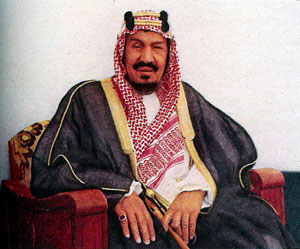 King Ibn Saud, who ordered all faithful Muslims in Saudi Arabia to pray to Allah for rain in 1949 after a protracted drought. It worked!
Photo from the April 1948 issue of National Geographic, which featured an in-depth report on Aramco’s work in Saudi Arabia.
From Ken Slavin’s personal collection of Aramco memorabilia.
An example of what faith can do was exhibited here. The King proclaimed prayers for rain and all citizens of Saudi Arabia prayed one day about two weeks ago. This happens one to three times each year. . . Two weeks went by with overcast skies, lightning at night, but no moisture fell. Then at 3 A.M. three days ago, a real downpour occurred which washed away many new lawns and gardens, roads between camps, etc. In Dhahran, the total official rainfall in a few hours was 0.97 inches and was the first rain since April 7th when 0.07 inches fell. . . To the local Arabs it was very welcome, and strengthened their faith in Allah. To us it was a shower only, but due to its effect on travel between here and Ras Tanura, as there was no drainage where the roads are built, it was a nuisance. It probably will do gardens a lot of good.
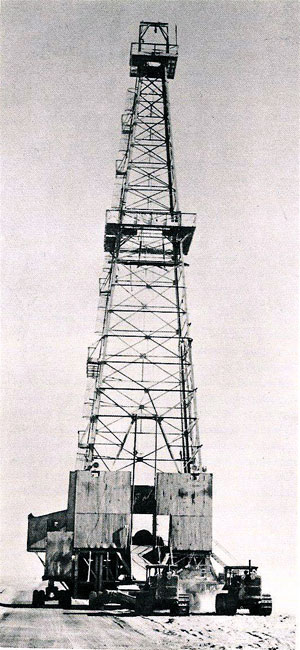 An Aramco oil rig being moved on extra-large, low-pressure sand tires, 1950s.
Photo from the Aramco Handbook.
Newest item in my work is the use of large tires for moving very heavy loads . . . These loads exceed 130 tons . . . now we are experimenting with larger tires which are to lift the rigs off their foundations. These tires are taller than I am, and each one can carry a load of 80,000 pounds. They were made by the Firestone Co. and are the largest industrial tires in the world. There is only one mold in existence . . . and, as far as we know, Le Tourneau Company (tractors) and Aramco are the only ones who ever bought this size tire for actual transportation needs.
Hi, Folks – Ken stopped this some hours ago. We went out to make a couple of calls, then back to dinner. The children are asleep and it is time for us to go to bed, too.
The girls are fine. Judy is rehearsing for the “Messiah”, then they are giving the Nativity again, so will rehearse for that, too. Susan just keeps busy navigating around. Her Brownie troop is going on a picnic tomorrow. Susan is president now – they only hold an office for three months, but it is good training. She is usually in the Nativity, too, so will probably be this year – in the choir.
Best love to all, Mimi, Ken and Girls
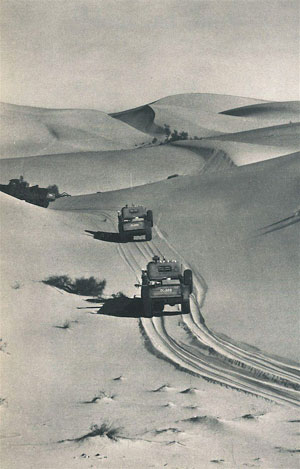 Aramco trucks in the desert, 1950′s.
Photo from the Aramco Handbook.
Dhahran
December 2, 1949
Dear Folks:
Both Judy and Susan finished first semester with flying colors. A little girl asked me yesterday at Hobby Farm, how old Susan was. I told her almost nine. She said, gee, I was just ten. Susan is a grade ahead of me in school and is real smart. I said, what do you mean smart. She said, boy, you should hear her read in school. Apparently, others besides us think our kids do all right.
Dhahran school enrollment now: Grade one 25, grade two 26, grade three 11, grade four (Susan’s) 11, grade five 19, grade six 13, grade seven (Judy’s) 15, grade eight 11, grade nine 9, total 140. Plenty of teachers here and all is well in the schools.
Poem for today: With eager zest, the Dean undressed, the Bishop’s wife, to lie on. He thought it rude, to do it nude, so kept the old school tie on.
(I think that was a good place for Ken to stop! He has covered the news, so I’ll just say bye now. Love, Mimi)
Dhahran
December 9, 1949
Dear Folks:
[We were] out late to a birthday party at Underwoods next door and slept until after nine. Took Susan to Hobby Farm for two hours and she rode almost that long on two horses in turn. She sure is crazy about horses. . .
Did I tell you we can go to Bahrain Island and call home? It means a three-hour trip each way, and unknown time of waiting to place and make the call, after prior arrangement. 2 to 9 in A.M. and 7:30 to 10 P.M. are the designated hours. Subtract nine hours for East coast, ten for Oklahoma and Texas, for time . . . it is better than before, when we had to go 1,300 miles to Cairo to use the phone for three minutes at twelve dollars. If you call us, please give three weeks’ notice – ha ha.
[I] made inspection of Communications system this past week, as it comes under me, and I didn’t really know much about it. It may be of interest, so will briefly state of what it consists.
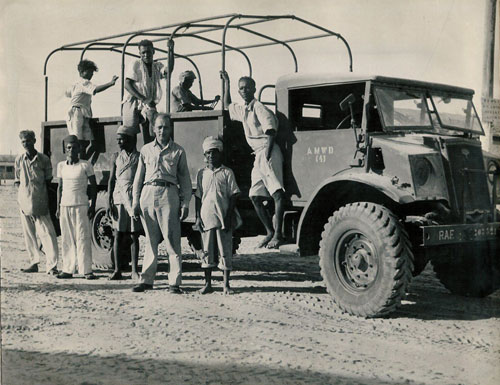 Paul Dale, center, an Aramco employee in the 1930s, ‘40s and early ‘50s. He is shown here with a group of Arab workers near Dhahran. He was a supervisor in the Communications Department.
Photo courtesy Patricia Dale Watkins.
We have radio contact with tankers and freighters enroute to or from Arabia for their protection and to permit being ready to load or unload them. This also includes numerous times daily weather reports to and from these ships at various parts of the world, and such are combined with others received at and properly interpreted by the local Army Airport Group. Quite frequently our medical department give[s] advice to ships at sea for sickness or accident cases.
When the ships arrive, we converse with them and our representative on [board] as the unloading takes place, as most freighters are unloaded while moored in the stream, into barges, and we coordinate barge movement in this way. Almost thirty thousand words a month are sent and received for this operation. We also use walkie-talkie for some of the daily contacts from the pier to the freighters. Over 80,000 words monthly are sent and received from Jeddah on the Red Sea. We have a main office there for contact with the Government Headquarters, transfer of messages to and from New York through Mackay who has a station there, and to cover truck and plane movements between the Persian Gulf and Red Sea. We have an air-to-ground section, for flight operation of our local planes, the planes from New York, and air traffic to Beirut, etc. Such contacts total 30 per day. The halfway station to Red Sea is in daily contact by radio phone and radio, same for headquarters of the Agricultural group about 400 miles into the desert, and 30 contacts daily with field parties of the Exploration and drilling group all over Arabia and off shore operation. We also have teletype service between here and Ras Tanura, here and Abqaiq, and here and Jeddah on the Red Sea.
Our news is broadcast daily from the States by UP (Editor’s note: United Press International) and is automatically picked up and recorded on a Teletype ready for issuing to our news editor.
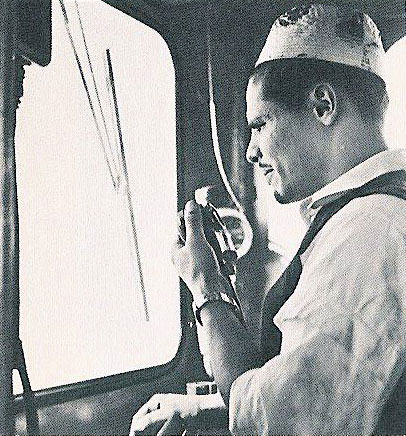 A Saudi Arab employee of Aramco operates a radio on one of the Saudi Government railroad cars, 1950s.
Photo from Aramco Handbook.
We use over fourteen different frequencies now, and will need to add others as we expand the service to operate the railroad and 30-inch [pipe]line 1,100 miles to the Mediterranean. The railroad uses radio now in each engine, and we shall soon need radios in each station. The entire R.R. operation will be radio-controlled over its 450-mile length as an economy and safety feature.
Our telephone system in and between the main camps is automatic dial type, and we just finished this last step to permit use without any operators, except one in main headquarters here who will have info on all personnel as to phone number, residence, office, etc. and for emergency locating of individuals [such] as doctors, fire marshals, oil and power dispatchers, etc.
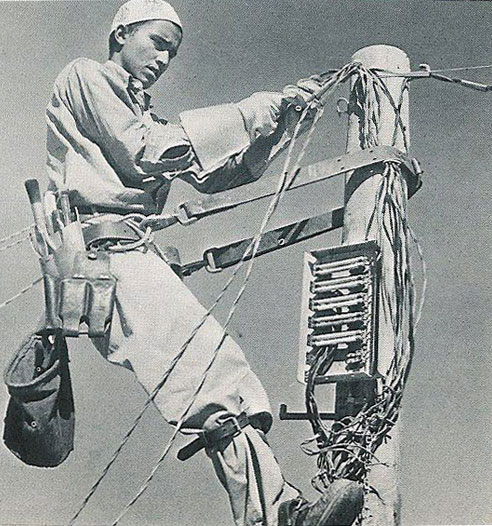 Another Saudi Arab employee of the company works on the massive telephone network in Saudi Arabia, 1950s.
Photo from the Aramco Handbook.
My investigation is not yet complete, but it is indicated that this communications system costs $42,000 per month for direct charges of labor and materials and supplies, and the overall cost of the equipment installed exceeds $4,000,000. Few companies require such an elaborate communications system, but this one pays out in controlling oil movement and all operations in camp, as well as in the desert, and is a decided safety feature for protecting lives and property.
This letter is almost all business, but that is all I know.
Love, Ken
Dhahran
December 16, 1949
Dear Folks:
Christmas is almost here and we have much to do to get ready. We expect to have only two guests, Don Larkin from Sunburst and Lockport, as his wife is home, and Stella, my former secretary who is our baby sitter now and again. Of course, Allyn and Lynn will be with us, as we want the family to be together on such an occasion.
My new assistant arrived last Saturday from New York office with his family. We brought them home, gave them a snack, then dinner, Mildred shopped for them to stock the pantry initially, and loaned them things to eat with, rugs for floor, bedspreads, etc. She was born in Australia and he appears to be a Scotchman – named [Alex] MacKenzie. [They have] two boys, six and ten.
Today we went to the Hobby Farm, then Al Khobar shops, bought nothing, came home, Judy to show at 3:15, Susan out roller skating.
Have invited 150 friends to [a] cocktail party next Tuesday to introduce MacKenzies, so Mildred will be busy with turkey, ham, nuts, etc., to feed them. This will serve as our Christmas party also, so we are ahead of many.
Holiday programs include: Dec. 18-Women’s Club Children’s Christmas Party and Orpheus Group presentation of Handel’s greatest Oratorio. Dec. 20-Boy Scout Christmas Party. Football game, Dhahran Bears vs. Air Force Commandos. Dec. 22-Nativity Pageant. Dec. 23-Special Christmas Golf Tournament, Bingo Party, Football between Air Force Commandos and Air Force Tigers. Dec. 24-Christmas Carols 7-8 p.m., then Seasonal gathering with choir in Dining Hall at midnight. Dec. 25th-Open House in the Clubs 10 A.M. to 2 P.M. Children’s Christmas party with Santa Claus arriving by plane at 9:30 A.M. Plus all the family parties to which we will be invited. A full week and then ditto to and including New Year’s.
A little rain, which brought the total for this year to 2.76 [inches] at Dhahran and 3.19 inches at Ras Tanura.
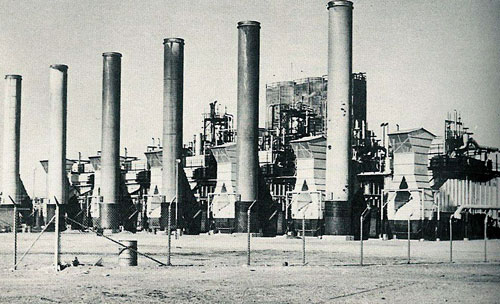 Power plant in Abqaiq, 1950s.
From Ken Slavin’s collection of Webster papers/Aramco memorabilia.
Started up second main power plant, this one at Abqaiq, 40 or so miles west of here. Total capacity [of the plant is] 20,000 kilowatts, produced by two 10,000-kilowatt steam driven generators. This should mean fewer power failures as we will have a supply from two main sources. The other one is in Ras Tanura, with three 6,000 KW steam-driven generators.
Fill-in for today: Our main office building has 71,057 square feet and the Dhahran Dining Hall [has] 42,525. The former cost almost $2,000,000 and the latter $1,622,000. Both are as modern as anything in the States, fully air conditioned, and are some of the reasons visitors cannot feel they are away from home.
Allyn [Ken’s brother] is working on the new Dammam Port approach and pier. It is 7 miles long, 4.8 miles being earth-filled causeway and 2.2 miles of steel pile trestle. In early February, ships can dock at it, load onto railroad cars, and haul freight over 100 miles into the desert. This will be the third deepwater pier constructed by us, and will be entirely for freight and operated and owned by the Saudi Government.
We are all happy and healthy, but would like to step on a magic carpet and come home for Christmas.
Love, Ken
(Had a cable this morning. Mother died Wednesday night at midnight. It’s hard to take, but she had no life at all the way she was and had been so sick so long. I’m glad we had the time with them this last summer. She did want to go [to New York and Connecticut] so badly and she had her trip and got to see everyone. Love, Mildred.)
Dhahran
December 23, 1949
Dear Folks:
Have skipped the parties to date, since we had news of Momma Cook [Mildred’s mother], and we shall confine ourselves to family dinner Christmas Eve and some minor visiting during the holidays.
Had a fence installed today between the patio and front lawn, so will have a little privacy. Also had two trees brought to us, which add to our front yard. The lawns are still quite green, and the garden is progressing fine. Should have corn before long, lettuce is almost ready, and the carrots and radishes are coming along fine.
We were worried about receiving our effects in time for Christmas, as they contained all presents for the girls. They arrived today at 2:30 and we have brought them all into the house . . .Will try and get all the things put away tonight, and the girls’ things ready for the tree tomorrow night. Will have Allyn and Lynn and two others for dinner Christmas Eve, then spend Christmas at home . . .
Went to Nativity program last night, as Judy and Susan were both in it. As the two years before, it was beautiful under the stars with all the sheep, donkeys, camels, Arabs, and under the stars atmosphere in the open taking everyone back several centuries. Sunday School program this morning was a showing of slides of the birth of Christ with wire recording music by the Sunday School children.
[We] have lights on [the] tree in [the] patio, a tree in the window, have sent a very few cards, but received a lot, and are ready to have Christmas be with us. Again, wish you all the best for the season, good weather, lots of friends, and wadjid gifts.
Love, Ken
(…I feel sad, but can’t bring myself to wish she [Mother] had lived on in such a painful condition. It comes to us all, but hard to take. Love, Mimi.)
Dhahran
December 30, 1949
Dear Folks:
Ken has been doing so well with the family correspondence and seemingly enjoying it, so I haven’t done much about it. He is out now and I will whip off a bit and he can finish it.
Our [Christmas] was a very pleasant one, if not a happy one. But those things are bound to come to us all.
We still have our Christmas decorations up – also lights on the tree in the middle of our patio. People do a lot of decorating here and it all makes for a festive air. . .
Ken surprised me with a very lovely Rolex Oyster watch – gold – and I gave him a new MacGregor jacket. We weren’t going to give each other anything! All your presents arrived intact . . . thanks for them all.
Allyn has been working nights . . . Lynn was just elected as Secretary of the Women’s Club and will be an excellent one, I know. They are both fine and Lynn looks very well.
It seems hard for me to realize that Mother is gone – even though I knew last summer it couldn’t be much longer. I know the life of an invalid is long, painful and tiring and I am so grateful she went in her sleep. Bye now . . . Best love to all of you, Mimi
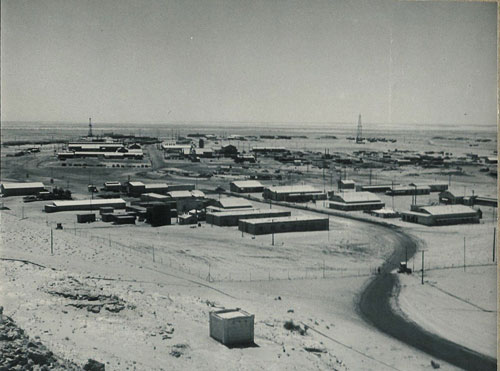 View of Aramco warehouses, Dhahran, late 1940s.
Photo courtesy Patricia Dale Watkins.
Drilling For Oil in Saudi Arabia
26 June 2007 | comments (1) | In Search Of Oil | by Aramco ExPats
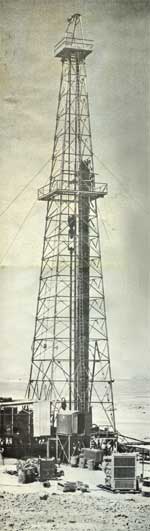
Drilling a well is like making a lengthy trip, straight down, into the long ago – millions of years ago – with one goal in mind: to find a dome-shaped formation of porous rock which, like a sponge, may serve as a reservoir for oil.
It takes a powerful drilling rig to make that trip. In the United States the rig is often pieced together at the drilling site like an Erector set. But in Saudi Arabia the Arabian American Oil Company rolls its 400-ton rigs into place on multiple sets of wheels. In that desert land, Aramco does not have to worry about crossing rivers or bridges.
The rig consists of four main parts: derrick, engines, drawworks and mud system. The derrick, 136 feet high, serves as the broad shoulders of the rig. From it hangs a heavy string of drill pipe (the term “derrick” comes from a London hangman of the seventeenth century). The diesel engines are the muscles. They turn the drill pipe and drilling bit that bore deep into the earth. The drawworks is the nerve center. The mud system is the circulatory system.
Aramco’s drilling crews today consist entirely of highly trained Saudi Arabs supervised by an American drilling foreman. Three shifts work around the clock to drill each well. Aramco’s average well in a proven area takes about 35 days to drill and finds oil at from 5,000 to 7,000 feet – roughly four times the height of the Empire State Building. The deepest yet took two years to drill, cost $5,000,000 and reached a depth of 14,875 feet, or almost three miles. It found no oil and was abandoned as a “dry hole.”
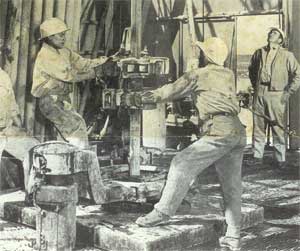
THE DRILLING FLOOR is a platform at the bottom of the derrick where the “roughnecks” of the drilling crew work in their hard safety hats. In the center is the rotary table which rotates the drill pipe and bit, like a carpenter’s drill, as fast as 200 revolutions per minute. New 30-foot lengths of drill pipe, weighing about 500 pounds each, are screwed on as the hole is deepened.
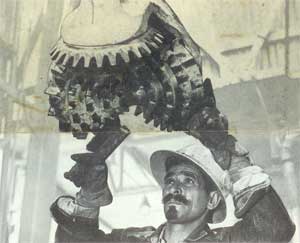
SEVERAL TYPES OF BITS are used to chew their way deep into the earth. Sometimes the rock is so hard that the hole can be deepened only one inch an hour. Some rock formations are soft enough to permit a speed of 400 feet an hour. Because of wear and tear, 60 or 70 individual bits may be used to drill one hole. A special hollow bit, studded with diamonds, is used to cut cylindrical cores of rock for geological examination. Such cores, as well as the cutting brought up by the mud system, may provide telltale clues to the presence of oil.
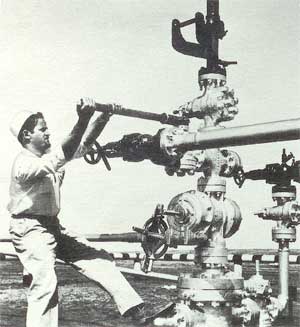
AFTER THE WELL HAS BEEN DRILLED down to an oil-bearing rock, the well bore is lined with a thin-skinned steel casing, cemented in place, to withstand the powerful pressures exerted by the crude oil and dissolved gas. Next comes the job of perforating the well. Explosive charges – sometimes as many as 120 bullets – are set off at the bottom of the well. They puncture the steel and cement casing in order to let the oil flow. In addition, the well may be washed with hydrochloric acid to dissolve the mud cake and to open up the pores in a limestone reservoir. Then a many-branched trunk of pipes and valves, called a “Christmas Tree,” is installed over the mouth of the well. Finally, natural pressures force the crude oil, like soda water in a siphon bottle, to the surface at a rate controlled by the Christmas Tree. Once the well is brought in, the drilling rig is wheeled away to another site, leaving only the Christmas Tree visible as a year-round ornament.
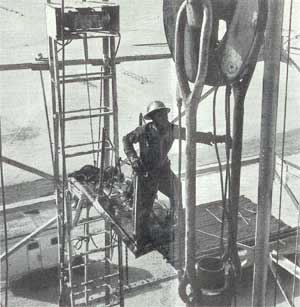
THE LONELIEST JOB on a drilling rig belongs to the derrickman. Strapped by a safety belt to the “monkey board” high up in the tower, the derrickman attaches the elevators to the drill pipe each time a new section is added. By the time the drill pipe stretches to 6,000 feet, it consists of 200 lengths of 30 feet each and weighs about 50 tons. Whenever a worn bit has to be changed, the drill pipe must be lifted from the hole and unscrewed into 90-foot “strands,” which the derrickman stacks inside the rig. After the bit has been changed, the pipes of the drilling string are screwed together again. More time is often spent on these “round-trips” than in actual drilling.
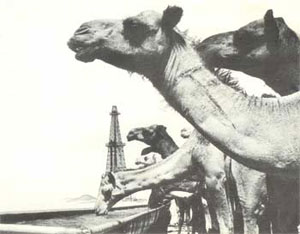
TENS OF THOUSANDS of gallons of water are needed each day for drilling an oil well, especially for mixing mud. The best way to find water in the deserts of Saudi Arabia is to drill for it. Once water has been discovered, the well site becomes a man-made oasis, with watering troughs provided for camel herds.
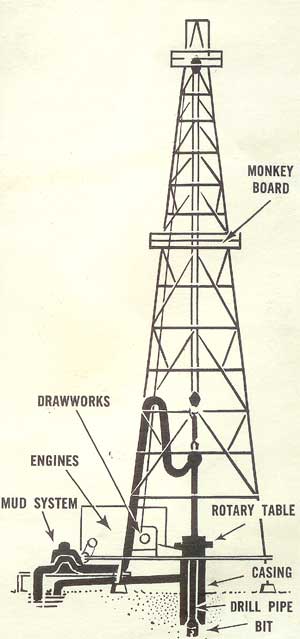
THE DIAGRAM IDENTIFIES some key parts of a drilling rig. The draw-works, with its geared winches, transfers the engines’ power to the rotary table, as well as hoisting the drill pipe by means of a block-and-tackle system of huge pulleys and thick steel cable. While the rotary table revolves the drill pipe and bit, the mud system circulates a mixture of water, clay and chemicals (called “mud” by oilmen) through the hollow drill pipe out through holes in the bit, and back to the surface. This mud cleans, cools and lubricates the bit and removes the rock cuttings. It helps control any high-pressure flow of oil or gas. It also deposits a mud pack (like a lady’s facial) on the walls of the well to prevent cave-ins.
King’s Visit to Aramco A Royal Affair
15 June 2007 | comments (0) | In Search Of Oil | by Aramco ExPats
 Big Oil Can from Arabia, Dhahran Fair 1966
Photograph Contributed by Dick and Ruth Maise
Among the many Aramco events that take place heralding celebration and much fanfare, the visit of the King and other members of the royal family to an Aramco camp continues to be an event for the record books.
In excerpts from letters to family beginning in 1958, Dick and Ruth Maise report on many royal visits to Aramco and the festivities that accompanied these special occasions.
October 21, 1958 N 19-30-00 E 46-00-00 (Rub’ al-Khali)
Dick to Ruth: “The new geologist told us that King Sa’ud is currently visiting the Aramco operations in Dhahran, and will be there until this Thursday. The Air Force put on a show for him at the airfield, and the company put on a water show in his honor at Half Moon Bay. The air show was staged by a number of American-trained Saudis flying jets in formation, and one broke the sound barrier for the king.”
“Since the Amir and his soldiers have arrived here, tomorrow we’ll probably go over and pay a social call on him with our Saudi geologist as interpreter. Actually, he says that the Bedu out here speak a different dialect than he knows and he has difficulty understanding them lots of times. They use different terms and phrases than the town Arabs do, I think is what the difference is, something like the difference between the Kentucky hill folks and the people from the metropolitan areas in the States.”
November 20, 1959
Dick to Ruth: “We’ve been hearing over the communication radios the last 2 days about the goings on at camp G-9. They have been playing ‘host’ to a big royal hunting party. Seems there were about 38 vehicles of one sort and another along with the party and they needed all sorts of stuff like gasoline, oil, spare parts, new engines, food, water, and just about anything you can imagine. It wasn’t the king, but one of the princes, I guess. They left this morning headed north, so they might just pay us a visit over here, too.”
February 6, 1960
Dick to Ruth: “That reminds me–it must be about time for the king’s visit to Dhahran. Keep your eye peeled for the king, although it will be hard to miss him when he does arrive. I was out in the field when he came through last year, so missed all the fun and games. I understand that he has held royal audiences for the Americans there in town so maybe you’ll get a chance to meet the old boy. If he’s looking for additions to his hareem, tell him I won’t sell.”
“About 3 years ago the king decided to move the main capitol to Riyadh (from Jiddah) and the building program they have carried out is fantastic. Everything connected with the government is new. And the palaces and villas! You can certainly tell where all the oil money pouring into the treasury is going–into palaces for the king’s many sons and other relatives as well as into elaborate government buildings. There are lots of wide paved roads, an airport, hospitals, schools, etc. You simply can’t appreciate the terrific change that’s taken place there unless you could see the typical Arabian city as compared with Riyadh. Or in Riyadh you could just compare the old part of town with the new.”
April 17, 1960
Ruth: “The King (King Sa’ud) has arrived in Dammam for a 2 month’s stay. Someone said he brought 2,000 people with him! That includes family, servants, guards, etc. I talked with the repair foreman this morning and he said that the repair schedule will be behind because the king has taken almost all of Aramco’s carpenters, plumbers, etc., to work for him! The king also ‘borrowed’ dining room help and other Arab employees. When the king wants something, nobody says no, particularly Aramco! My Arabic teacher, a Palestinian, lives in Dammam and he said that people there are a little unhappy because the prices are all going up, of course, since 2,000 extra people will mean a shortage. Some other people said that the king only brought 500 people! Who knows?!”
April 24, 1960 N 21-23-17 E 54-50-23 SD-2
Dick (continued the letter from home): “The king and his entourage finally left yesterday. He has disrupted normal life around here for about 3 weeks. He requisitioned most of the taxis from Dhahran, as well as the entire staff of maintenance people to fix up his palace in Dammam, install air conditioning, etc. The company put on a water show and a horse show for him, as well as a number of misc. functions, including a tea for about 200 women of the royal household. It was mostly over by the time I got to town, so still haven’t seen the old boy.”
May 5, 1961
Dick: “Last week King Sa’ud stopped off here in Abqaiq for a few minutes on his way back to Riyadh from Dammam and so everybody got a couple hours off to go see him. So I picked up Ruth over at the library where she was reading to the little kids and we went out to the RR station to see the fun. There was a goodly crowd out there, and we saw some soldiers rounding up all the Arab women in the crowd and herding them off to one side of the station. They lined them all up, about 60 or 70 I guess, and then passed out ten riyal notes to each one! (About $2.25) After they had taken care of all the women, they started passing out the rest of the bills they had to all the men around the area until they ran out of money. Must be part of the King’s strategy to keep the people happy. In the old days they used to toss handfuls of gold coins to the crowds. Another way he keeps the tribes loyal is to marry a girl from one of the tribes. He is allowed 4 wives at a time and he keeps 3 of these as permanent but the 4th one sort of floats around amongst the girls. When he visits a tribe, he might marry the daughter of one of the leaders, then a few weeks later, he divorces her and marries a daughter of another tribe. That way, each tribe is connected to the royal family and will be loyal to him; he hopes. This gets to be expensive because he gives each one he divorces quite a sum of money. [Editor: I don’t know where we got this information, or even if it is accurate. Actually, it’s also supposed to be one way the old king unified the country.]“
“We stood around the station for about fifteen minutes or so and then a train appeared coming down the track. Everyone cheered and waved as the train came into the station and went on through and stopped about a hundred yards down the track! It just sat there. Then about five minutes later another train, longer than the first, came down the track, and this was the one with the King on it. Lots of cheering and waving and hand clapping. The King’s bodyguard jumped down and pushed the crowd back away from the big blue Cadillac standing by the track, and the King appeared in the doorway of the train coach. He looked regal and healthy, smiled and waved a couple times for the photographers, then climbed down and got into the Cadillac which roared off through the crowd accompanied by numerous heavily armed bodyguards hanging on the sides and running along with it. Anyway, we got a good look at him. He must be just about the tallest Arab in this country, except for one of his bodyguards who is even taller.”
“He went to the Amir’s palace, about 100 yards from the station, made a speech, then went to the qadi’s palace and did the same, got back on the train and it pulled out. The qadi, incidentally, is the chief religious judge who decides everything from traffic fines to head choppings in the Abqaiq area. There were a few Americans there but not many. It was the first time I had seen the old boy, having been out in the desert every other time he came around since I’ve been here.”
January 30, 1965
Dick: “Last weekend was a 3-day holiday in honor of the new king’s visit to the area. There was lots of fanfare around the local towns, but Aramco didn’t participate to any great extent, reportedly at King Faisal’s request. [Editor: What a change from King Saud’s trips to the Eastern Province!]“
December 9, 1971
Dick to Mom and Dad: “Last weekend was also a big time in Dammam and al- Khobar. The king visited the area to dedicate the new irrigation project in Hofuf, and was around for several days. He didn’t come to Dhahran, but al-Khobar was all decorated up for his visit with big arches built across the main street and lots of lights on the stores and arches. It was very pretty at night. We drove down to look at it and so, I guess, did everyone else in the Eastern Province. I’ve never seen so many cars and people in al- Khobar before.”
November 22, 1974
Dick: “We haven’t heard much about the impending government takeover of Aramco out here. The dates keep shifting so I guess the negotiations are still going on with no definite proposals worked out or agreed upon as yet. You probably see more about it in the papers there than we hear out here, at this stage. I guess it’s mostly a matter of how much the government will pay for the facilities and what preferential arrangements the owner companies will get on the oil production. We’re seeing indications of the government spending money around here; the roads in the area are being rebuilt, widened, lighted and improved, fountains are being put in and the towns spruced up. The king is supposed to come over and inspect all these improvements in a few weeks, so there will be great excitement when that happens. Charlene and I went to al-Khobar yesterday morning and the main roads were torn up, being repaired, and I guess every painter in the Eastern Province was busy painting store fronts and buildings. The town is crowded with foreigners as well as Saudis, and prices are going up.”
March 29, 1975 (Sat.)
Dick wrote to Aunt Nina and Uncle Harold: “The shooting of King Faisal was a real shock to all of us here. We heard the news over Riyadh radio, which, I guess, is where everyone else got the first word of it. It must have happened about noon local time (3 or 4 a.m. Eastern Standard Time) on Tuesday. We got the word right after lunch, about 2 p.m. here, that he had been shot several times by a ‘mentally deranged’ nephew and had died on the way to the hospital or shortly after he got there. We had the next day, Wednesday, off from work, and everything in the whole country, I guess, was shut down all weekend. The Aramco TV and radio stations went off the air, and are still off today, except for the fifteen minutes of news twice a day. I listened to the BBC quite a bit to pick up any details, but there wasn’t much given out. He was buried on Wednesday in an unmarked grave on the outskirts of Riyadh. The Arabs here aren’t much for burial rites and memorials. They are supposed to be buried before sundown on the day they die. The King’s burial was probably postponed a day so that the members of the Royal family and representatives of other governments could get to Riyadh.”
“I watched the reception of people by the new King and the prime minister that evening on TV. They had taped the proceedings and put about 2.5 hours of it on the air. There was a huge crowd of people. The reception was held in the reception hall across the street from the mosque in Riyadh, the one near the old suq where we all went when you were here. All of the square outside was crowded, and apparently, anyone who wanted to could go in and greet the new King, Khalid, and Amir Fahd. I saw people from all walks of life go through–business, Bedouin, soldiers, young men, old men, some in thobes, some in business suits, most of the Bedouin with rifles or pistols hanging on them. But all was orderly and dignified, if hurried. They went through at the rate of about 40-50 per minute, each one shaking hands with Khalid and Fahd and embracing them or kissing them. There seemed to be quite a few photographers around, both movie and stills. And it looked pretty warm, most were sweating and mopping their faces. It was quite a momentous occasion. Probably the most impressive thing about it was the orderly and unemotional transfer of power; there wasn’t any show of force; everything seemed to be under control.”
“Now the big question of course is, what happens now? The general opinion is that there won’t be any substantial change in policy or programs. Both Khalid and Fahd had worked quite closely with Faisal and are expected to carry on in the same sort of manner. There’s probably been plenty of speculation in the stateside papers about what will happen. We’d be interested in seeing any clippings that you could send us to see what’s being said.”
Easter Sunday, 1975 (March 30, 1975)
Ruth added to Dick’s letter: “Dick said, ‘We heard the news over Riyadh radio.’ He means the Aramco men who are paid to listen to all the radio broadcasts first heard it that way. I first heard it from a neighbor! Of course, not knowing any details, it was a bit frightening. I called to tell Dick but he already knew about it. (Or course, he didn’t bother to call me!) I did start collecting things in a suitcase, just in case. But later that night when we heard more details (well, that is, that it was a ‘mentally deranged’ nephew), it seemed as though it would not be a palace revolution after all, so we relaxed about the whole thing. We feel very sad because King Faisal was really a good man, a goodhearted man, totally dedicated to helping his country. It just doesn’t seem right for such a good man to end that way.”
1982 CHRISTMAS LETTER – December, 1982
…“Sometime this month King Fahd is expected to visit the area, something that he doesn’t do very often, so the whole area is being spruced up, construction projects are being rushed to completion, and lots of flags and welcoming signs are going up. Aramco has recently completed two new large office buildings in Dhahran and the King is expected to come to town to visit and dedicate the new buildings. That should be a festive occasion and we are looking forward to it.”
May 16, 1983 (Mon)
Ruth to folks: “This has been an eventful week around here. Today is an unexpected day off–in honor of the 50th anniversary of Aramco’s beginnings. It just also happens to be the day the King is coming to dedicate the new Exploration and Engineering buildings. The real anniversary of the signing of the concession agreement between the government of Saudi Arabia and the U.S. oil people is May 29; but King Fahd is here now so we get the day off today. They just about had to give us the day off since they aren’t letting anybody into the 3 big office towers where the king will be having his luncheon today. At first, we thought the rest of us poor working souls would have to continue slaving away in our offices but yesterday they finally announced a holiday for everybody. Dick has gone down now to where all the activity is supposed to be going on, hoping to get a glimpse of the king. He went out waving his small Saudi flag (!) and carrying his binoculars.”
Dick added: “Hi. Just got back from waving my Saudi flag and cheering the King over at the EXPEC building. He was here for about an hour and a half and looked pretty good. I got there just in time to see the motorcade come up the road and into the parking lot. The King’s car drove right up to the door, of course, and he got out and went in. There were a couple hundred Saudis gathered around and a few of us westerners. Interestingly enough, no Saudi women turned out to see him. It was all rather low-key; there were a couple cars of body guards, then the king in a Mercedes, a couple more cars of bodyguards, and then about 30 or 40 cars of ministers and other dignitaries. Yamani was there, of course, and the crown prince. There were quite a few security guards and National Guard troops around the buildings and along the roads, but no motorcycles or jeeps with machine guns or any of that. Both sides of the highway all the way from Dammam, about 5 miles, were lined with soldiers, standing about 50 yards apart. It was breezy and cool, so standing around outside wasn’t too bad.”
News Categories
- Announcements (385)
- Births & Birthdays (101)
- Graduations & Retirements (165)
- Weddings & Engagements (119)
- Aramcon Recipes (276)
- Community (1153)
- Annuitants (278)
- Brats (157)
- Employees (58)
- Pakistan (78)
- Reunions (104)
- Special Interest (221)
- Travel & Leisure (258)
- In Search Of Oil (181)
- Opinions & Editorials (213)
- Pipeline (1876)
- Al-Ayyam Al-Jamilah (15)
- Alaela (8)
- ASC Contact (2)
- Other Aramco Magazines (4)
- Saudi Arabia (29)
- Saudi Aramco News (1817)
- Sun & Flare (1)
Featured Authors
- Arab News (4)
- Aramco ExPats (1893)
- Colleen Wilson (48)
- Engr. Iqbal Ahmed Khan (66)
- Khaled Almaeena (3)
- Nestor J. Sander (15)
- Rahmah Nawwab (1)
- Saudi Aramco News (1840)
- Saudi Aramco World (1)
- Tim Barger (53)
Aramco Travel Club
Have You Joined?
Learn More- Travel around the world with your fellow ExPats.
- All trips organized through a professional travel agency.
- Activities like Scuba Diving, RV trips, Skiing, Cruises, and more!




Sign Up for Our Newsletter
Receive a monthly email with updates and announcements right from Aramco ExPats!
Internal Links
Aramco Expats and this website are not affiliated or sponsored by Saudi Aramco.
"Saudi Aramco" is a registered trademark of Saudi Aramco.
Privacy Statement Website by Mindfly Web Studio