Egypt expedition 1842 : A Prussian tour to the land of the Pharaohs - Qantara.de

Egypt expedition 1842 A Prussian tour to the land of the Pharaohs
On 15 October, a Saturday, the six travellers from Germany and their two English guides crossed the Nile north of Cairo and rode along the western bank of the river to Giza. There, they climbed the Cheops Pyramid to mark a special occasion.
It was the birthday of Prussia's King Friedrich Wilhelm and to celebrate the tour group took along not only a picnic basket and a flag to be unfurled on the summit plateau amid cheers but also a commemorative plaque with a hieroglyphic inscription. "Thus spake the servants of the king, whose name is the sun and rock of Prussia, Lepsius the scribe, Erbkam the architect, the Weidenbach brothers the painters, Frey the painter, Franke the plaster-caster, Bonomi the sculptor, Wild the architect: all hail the eagle, protector of the cross…".
The year was 1842. At the beginning of September, the participants of the expedition landed in Alexandria, three weeks later they reached the Egyptian capital with boxes full of books, maps, drawing utensils, measuring instruments, eyeglasses and a daguerreotype (which ultimately remained unused). Ascending the pyramid was the symbolic climax of their trip.
The Swiss painter Jakob Frey captured the scene: above, the Europeans in tails and waistcoats, below their local attendants in light linen clothes. In the painting, the Europeans wave their hats in triumph. The plaque was embedded in a beam at the entrance to the pyramid. Then the research work began. It lasted three years.
The launch of Egyptology as a science in Germany
The exhibition at the New Museum on Berlin’s Museum Island was curated to mark the 180th anniversary of the Prussian expedition to the Nile. Its challenge was to relate the story of the endeavour without it becoming a glass-case version of "Terra X" (brand name for documentaries broadcast on the German public channel ZDF). After all, this expedition was no tall story, but laid the foundations for a new scholarly discipline in Germany.
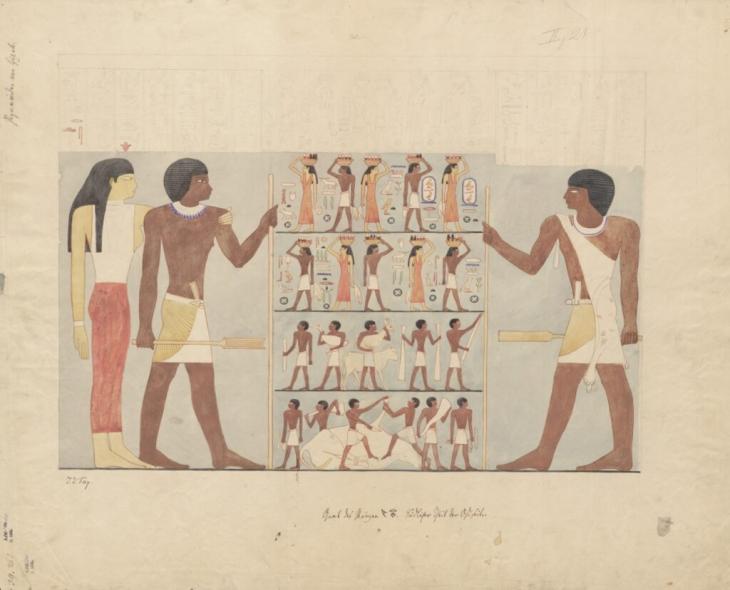
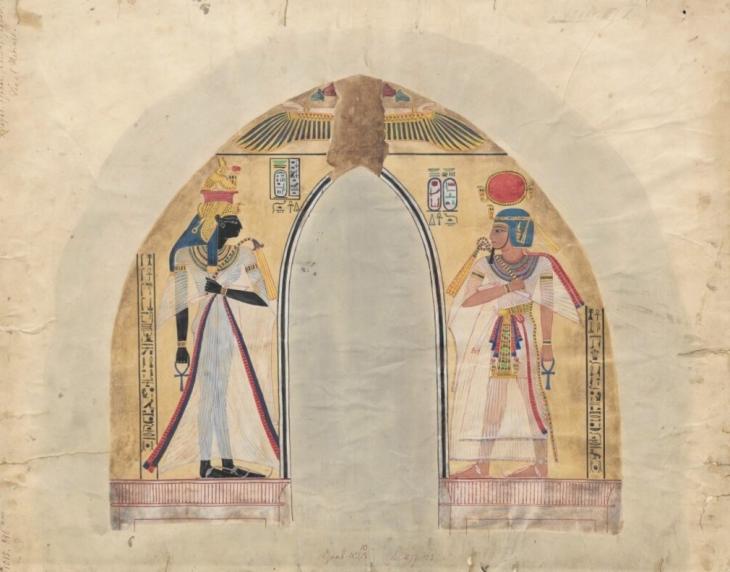
The travellers brought back to Berlin more than 1,300 drawings, almost 7,500 paper copies and dozens of plaster casts of Egyptian reliefs, wall paintings and temple architecture. As well as 1,900 original pieces, presented to Friedrich Wilhelm IV by the governor Mehmed Ali Pascha and added to royal collection inventories.
The “Monuments from Egypt and Ethiopia”, published in 12 volumes by 1859 and documenting expedition yields in words and pictures, became the international standard; many of the illustrations and explanations reflect the current research status.
On the other hand, the Prussian experts’ tour from the Mediterranean to the Nubian principalities on the Blue Nile was marked by a host of adventures, some of them of exhilarating, most of them not. They were plagued by sandstorms; Bedouins raided the camp and the travellers suffered various diseases and ailments.
For example, the story of the child slaves received by expedition leader Karl Richard Lepsius as a gift from a Sudanese princess would provide enough material for a post-colonial novel in the current popular style.
Lepsius, refusing to treat the boy as personal property, even put money aside for him during the expedition. Back in Berlin, he had Gaber Mariam, who was born a Christian, trained as a missionary. But then something evidently went wrong, because the young Sudanese was sent back to his homeland with no official assignment.
The expedition’s large material yield
Curators Jana Helmbold-Doyé and Silke Grallert solve the dilemma of how best to display the scientific significance and the narrative possibilities of their subject matter in a decisive expression of both. The wedge-shaped wall in the Greek Courtyard of the New Museum opening the exhibition relates the expedition story in notebook form, with the political and organisational prerequisites on one side and participants’ biographies on the other.
Factual knowledge is enriched and embellished with humorous details, for example when we discover that instead of planes and smartphones, research goals were attained with the help of 68 dromedaries and 130 letters.
Two main items of expedition booty are exhibited directly opposite one another: the palm column from the western colonnade of the Isis temple on the Nile island of Philae and the ram from the Temple of Amun-Re in the Nubian city of Napata. To be able to remove the column, Lepsius had the architraves knocked off the tops.
He was equally heavy-handed when transporting three burial chambers from Giza, today among the New Museum’s most prized exhibits. This kind of blatant looting of ancient structures would have been unthinkable a generation later, but during the reign of Ottoman ruler Muhammad Ali Pasha, who afforded privileges to the Prussians to keep the French and the English off his back, it was common practice.
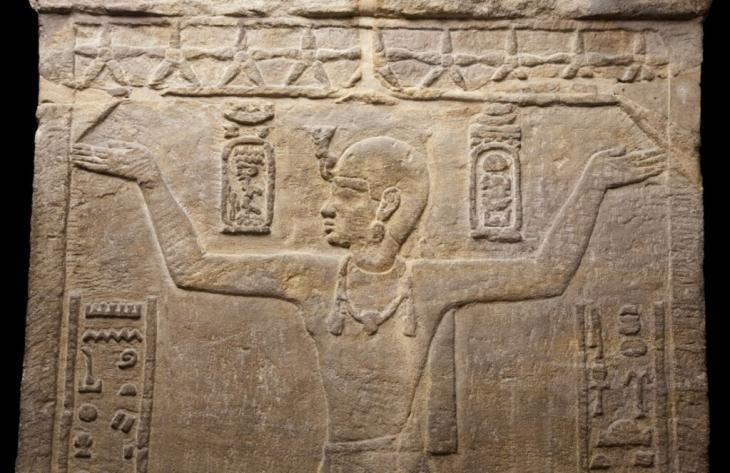
Lepsius was then appointed museum director and although he went back to Egypt in 1866, he didn’t bring anything back with him that time. He did however discover the trilingual Decree of Canopus, the most important instrument for deciphering hieroglyphic script after the Rosetta Stone.
The exhibition continues apace in this dual rhythm: with original objects, drawings and colour copies on one side – exhibits you could spend not just hours but entire days examining – and on the other news from the expedition journal presented in tabular form.
One member of the crew had toothache, another fell off a donkey, a third broke his arm and half of the group had dysentery. That Lepsius, wracked by malaria and colic, survived almost another 40 years after his return was a Prussian miracle; that he fired Franke the plastercaster for damaging a find site with explosives and openly rebelling against him, was on the other hand an indication of his leadership qualities. Order and obedience may be superfluous in science; but on journeys through lawless lands, they’re part of the overall survival strategy.
The exhibition’s stand-out achievement is how it revitalises the space it occupies. Otherwise, visitors wander through the Egypt galleries with the antiquarian interest of the flaneur, with all roads leading to Nefertiti. But now, the objects are presented in a new historic light and you realize that their creation is a slice of contemporary history in itself. The museum that housed them was already under construction in 1842. Lepsius became its director 13 years later, an appointment that fulfilled the aim of the expedition. The King who financed the trip also saw to that: by commissioning the New Museum.
Andreas Kilb
© Frankfurter Allgemeine Zeitung/Qantara.de 2023
Translated from the German by Nina Coon
Adventures on the Nile: Prussia and Egyptology 1842–45 runs until 7 March 2023.
Related Content
Exclusive: Egyptian activist Sanaa Seif
"Egypt's regime must overcome its paranoia"
Philosophy, Arab world trend
Erich Fromm's advice for troubled times
Language and language acquisition
How the brain processes German and Arabic
“Hot Cities: Lessons from Arab Architecture”
Inspiring cities of the future
Humanitarian crisis in Sudan
"I'm trapped in the war"

UN Special Envoy Volker Perthes on Sudan
"We must make sure this war does not drag on"
Most Recent Photo Essay
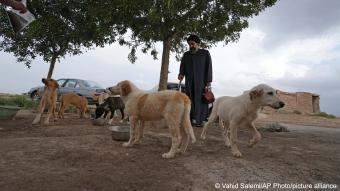
Iran: Defiant Shia cleric takes in stray dogs
It's rare these days for a turbaned cleric in Iran to attract a large following of adoring young fans on Instagram, but Sayed Mahdi Tabatabaei has done it by rescuing street dogs in defiance of a local taboo.
