
• Calligraphy - the dance in a tiny stage of the living, breathing hand. - Robert Bringhurst in The Elements of Typographic Style
Calligraphy is a type of visual art, often called the art of fancy lettering (Mediavilla 1996: 17). A contemporary definition of calligraphic practice is "the art of giving form to signs in an expressive, harmonious and skillful manner" (from Greek κάλλος kallos "beauty" + γραφή graphẽ "writing"). The story of writing is one of aesthetic evolution framed within the technical skills, transmission speed(s) and material limitations of a person, time and place (Diringer 1968: 441). A style of writing is described as a script, hand or alphabet.
Modern calligraphy ranges from functional hand-lettered inscriptions and designs to fine-art pieces where the abstract expression of the handwritten mark may or may not compromise the legibility of the letters (Mediavilla 1996). Classical calligraphy differs from typography and non-classical hand-lettering, though a calligrapher may create all of these; characters are historically disciplined yet fluid and spontaneous, at the moment of writing (Pott 2006 and 2005; Zapf 2007 and 2006).

Calligraphy continues to flourish in the forms of wedding and event invitations, font design/typography, original hand-lettered logo design, religious art, announcements/graphic design/commissioned calligraphic art, cut stone inscriptions and memorial documents. It is also used for props and moving images for film and television, testimonials, birth and death certificates, maps, and other works involving writing (see for example Letter Arts Review; Propfe 2005; Geddes and Dion 2004). Some of the finest works of modern calligraphy are charters and letters patent issued by monarchs and officers of state in various countries.
Islamic calligraphy

Islamic calligraphy, also known as Arabic calligraphy, is the artistic practice of handwriting, or calligraphy, and by extension, of bookmaking, in the lands sharing a common Islamic cultural heritage. This art form is based on the Arabic script, which for a long time was used by all Muslims in their respective languages. They used it to represent God because they denied representing God with images. Calligraphy is especially revered among Islamic arts since it was the primary means for the preservation of the Qur'an. Suspicion of figurative art as idolatrous led to calligraphy and abstract depictions becoming a major form of artistic expression in Islamic cultures, especially in religious contexts. The work of calligraphers was collected and appreciated.
 Arabic, Persian and Ottoman Turkish calligraphy is associated with abstract arabesque motifs on the walls and ceilings of mosques as well as on the page. Contemporary artists in the Islamic world draw on the heritage of calligraphy to use calligraphic inscriptions or abstractions in their work.
Role in Islamic culture

Calligraphy has arguably become the most venerated form of Islamic art because the Arabic script was the means of transmission of the Qur'an. The holy book of Islam, the Qur'an, has played an important role in the development and evolution of the Arabic language, and by extension, calligraphy in the Arabic alphabet. Proverbs and complete passages from the Qur'an are still active sources for Islamic calligraphy.
Instruments and media
Inscriptions in calligraphy, form regular bands throughout the Qutb Minar, India, built 1192 CE
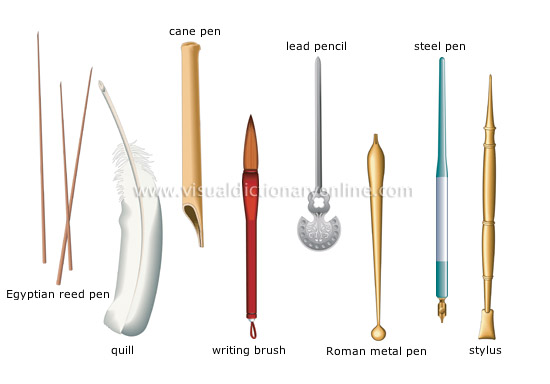
The traditional instrument of the Arabic calligrapher is the qalam, a pen made of dried reed or bamboo; the ink is often in color, and chosen such that its intensity can vary greatly, so that the greater strokes of the compositions can be very dynamic in their effect.
To present calligraphy, diverse media were used. Before the advent of paper, papyrus and parchment were used for writing. The advent of paper revolutionized calligraphy. While monasteries in Europe treasured a few dozen volumes, libraries in the Muslim world regularly contained hundreds and even thousands of volumes of books.

Coins were another support for calligraphy. Beginning in 692, the Islamic caliphate reformed the coinage of the Near East by replacing visual depiction by words. This was especially true for dinars, or gold coins of high value. Generally the coins were inscribed with quotes from the Qur'an.
By the tenth century, the Persians, who had converted to Islam, began weaving inscriptions on to elaborately patterned silks. So precious were calligraphic inscribed textile that Crusaders brought them to Europe as prized possessions. A notable example is the Shroud of St. Josse, used to wrap the bones of St. Josse in the abbey of St. Josse-sur-Mer near Caen in northwestern France.
calligraphy and architecture
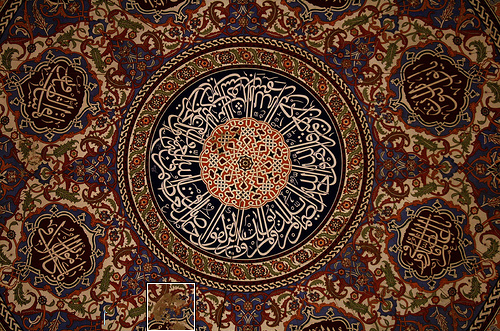 |
| Sulaimaauye mosque, Istanbul |
Islamic Mosque calligraphy is calligraphy that can be found in and out of a mosque, typically in combination with Arabesque motifs. Arabesque is a form of Islamic art known for its repetitive geometric forms creating beautiful decorations. These geometric shapes often include Arabic calligraphy written on walls and ceilings inside and outside of mosques.
The subject of these writings can be derived from different sources in Islam. It can be derived from the written words of the Qur'an or from the oral traditions relating to the words and deeds of Islamic Prophet Muhammad.
There is a beautiful harmony between the inscriptions and the functions of the mosque. Specific surahs (chapters) or ayats (verses) from Koran are inscribed in accordance with functions of specific architectural elements. For example, on the domes you can find the Nour ayat (the divine stress on light) written, above the main entrance you find verses related to the entrances of the paradise, on the windows the divine names of Allah are inscribed so that reflection of the sun rays through those windows remind the believer that Allah manifests Himself upon the universe in all high qualities.
 |
| minarets, Qutb Minar, Dehli, india |
Posted 29th June 2012 by haroon ditta
0
Add a comment
Comment as: