
April 14, 2015
How to Sketch People, When They Insist on Moving About!

I'm still working hard on my book. I'm currently writing a chapter about the complications of sketching people, who are, of course, inclined to move about.
It's a problem. Even if they are pretending to be still, it never lasts. People are basically fidgets - you just have to read the text on the sketch below:
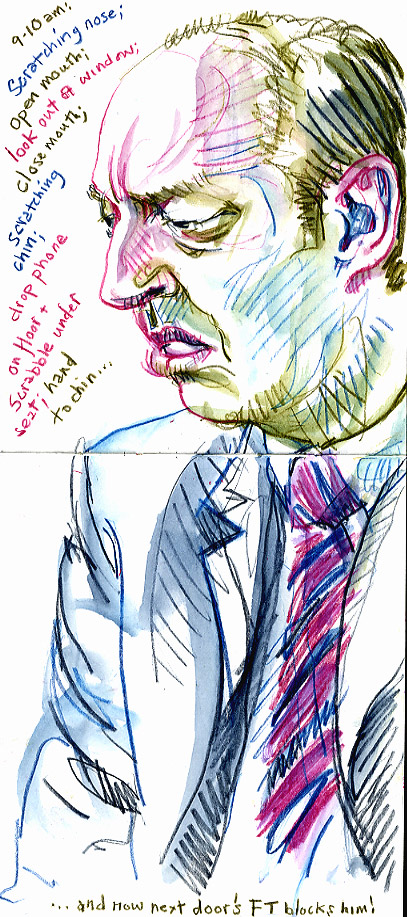
Even when they are asleep they snuffle and slide and change position to get more comfortable. Honestly. The worst ones are those who have been still as a statue for the last ten minutes, so you finally decide that they would be good to draw, but then, just when you have made your first, indelibly black mark right in the middle of the page, their friend arrives and they leave.


One counter-intuitive tool tip is that, even though a pencil might feel safer when the job is tricky, as it pretty much always is with people, since there's no time for rubbing out, you might just as well use ink and get the benefit of a bold mark:
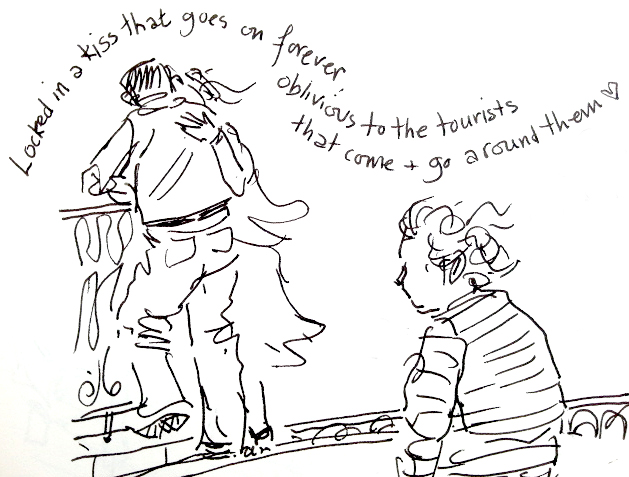
Another tip is that composite characters are not cheating. Whether you are drawing people buying apples at the market, paddling in the sea, or standing at a bar, you can more or less guarantee that you will have a steady supply of people turning up to strike similar poses, standing in more or less the same place.

Grafting one person's legs onto someone else's torso might be a bit Silence-of-the-Lambs in real life, but in a sketchbook it's fine. That's the technique I used in the National Portrait Gallery sketch above and how I managed to capture what I did of these skater-boys:


12 comments :
- Mark Leibowitz said...
-
Wonderful Lynn. You packed a lot of brilliant observations. Can't wait for the book.
- April 14, 2015 at 4:01 AM
- Mário Linhares said...
-
Awesome post Lynne and wonderful sketches!
- April 14, 2015 at 4:47 AM
- Jennifer Branch said...
-
Great post! I'm looking forward to your book!
- April 14, 2015 at 6:11 AM
- Richard Sheppard said...
-
Great work and observations Lynne! It sounds like a great book.
- April 14, 2015 at 6:58 AM
- VHein said...
-
Love these wonderful sketches and as always your humor--this will be a great book!
- April 14, 2015 at 9:18 AM
- Gail Wong said...
-
Wonderful sketches and observation. I can't wait to see the book when it comes out.
- April 14, 2015 at 10:42 AM
- Lynne the Pencil said...
-
Thanks so much guys. It's coming along. Nearly finished the first draft, right through!
- April 15, 2015 at 8:18 AM
- kumi matsukawa said...
-
Looking forward to seeing your book! I'm sure drawing them and describing how is quite different thing. Kudos.
- April 15, 2015 at 10:49 PM
- Connie Nobbe said...
-
How did you get that rainbow effect on some of those sketches, especially the last one?
Looking forward to your book! - April 16, 2015 at 9:10 AM
- John Wright said...
-
as always Lynne - like the drawings...love your wry delivery
- April 16, 2015 at 4:34 PM
- DHAR CEDHAR said...
-
great sketches and the book too - I think...
- April 19, 2015 at 5:10 AM
- annie said...
-
Great chapter, Lynn. Can't wait until the book is out.
- April 22, 2015 at 3:58 AM


2015 Symposium

Workshop Sponsor

ADS


Updates from USk communities
-
-
-
Sketchcrawl 25.4.20152 hours ago
-
-
-
-
-
-
-


Archive
Archive
some topics
some locations
Subscribe To This Blog

 |
Gadgets powered by Google |