Al-Ahram: A Diwan of contemporary life (577)
Kings also die
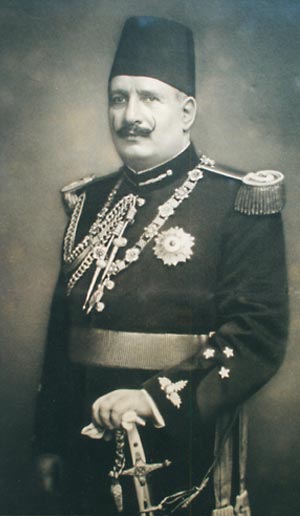
Despite a long illness, the death of King Fouad I in 1936 was shocking all the same. Professor Yunan Labib Rizk gives a minute-by-minute account of the king's final moments and the reaction to his death of a nation in mourning
|
King Fouad I
|
Al-Ahram of 29 April 1936 was a very special edition. Two large photographs stood side by side on the front page. The one on the right was of King Fouad I, under which the caption read, "The king is dead". To the left was King Farouk, with the caption, "Long live the king"!
Although Fouad had been ill for some time, his death still came as a shock to the Egyptian people. As Al-Ahram put it that day: "The last three days, indeed, the gradual decline of the energies of the king over the past 30 months, never prepared the people for this catastrophe that has befallen the nation. This fateful day took us entirely by surprise as though we had never been aware of its eventuality." In so saying, the newspaper voiced the belief that Egyptians have held since time immemorial, which is that "kings never die."
Certainly we have inherited this conviction from our Pharaonic ancestors who conceived of life after death as but an extension of their worldly life. They therefore undertook the most exacting preparations to ensure the continuity of their lives in the life hereafter, constructing towards this end tombs that would house them throughout eternity and which they filled with all conceivable necessities and luxuries, from food and clothes to ornate furniture and precious jewellery. They even invented the art of mummification in order to preserve their bodies over the millennia. The only people of that era who did not subscribe to this belief were grave robbers, against whom the Pharaohs took the extra precaution of devising artfully concealed secret chambers. However, even this did not save them from the plunder of their tombs, apart from a few exceptions, the most notable of which is that of Tutankhamen, whose fame derives not from the importance of that child king but precisely from the fact that it was spared from violation by thieves.
It was in part because of this age-old belief in the immortality of their kings that Egyptians, in 1936, received the news of the death of their king, who was in his 70s at the time, with anguish. Again in the words of Al-Ahram : "He occupied a place in the hearts of his people that his death has left gapingly vacant. He was the pillar of their strength; from him the nation's energies emanated and towards him they converged. He was the beacon of the national awakening, his opinions the signposts of the proper path. His was the light of the full moon that spared them misadventure and that dispelled the gloom in times of distress and woe. In solving their problems, all difficulties subsided and all obstacles diminished before him. He was their fluttering flag around whom soldiers rallied and organised their ranks as he led them on the path to glory." Apparently when penning obituaries of kings the maxim, "Speak well of the dead," had to be taken to the nth degree.
But another reason that Egyptians were taken by surprise by the death of their king was the veil of ambiguity that had descended over the state of his health. A week before the announcement of his death the palace released an official statement to the effect that His Majesty had complained of a dental ailment. "In the opinion of some physicians, this ailment is a symptom of the illness that plagued His Majesty for nearly two years. The dentist who is treating His Majesty had observed that substances had accumulated under the teeth and indicated that they must be extracted, which was done gradually over a period of time. By the day before yesterday, only three teeth remained. These, too, had to be extracted and under excruciating conditions as no anesthetic could be given due to the frailty of His Majesty's heart and as incisions had to be made in the gums in order to perform the extraction. The king's condition worsened due to the heavy bleeding from the gums and nose. The persistent hemorrhaging and the inflammation due to decay is what most concerns the physicians at present for the former weakens the body's ability to combat the infection resulting from the latter."
There then surfaced the name of Mohamed Radwan, an officer from the Royal Guard whose blood type, it was discovered, matched that of the king. Fouad's physicians decided to perform a blood transfusion. From the names attached to the reports one notes that all of the physicians who were attending His Majesty in his final hours were foreigners. The six-member team consisted of Fargoni, Doner, Reider, Day, Hess and Gross. It is not certain whether they were residents in Egypt or were brought in especially to treat the king.
The trickle of updates that the doctors issued from Qubba Palace after the operation varied in tone. The first few were cautious. "The day passed calmly with no untoward events. The hemorrhaging has not returned and his condition is stable," the third bulletin read. The fifth bulletin appeared hopeful: "The last 10 hours were the best His Majesty spent recently. The infection appears to be subsiding and although his condition still persists it appears that his powers of resistance are strengthening." However, the optimism was short-lived. The sixth medical update states: "The infection has flared up again alarmingly and the overall condition is less positive due to the long duration of the illness, the septicemia and poor nutrition."
It was not long before physicians observed "a sudden drop in pulse and blood pressure", as Al-Ahram reports. "Professors Fargoni and Doner were called to the clinic at 5am and the situation was reported to senior palace officials and the prime minister. The physicians found that the septicemia had spread and declared the condition critical. They injected His Majesty with as much antiseptic as they felt he could tolerate in the hope of forestalling gangrene. They then spent considerable time washing the areas of decayed tissue and cleansing the wounds and sores."
Meanwhile, the Egyptian public began to prepare for the inevitable. Prayers sounded from mosques and churches in supplication for the king's recovery so that he could continue to protect the nation. National radio suspended all musical, dramatic and other entertainment programmes. Various cultural societies and associations postponed the anniversary or commemorative celebrations they had scheduled. In short, a pall of anxious silence descended upon the nation.
In the same edition that carried the news of the king's death, Al-Ahram describes the last hours in the life of King Fouad. Under the headline "Death awakens" it relates: "The people were heartened yesterday when they learned that King Fouad had awoken feeling comfortable and energetic, and that he had received several physicians, palace officials and the prime minister with whom he spoke on various matters. So much greater, then, was the shock when they learned the news of his death. Many refused to believe the news until they heard it confirmed from official sources. It was as though death had been subdued and then had awakened."
The newspaper goes on to recount death's vigil. After midnight on that day in which the king felt so energetic, he relaxed on a chair and dozed off. "He woke up again at 3am and attempted to remedy his sleeplessness by reading some newspapers. He then slept again until 7am, awakening in better condition than he had felt for days. When the physicians arrived they expressed their delight at his evident improvement. He then received several palace officials to whom he issued instructions, signed some papers, orders and decrees, and issued instructions to invite the prime minister to spend Friday with him on his estate in Faroukiya. Afterwards, he spoke with his physicians again, telling them with a smile on his face, 'I do not want to die.'"
That was one "royal decree" that would not see the light of day. At precisely 1.27pm, Al- Ahram reports, "he reached for his glasses and put them on, switched on the lamp that had been placed next to his chair, took up the letter that Prince Farouk had sent him from London and opened it in order to commence reading. Suddenly, however, the physicians noticed that his hands had gone slack and had released their hold on the letter. They rushed over to their noble patient and discovered with great sorrow that King Fouad I had passed away. It was precisely 1.30pm."
Immediately afterwards in the offices of the cabinet the telephone rang. Ali Maher went to pick up the phone to hear Hess inform him that His Majesty had died. "Maher Pasha, tears welling in his eyes, repeated the distressful news loud enough for the ministers to hear. They were thunderstruck and when Maher Pasha returned to the chamber, his eyes streaming, many of them burst into tears as well. The cabinet then held an emergency meeting to discuss the situation."
Forty minutes later, the cabinet's secretary-general called a news conference in which he officially announced the king's death. Al-Ahram continues: "The cabinet is in session in order to make the necessary preparations for the publication of the official obituary, the setting of the time for the funeral and other such matters. Orders were issued to place the flags at half mast on the cabinet building, the ministries and all other government authorities. The cabinet has declared a state of mourning throughout the country, and all foreign missions, all financial houses, commercial establishments, stock markets and other such institutions have placed their flags at half mast." The newspaper added that the national broadcasting company had interrupted its programmes to announce the grievous news and that it had decided to halt transmission for two days until after the internment of the king.
Government institutions were not alone in signalling their grief. Al-Ahram relates: "Coffeehouses and clubs are deserted, and cinemas and other entertainment establishments have closed, posting signs on their doors stating, 'This evening's performances have been cancelled in mourning for His Majesty the king.'" The newspaper took the occasion to observe that the monarch had been "an avid supporter of the cinema and the best films from around the world were screened in his palaces."
While the funerary preparations were under way, the cabinet issued the necessary documents regarding the succession. Under the headline, "The king is dead. Long live King Farouk," we find a reproduction of a document signed by all the ministers listing many of the accomplishments of the late king and stating that "future generations will greatly appreciate the glory and momentousness of his reign, laud him for the impact he had on our destiny and commemorate him with the honour and reverence he merits in the annals of Egyptian history."
There followed the decree authorising the transfer of power to Farouk, stating: "Out of the reverence and duty we owe the master of this era, we place our faith in his beloved son in whom we bestow the confidence and affection that we had for his noble father. Therefore, at this time of anguish at the painful news of the death of the king, we call upon all Egyptians to rally around the throne with firm and unyielding loyalty, and to hail His Majesty King Farouk I, king of Egypt."
Farouk would become the ninth ruler of Egypt from the house of Mohamed Ali. His father's reign, Al-Ahram notes, had been the third longest in this dynasty (19 years). The record was held by the founder of the dynasty himself (43 years), followed by Abbas II (22 years). The shortest reigns were those of Hussein Kamel (three years) and Abbas I (six years).
Farouk would also be the first and last monarch in modern Egyptian history to ascend the throne in accordance with the provisions of a national constitution. His descendants had to have their ascendancy confirmed by a firman or edict issued from the Ottoman Porte or, in the case of Hussein Kamel and Fouad, a decree issued by the British Foreign Office. The constitutional provisions that pertained to the succession were:
Article 50, which stated that before exercising his constitutional powers the king had to take the following oath before a joint assembly of both houses of parliament. "I swear by God Almighty to respect the constitution and the laws of the Egyptian nation and to protect the independence of the nation and the safety of its territories." Article 51, which stated: "Regents of the throne may not undertake their duties until they have sworn the above stated oath before both houses of parliament... and to remain faithful to the king." The third was Article 55, which stated, "From the time of the death of the king until his successors or the regents of the throne are sworn in the constitutional powers of the king reside in the cabinet which exercises these powers in the name of the Egyptian nation and at its own responsibility."
In another section of its coverage, Al-Ahram pens a verbal portrait of the new king. Born on 11 February 1920, Farouk was carefully groomed to become a thoroughly Egyptian king who would preserve the traditions of his family and nation. He was raised by the best nurses and tutors of various nationalities and brought up to speak numerous languages -- classical Arabic, "which he speaks with eloquence and precision", and French and English, "which he speaks as though he were a native of those countries". He was also trained in horseback riding, driving, swimming "and all other known sports".
God had blessed Egypt with the paragon of crown princes, Al-Ahram wrote. And, as though to put the final touches on this image, it adds that Farouk was awarded the rank of "Grandmaster Scout" in April 1931. Two years later he was dubbed prince of Upper Egypt, a title that was given with the purchase in his name of "3,000 feddans of the best agricultural land". Naturally, the young prince excelled in his studies. In his visits to the Egyptian and Islamic antiquities museums the questions he asked were indicative of a keen intelligence and familiarity with the subject matter. Lest readers get the impression that the prince was over-indulged and pampered, Al-Ahram recounts that in college in London he had to get up at 6am every morning, begin his studies at 8am and undergo other such rigours of public school life. Nor did the newspaper forget to remind readers that the new king would reach the age of majority -- 18 -- after one year, three months and 14 days.
The sculpting of the golden image of a monarch was an ancient and authentic Egyptian art and Al-Ahram was not the only one proficient at it. Various government agencies also bent themselves to that task. The National Courts Committee issued instructions that henceforward all rulings in the national and mixed courts would be pronounced in the name of His Majesty King Farouk, and the Ministry of Waqf Foundations instructed imams throughout the country to include in their ritual supplications a prayer for the health and success of "Our Great King Farouk I, may he have God's lasting support."
As Egypt was hailing its new king, the government announced that the body of the late king would be transferred from the Qubba Palace to Abdeen Palace on the afternoon of 29 April and that the funerary procession would proceed from there to Al-Rifaai Mosque at 10am the following day. Special passes had already been issued to the people who would take part in the procession and who were invited to present themselves half an hour before the procession began. Traffic blockades had been set up and eight army regiments had been brought in to participate in the procession and to line the roads through which it would pass. "Large tents have been set up in Azbakiya Gardens to accommodate the soldiers of these regiments until they have completed their duties." Although senior British army officers had been invited to attend the ceremonies as "privileged guests", the government stressed that British soldiers would not take part in the procession. "Egyptians regard the funeral as a purely Egyptian affair and would recoil at the participation of a British military unit, even if only sent as a gesture of respect from a revered ally."
In anticipation of the funeral, Al-Ahram dedicated several pages of its edition of the day after Fouad's death to commemorative articles. Of these, nearly a full page was devoted to a biography of the monarch, featured alongside a rare photograph of Fouad at the age of 10. Although the biography covered his upbringing and activities as a prince, and the short period during which he had served as sultan, the bulk of the article focussed on his accomplishments as king, the title he acquired following the declaration of Egypt's independence in 1922. In particular it notes his contributions to the field of education -- he founded Egypt's first national university, expanded public education, promoted female education and founded the Arab Language Academy and the Institute of Marine Life, and to the economy -- he initiated major irrigation and agricultural reform projects and founded the Agricultural and Real Estate lending bank. He also promoted the development of public healthcare, judiciary reform, the preservation of Islamic antiquities and the development of transportation. Not surprisingly, given the occasion, the article overlooked the king's frequent attempts to subvert the constitution, because of which the country was rife with political tensions at the time of his death.
We turn now to Abdeen Palace on the morning of Wednesday 30 April 1936. Al-Ahram reports: "With the first rays of dawn, hundreds of people poured into the capital and joined the thousands who were making their way to the streets through which the procession would pass. Trams were so crowded that passengers were precariously clinging to the doors or grasping whatever handle they could get on the carriages. Many people arrived by car or by horse-drawn carriage.
"On Fouad I Street, all stores and coffeehouses had closed and draped flags fluttered in mourning. By 8am Ibrahim Square had already filled up with tens of thousands of mourners. Many of the popular classes had climbed onto the base of the statue in Ibrahim Square and held on to their places there for more than three hours. A large crowd had gone to Azbakiya Gardens, climbed onto its walls or scrambled for other elevated locations from where they could watch the procession.
"At 10am, the funerary procession began, emerging into Abdeen Square from between the large pavilions that had been set up in front of Abdeen Palace, each of which had a capacity of 8,000 spectators. The procession was led by Egyptian army officers, advancing in a slow military march. The bier was mounted on an artillery vehicle drawn by six horses, with an officer of the cavalry guard preceding it and officers from the navy, army and royal guards escorting the bier on all sides."
It took 65 minutes for the "awesome procession", as Al- Ahram described it, to wend its way to its destination. The newspaper continues: "People had raced to rent out places on the roofs and balconies of the buildings overlooking the procession route, many protecting themselves from the glare of the sun with large umbrellas... At noon, the bier of the great late king reached the royal family's tomb in Al-Rifaai Mosque, after having passed between the soldiers who lined the road between the mosques of Sultan Hassan and Al-Rifaai. Sacrificial animals were slaughtered and their meat distributed to the poor."
Al-Ahram had established the custom of a "photo gallery" on its last page. In this edition, the photographs recorded scenes from Fouad's historic funeral. Riad Shehata, head of the Al- Ahram photography department, had been charged with assembling this collection, which he ordered as follows:
- "The king's coffin, draped in the Egyptian flag, is carried out of Qubba Palace."
- "The coffin transported on artillery vehicle to its final resting place."
- "Princes emerging from Qubba Palace after transport of coffin."
- "The eminent ulamaa of Al-Azhar walking slowly and somberly behind the coffin."
- "Artillery force fires salute from Royal Guards barracks."
- "Representatives of King Farouk, Prince Mohamed Ali and Ali Maher Pasha, walk behind coffin."
- "Senior British officers participate in funeral procession."
- "Former prime ministers Mustafa El-Nahhas, Ahmed Ziwar, Ismail Sidqi and Mohamed Mahmoud in the funerary procession."
- "The public throngs behind the coffin."
- "Façade of Al-Rifaai Mosque."
- "Elite Royal Guards unit, displaying regimental spears and banners, passing through the capital."
As memorable as this occasion was, it was not long before the physical symbols of the late king vanished. Perhaps the last was the postage stamp carrying his picture and which was replaced by one bearing the picture of King Farouk. Farouk, for his part, was homeward bound from Britain on the SS Viceroy of India, and Egypt embarked on a new era that opened with a regency council and parliamentary elections.