Researching how best to evade deer
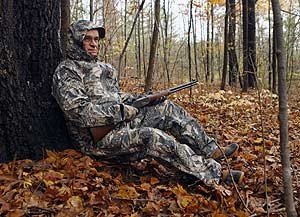
GLENVILLE, N.Y. - Covered in his old forest camouflage, Steve Balser proved he's nearly invisible to humans. His hunting partner walked within 25 feet and didn't see him.
"I'm just not that sure about deer," Balser said.
His suspicions are backed up by scientists who have studied the sensory advantages deer have over hunters, hence the quest for strategies and camouflage that will tip the odds in hunters' favor.
Balser's apparel has brown, gray and green patterns that resemble the autumn forests of upstate New York. While he can sit quietly, the outdoorsman is sure his human smell is a giveaway to wildlife, despite garments meant to conceal that.
Researchers studying animal vision and behavior say prey have certain evolutionary advantages in perception, triggering their decisions to run or hide. Science based on biological analysis and behavior supports several theories, including the superior sense of smell, which deer use to communicate, find food and avoid predators.
"The most important thing is to watch the wind. … Anything downwind doesn't exist to your nose," said Dr. Karl Miller, a professor of wildlife ecology and management at the University of Georgia. And while deer probably hear only a little better than people, they have a better sense of unusual sounds and large external ears that help them localize the source, he said.
That led to modern camouflage, evolving from red and black checked coats that broke up a hunter's silhouette to raggedy suits that resemble a leaf and brush pile to digitally designed clothing meant to fool a deer's eye into seeing nothing recognizable at all.
"Based on some very preliminary stuff we've done, deer don't see quite as clearly as we do," said Miller. "They don't see 20/20. That's not their purpose — to see detail. Their purpose is to see movement."
That, said Miller, is something they do very well. "They have a harder time identifying an object, but as soon as you move on a deer, it busts you," he said.
They also see far better than people in dim light. With big eyes on both sides of their head that don't constantly move like human eyes, they have a 300-degree field of vision, giving them an advantage in detecting motion even at the periphery, Miller said.
In their 2005 paper in the journal Equine Ophthalmology, researchers Paul Miller and Christopher Murphy identified the vision issue for prey animals.
"A critical aspect of vision is that an object (a wolf, for example), is identified as separate from its surroundings (dense vegetation)," they wrote. "Because this distinction is so important for survival, animals (including humans) with normal vision, can 'see' an object if it differs sufficiently from its surroundings in any one of five different aspects: luminance, motion, texture, binocular disparity (depth), or color."
Cal Welch estimated he's seen hundreds of deer in 53 years of hunting and shot at least 20, though not the three that came within 25 feet of him last year. "I've found that even wearing orange, when you don't move, the deer don't see you," he said.
He's also found he can raise his rifle or pivot very slowly without alarming the animals. He'd been told by an old hunter not to wear anything shiny, or blue jeans, which make an unusual noise if they rub against something.
"Basically as hunters we talk to other hunters. Between you and me, there's a lot of BS that goes around. You really have to sort it out," Welch said.
Science supports that deer see shininess and a limited range of color.
"They don't see as far into the red part of the spectrum as we do, which means they don't see blaze orange the way that we do," Miller said.
It's probably as a less intense color, and there's no reason for hunters to avoid wearing it as a safety measure, since there often are oranges in the autumn woods, but you need to break it up with a pattern so it doesn't look to a deer like a large, strange blob, he said.
Dr. Jay Neitz, professor of vision science at the University of Washington, consulted with W.L. Gore & Associates for the gray-and-tan digital camouflage new to the market this year with a large pattern to disguise the symmetry and silhouette of a hunter and a micro pattern meant to make the hunter fade into something unremarkable to deer.
"You want to be able to break up the pattern so whether you're not moving or you are moving, what the animal sees never turns into a recognizable form," he said.
If you do that and stay down wind you've got a shot.
More Sports stories

Recommendations
-
Oregon man gets life in prison for baby's death (The World Link - Homepage)
-
Actor, TV host Gary Collins dies at 74 in Miss. (The World Link - Homepage)
-
Coos Bay sees first train in 5 years (The World Link - Homepage)