Safety Guide
- Overview
- Parking
- Airport Connections
- Transit Connections
- Bikes on BART
- Accessible Services
- Destinations
- Lost & Found
- Safety & Security
- Title VI
Partners in Safety
Your safety is BART's top priority. BART is one of the safest transit systems in the nation, thanks to uncompromising programs driven in part by the participation of our most important safety partners - our customers.
Since 1980, BART has invested significantly in safety-related improvements, everything from transit car modifications to escalator upgrades. BART contingency plans cover virtually every conceivable emergency and fully integrate the support of local police, fire departments and other emergency agencies, all of which practice emergency responses jointly with BART.
The planning, training and constant monitoring involved in BART safety programs also includes informing our customers about how BART safety features and policies work, how to avoid hazards and how to become an active partner in ensuring your own safety.
This "BART Safety Guide" is designed to provide you with an overview of a variety of critical safety rules, practical tips and procedures to follow while riding on BART. Being informed plays an important role in being safe.
Safety Rules As Simple As 1-2-3
General Safety
Overview
Important Safety Notes
Evacuation On An Elevated Track (Aerial Structure)
Evacuation In A Subway (Not Transbay Tube Or Berkeley Hills Tunnel)
Berkeley Hills Tunnel Evacuation
Transbay Tube Evacuation
Evacuation On Ground Level
Emergency Phones
Passengers With Disabilities
Bike Safety
Safety Quick Reference
SAFETY RULES AS SIMPLE AS 1-2-3
Being safe can be as simple as these three steps...
- Be aware of your surroundings. Knowing that something doesn't look "right" can sometimes make the difference in your safety.
- Listen carefully to emergency instructions. A trained BART employee issuing instructions is a critical emergency resource. Whether you are on the train and listening to instructions over an intercom, or face-to-face with a Station Agent or a BART Police Officer, please listen carefully and follow directions calmly.
- Report or act upon an unsafe condition immediately. Reporting an unsafe incident or condition to BART personnel can protect you and others from a dangerous situation. If that's not possible, this brochure contains some specific instructions for emergency situations.
AT THE STATION
When entering stations, watch your step on stairs and escalators. Hold onto handrails and keep your eyes on the stairs and escalators.
At stations, do not cross the tracks, walk on the trackways or touch the electric third rail.
Do not run in stations or trains or on platforms.
Wet floors can be slippery. Avoid any wet areas in the station if possible. If a wet area is not marked off, report its location to the Station Agent.
Although stairs are constructed with anti-slip material, be careful to avoid any water or debris that may be on them. Use handrails at all times.
Roller skating, roller blading, bicycle riding, skateboarding and riding 2-wheel motorized/ electric scooters are not allowed in stations or on trains. Be aware of passengers carrying bikes.
For security reasons, make sure you know where your luggage and personal possessions are at all times.
Gasoline, flammable or volatile solvents, acids, etc. are not allowed in stations or on trains.
ON THE ESCALATOR
 Safe use of escalators requires observing the following critical rules.
Please Pay Attention:
- Look at the direction of the escalator before you take the first step.
- On escalators, be alert and ready to step off the tread when you have reached the landing.
- Keep your feet away from the side of the tread where a shoe may be caught between the tread and the side of the escalator.
- Use the Handrail
- Always use the handrails to maintain your balance.
- NEVER ride on the handrail. Exit Promptly
- Do not block the escalator landing.
- NEVER stop, stand or play on an escalator landing.
- Supervise Children
- Hold the hands of small children.
- Carefully supervise children who are in your care so that they do not sit or play on stairs and escalators.
- Stay Clear of Pinch Areas
- Keep your hands, feet and clothing clear of the side panels of the escalator.
- Be careful - loose shoelaces, rubber boots and baggy clothes can get caught in the moving parts of the escalator.
- Step Over Comb Plate
- Always pick up your feet and step carefully on or off the escalator. NEVER drag or slide your feet off the edge of the escalator.
Please Don't Use the Escalator If...
- you have limited physical abilities or are carrying large packages and luggage.
- you are carrying a small child in your arms or in a stroller.
- you are carrying or walking a bicycle. Bicycles are not allowed on escalators.
- In all of the above instances, we recommend you use the elevators.
- Please stay behind the yellow and black platform edge detection tiles. Do not approach the train until it comes to a complete stop in the station.
- Never sit on the platform edge or touch the outside of the trains!
- Do not cross the tracks or enter the trackway under any circumstances!
- If you drop something on the trackway, do not attempt to retrieve it! Contact the Station Agent for help.
- There is a refuge area underneath the train platform that may provide some protection in the event of an accidental fall onto the track.
- Watch your step when boarding and watch the narrow gap between the platform edge and the train.
- Stand in the center of the platform and in well-lighted areas.
- If you need help, use a white courtesy phone to contact a Station Agent. For police assistance, call the Station Agent or go to the nearest pay phone and dial (877) 679-7000.
- BART train doors close automatically. Doors do not reopen for obstructions. Please keep yourself and your possessions well clear of the doors upon entering and exiting the train.
- Station platform edges have special rubber tiles and a noticeable change of texture to alert vision impaired passengers that they are approaching the edge. The tiles are bright yellow and interspersed with black tiles at the positions of the train's doors to aid passengers with limited vision.
- Do not lean against the doors when inside the train.
- Flammable liquids are not allowed in stations or on trains.
- When entering and exiting the train be sure to watch your step. There is a gap of approximately three inches between the train and the platform.
- Intercoms are located at both ends of each car.
- Take time out to review the Emergency Procedures signs posted on all of the trains.
- Make a note of the locations of the intercoms.
- Please keep luggage out of the way of fellow passengers. Luggage must never block walkways and doorways. To help prevent tampering, theft or damage; keep luggage secure and within your sight.
IN THE PARKING LOT
Observe all posted regulations and park in designated areas. Before leaving you car:
- check your headlights,
- lock your car, and
- don't leave valuables or packages where they can be seen.
FIRE EXTINGUISHERS
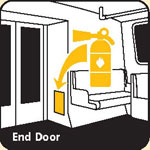 Emergency fire extinguishers are located on all levels of the stations and are well marked. In the event of an emergency, listen for instructions over the public address system or directly from BART personnel.
Emergency fire extinguishers are located at the end door of all BART cars. Follow the operating instructions listed on the label.
INTERCOM
Locate the intercom onyour train.
- Press, then release, the "Attendant Call" button to speak directly with the Train Operator.
- Use the intercom to ask the Train Operator questions or to report anything you believe is important.
- The Train Operator can contact the BART Control Center to provide whatever emergency or other services are needed.
- If something is happening in the car you are in and you don't want to be seen calling the Train Operator, walk to the next car and call from there.
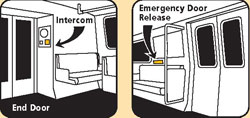 EMERGENCY DOOR RELEASE
An emergency door release is located above the seats next to each outside door.
- To open the door manually after the train stops, pull the cover panel away and move the lever in the direction of the arrow.
- Use the door release only in emergencies.
CALLING FOR HELP AT THE STATION
In the event of a medical emergency in the BART station, contact the Station Agent by using the white courtesy telephone. If BART personnel are not immediately available, use your cell phone or go to the nearest pay phone and contact BART Police at (877) 679-7000. You will not have to deposit money in the phone.
CALLING FOR HELP ON THE TRAIN
If a medical emergency occurs on the train, contact the Train Operator using either of the intercoms located at each end of the car.
BEFORE MEDICAL HELP ARRIVES
Avoid moving the stricken person while you are waiting for trained personnel to arrive. Apply first aid to the level of your ability.
 OVERVIEW
Evacuation procedures vary depending on whether the tracks are:
- Elevated (Aerial Structure)
- In subways
- In the Transbay Tube
- In the Berkeley Hills Tunnel
- On ground level
IMPORTANT SAFETY NOTES
For all evacuation procedures that follow, there are three life-saving rules that must always be followed:
- Listen to the Train Operator.
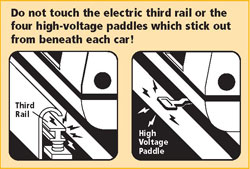
- Do not touch the electric third rail.
- Do not touch the four high-voltage paddles that stick out from beneath each car.
 EVACUATION ON AN ELEVATED TRACK
(Aerial Structure)
On aerial structures, also called elevated tracks, the walkway is approximately five feet below the level of the train. If you have to evacuate, the Train Operator will open a door that has handrails and inset footsteps outside the door. These doors are located on each car.
- Step carefully when you leave the train and walk along the walkway away from the train.
- Walk on the tracks or walkway far enough past the train so that people behind you can also get a safe distance from the train.
- Wait for help to arrive, listening for instructions from the Train Operator or rescue personnel.
- Please assist children, older passengers and people with disabilities.
EVACUATION IN A SUBWAY
(Not Transbay Tube or Berkeley Hills Tunnel)
- When evacuating a train in a subway, the Train Operator will open the doors or you may open the doors yourself.
- Emergency door releases are located above the seats next to the side doors. Pull the cover panel away and move the lever in the direction of the arrow.
- When the doors open, look to see if there is a walkway.
- If there is no walkway, walk through the train to the next car and exit.
- Proceed along the walkway away from the train until you reach the nearest door.
- Cross through the passageway to the opposite tunnel and walk along the trackway until people behind you have cleared the doorway.
BERKELEY HILLS TUNNEL EVACUATION
If evacuation in the Berkeley Hills Tunnel is necessary, the Train Operator will open selected doors for your evacuation and give you instructions.
- Watch your step when exiting the train.
- Go along the walkway or trackway to the nearest door, cross through the passageway to the opposite tunnel and walk along the tracks until the people behind you have cleared the doorway.
- Do not touch the electric third rail or the four high-voltage paddles which stick out from beneath each car!
- Wait for the rescue train.
- Do not block the doorway. Doors leading to the passageway are lighted and painted bright yellow and are located about every 1,000 feet.
- Remember, listen closely to instructions from the Train Operator should any evacuation be necessary.
 TRANSBAY TUBE EVACUATION
If evacuation in the Transbay Tube is necessary, carefully step from the train to the walkway.
- If there is no walkway, walk through the train to the next car, then exit the train.
- Yellow arrows painted on the wall indicate the distance and direction to the nearest door.
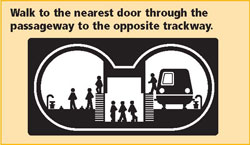
- Go along the walkway and down the ramp to the nearest door, go through the passageway to the opposite trackway, proceed along the walkway until people behind you have cleared the doorway.
- Wait for the rescue train.
- Do not block the doorway. Cross-passage doors are lighted and painted bright yellow and located every 330 feet.
EVACUATION ON GROUND LEVEL
Evacuation on ground level involves essentially the same procedures as for aerial evacuation - see section titled Evacuation on an Elevated Track (Aerial Structure).
- Wait for the Train Operator to open the doors.
- Once outside the train, walk to the wire fence and away from the train.
- Stay between the fence and trackway until help arrives.
Again, do not touch the electric third rail or the four high-voltage paddles which stick out from beneath each car! Help those who need assistance.
 EMERGENCY PHONES
Pick up receiver for a direct line to the BART Control Center.
PASSENGERS WITH DISABILITIES
In case of an emergency, leave your wheelchair on the train. The walkways and ramps used for evacuation are too narrow to accommodate wheelchairs. Passengers who are vision or hearing impaired or who use mobility aids should ask for assistance from other passengers.
BIKE SAFETY
Bikes are never allowed on crowded cars. Bicyclists must do the following:
- use elevators or stairs - not escalators,
- walk bikes,
- yield priority seating to seniors and people with disabilities,
- yield to other passengers,
- hold bikes while on trains and not block aisles or doors.
- In the case of evacuation, leave your bike on the train and do not let it block aisles or doors.
- Gas powered vehicles are never permitted.
- Customers with 2-wheel motorized/electric scooters can only use elevators - not stairs or escalators.
For a complete list of bike rules and regulations, please visit the Bikes on BART section, pick up a brochure at the BART station and check posted signs in stations and on trains.
EMERGENCY PHONES: Emergency phones located in the tunnel and subway areas are marked with a blue light. Pick up receiver for a direct line to the BART Control Center.
FIRE EXTINGUISHERS: Each car is equipped with two fire extinguishers located next to the doors connecting the cars. Signs mark their locations and instructions for their use are clearly stated.
INTERCOM: An intercom is located at the end of each car should you need assistance from the Train Operator.
EMERGENCY DOOR RELEASE: Emergency door releases are located above the seats next to the side doors. To open the door, pull the cover panel away and move the lever in the direction of the arrow.
THIRD RAIL: Never touch the electric third rail or the four high-voltage paddles which stick out from beneath each car.
EMERGENCY EVACUATION: In case of emergency evacuation, rescue personnel will assist passengers with disabilities. If evacuation is necessary before rescue personnel arrive, please assist such passengers. Leave wheelchairs on train.
AERIAL STRUCTURES: Aerial structures have sunken walkways between the tracks. Step carefully! There is an extreme danger from the high-voltage paddles protruding from beneath each car. Do not touch the paddles! There are four paddles beneath each car, one near each corner.
BICYCLES AND LUGGAGE: Leave bicycles and luggage behind in the event of an emergency.
Contracting and Procurement Opportunities
Take a look at upcoming procurement opportunities and contracts out for bid at BART, including bids received and contracts awarded.
Developer resources
Creating an application or website and want access to BART schedule data? Check out our Developer Resources and we'll hook you up.


