Earliest History
The art of pre dynastic Egypt (c.4000–3200 B.C.),
known from funerary offerings, consisted largely of painted pottery and
figurines, ivory carvings, slate cosmetic palettes, and finely worked
flint weapons. In painting, a monumental treatment was given to designs
like those drawn in red on buff-colored pottery from Hieraconpolis, a
palace city of upper Egypt. Toward the end of the pre dynastic period,
sculptors began to carve monolithic figures of the gods from limestone,
such as the Min at Coptos. In the proto dynastic and early dynastic
periods (3200–2780 B.C.) some
Mesopotamian motifs began to appear. The craftsmanship of the finely
worked stone bowls and vases of these periods is particularly remarkable.
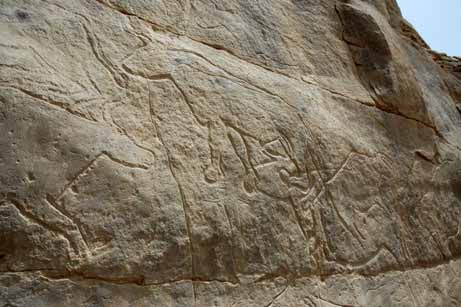 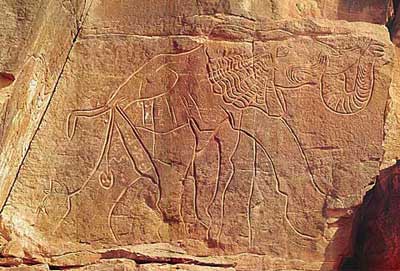
Oldest carving in Egypt, as old as
12000 years
Art of the Old Kingdom
Royal and private statuary, as well as wall paintings and reliefs,
reflected the concepts of art that served the cult of the gods, the kings,
and the dead.
In royal statuary, traditional poses are combined with idealistic
features. The statuary was designed to depict royalty as physically strong
with softened features, sometimes with touches of realism.
This can be traced in the sculpture of King Djoser, the only surviving
statuette of King Khufu, the figure of King Khafra in different stones,
the schist triads of King Menkaure, and the head of King Userkaf.
The private statuary followed the same concepts, but had more freedom in
movement and more varieties of poses.
Artists created seated scribe statues or figures standing, kneeling, or
praying and others busy in domestic works.
Examples are the statues of Prince Ra-hotep and his wife Nofret, which
look like real humans because of the colors and the inlays of the eyes.
The wooden statue of Ka-aper, with a realistic modeling of the features
and the body, his other bust, and that of his wife, are additional
examples of private statuary.
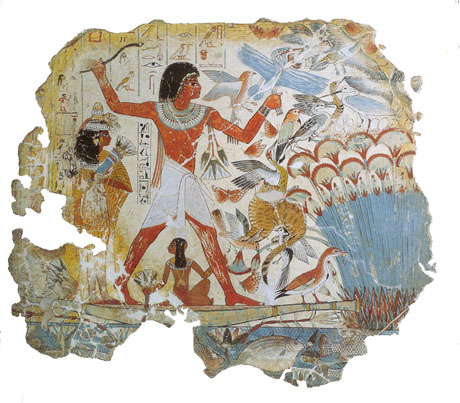
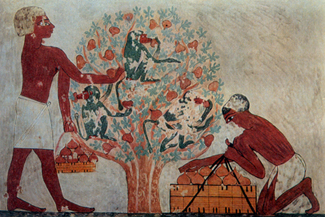
Wall spaces in the tombs and temples began to use reliefs and paintings to
depict daily activities in homes, estates, and workshops.
There were also scenes of entertainment as well as offerings.
Such reliefs and paintings were sometimes executed to depict the
activities of working groups, animals, and birds.
Sunken or raised relief and paintings were well proportioned and composed
with fine details, especially in the Saqqara tombs.
With the beginning of the Old Kingdom, centered at Memphis
(2680–2258 B.C.), there was a
rapid development of the stylistic conventions that characterized Egyptian
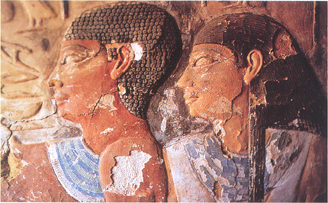
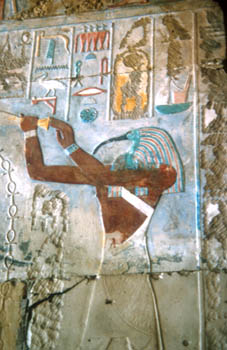
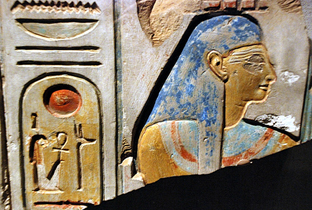
art throughout its history. In relief sculpture and painting, the human
figure was usually represented with the head in profile, the eye and
shoulders in front view, and the pelvis, legs, and feet in profile (the
law of frontality). There was little attempt at plastic or spatial
illusionism. The reliefs were very low; relief and shallow intaglio are
often found in the same piece. Color was applied in flat tones, and there
was no attempt at linear perspective. A relief masterpiece from the I
dynasty is the palette of Namer (Cairo). It represents animal and human
forms in scenes of battle with the ground divided into registers and with
emphasis on silhouette in the carving.
In statuary in the round various standing and seated types
were developed, but there was strict adherence to the law of frontality
and a tendency to emphasize symmetry and to minimize suggestion of
movement. Outstanding Old Kingdom examples of sculpture in the round are
the Great Chephren, in diorite, the Prince Ra-hetep and Princess
Neferet, in painted limestone, the Sheik-el-Beled (mayor of the
village), in painted wood (all: Cairo), and the Seated Scribe, in
painted limestone (Louvre). Probably because of its relative impermanence,
painting was little used as a medium of representation; it appears to have
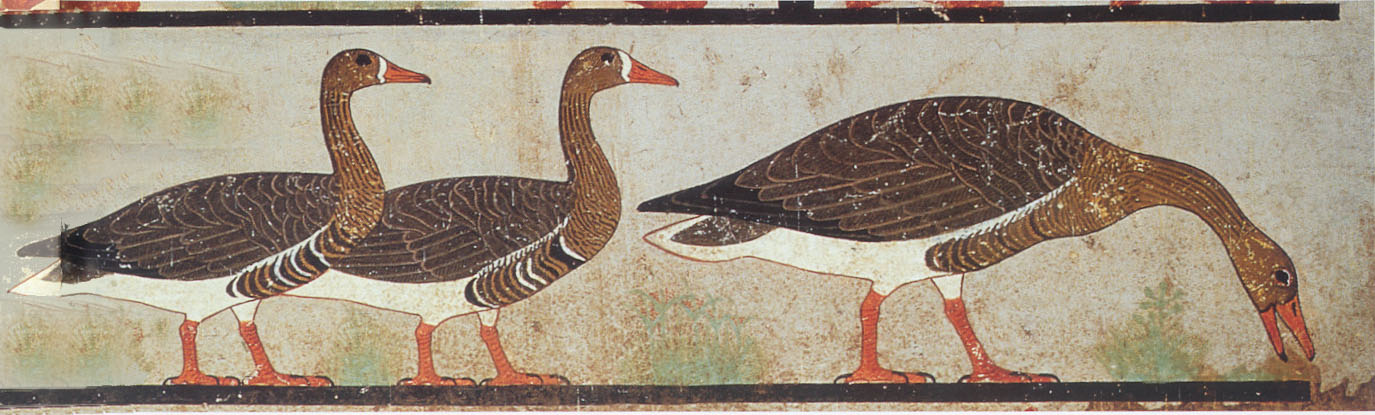
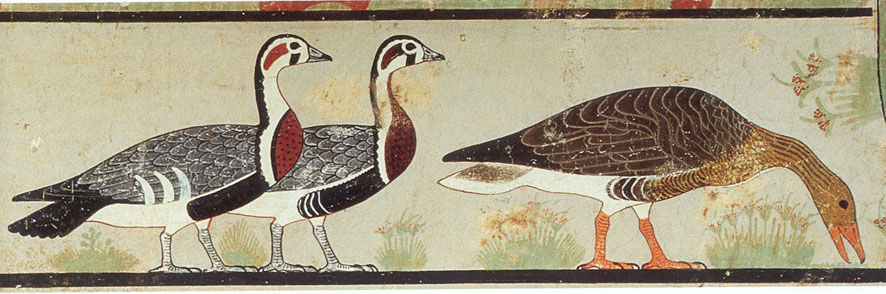
served principally as accessory to sculpture. A rare example is the
painting of geese from a tomb at Medum (Cairo).
Religious beliefs of the period held that the happy
posthumous existence of the dead depended on the continuation of all
phases of their earthly life. The artist's task was therefore to produce a
statement of reality in the most durable materials at his command. Tombs
were decorated with domestic, military, hunting, and ceremonial scenes.
Entombed with the deceased were statues of him and of his servants and
attendants, often shown at characteristic occupations.
The Middle Kingdom
The Middle Kingdom, with its capital at Thebes
(2000–1786 B.C.), was a new age of
experiment and invention that grew out of the turbulence of the First
Intermediate Period (2134–c.2000 B.C.).
The forms of the Old Kingdom were retained, but the unity of style was
broken. Increasing formalism was combined with a meticulous delicacy of
craftsmanship. The paintings of the rock-cut tombs at Bani Hasan (e.g., Slaves
Feeding Oryxes and Cat Stalking Prey, Tomb of Khnemu-hetep) are
outstanding for freedom of draftsmanship. In sculpture the sensitive
portraits of Sesostris III and Amenemhet III (both: Cairo) are exceptional
in Egyptian art, which at all other times showed a reluctance to portray
inner feeling.
The New Kingdom
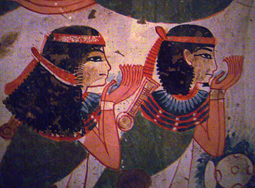 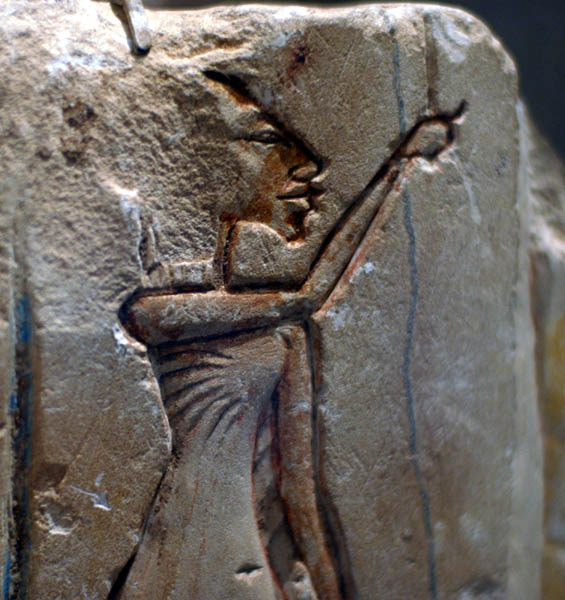 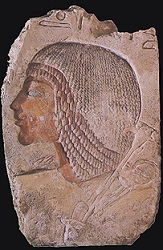 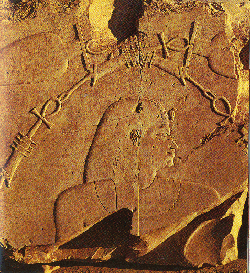
The art of the New Kingdom (1570–1342 B.C.)
can be viewed as the final development of the classic Egyptian style of
the Middle Kingdom, a combination of the monumental forms of the Old
Kingdom and the drive and inspiration of the Middle Kingdom. The paintings
of this period are noted for boldness of design and controlled vitality.
In sculpture the emphasis is on bulk, solidity, and impersonality.
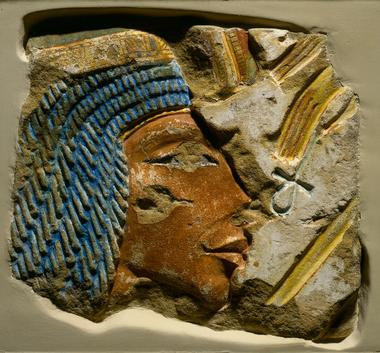
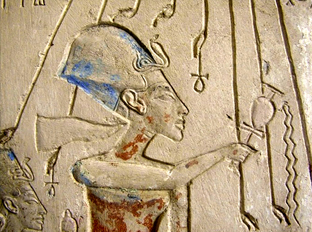
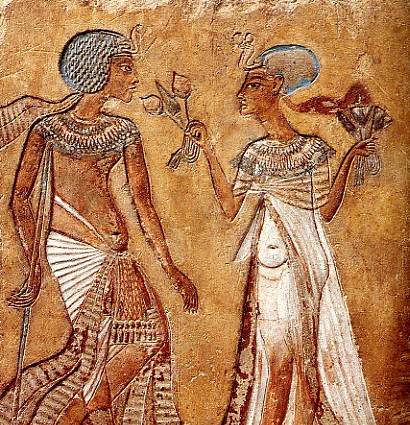
During the Amarna period (1372–1350 B.C.)
a free and delicate style developed with many naturalistic tendencies and
a new sense of life and movement. In sculpture the new style was carried
to the point of caricature, e.g., in the colossal statue of Ikhnaton
(Cairo). The outstanding masterpiece of this period is the painted
limestone bust of Queen Nefertiti (Berlin Mus.). The delicacy,
sophistication, and extreme richness of this style in its late period is
best exemplified by the furnishings from the tomb of Tutankhamen.
The Ramesside period (1314–1085 B.C.)
saw an attempt to return to the classic formalism of the earlier New
Kingdom, but the vitality that characterized that period could not be
recovered. The sculpture, both in relief and in the round, became
monotonous and even overbearing except in the numerous battle scenes. The
period of decline (1085–730 B.C.)
is characterized by mechanical repetition of earlier forms in the major
arts and by the introduction of satirical and often cynical drawings in
the papyri. In the Saïte period (730–663 B.C.)
there was an attempt to return to the austerity of the Old Kingdom style,
but for the simplicity of the earlier forms a coarse brutality was
substituted.
After the conquest of Egypt by the Assyrians in 663 B.C.
all the arts declined with the exception of metalworking, in which a high
standard of skill was maintained. Neither the Assyrian nor the subsequent
Persian invasions left a mark on Egyptian art, and even under the
Ptolemaic dynasty (332–30 B.C.)
Egypt proved extraordinarily resistant to Hellenic conceptions of art. The
ancient architectural tradition retained its vitality, as in the temples
of Horus at Idfu and Isis at Philae, but painting and sculpture continued
to decline. Native naturalism may have influenced the painted Fayum panels
and orant (praying) portraits on mummy shrouds, but neither their subjects
nor their style is essentially Egyptian. The minor arts, however,
continued to flourish; alabaster vases, faience pottery and figurines,
glassware, ivories, and metalwork were produced with the ancient skill and
in the traditional Egyptian style.
  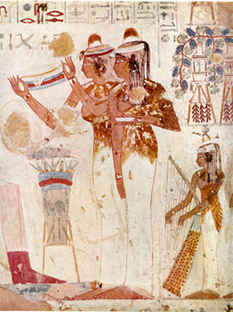
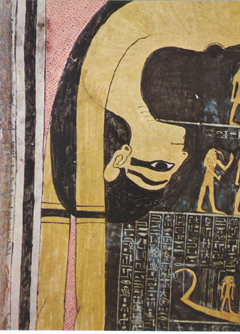
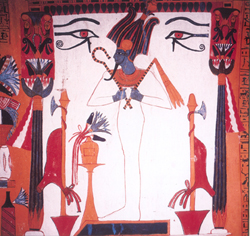
Relief
sculpture and painting
For Egyptians the
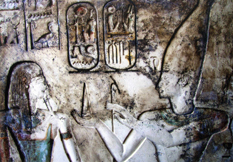
decoration of tomb walls with reliefs or painted scenes provided some
certainty of the perpetuation of life; in a temple, similarly, it was
believed that mural decoration magically ensured the performance of
important ceremonies and reinforced the memory of royal deeds.
The beginnings of the
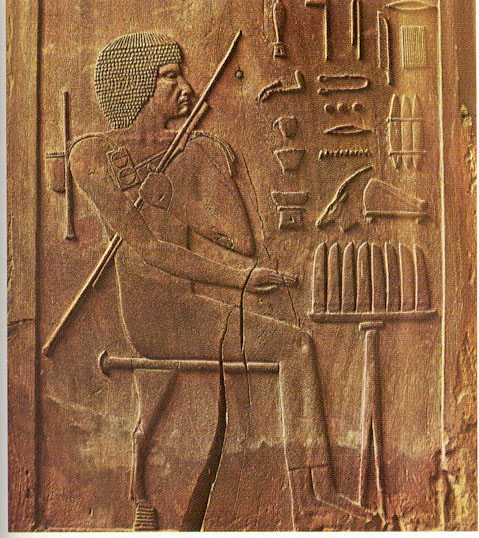
dynastic tradition can be found in tombs of the 3rd dynasty, such as that
of Hesire at Saqqarah; it contained mural paintings of funerary equipment
and wooden panels carrying figures of Hesire in the finest low relief
(Egyptian Museum). Generally speaking, mural decorations were in paint
when the ground was mud brick or stone of poor quality, and in relief when
the walls were in good stone. Painting and drawing formed the basis of
what was to be carved in relief, and the finished carving was itself
commonly painted.
In tombs the mural
decorations might be left unfinished, being only partly sketched or partly
carved by the time of the burial. Uncompleted scenes reveal clearly the
methods of laying out walls for decoration. The prepared wall was marked
out with red guidelines, the grid described earlier being used for major
human figures and sometimes for minor ones. Preliminary outlines were
corrected and paint was applied usually in tempera, pigments being mostly
mineral-based.
In the Old Kingdom
pure painting of the highest quality is found as early as the 4th dynasty
in the scene of geese from the tomb of Nefermaat and Atet at Maydum. But
the glory of Old Kingdom mural decoration is the low-relief work in the
royal funerary monuments of the 5th dynasty and in the private tombs of
the 5th and 6th dynasties in the Memphite necropolis. Outstanding are the
reliefs from the sun temple of King Neuserre at Abu Jirab (Ägyptisches
Museum, East and West Berlin) and the scenes of daily life in the tombs of
Ptahhotep and Ti at Saqqarah.The tradition of fine painting was continued
in the Middle Kingdom. At Beni Hasan the funerary chambers are crowded
with paintings exhibiting fine draftsmanship and use of color. The best
relief work of the period, reviving the Memphite tradition, is found at
Thebes in the tomb of Mentuhotep II at Dayr al-Bahri and in the little
shrine of Sesostris I at Karnak, where the fine carving is greatly
enhanced by a masterly use of space in the disposition of figures and
text.
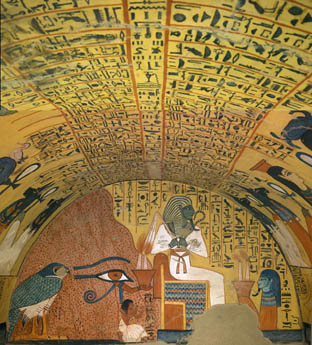 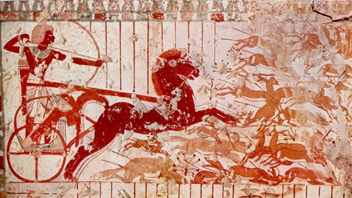
In the early 18th
dynasty the relief tradition was revived at Thebes and can best be
observed in the carvings in Hatshepsut's temple at Dayr al-Bahri. Later
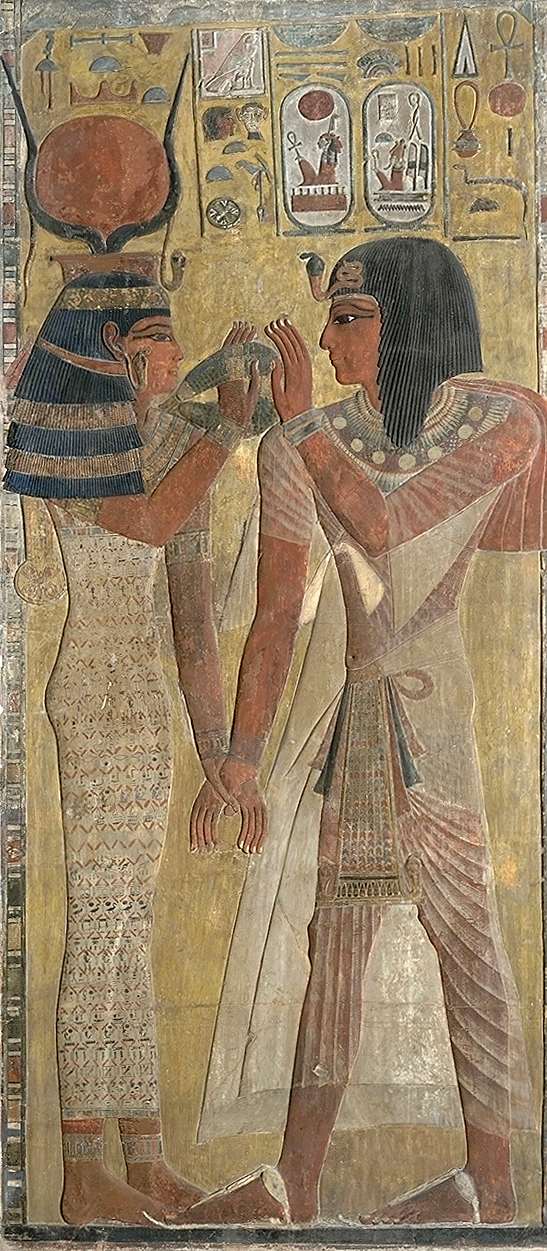
royal reliefs of Amenhotep III and of the post-Amarna kings show a
stylistic refinement that was carried to its best in the reign of Seti I,
at Karnak, at Abydos, and in his tomb at Thebes.
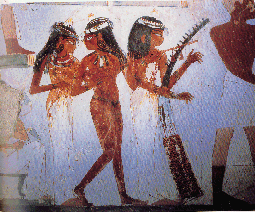
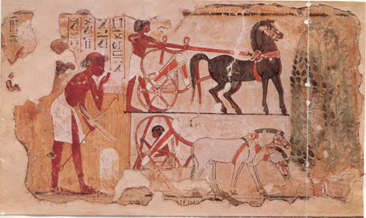
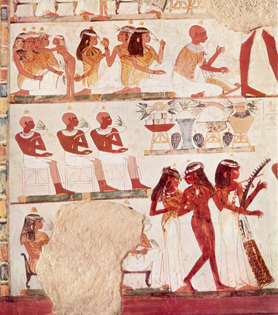
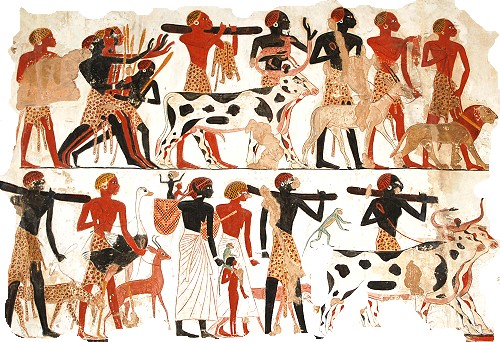
The 18th dynasty also
saw Egyptian painting reach its highest achievement in the tombs of the
nobles at Thebes. The medium of decoration and an apparently greater
artistic freedom led to the introduction of small, often entertaining
details into standard scenes. The tiny tombs of Menna and Nakht are full
of such playful vignettes. The paintings in great tombs, such as that of
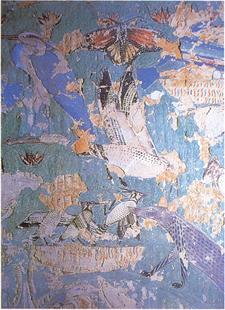
Rekhmire, are more formal but still crammed with unusual detail. Fragments
of mural and floor paintings from palaces and houses at Thebes and Tell
el-Amarna provide tantalizing glimpses of the marsh and garden settings of
everyday upper-class life.
The fine royal reliefs
of the late 18th dynasty were matched by those in private tombs at Thebes
(Ramose and Kheruef) and Saqqarah (Horemheb); these are breathtaking in
execution and, in the case of Horemheb, both moving and original. Interest
in relief subsequently passed to the work in the temples of the 19th and
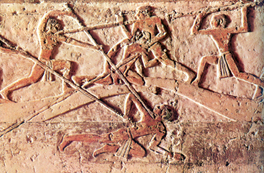
20th dynasties. The most dramatic subject was war, whether the so-called
triumph of Ramses II at Kadesh (Thebes and Abu Simbel), or the more
genuine successes of Ramses III against the Libyans and the Sea Peoples (Madinat
Habu). The size and vitality of these ostentatious scenes are stupendous,
even if their execution tends to be slapdash.
The artistic
renaissance of the 25th and 26th dynasties is less evident in painting and
relief than in sculpture. Although the fine work in the tomb of Montemhat
at Thebes is distinctly archaizing, it is, nevertheless, exceptional in
quality. The skills of the Egyptian draftsman, nurtured by centuries of
exercise at large and small scale, remained highly professional. This
skill is seen at its most consistent level in the illumination of
papyruses. The practice of including drawings, often painted, in religious
papyruses flourished from the time of the 18th dynasty and reached a high
point around 1300 BC. The peak of achievement is probably represented by
the Book of the Dead of the scribe Ani (British Museum), in the vignettes
of which both technique and the use of color are outstanding.
Subsequently, and especially in the Late Period, pure line drawing was
increasingly employed.
|
|
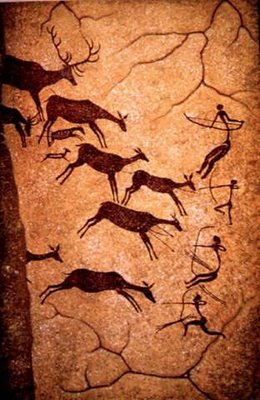
The earliest Egyptian art is very different from that of
the
pyramids
and
temples
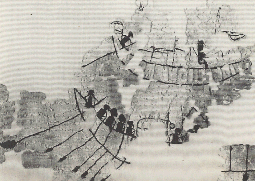
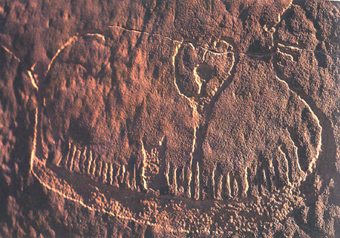
of the Pharaonic period. As early as the eighth millennium BC, the first
inhabitants of the Nile Valley began to make engraved drawings on the
cliffs, particularly in Upper Egypt and
Nubia.
They depicted the fundamentals of their lives, from wild game and hunting
scenes in the earlier times to river boats and herds of cattle in the
early Neolithic period. The art of the
Predynastic
period has survived mainly in the form of small carved stone and ivory
grave goods, together with pottery vessels, placed alongside the deceased
in simple pit burials. The small votive figures of people and animals
include many female statuettes made of pottery and ivory, whose
exaggerated sexual characteristics suggest that they probably related to
early fertility
cults.
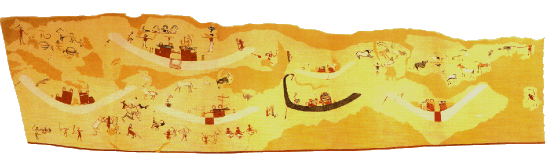
Some of the painted scenes on pottery vessels continue,
during the
Predynastic period,
to reflect the prehistoric rock-carvings, while others begin to display
the styles and preoccupations of the Dynastic period. In the final stages
of the Predynastic period, a range of unusual ceremonial artifacts,
including maces, palettes and ivory handled flint knives, began to play an
important role in the emerging religious ritual and social hierarchy. Many
of the more elaborate mace heads and palettes, such as those of the kings
named
Scorpion
and
Narmer,
were discovered in a deposit of the temple at
Hierakonpolis,
and though the archaeological circumstances of their discovery are poorly
documented, they were apparently meant as votive offerings. Their carved
decoration appears to summarize the important events of the year in which
they were offered to the god. However, it is unclear whether any of the
scenes depicting historical events are real, or simply generalized
representations of
myth
and ritual. In fact, this would be a problem with Egyptian art throughout
the ages.
A number of references on ancient Egypt insinuate
that the Egyptians had no concept of the term, art. Indeed, we know of no
word from the ancient
Egyptian
language that exactly conforms to our abstract use of the word. They
did have words for their creations that we today regard as examples of
Egyptian art, such as statues, stelas and tombs, but we have no reason to
believe that these words necessarily included an aesthetic dimension in
their meaning.
Though the ancient Egyptians built and decorated their
monuments, and cut their statues first and foremost for religious
functionality, this does not mean that the Egyptians were not aware of and
did not aim for an aesthetic content. To represent was, in a way, to
create, and Egyptian representation in both two and three dimensions was
meant to create images that would function as a meaningful part of the
cult of
the gods and the
dead.
Statues were objects in which deities could manifest
themselves, while images of the dead ensured their survival in the next
world and formed a point of contact between this and the next domains,
where the deceased could receive the offerings of the living. Depictions
of temple cult ceremonies ensured their enactment for all time, and
portrayals of offering goods meant that these items would be
available in the next world. Furthermore, images of protective deities
found in houses, on furniture and made into amulets created a powerful
shield against the malign forces of the universe.
Most of what we see of ancient Egyptian art, at museums
or in books, are pieces that appeal to modern aesthetic tastes. Yet they
represent only a selection of surviving Egyptian material and are usually
pieces produced under royal patronage. For each of these pieces, there are
many, many others collecting dust in museum reserve collections that are
not so finely made. These latter items may demonstrate poor workmanship,
unbalanced compositions, awkward proportions or clumsy execution, but they
were came from the more common Egyptians. Though these items lack the
artistic quality of the more accomplished works, they must have still been
thought to have functioned for the benefit of their owners.
Hence, we must ask ourselves why those of power sought
out the best artists, if not for their superior artistic abilities. And we
must also question
Egyptologists
who tell us that art completely surrounded
Egyptian
religion, for it did not, nor may it have always served a specific
function. We find, in tombs of common Egyptians, sometimes intricate
scenes of daily life that seemingly have really very little mortuary
functionality, but we also find designs on pottery and other items
that today we would call art, and appear to have no further function than
to adorn the pottery, making it more appealing. Indeed, while the ancient
Egyptians may not have had an abstract word to denote art in general, they
did appreciate fine designs and well decorated objects.
However, it should also be pointed out that artists in
ancient Egypt were very different than their modern counterparts. In
ancient
Egyptian
society, conformity and not individualism was encouraged, and there
was hardly a place for an artist with a personal vision that broke the
accepted norms. In fact, Egyptian artists usually worked in teams and
according to strict guidelines, even though their works might be highly
regarded. This does not mean that artists could not experiment and
innovate within certain limits.
Many of the fundamentals of Egyptian art were
established at the very beginning of Egyptian history and changed little
over time. Subject matter also remained relatively unchanged over long
periods of time. However, Egyptian art did not remain completely static
over the three thousand years of pharaonic history. Despite the limited
repertory of subject matter, Egyptian artists valued variation and avoided
producing exact copies of the same forms.
To understand most of the Egyptian artwork that we see
in museums and books, we must understand that it was produced by elite
Egyptians, mostly for specific functions, and that it was an integral part
of their world view. It is important that we understand the purpose of the
artwork, or the concepts that shaped it, because a lack of such
information has often led people to unfavorably compare it to the art of
other cultures. For example, while the ancient Egyptians produced
sculptures that were intricately detailed and lifelike in many ways, they
never turned the body and twisted it through space as we find in classical
Greek statuary. Egyptian artists sometimes got left and right
"muddled, and never seem to have discovered the rules of geometric
perspective as European artists did in the Renaissance. In fact, such
shortcomings had little if anything to do with the ability of the artists,
and everything to do with the purpose for which they were producing their
art. Egyptian art was not intended to merely imitate or reflect
reality, but to replace and perpetuate it. Hence, for example, the
religious ritual known as "the
opening of the mouth" was not just performed by Egyptian funerary
priest
on the
mummy
of the deceased, but also on his or her statuary.
Egyptian art was concerned above all with ensuring the
continuity of the universe, the gods, the king and the people. The artists
therefore depicted things not as they saw them but as idealized symbols
intended to be more significant and enduring than was otherwise possible
in the real world. The best, most inspired Egyptian art therefore blends
the real with the ideal.
The essential elements of art during the
Old
Kingdom were the funerary sculpture and painted reliefs of the royal
family and the provincial elite. One of the most impressive statues to
come from this period is the diorite figure of the seated
Khafra,
builder of the
second
pyramid at
Giza,. On the
simplest level, the statue is a portrait of a powerful individual, but is
also made up of symbols that relate to the general role of the pharaoh.
His head and neck are physically embraced by the wings of a hawk
representing the protective god,
Horus,
who was also the divine counterpart of the mortal ruler. His throne is
decorated on either side with a complex design consisting of the
hieroglyph meaning "union" tied up with the tendrils of the
plants of Upper and Lower Egypt, all of which symbolizes the unified state
over which he ruled. In the same manner, an alabaster statue of the
6th
Dynasty ruler
Pepi
I has the rear of the throne carved to imitate a serekh with Horus
perched on the top.
After the
Old
Kingdom, centralized power within Egypt declined into what we refer to
as the First Intermediate Period. This decline in power resulted in a
period when provincial workshops at sites such as el-Mo'alla and Gebelein
began to create distinctive funerary decoration and equipment rather than
being influenced by the artists at the royal court, as they were earlier
during the Old Kingdom and later during the
Middle
Kingdom.
During the Middle Kingdom, Egyptian art is exemplified
both by the fragments of reliefs from the royal pyramid complexes at
Dahshur, el-Lisht, el-Lahun and Hawara, and by the spacious tombs of the
governors buried at Beni Hassan in Middle Egypt. In the latter, the
traditional scenes of the deceased receiving offerings or hunting and
fishing in the marshes are joined by large depictions of wrestling and
warfare, perhaps copied from
Old
Kingdom royal prototypes.
The history of the
Middle
Kingdom is very much characterized by a tension between the artistic
styles of the various provincial sites and the styles of the royal
workshops at Itjtawy, the new capital established near el-Lisht. Only by
the late Middle Kingdom does the distinctive provincial styles become
eclipsed by the art of the royal workshops..
After the
Middle
Kingdom, Egypt was ruled for a period of time by Asiatics, who gained
control of a considerable area of the country. The works of art surviving
from this phase show that the foreign rulers simply re-used and copied
traditional Egyptian sculptures and reliefs in order to strengthen their
claims to the throne.
After these foreign rulers were expelled, Egypt entered
one of it's most grand periods, the
New
Kingdom. The grand art of this period actually varied considerably so
that we have the very formal art found in the great
temples
such as
Karnak
and
Luxor, the tombs in
the
Valley of the Kings,
and the private artisans' tombs at
Deir
el-Medina, with their intimate details. Art during this period also
varied because of radical religious changes, such as the
Amarna
period which resulted in a dramatic change in
art
styles..
After the
New
Kingdom, the rapidly changing artistic styles of the first millennium
BC demonstrate that Egyptian art could assimilate new possibilities while
retaining its essential character and integrity. During the
Late
Period, when Egypt had really already lost much of its prestige,
Egyptians attempted to revive the classic images of the
Old
and
Middle
Kingdom, which must have symbolized a lost sense of stability and
certainly. Then, after the conquest of Egypt by
Alexander
The Great, the nature of Pharaonic art was adapted to create a
compromise between the needs of the native Egyptians and the preferences
of the New Greek, and later Roman rulers. Though from this period we have
some of the largest surviving religious buildings, the reliefs were
beginning to appear mass produced and repetitive, and the artwork was
increasingly poorly formulated and executed. However, at the same time,
there were new cultural elements absorbed from the Mediterranean word,
such as the
Fayoum
mummy
paintings.
Most all three-dimensional representations, whether
standing, seated or kneeling, exhibit what is called frontality. That is,
they face straight ahead, even though at times they may be striding. Were
it not for our understanding of their purpose, it might be easy to
criticize their rigidity that remained unchanged for three thousand years,
particularly when viewed outside of their original context. However, such
statues were not produced as pure art, but rather to play a primary role
in the
cults
of the
gods,
kings and the dead. They
were places in which these beings could manifest themselves in order to be
the recipients of ritual actions. Hence, it made perfect sense to show the
statue looking forward at what was happening in front of it, so that the
living could interact with the divine or deceased recipient. Furthermore,
such statues were very frequently enclosed in rectangular shrines or
wall niches with an opening only in the front, making it natural for the
statue to display frontality. Other statues were frequently placed in
pillared courts, where they would typically be situated between pillars,
and frontality worked perfectly for this context as well.
Most of the statues produced in ancient Egypt were made
of stone, wood or metal. Stone statues were produced usually from a single
rectangular block. Stone between the arms and the body, as well as between
the legs in standing figures or the legs and the seat in seated ones, was
commonly not cut away, adding to the strength of the physical sculpture.
This method also added to the image of strength and power of the being
depicted, and frequently the statue was "engaged" to the front
of a pillar or
column
which added to this effect.
Wooden statues, on the other hand, were generally carved
from several pieces of wood and pegged together, while metal statues were
either made by wrapping sheet metal around a wooden core or cast by the
lost wax process. In these, the arms were sometimes held away from the
body and could carry separate items in their hands. However, though wooden
and metal sculptures have a completely different effect, altogether
lighter and freer than their stone counterparts, they still display
frontality.
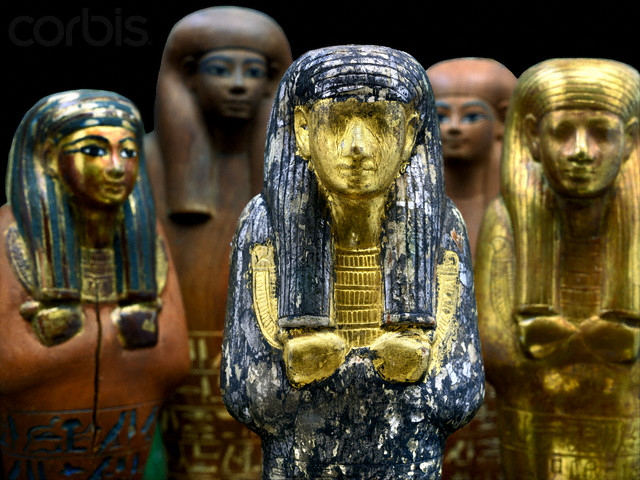
There was one other type of statuary aside from those
depicting deities, kings and other elite members of society. These small
statuettes depicted generic figures, frequently servants, from the
non-elite population. Their function varied considerably from other
statues, for these were made to put in tombs of the elite in order to
serve the tomb owner in the afterlife. These
funerary
figurines depict a wide range of actions, from grinding grain to
making music, while some are simply standing figures, depending on the
time frame in which they were produced. They were not used in any cult,
and are not meant to help perpetuate the existence of a particular person.
In effect, they are merely a component of the overall
funerary
equipment placed in tombs for the benefit of the owner. Unlike formal
statues, these were not limited to static poses. Depending on the activity
in which they are engaged, they may be bending or squatting or take
another position suitable to their work. In fact, it is the action and not
the figure itself that is important.
Producing the three dimensional world on a two
dimensional surface is very different than working with statuary. In a
number of cultures, artists have found ways by which to obtain the
illusion of the third dimension, adding depth to their work, while in
others the two-dimensionality of the drawing surface has been accepted and
even exploited. The ancient Egyptians belong to this latter group. Rather
than attempting to create the appearance of depth, they instead arranged
the objects they wished to depict over the flat drawing surface.
Such objects were drawn using their most characteristic and easily
recognized aspect, usually in profile, full view, plan or elevation.
Because these different views can occur together in the same picture
plane, the result is not rendered as though from a single viewpoint.
Rather, it is a composite assemblage containing information that can be
interpreted by the educated viewer.
The human figure was usually formed from a composite
built up from its individual parts. Hence, the head may be shown in
profile, though with a full view of the eyebrow and eye set into it. The
shoulders of formal figures are most usually shown frontally, while the
waist, buttocks and limbs are in profile. Normally, the nipple on male
figures and the breast on females are drawn in profile on the front line
of the body, while items that lie on the chest such as collars, necklaces,
pectorals and clothing are shown in full frontal view on the expanse of
the torso framed by the front and back lines of the body. The navel is
shown full view and is placed inside the front line of the body at the
appropriate level. Prior to the
18th
Dynasty, the two feet are depicted identically from the inside,
showing the big toe and the arch. Later, the near foot was increasing
shown from the outside with all the toes showing.
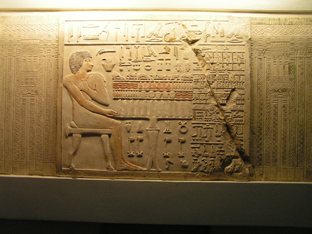
Even when the figures on the walls of Egyptian tombs and
temples
are acting out myths, rituals and historical events, they
are nevertheless carved or painted with the stiffness and formality of
hieroglyphs.
The ancient Egyptians sought order in their world, and
it was also fundamental to their art. Only when the concept of chaos was
intended, were figures placed haphazardly on the drawing surface.
Otherwise, they were set within a system of registers, the lower border of
which acted as the ground line for the figures within the register.
The position of figures within a scene could be
determined by the viewer according to several rules. Objects could be
overlapped within the register, which means that the object partially
covered by another is farther away. Items higher up in the register are
further away than those lower down. The hierarchical ordering of society
was reflected in both two-dimensional and three-dimensional art by scale.
Hence, the king's figure is usually the same size as the gods whom he
interacts with, though larger than his queen, children or subjects.
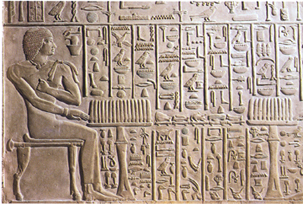
Whether in two or three-dimensions, Egyptian art was
usually combined with text. Short captions might describe the figures
depicted and the actions taking place, while longer texts included
requests for offerings for the dead, hymns to deities, works spoken by
deities to the king, etc. The hieroglyphic texts within any scene
typically formed an integral part of the whole composition. Because the
blocks of hieroglyphic texts was often set against representational
elements, the composition would lack balance without them.
In fact,
hieroglyphs
were small images drawn according to the principles that underlie Egyptian
two dimensional art. Nevertheless, the images often do not resemble the
objects that they describe, but are phonetic, representing different
consonantal sounds in the Egyptian language. However, other hieroglyphs
are logographic, representing literally or metaphorically an object or
idea. Interestingly, hieroglyphs can act as determinatives. That is, they
are placed at the ends of individual words to "determine" a
category. For example, the name of a man may be followed by an image of a
man identifying the word as a man's name. However, so clearly
connected is art and
hieroglyphs
that when a figure is identified by its name in
hieroglyphs,
the expected determinative is usually omitted because the picture the name
identifies acts as its determinative.
Usually, the orientation of scenes in two dimensional
art for
hieroglyphs
and figures was facing to the right. However, it was not uncommon for both
to also face left, dictated by the circumstances, or for the hieroglyphs
to be written in horizontal lines or vertical columns. Of course, this
allowed for considerable versatility and subtlety when combining text with
depictions. Usually, hieroglyphs faced the same direction as the figures
they refer to, and in fact, the art was intended to be read like an
elaborate code much like the hieroglyphic text.
The
mediums
with which Egyptian artists worked were varied. One of the most easily
obtained was limestone, which composed the cliffs to either side of much
of the Nile Valley. Other common soft stone materials included calcite
(Egyptian Alabaster), a crystalline form of calcium carbonate,
sandstone, schist and greywacke. Harder stones included quartzite (a
crystalline form of sandstone), diorite, granodiorite, granite and basalt.
Stone was almost always used in royal free standing and rock cut
temples
and tombs after the earliest periods. It was also used to
make statues, stelae, offering tables, libation bowls, vessels and other
ritual equipment.
Soft stone, whether cut in place such as a rock cut
tomb, or carved into blocks as in free standing
temples,
was usually covered by plaster prior to being decorated. Paint was
sometimes also applied to hard stone, but often it was left visible for
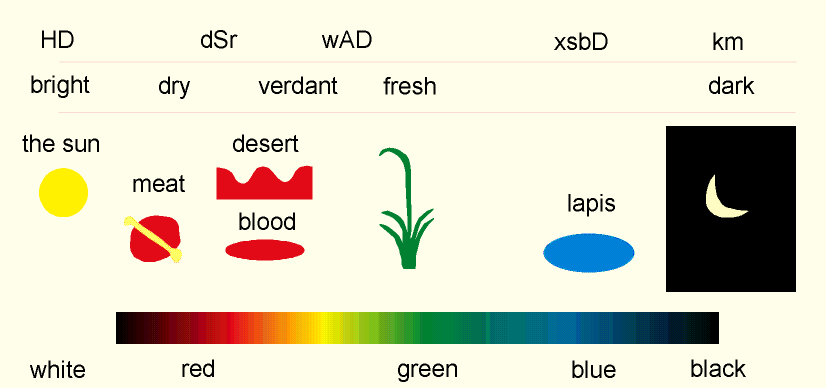
its symbolism. Hence, black stone such as granodiorite was representative
of the life giving black silt left by the
Nile
inundation, thus symbolizing new life, resurrection and the
resurrected god of he dead,
Osiris.
Red, brown, yellow and gold were associated with the sun, and so stones of
those colors, such as red and brown quartzite and red granite, symbolized
the sun. Green stone referred to fresh, growing vegetation, new life,
resurrection and Osiris as well, who sometimes appears with black skin and
sometimes green.
Limestone and other soft stones were carved with copper
chisels and stone tools. Hard stones were worked by hammering and grinding
them with tools made of even harder stone together with sand, which is
basically quartz, acting as an abrasive. Stone vessels were hollowed out
using drills with copper bits, together with an abrasive. These tools were
also used to apply details and inscriptions to hard stone monuments.
Afterwards, the finished object was polished with a smooth rubbing stone.
If the stone was to be painted, the surface had to be
smoothed and any holes in the stone or joints between blocks filled in
with plaster.
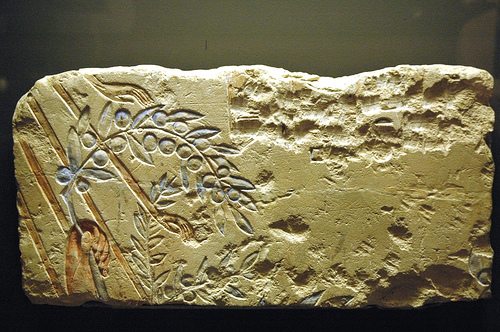
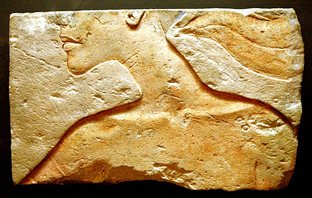
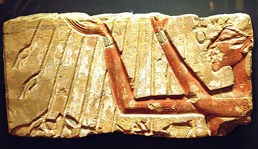
Scenes on stone surfaces were often cut into relief
before painting (or when not painted at all). There were two main types of
reliefs, consisting of raised and sunk relief. In both, chisels were used
to cut around the outlines of figures. Then, in raised relief, the stone
of the background was cut away, so that the figures were left standing out
from the surface. In sunk relief, it was the figures that were cut back
within their outlines, leaving the surface of the background at a higher
level. In both methods, the figures were modeled to a greater or lesser
extent within their outlines. Traditionally, sunk relief was used on
outside walls and raised relief on interior walls, because bright sunlight
has the effect of flattening raised relief and enhancing sunk relief. It
should be noted that such work could also be applied to plastered surfaces
on soft stone.
In Theban tombs which were often simply painted, as
opposed to relief-cut, rock cut walls, the walls were first covered with
mud that was then plastered before painting. Treated similarly to soft
stone, mudbrick was used in houses, palaces and other public buildings.
And like the walls in
Theban
tombs, the mud was prepared for decoration with a layer of plaster.
Prior to actually painting the prepared surfaces of
stone or plaster over stone or mudbrick, scenes were laid out by first
marking off the area to be decorated and then drawing in the initial
sketches in red, to which corrections were often made in black, probably
by the master draughtsman in charge of the project. Squared grids were
introduced at the beginning of the
Middle
Kingdom. Used to assist the artist in obtaining the proper proportions
of their figures and often also to lay out the composition as a whole, the
grids were drawn out on the surface before the scene was sketched in.
The lines of the grid were either drawn against a straight edge, or more
commonly made with a string that was dipped in red paint and stretched
taut across the surface before being snapped against it like a modern
chalk line.
The sketches were drawn with brushes, similar to those
that were used by scribes. They were made from fine reeds that were
trimmed at one end to an angle and chewed or split to fray the fibers. For
the actual application of paint, thicker brushes were made from fibrous
wood such as palm ribs, or from bundles of twigs tied together that were
than beaten at one end to separate the fibers and make a course brush.
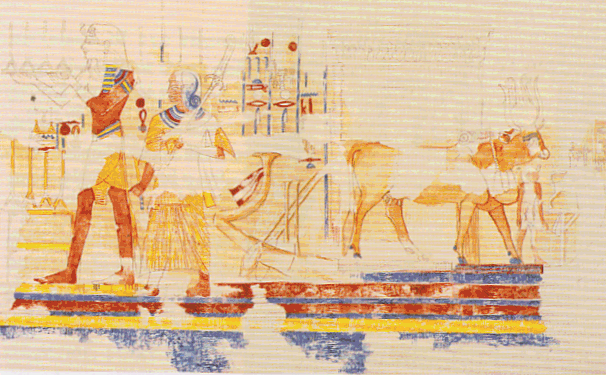
Pigments for paint came primarily from minerals that occur naturally in
Egypt and the surrounding desert. White was usually made from calcium
carbonate (whiting) or calcium sulphate (gypsum). However, huntite, which
was already in use during the
Middle
Kingdom, and which became common during the
New
Kingdom, produced a more intense white. It was frequently used
to paint white areas, such as clothing, so that it would stand out against
the less white background of calcium carbonate.
Black was produced from one of several forms of carbon, most commonly
soot or charcoal.
Ochre (iron oxide) could produce a range of colors from light yellow to
dark brown depending on the level of hydration. It was frequently used for
reds and yellows. During the
New
Kingdom, realgar was also used for red, but is unstable in
light, and has often degraded over time to yellow. Orpiment was used from
the
Middle
Kingdom onward to obtain a very bright yellow that was used to
simulate gold. However, it fades in light to a dull off-white so that its
effect is often lost. Jarosite was also used to produce a pale yellow. The
artists used different yellow pigments side by side, showing that they
were not mere substitutes for each other.
Blue was sometimes provided from azurite (copper carbonate), which over
time becomes green as it changes to malachite, another form of copper
carbonate. However, Egyptian blue was more common, which consisted of a
compound made from heating quartz, ground malachite and calcium carbonate
together. Different shades of blue were obtained according to the way in
which the resulting compound was ground for use, since the finer the grain
the paler the blue. Green rather than blue could be produced if the
proportions of malachite and calcium carbonate were varied. However, green
was more frequently made from naturally occurring malachite. Sometimes,
the pigments were mixed together to make different colors prior to
application. For example, black might be mixed with white to obtain gray,
or red and white to make pink.
Pigments were prepared by grinding them on a hard stone mortar before
mixing them with a medium such as plant gum or animal glue.
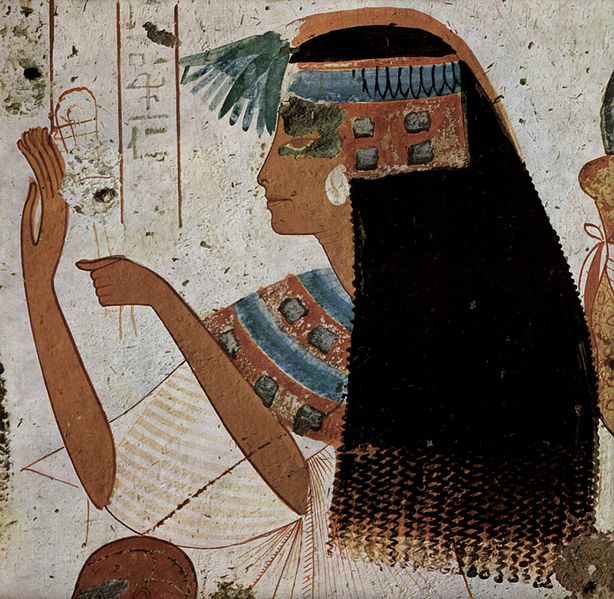
Paint was laid on in flat washes, pigment by pigment, so
that painters mixed as much of one color as they needed, painted in all
the appropriate areas, and then moved on to another color. However, colors
could also be painted over one another in layers to obtain different color
effects. The final stage of painting was to outline figures and add
interior details with a fine brush. Many details in relief work and on
statues were often only added in paint and not cut into the stone.
No discussion of stone art would be complete without
reference to Ostracons, rock fragments that were used for various
purposes. They were generally discarded fragments, which were frequently
used to draw plans and sketch out drawings. However, some of the most
interesting artwork ever produced in Egypt were recorded on their small
surfaces, usually by craftsman, but also by anyone else. They were the
scratchpads of ancient Egypt, used by the common man to do the ancient
equivalent of doodling. As such, there were no real rules that applied and
so we find a completely unique art form known perhaps no where else in
Egypt other than perhaps the graffiti drawn on the faces of cliffs.
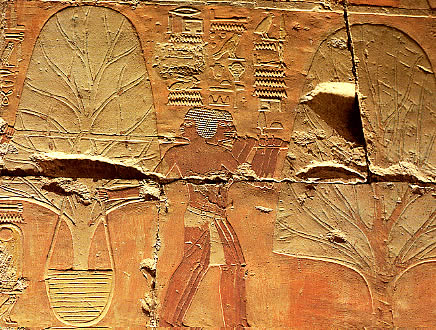 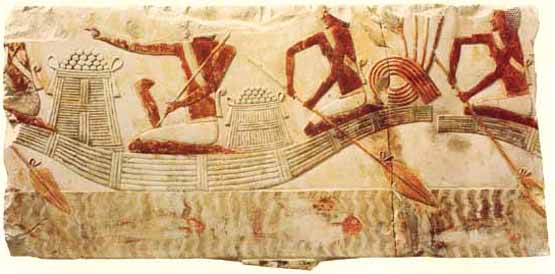
Even though Egypt has very little
wood,
there is nevertheless a long tradition of working with this material. Most
Egyptian timber consists of tamarisk, acacia and Sycamore figs, wood that
tends to be irregular, small and knotted, at least in comparison to the
coniferous wood imported from Syria. However, Egyptian artisans became
skilled at piecing together uneven lengths of native Egyptian wood in
order to build furniture, chests,
coffins
and even statues. Wood was shaped with chisels and adzes and the surface
smoothed down with rubbing stones. Sometimes the surface of these objects
were plastered over and painted, but on good quality wood, paint was
sometimes applied to the wood itself.
Egyptians worked with metals for earlier than many
realize. There are scenes in
Old
Kingdom tomb depicting metal working, and we know that they used
copper from during the earliest periods, arsenic bronze (copper and
arsenic) from the late Old Kingdom, and bronze (copper and tin) from the
later
Middle
Kingdom. Gold and silver were also highly prized as precious metals,
though initially silver was very rare.
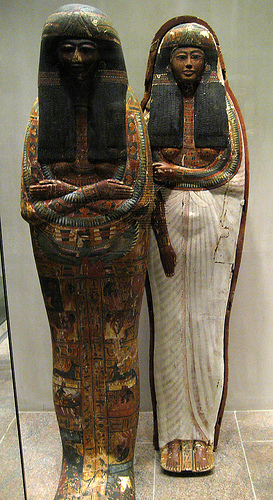
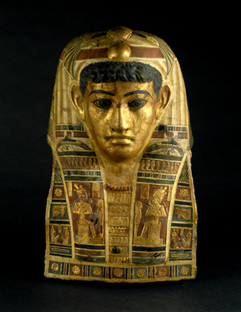
In addition to wood and stone, linen could also be
plastered and painted to make decorated funerary and votive cloths.
Alternating layers of linen and plaster were used to build up car tonnage,
from which painted
funerary
masks,
coffins
and
mummy
wrappings were manufactured.
We must also mention papyrus paper as a medium. It was
primarily used as a writing surface for a wide range of administrative,
economic, literary and ritual documents, but it was also used for other
purposes. Specifically, papyrus was used for the production of funerary
texts, such as versions of the
Book
of the Dead, which also included illustrations drawn and painted with
the fine scribal brush. Other non-funerary papyrus were also sometimes
painted or sketched upon with little or no text.
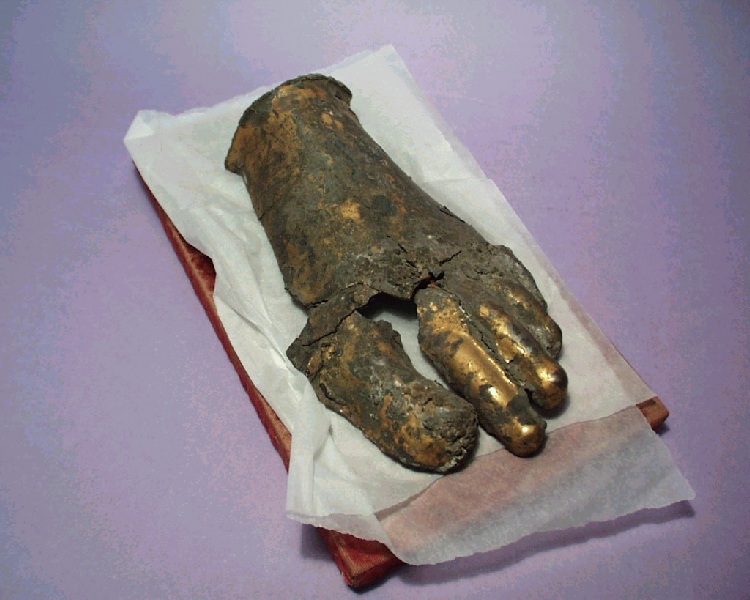
Metal was used in the production of statues, temple
fittings and cult implements, jewellery and
funerary
equipment. Both
silver
and
gold
were used to product cult statues, which were then frequently inlaid with
materials such as precious stones. Obviously, many of these statues did
not survive, for they were repeatedly melted down for their valuable metal
and stones. Gold and Silver were not used in religious statuary simply
because of their value, but also because of the symbolism
associated with these metals. Gold was considered the flesh of the gods,
particularly the sun god, and silver was the material from which the bones
of the gods were made. Furthermore, silver was associated with the moon,
so lunar disks on statues were sometimes made from this material.
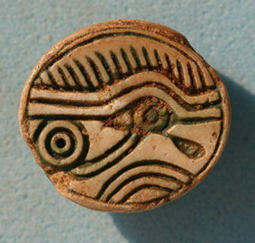
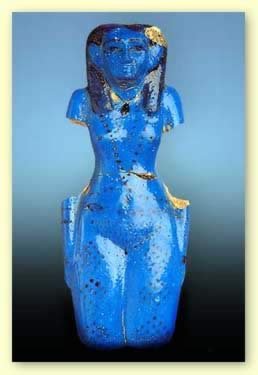
The Egyptians also manufactured a material which we
often call
Egyptian
faience or glazed composition. Faience consists of a quartz core with
a glazed surface. The material could be modeled and molded, and because it
was inexpensive, this material was used to mass produce many small objects
such as statuettes, amulets, rings and ear studs. It was often made to
imitate stone and used as a substitute for that material.
The color of the glaze depended on additions to the
basic mixture. One of the most common colors was a blue-green, imitating
turquoise, which was associated with the important goddess,
Hathor,
sometimes known as the "Lady of Turquoise". Also, the ancient
Egyptian word for faience was tjehenet, from the root tjehen, meaning
"to dazzle or gleam". Hence, the material also had a solar
symbolism.
|